EDUCATION IN
SPAIN
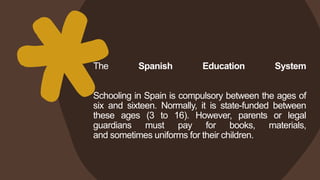
The Spanish Education System
Schooling in Spain is compulsory between the ages of
six and sixteen. Normally, it is state-funded between
these ages (3 to 16). However, parents or legal
guardians must pay for books, materials,
and sometimes uniforms for their children.
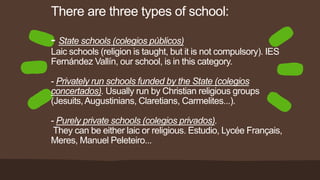
There are three types of school:
- State schools (colegios públicos)
Laic schools (religion is taught, but it is not compulsory). IES
Fernández Vallín, our school, is in this category.
- Privately run schools funded by the State (colegios
concertados). Usually run by Christian religious groups
(Jesuits,Augustinians, Claretians, Carmelites...).
- Purely private schools (colegios privados).
They can be either laic or religious. Estudio, Lycée Français,
Meres, Manuel Peleteiro...
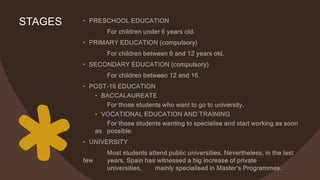
STAGES •
•
•
•
•
•
•
What subjects are taught in
Primary Education?
•Spanish Language and Literature
•Mathematics and science
•Natural science
•Social science
•Physical education
•First Foreign Language (English)
•Artistic education: Arts and Crafts and Music
•Second Foreign Language (usually French or
German)
•Ethical Values / Religion (mostly Catholic, but
sometimes Jewish, Muslim or Evangelic).
•Regional Language:
Catalan, Galician, Basque, Valencian, Aragonese, Oc
citan-Aranese or Asturian (if so)
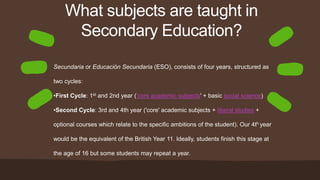
What subjects are taught in
Secondary Education?
Secundaria or Educación Secundaria (ESO), consists of four years, structured as
two cycles:
•First Cycle: 1st and 2nd year ('core academic subjects' + basic social science)
•Second Cycle: 3rd and 4th year ('core' academic subjects + liberal studies +
optional courses which relate to the specific ambitions of the student). Our 4th year
would be the equivalent of the British Year 11. Ideally, students finish this stage at
the age of 16 but some students may repeat a year.
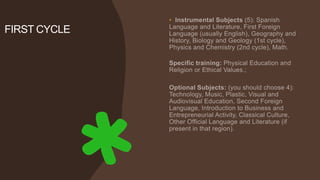
FIRST CYCLE
•
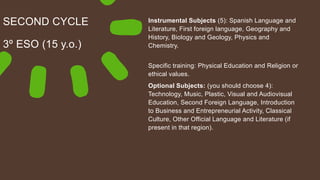
SECOND CYCLE
3º ESO (15 y.o.)
Instrumental Subjects (5): Spanish Language and
Literature, First foreign language, Geography and
History, Biology and Geology, Physics and
Chemistry.
Specific training: Physical Education and Religion or
ethical values.
Optional Subjects: (you should choose 4):
Technology, Music, Plastic, Visual and Audiovisual
Education, Second Foreign Language, Introduction
to Business and Entrepreneurial Activity, Classical
Culture, Other Official Language and Literature (if
present in that region).
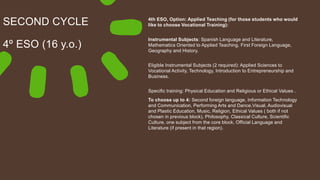
SECOND CYCLE
4º ESO (16 y.o.)
4th ESO, Option: Applied Teaching (for those students who would
like to choose Vocational Training):
Instrumental Subjects: Spanish Language and Literature,
Mathematics Oriented to Applied Teaching, First Foreign Language,
Geography and History.
Eligible Instrumental Subjects (2 required): Applied Sciences to
Vocational Activity, Technology, Introduction to Entrepreneurship and
Business.
Specific training: Physical Education and Religious or Ethical Values .
To choose up to 4: Second foreign language, Information Technology
and Communication, Performing Arts and Dance,Visual, Audiovisual
and Plastic Education, Music, Religion, Ethical Values ( both if not
chosen in previous block), Philosophy, Classical Culture, Scientific
Culture, one subject from the core block, Official Language and
Literature (if present in that region).
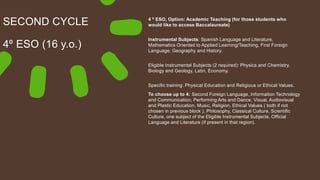
SECOND CYCLE
4º ESO (16 y.o.)
4 º ESO, Option: Academic Teaching (for those students who
would like to access Baccalaureate)
Instrumental Subjects: Spanish Language and Literature,
Mathematics Oriented to Applied Learning/Teaching, First Foreign
Language, Geography and History.
Eligible Instrumental Subjects (2 required): Physics and Chemistry,
Biology and Geology, Latin, Economy.
Specific training: Physical Education and Religious or Ethical Values.
To choose up to 4: Second Foreign Language, Information Technology
and Communication, Performing Arts and Dance, Visual, Audiovisual
and Plastic Education, Music, Religion, Ethical Values ( both if not
chosen in previous block ), Philosophy, Classical Culture, Scientific
Culture, one subject of the Eligible Instrumental Subjects, Official
Language and Literature (if present in that region).
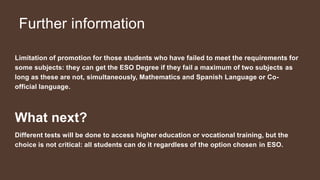
Further information
Limitation of promotion for those students who have failed to meet the requirements for
some subjects: they can get the ESO Degree if they fail a maximum of two subjects as
long as these are not, simultaneously, Mathematics and Spanish Language or Co-
official language.
What next?
Different tests will be done to access higher education or vocational training, but the
choice is not critical: all students can do it regardless of the option chosen in ESO.
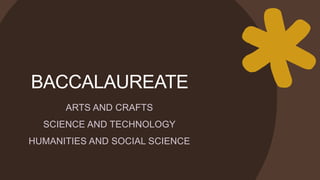
BACCALAUREATE
ARTS AND CRAFTS
SCIENCE AND TECHNOLOGY
HUMANITIES AND SOCIAL SCIENCE
VOCATIONAL
TRAINING
• GRADO MEDIO
(AFTER 4º ESO)
• GRADO SUPERIOR
(AFTER BACCALAUREATE OR GRADO
MEDIO)
VOCATIONAL
TRAINING GRADO MEDIO
(AFTER 4º ESO)
GRADO SUPERIOR
(AFTER
BACCALAUREATE
OR GRADO MEDIO)
VOCATIONALTRAINING IN OUR SCHOOL
• AUTOMOTIVE
• AUTOMATION AND ROBOTICS
• PLANNING AND BUILDING PROJECTS
• CIVIL ENGINEERING
• ELECTRIC SYSTEMS
OTHER TYPES OF EDUCATION WITHIN THE
PUBLIC SYSTEM
LANGUAGES
(ESCUELAS
OFICIALES DE
IDIOMAS)
MUSIC AND SCENIC
ARTS
(CONSERVATORIOS
Y ESCUELAS DE
ARTES ESCÉNICAS)
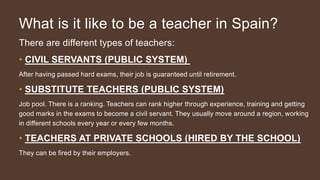
What is it like to be a teacher in Spain?
There are different types of teachers:
• CIVIL SERVANTS (PUBLIC SYSTEM)
After having passed hard exams, their job is guaranteed until retirement.
• SUBSTITUTE TEACHERS (PUBLIC SYSTEM)
Job pool. There is a ranking. Teachers can rank higher through experience, training and getting
good marks in the exams to become a civil servant. They usually move around a region, working
in different schools every year or every few months.
• TEACHERS AT PRIVATE SCHOOLS (HIRED BY THE SCHOOL)
They can be fired by their employers.
Any questions?
Feel free to ask us!

Education in spain (1)

  • 1.
  • 2.
    The Spanish EducationSystem Schooling in Spain is compulsory between the ages of six and sixteen. Normally, it is state-funded between these ages (3 to 16). However, parents or legal guardians must pay for books, materials, and sometimes uniforms for their children.
  • 3.
    There are threetypes of school: - State schools (colegios públicos) Laic schools (religion is taught, but it is not compulsory). IES Fernández Vallín, our school, is in this category. - Privately run schools funded by the State (colegios concertados). Usually run by Christian religious groups (Jesuits,Augustinians, Claretians, Carmelites...). - Purely private schools (colegios privados). They can be either laic or religious. Estudio, Lycée Français, Meres, Manuel Peleteiro...
  • 4.
  • 5.
    What subjects aretaught in Primary Education? •Spanish Language and Literature •Mathematics and science •Natural science •Social science •Physical education •First Foreign Language (English) •Artistic education: Arts and Crafts and Music •Second Foreign Language (usually French or German) •Ethical Values / Religion (mostly Catholic, but sometimes Jewish, Muslim or Evangelic). •Regional Language: Catalan, Galician, Basque, Valencian, Aragonese, Oc citan-Aranese or Asturian (if so)
  • 6.
    What subjects aretaught in Secondary Education? Secundaria or Educación Secundaria (ESO), consists of four years, structured as two cycles: •First Cycle: 1st and 2nd year ('core academic subjects' + basic social science) •Second Cycle: 3rd and 4th year ('core' academic subjects + liberal studies + optional courses which relate to the specific ambitions of the student). Our 4th year would be the equivalent of the British Year 11. Ideally, students finish this stage at the age of 16 but some students may repeat a year.
  • 7.
  • 8.
    SECOND CYCLE 3º ESO(15 y.o.) Instrumental Subjects (5): Spanish Language and Literature, First foreign language, Geography and History, Biology and Geology, Physics and Chemistry. Specific training: Physical Education and Religion or ethical values. Optional Subjects: (you should choose 4): Technology, Music, Plastic, Visual and Audiovisual Education, Second Foreign Language, Introduction to Business and Entrepreneurial Activity, Classical Culture, Other Official Language and Literature (if present in that region).
  • 9.
    SECOND CYCLE 4º ESO(16 y.o.) 4th ESO, Option: Applied Teaching (for those students who would like to choose Vocational Training): Instrumental Subjects: Spanish Language and Literature, Mathematics Oriented to Applied Teaching, First Foreign Language, Geography and History. Eligible Instrumental Subjects (2 required): Applied Sciences to Vocational Activity, Technology, Introduction to Entrepreneurship and Business. Specific training: Physical Education and Religious or Ethical Values . To choose up to 4: Second foreign language, Information Technology and Communication, Performing Arts and Dance,Visual, Audiovisual and Plastic Education, Music, Religion, Ethical Values ( both if not chosen in previous block), Philosophy, Classical Culture, Scientific Culture, one subject from the core block, Official Language and Literature (if present in that region).
  • 10.
    SECOND CYCLE 4º ESO(16 y.o.) 4 º ESO, Option: Academic Teaching (for those students who would like to access Baccalaureate) Instrumental Subjects: Spanish Language and Literature, Mathematics Oriented to Applied Learning/Teaching, First Foreign Language, Geography and History. Eligible Instrumental Subjects (2 required): Physics and Chemistry, Biology and Geology, Latin, Economy. Specific training: Physical Education and Religious or Ethical Values. To choose up to 4: Second Foreign Language, Information Technology and Communication, Performing Arts and Dance, Visual, Audiovisual and Plastic Education, Music, Religion, Ethical Values ( both if not chosen in previous block ), Philosophy, Classical Culture, Scientific Culture, one subject of the Eligible Instrumental Subjects, Official Language and Literature (if present in that region).
  • 11.
    Further information Limitation ofpromotion for those students who have failed to meet the requirements for some subjects: they can get the ESO Degree if they fail a maximum of two subjects as long as these are not, simultaneously, Mathematics and Spanish Language or Co- official language. What next? Different tests will be done to access higher education or vocational training, but the choice is not critical: all students can do it regardless of the option chosen in ESO.
  • 12.
    BACCALAUREATE ARTS AND CRAFTS SCIENCEAND TECHNOLOGY HUMANITIES AND SOCIAL SCIENCE
  • 13.
    VOCATIONAL TRAINING • GRADO MEDIO (AFTER4º ESO) • GRADO SUPERIOR (AFTER BACCALAUREATE OR GRADO MEDIO)
  • 14.
    VOCATIONAL TRAINING GRADO MEDIO (AFTER4º ESO) GRADO SUPERIOR (AFTER BACCALAUREATE OR GRADO MEDIO)
  • 15.
    VOCATIONALTRAINING IN OURSCHOOL • AUTOMOTIVE • AUTOMATION AND ROBOTICS • PLANNING AND BUILDING PROJECTS • CIVIL ENGINEERING • ELECTRIC SYSTEMS
  • 16.
    OTHER TYPES OFEDUCATION WITHIN THE PUBLIC SYSTEM LANGUAGES (ESCUELAS OFICIALES DE IDIOMAS) MUSIC AND SCENIC ARTS (CONSERVATORIOS Y ESCUELAS DE ARTES ESCÉNICAS)
  • 17.
    What is itlike to be a teacher in Spain? There are different types of teachers: • CIVIL SERVANTS (PUBLIC SYSTEM) After having passed hard exams, their job is guaranteed until retirement. • SUBSTITUTE TEACHERS (PUBLIC SYSTEM) Job pool. There is a ranking. Teachers can rank higher through experience, training and getting good marks in the exams to become a civil servant. They usually move around a region, working in different schools every year or every few months. • TEACHERS AT PRIVATE SCHOOLS (HIRED BY THE SCHOOL) They can be fired by their employers.
  • 18.