VO, Provisional sum and
Prime cost sum
By
Yap Kian Hoong
Wendy Teo
VARIATION ORDER
• A change of job scope in a construction contract
• Additional, substitution or omission of the original scope of works
• Parties make a further valid agreement for alteration
VARIATION ORDER
• Changes to the provision in the Contracts regard to:
• Any limitation of working hours;
• Working Space
• Access to utilization of any specify part of the Site;
• The execution and completion of the work in any specific order
• Negligence, omission, default and/or breach of contract by the
Contractor and such change shall be executed by the Contractor
entirely at his own cost.
PRIME COST SUMS
• Sums included in the contract to cover specialist works and specific
materials
• This sums entail the employment of nominated sub-contractor
• Prime Cost Sums are to be excluded of any profit
PROVISIONAL SUMS
• Works for which the full extent and character cannot be determined
precisely at the time the BQ is prepared
VALUATION RULES
Clause 11.3 – Issue of Variations after
Practical Completion
• Architect may request for variations in writing before the
issuance of Certificate of Practical Completion.
• However, any variations AFTER the completion of original
contract works will be permitted.
• Only limited to certain circumstances.
• These variations need to be necessitated by obligations with
the requirement of any appropriate authority or service
provider.
• If the VO does not fall within the scope – contractually
invalid
• Therefore, no duty of compliance on the contractor.
• In the event that the VO falls within the scope, rates for
valuation is not stated.
• Presumably, contract rates may not be applicable.
• Contractor may be able to renegotiate new rates.
Clause 11.6 – Valuation rules
• Any variation works done by contractor for which a
provisional quantity is included in the contract and the
expenditure of provisional sum shall be made in accordance
to the following rules:
Clause 11.6 (a)
– work is of SIMILAR CHARACTER under SIMILAR
CONDITIONS and does not significantly change the
quantity of work as set out in contract documents, rates and
prices in the contract shall determine the valuation.
 Adding extra work – tiling works during work
Clause 11.6 (b)
– work is of SIMILAR CHARACTER but NOT under
SIMILAR CONDITIONS or under similar conditions but
there is significant change in work quantity, rates and prices
in the contract shall be the basis for determining the valuation
which shall include fair adjustment to take into account.
 tiling after completion.
Clause 11.6 (c)
– work is NOT of SIMILAR CHARACTER as set out in the
contract documents, valuation shall be at fair market rates
and prices determined by the QS.
 different works provided in contract – changing material (character)
Requesting for tiling works which is not in the contract scope of works.
Clause 11.6 (d) – work cannot be properly measured
and valued in accordance with clause 11.6 (a), (b) or (c),
contractor shall be allowed:
• Clause 11.6 (d) (i) – daywork rates in contract document.
• Clause 11.6 (d) (ii) – no such daywork rates in contract
document, actual cost of his materials, additional
construction plant and scaffolding, transport and labour for
the work concerned, add 15% for use of tools, standing
scaffolding, supervision, overheads and profits.
 Variations after work completion, plant and resources are
not on site and have to be brought specifically for the varied
work.
• To claim for payment, daywork records or vouchers should
be submitted as pre-agreed by architect and contractor.
Content
1. Workers’ names
2. Materials
3. Additional construction plant
4. Scaffolding and transport used
5. Time spent daily upon the work
• Contractor’s site agent records and sign before submitting
to site staff to verify for accuracy and sufficiency.
• This is done at weekly intervals with final record delivered
to architect and QS not later than 14 days after work
completion.
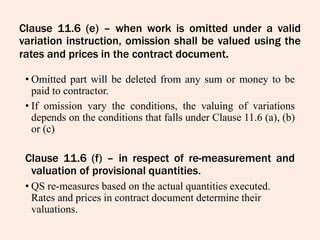
Clause 11.6 (e) – when work is omitted under a valid
variation instruction, omission shall be valued using the
rates and prices in the contract document.
• Omitted part will be deleted from any sum or money to be
paid to contractor.
• If omission vary the conditions, the valuing of variations
depends on the conditions that falls under Clause 11.6 (a), (b)
or (c)
Clause 11.6 (f) – in respect of re-measurement and
valuation of provisional quantities.
• QS re-measures based on the actual quantities executed.
Rates and prices in contract document determine their
valuations.
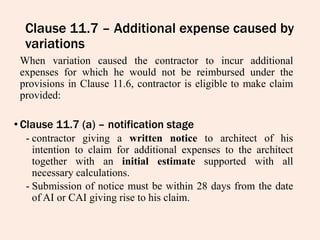
Clause 11.7 – Additional expense caused by
variations
When variation caused the contractor to incur additional
expenses for which he would not be reimbursed under the
provisions in Clause 11.6, contractor is eligible to make claim
provided:
• Clause 11.7 (a) – notification stage
- contractor giving a written notice to architect of his
intention to claim for additional expenses to the architect
together with an initial estimate supported with all
necessary calculations.
- Submission of notice must be within 28 days from the date
of AI or CAI giving rise to his claim.
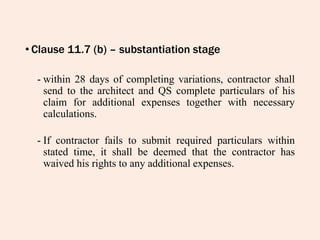
• Clause 11.7 (b) – substantiation stage
- within 28 days of completing variations, contractor shall
send to the architect and QS complete particulars of his
claim for additional expenses together with necessary
calculations.
- If contractor fails to submit required particulars within
stated time, it shall be deemed that the contractor has
waived his rights to any additional expenses.
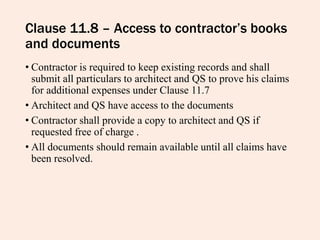
Clause 11.8 – Access to contractor’s books
and documents
• Contractor is required to keep existing records and shall
submit all particulars to architect and QS to prove his claims
for additional expenses under Clause 11.7
• Architect and QS have access to the documents
• Contractor shall provide a copy to architect and QS if
requested free of charge .
• All documents should remain available until all claims have
been resolved.
Clause 11.9 – Variations and additional
expenses added to contract sum
• Once the architect has ascertained the variation amount and
additional expenses claimed by contractor, the amount shall
be added to the contract sum.
• The amount will be included in the interim certificate.
QUESTIONS & ANSWERS
QUESTION 1
What is variation order and what are the clauses about variation order
in the PAM standard form of contract?
ANSWER 1
• Variation order are changes of job scope in construction contract
• Additional, substitution or omission of the original scope of works
• Parties make a further valid agreement for alteration
• Clauses for variation order in the PAM standard form of contract is
clause 11
QUESTION 2
• What are the differences between Prime Cost Sums and Provisional
Sums
ANSWER 2
• Prime Cost Sums are sums included in the contract for specialised
works.
• Provisional Sums are works that are not able to be determined by the
time the BQ is prepared
QUESTION 3
Clause 11.6 (a), (b) and (c) seem quite alike but they differ when
examined in detail. Briefly explain the difference of pre-conditions
between these clauses.
Clause 11.6 (a), (b) and (c) seem quite alike but they differ
when examined in detail. Briefly explain the difference of pre-
conditions between these clauses.
ANSWER
• Clause 11.6 (a) – similar character under similar conditions; no significant
change in quantity of works
• Clause 11.6 (b) – similar character but NOT under similar conditions; no
significant change in quantity of works
or
- similar character and conditions but significant change in
quantity of works
• Clause 11.6 (c) – not of similar character
QUESTION 4
•Briefly explain the two stages to claim for additional
expenses in Clause 11.7
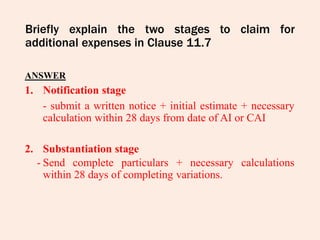
Briefly explain the two stages to claim for
additional expenses in Clause 11.7
ANSWER
1. Notification stage
- submit a written notice + initial estimate + necessary
calculation within 28 days from date of AI or CAI
2. Substantiation stage
- Send complete particulars + necessary calculations
within 28 days of completing variations.
THANK YOU!

Pp1 seminar

  • 1.
    VO, Provisional sumand Prime cost sum By Yap Kian Hoong Wendy Teo
  • 2.
    VARIATION ORDER • Achange of job scope in a construction contract • Additional, substitution or omission of the original scope of works • Parties make a further valid agreement for alteration
  • 3.
    VARIATION ORDER • Changesto the provision in the Contracts regard to: • Any limitation of working hours; • Working Space • Access to utilization of any specify part of the Site; • The execution and completion of the work in any specific order • Negligence, omission, default and/or breach of contract by the Contractor and such change shall be executed by the Contractor entirely at his own cost.
  • 4.
    PRIME COST SUMS •Sums included in the contract to cover specialist works and specific materials • This sums entail the employment of nominated sub-contractor • Prime Cost Sums are to be excluded of any profit
  • 5.
    PROVISIONAL SUMS • Worksfor which the full extent and character cannot be determined precisely at the time the BQ is prepared
  • 6.
  • 7.
    Clause 11.3 –Issue of Variations after Practical Completion • Architect may request for variations in writing before the issuance of Certificate of Practical Completion. • However, any variations AFTER the completion of original contract works will be permitted. • Only limited to certain circumstances. • These variations need to be necessitated by obligations with the requirement of any appropriate authority or service provider.
  • 8.
    • If theVO does not fall within the scope – contractually invalid • Therefore, no duty of compliance on the contractor. • In the event that the VO falls within the scope, rates for valuation is not stated. • Presumably, contract rates may not be applicable. • Contractor may be able to renegotiate new rates.
  • 9.
    Clause 11.6 –Valuation rules • Any variation works done by contractor for which a provisional quantity is included in the contract and the expenditure of provisional sum shall be made in accordance to the following rules: Clause 11.6 (a) – work is of SIMILAR CHARACTER under SIMILAR CONDITIONS and does not significantly change the quantity of work as set out in contract documents, rates and prices in the contract shall determine the valuation.  Adding extra work – tiling works during work
  • 10.
    Clause 11.6 (b) –work is of SIMILAR CHARACTER but NOT under SIMILAR CONDITIONS or under similar conditions but there is significant change in work quantity, rates and prices in the contract shall be the basis for determining the valuation which shall include fair adjustment to take into account.  tiling after completion. Clause 11.6 (c) – work is NOT of SIMILAR CHARACTER as set out in the contract documents, valuation shall be at fair market rates and prices determined by the QS.  different works provided in contract – changing material (character) Requesting for tiling works which is not in the contract scope of works.
  • 11.
    Clause 11.6 (d)– work cannot be properly measured and valued in accordance with clause 11.6 (a), (b) or (c), contractor shall be allowed: • Clause 11.6 (d) (i) – daywork rates in contract document. • Clause 11.6 (d) (ii) – no such daywork rates in contract document, actual cost of his materials, additional construction plant and scaffolding, transport and labour for the work concerned, add 15% for use of tools, standing scaffolding, supervision, overheads and profits.  Variations after work completion, plant and resources are not on site and have to be brought specifically for the varied work.
  • 12.
    • To claimfor payment, daywork records or vouchers should be submitted as pre-agreed by architect and contractor. Content 1. Workers’ names 2. Materials 3. Additional construction plant 4. Scaffolding and transport used 5. Time spent daily upon the work • Contractor’s site agent records and sign before submitting to site staff to verify for accuracy and sufficiency. • This is done at weekly intervals with final record delivered to architect and QS not later than 14 days after work completion.
  • 13.
    Clause 11.6 (e)– when work is omitted under a valid variation instruction, omission shall be valued using the rates and prices in the contract document. • Omitted part will be deleted from any sum or money to be paid to contractor. • If omission vary the conditions, the valuing of variations depends on the conditions that falls under Clause 11.6 (a), (b) or (c) Clause 11.6 (f) – in respect of re-measurement and valuation of provisional quantities. • QS re-measures based on the actual quantities executed. Rates and prices in contract document determine their valuations.
  • 14.
    Clause 11.7 –Additional expense caused by variations When variation caused the contractor to incur additional expenses for which he would not be reimbursed under the provisions in Clause 11.6, contractor is eligible to make claim provided: • Clause 11.7 (a) – notification stage - contractor giving a written notice to architect of his intention to claim for additional expenses to the architect together with an initial estimate supported with all necessary calculations. - Submission of notice must be within 28 days from the date of AI or CAI giving rise to his claim.
  • 15.
    • Clause 11.7(b) – substantiation stage - within 28 days of completing variations, contractor shall send to the architect and QS complete particulars of his claim for additional expenses together with necessary calculations. - If contractor fails to submit required particulars within stated time, it shall be deemed that the contractor has waived his rights to any additional expenses.
  • 16.
    Clause 11.8 –Access to contractor’s books and documents • Contractor is required to keep existing records and shall submit all particulars to architect and QS to prove his claims for additional expenses under Clause 11.7 • Architect and QS have access to the documents • Contractor shall provide a copy to architect and QS if requested free of charge . • All documents should remain available until all claims have been resolved.
  • 17.
    Clause 11.9 –Variations and additional expenses added to contract sum • Once the architect has ascertained the variation amount and additional expenses claimed by contractor, the amount shall be added to the contract sum. • The amount will be included in the interim certificate.
  • 18.
  • 19.
    QUESTION 1 What isvariation order and what are the clauses about variation order in the PAM standard form of contract?
  • 20.
    ANSWER 1 • Variationorder are changes of job scope in construction contract • Additional, substitution or omission of the original scope of works • Parties make a further valid agreement for alteration • Clauses for variation order in the PAM standard form of contract is clause 11
  • 21.
    QUESTION 2 • Whatare the differences between Prime Cost Sums and Provisional Sums
  • 22.
    ANSWER 2 • PrimeCost Sums are sums included in the contract for specialised works. • Provisional Sums are works that are not able to be determined by the time the BQ is prepared
  • 23.
    QUESTION 3 Clause 11.6(a), (b) and (c) seem quite alike but they differ when examined in detail. Briefly explain the difference of pre-conditions between these clauses.
  • 24.
    Clause 11.6 (a),(b) and (c) seem quite alike but they differ when examined in detail. Briefly explain the difference of pre- conditions between these clauses. ANSWER • Clause 11.6 (a) – similar character under similar conditions; no significant change in quantity of works • Clause 11.6 (b) – similar character but NOT under similar conditions; no significant change in quantity of works or - similar character and conditions but significant change in quantity of works • Clause 11.6 (c) – not of similar character
  • 25.
    QUESTION 4 •Briefly explainthe two stages to claim for additional expenses in Clause 11.7
  • 26.
    Briefly explain thetwo stages to claim for additional expenses in Clause 11.7 ANSWER 1. Notification stage - submit a written notice + initial estimate + necessary calculation within 28 days from date of AI or CAI 2. Substantiation stage - Send complete particulars + necessary calculations within 28 days of completing variations.
  • 27.