Group Members:
• Tan Kai Xuan (0325066)
• Tan Shen Sin (0324602)
• Tee Wan Nee (0325074)
• Teo Chiang Loong (0323762)
Professional Practice 1
QSB 60103
[ Tender Document / Tender Method/ Factors to consider before entering a tender ]
Q1 A) As a Consultant QS, briefly explain what a “Tender Document’’ is and what is its main purpose.
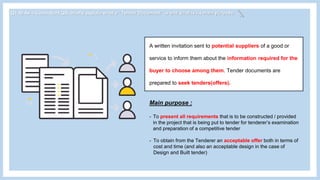
A written invitation sent to potential suppliers of a good or
service to inform them about the information required for the
buyer to choose among them. Tender documents are
prepared to seek tenders(offers).
Main purpose :
- To present all requirements that is to be constructed / provided
in the project that is being put to tender for tenderer’s examination
and preparation of a competitive tender
- To obtain from the Tenderer an acceptable offer both in terms of
cost and time (and also an acceptable design in the case of
Design and Built tender)
B) What are the five important components of a tender document? Explain
Forms of Contract Contract Bills DrawingsAncillary FormsSupplementary
Requirements
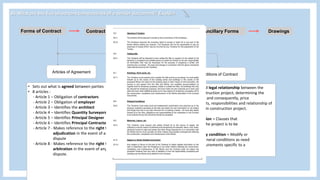
Articles of Agreement
Conditions of Contract
• Sets out what is agreed between parties
• 8 articles :
- Article 1 – Obligation of contractors
- Article 2 – Obligation of employer
- Article 3 – Identifies the architect
- Article 4 – Identifies Quantity Surveyors
- Article 5 – Identifies Principal Designer
- Article 6 – Identifies Principal Contractor
- Article 7 - Makes reference to the right to
adjudication in the event of any
dispute
- Article 8 - Makes reference to the right to
arbitration in the event of any
dispute.
• Sets out principal legal relationship between the
parties to a construction project, determining the
allocation of risk and consequently, price
• Define basic rights, responsibilities and relationship of
parties involved in construction project.
• 2 types :
- General condition = Clauses that
establish how the project is to be
administered
- Supplementary condition = Modify or
supplement general conditions as need
to provide requirements specific to a
project
B) What are the five important components of a tender document? Explain
Forms of Contract Contract Bills DrawingsAncillary FormsSupplementary
Requirements
Preliminaries
General Summary of
Tender
Bills Of QuantitySpecificationPreamble
• Employer’s Requirement
& Contractor’s
Obligation in carrying out
construction work
• Collection of all priced
bills for all sections.
• Allows tenderer to insert
his sectional summary to
arrive at a total amount
which in the end
becomes the “Tender
Amount”
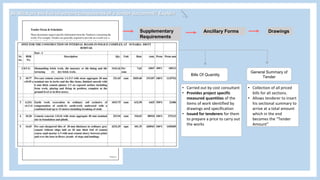
• Carried out by cost consultant
• Provides project specific
measured quantities of the
items of work identified by
drawings and specification
• Issued for tenderers for them
to prepare a price to carry out
the works
• Describe the materials
and workmanship
required for a
development.
• Does not include cost,
quantity or drawn
information.
• Need to be read
alongside of schedules
and drawings.
• Introduction of the
Specification and
BQ section
Forms of Contract Contract Bills DrawingsAncillary FormsSupplementary
Requirements
Declaration of
non-collusion
Conditions of TenderingInstruction to TenderForm of Tender
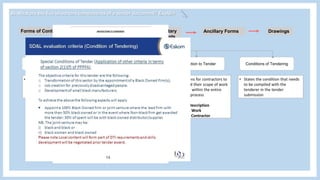
• Prevent corruption in
the tender process by
requiring a declaration
from the tenderer.
• Prepared by the client
and consultant, signed
by tenderer.
• Formal
acknowledgement that
the tenderer
understands and accepts
the term and condition
of the tender document
• Informations for contractors to
understand their scope of work
and duties within the entire
tendering process
• Includes :
- Project Description
- Scope of Work
- Dutes of Contractor
• States the condition that needs
to be compiled with the
tenderer in the tender
submission
B) What are the five important components of a tender document? Explain
Forms of Contract Contract Bills DrawingsAncillary FormsSupplementary
Requirements
Schedule of
finishes
Daywork Rates
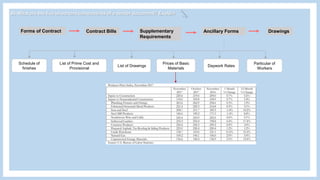
Prices of Basic
Materials
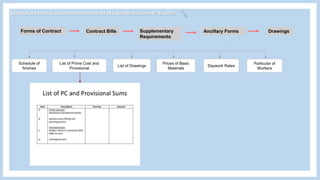
List of Prime Cost and
Provisional
List of Drawings
Particular of
Workers
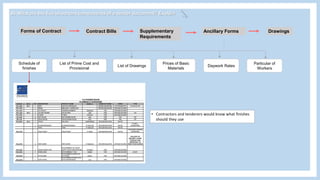
• Contractors and tenderers would know what finishes
should they use
B) What are the five important components of a tender document? Explain
Forms of Contract Contract Bills DrawingsAncillary FormsSupplementary
Requirements
Schedule of
finishes
Daywork Rates
Prices of Basic
Materials
List of Prime Cost and
Provisional
List of Drawings
Particular of
Workers
B) What are the five important components of a tender document? Explain
Forms of Contract Contract Bills DrawingsAncillary FormsSupplementary
Requirements
Schedule of
finishes
Daywork Rates
Prices of Basic
Materials
List of Prime Cost and
Provisional
List of Drawings
Particular of
Workers
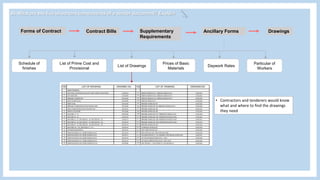
• Contractors and tenderers would know
what and where to find the drawings
they need
B) What are the five important components of a tender document? Explain
Forms of Contract Contract Bills DrawingsAncillary FormsSupplementary
Requirements
Schedule of
finishes
Daywork Rates
Prices of Basic
Materials
List of Prime Cost and
Provisional
List of Drawings
Particular of
Workers
B) What are the five important components of a tender document? Explain
Forms of Contract Contract Bills DrawingsAncillary FormsSupplementary
Requirements
Schedule of
finishes
Daywork Rates
Prices of Basic
Materials
List of Prime Cost and
Provisional
List of Drawings
Particular of
Workers
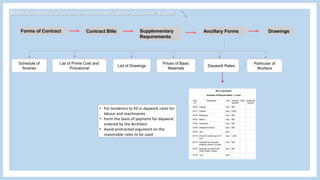
• For tenderers to fill in daywork rates for
labour and machineries
• Form the basis of payment for daywork
ordered by the Architect
• Avoid protracted argument on the
reasonable rates to be used
B) What are the five important components of a tender document? Explain
Forms of Contract Contract Bills DrawingsAncillary FormsSupplementary
Requirements
Schedule of
finishes
Daywork Rates
Prices of Basic
Materials
List of Prime Cost and
Provisional
List of Drawings
Particular of
Workers
B) What are the five important components of a tender document? Explain
Forms of Contract Contract Bills DrawingsAncillary FormsSupplementary
Requirements
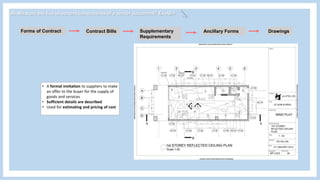
• A formal invitation to suppliers to make
an offer to the buyer for the supply of
goods and services
• Sufficient details are described
• Used for estimating and pricing of cost
B) What are the five important components of a tender document? Explain
Q1 C) List the TWO (2) common tendering methods which are adopted in the construction industry and give its advantages and
disadvantages.
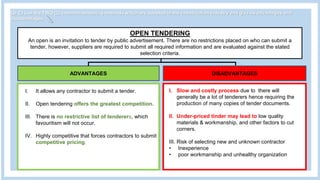
OPEN TENDERING
An open is an invitation to tender by public advertisement. There are no restrictions placed on who can submit a
tender, however, suppliers are required to submit all required information and are evaluated against the stated
selection criteria.
ADVANTAGES DISADVANTAGES
I. Slow and costly process due to there will
generally be a lot of tenderers hence requiring the
production of many copies of tender documents.
II. Under-priced tinder may lead to low quality
materials & workmanship, and other factors to cut
corners.
III. Risk of selecting new and unknown contractor
• Inexperience
• poor workmanship and unhealthy organization
I. It allows any contractor to submit a tender.
II. Open tendering offers the greatest competition.
III. There is no restrictive list of tenderers, which
favouritism will not occur.
IV. Highly competitive that forces contractors to submit
competitive pricing.
Q1 C) List the TWO (2) common tendering methods which are adopted in the construction industry and give its advantages and
disadvantages.
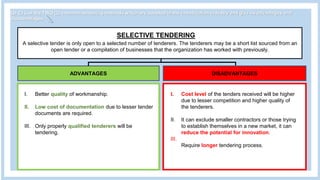
SELECTIVE TENDERING
A selective tender is only open to a selected number of tenderers. The tenderers may be a short list sourced from an
open tender or a compilation of businesses that the organization has worked with previously.
ADVANTAGES DISADVANTAGES
I. Better quality of workmanship.
II. Low cost of documentation due to lesser tender
documents are required.
III. Only properly qualified tenderers will be
tendering.
I. Cost level of the tenders received will be higher
due to lesser competition and higher quality of
the tenderers.
II. It can exclude smaller contractors or those trying
to establish themselves in a new market, it can
reduce the potential for innovation.
III.
Require longer tendering process.
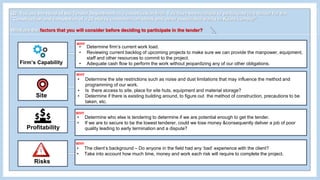
Q2. You are the Head of the Tender Department in a construction firm. You have been invited to participate in a tender for the
“Construction and completion of a 20 storey condominium block and other associated works in Kuala Lumpur”.
What are the factors that you will consider before deciding to participate in the tender?
Firm’s Capability
Site
Profitability
Risks
• Determine firm’s current work load.
• Reviewing current backlog of upcoming projects to make sure we can provide the manpower, equipment,
staff and other resources to commit to the project.
• Adequate cash flow to perform the work without jeopardizing any of our other obligations.
• Determine the site restrictions such as noise and dust limitations that may influence the method and
programming of our work.
• Is there access to site, place for site huts, equipment and material storage?
• Determine if there is existing building around, to figure out the method of construction, precautions to be
taken, etc.
• Determine who else is tendering to determine if we are potential enough to get the tender.
• If we are to secure to be the lowest tenderer, could we lose money &consequently deliver a job of poor
quality leading to early termination and a dispute?
• The client’s background – Do anyone in the field had any ‘bad’ experience with the client?
• Take into account how much time, money and work each risk will require to complete the project.
WHY
WHY
WHY
WHY
THANK YOU

Pp1 presentation 2

  • 1.
    Group Members: • TanKai Xuan (0325066) • Tan Shen Sin (0324602) • Tee Wan Nee (0325074) • Teo Chiang Loong (0323762) Professional Practice 1 QSB 60103 [ Tender Document / Tender Method/ Factors to consider before entering a tender ]
  • 2.
    Q1 A) Asa Consultant QS, briefly explain what a “Tender Document’’ is and what is its main purpose. A written invitation sent to potential suppliers of a good or service to inform them about the information required for the buyer to choose among them. Tender documents are prepared to seek tenders(offers). Main purpose : - To present all requirements that is to be constructed / provided in the project that is being put to tender for tenderer’s examination and preparation of a competitive tender - To obtain from the Tenderer an acceptable offer both in terms of cost and time (and also an acceptable design in the case of Design and Built tender)
  • 3.
    B) What arethe five important components of a tender document? Explain Forms of Contract Contract Bills DrawingsAncillary FormsSupplementary Requirements Articles of Agreement Conditions of Contract • Sets out what is agreed between parties • 8 articles : - Article 1 – Obligation of contractors - Article 2 – Obligation of employer - Article 3 – Identifies the architect - Article 4 – Identifies Quantity Surveyors - Article 5 – Identifies Principal Designer - Article 6 – Identifies Principal Contractor - Article 7 - Makes reference to the right to adjudication in the event of any dispute - Article 8 - Makes reference to the right to arbitration in the event of any dispute. • Sets out principal legal relationship between the parties to a construction project, determining the allocation of risk and consequently, price • Define basic rights, responsibilities and relationship of parties involved in construction project. • 2 types : - General condition = Clauses that establish how the project is to be administered - Supplementary condition = Modify or supplement general conditions as need to provide requirements specific to a project
  • 4.
    B) What arethe five important components of a tender document? Explain Forms of Contract Contract Bills DrawingsAncillary FormsSupplementary Requirements Preliminaries General Summary of Tender Bills Of QuantitySpecificationPreamble • Employer’s Requirement & Contractor’s Obligation in carrying out construction work • Collection of all priced bills for all sections. • Allows tenderer to insert his sectional summary to arrive at a total amount which in the end becomes the “Tender Amount” • Carried out by cost consultant • Provides project specific measured quantities of the items of work identified by drawings and specification • Issued for tenderers for them to prepare a price to carry out the works • Describe the materials and workmanship required for a development. • Does not include cost, quantity or drawn information. • Need to be read alongside of schedules and drawings. • Introduction of the Specification and BQ section
  • 5.
    Forms of ContractContract Bills DrawingsAncillary FormsSupplementary Requirements Declaration of non-collusion Conditions of TenderingInstruction to TenderForm of Tender • Prevent corruption in the tender process by requiring a declaration from the tenderer. • Prepared by the client and consultant, signed by tenderer. • Formal acknowledgement that the tenderer understands and accepts the term and condition of the tender document • Informations for contractors to understand their scope of work and duties within the entire tendering process • Includes : - Project Description - Scope of Work - Dutes of Contractor • States the condition that needs to be compiled with the tenderer in the tender submission B) What are the five important components of a tender document? Explain
  • 6.
    Forms of ContractContract Bills DrawingsAncillary FormsSupplementary Requirements Schedule of finishes Daywork Rates Prices of Basic Materials List of Prime Cost and Provisional List of Drawings Particular of Workers • Contractors and tenderers would know what finishes should they use B) What are the five important components of a tender document? Explain
  • 7.
    Forms of ContractContract Bills DrawingsAncillary FormsSupplementary Requirements Schedule of finishes Daywork Rates Prices of Basic Materials List of Prime Cost and Provisional List of Drawings Particular of Workers B) What are the five important components of a tender document? Explain
  • 8.
    Forms of ContractContract Bills DrawingsAncillary FormsSupplementary Requirements Schedule of finishes Daywork Rates Prices of Basic Materials List of Prime Cost and Provisional List of Drawings Particular of Workers • Contractors and tenderers would know what and where to find the drawings they need B) What are the five important components of a tender document? Explain
  • 9.
    Forms of ContractContract Bills DrawingsAncillary FormsSupplementary Requirements Schedule of finishes Daywork Rates Prices of Basic Materials List of Prime Cost and Provisional List of Drawings Particular of Workers B) What are the five important components of a tender document? Explain
  • 10.
    Forms of ContractContract Bills DrawingsAncillary FormsSupplementary Requirements Schedule of finishes Daywork Rates Prices of Basic Materials List of Prime Cost and Provisional List of Drawings Particular of Workers • For tenderers to fill in daywork rates for labour and machineries • Form the basis of payment for daywork ordered by the Architect • Avoid protracted argument on the reasonable rates to be used B) What are the five important components of a tender document? Explain
  • 11.
    Forms of ContractContract Bills DrawingsAncillary FormsSupplementary Requirements Schedule of finishes Daywork Rates Prices of Basic Materials List of Prime Cost and Provisional List of Drawings Particular of Workers B) What are the five important components of a tender document? Explain
  • 12.
    Forms of ContractContract Bills DrawingsAncillary FormsSupplementary Requirements • A formal invitation to suppliers to make an offer to the buyer for the supply of goods and services • Sufficient details are described • Used for estimating and pricing of cost B) What are the five important components of a tender document? Explain
  • 13.
    Q1 C) Listthe TWO (2) common tendering methods which are adopted in the construction industry and give its advantages and disadvantages. OPEN TENDERING An open is an invitation to tender by public advertisement. There are no restrictions placed on who can submit a tender, however, suppliers are required to submit all required information and are evaluated against the stated selection criteria. ADVANTAGES DISADVANTAGES I. Slow and costly process due to there will generally be a lot of tenderers hence requiring the production of many copies of tender documents. II. Under-priced tinder may lead to low quality materials & workmanship, and other factors to cut corners. III. Risk of selecting new and unknown contractor • Inexperience • poor workmanship and unhealthy organization I. It allows any contractor to submit a tender. II. Open tendering offers the greatest competition. III. There is no restrictive list of tenderers, which favouritism will not occur. IV. Highly competitive that forces contractors to submit competitive pricing.
  • 14.
    Q1 C) Listthe TWO (2) common tendering methods which are adopted in the construction industry and give its advantages and disadvantages. SELECTIVE TENDERING A selective tender is only open to a selected number of tenderers. The tenderers may be a short list sourced from an open tender or a compilation of businesses that the organization has worked with previously. ADVANTAGES DISADVANTAGES I. Better quality of workmanship. II. Low cost of documentation due to lesser tender documents are required. III. Only properly qualified tenderers will be tendering. I. Cost level of the tenders received will be higher due to lesser competition and higher quality of the tenderers. II. It can exclude smaller contractors or those trying to establish themselves in a new market, it can reduce the potential for innovation. III. Require longer tendering process.
  • 15.
    Q2. You arethe Head of the Tender Department in a construction firm. You have been invited to participate in a tender for the “Construction and completion of a 20 storey condominium block and other associated works in Kuala Lumpur”. What are the factors that you will consider before deciding to participate in the tender? Firm’s Capability Site Profitability Risks • Determine firm’s current work load. • Reviewing current backlog of upcoming projects to make sure we can provide the manpower, equipment, staff and other resources to commit to the project. • Adequate cash flow to perform the work without jeopardizing any of our other obligations. • Determine the site restrictions such as noise and dust limitations that may influence the method and programming of our work. • Is there access to site, place for site huts, equipment and material storage? • Determine if there is existing building around, to figure out the method of construction, precautions to be taken, etc. • Determine who else is tendering to determine if we are potential enough to get the tender. • If we are to secure to be the lowest tenderer, could we lose money &consequently deliver a job of poor quality leading to early termination and a dispute? • The client’s background – Do anyone in the field had any ‘bad’ experience with the client? • Take into account how much time, money and work each risk will require to complete the project. WHY WHY WHY WHY
  • 16.

Editor's Notes

  • #4 https://www.designingbuildings.co.uk/wiki/Articles_of_agreement
  • #6 file:///C:/Users/Winnie/Downloads/1.%20-%20Instruction%20to%20Tenderers.pdf – instruction to tender
  • #16 So, there are actauly quite a number of factors to be considered. I will pick out the one I think it is much more crucial. The first one will be the firm’s capability. We need to determine the firm’s current workload, whether are we have many ongoing project? Are we capable enough to tender for this project and complete in time? We need to review current backlog of upcoming project to make sure we have sufficient manpower, equipment and resource to commit this project. The firm’s financial capability also important as we need to have enough cash flow to perform work without jeopardizing any other of our obligations. Next, site, why is it our concern is because we need to know whether is there any site restrictions such as noise an d dust limitations that may influence our programming of work. We also have to find out is the site accessible , is there a space for site huts and material storage. If no, they might be a lot of planning has to be carried out to make sure all the prelims can be settled well. Moreover, for the site we need to know if there’s any existing building around , if yes the specialized works and precautions have to be taken into considerations , resulting the precautions steps and cost to increase. Thus, we will need to figure out whether is this project worth to tender or not. Next, the risks. We all know that every project has it owns risk, but if we are able to analyze the risk beforehand, we would able to figure out isit a big or small to enter the project. The first risk we need to identify is the client’s background. We have to make sure a company’s history, whether anyone in the field has bad experience with this client? If yes, we should not take risk and enter into the tender , to prevent us to face any loss. If a client has a very good background, it would be a great opportunity for us to enter the tender. Next, after analyze the factors above, we need to take account into how much time money and work each risk ( such as the site safety, if theres existing building, more precautios has to taken into account, make clear of the site boundary) will require to complete the project. Lastly, profitability, we only enter the tender when there it is a great profit project. We need to determine who else is tendering and if we are potential enough to get the tender. If we are to secure the lowest tenderer, will we lose money or consequently deliver a poor quality job? So If we were to be the lowest tenderer and using poor quality materials which gives a bad reputation of our firm n the field, why should we tender if we obtained the money but gaining a bad reputation ? Thus, its an important factors to consider about, we need to make sure the project makes profit and at the same time we provides a good quality of it, which resulting more and more opportunity for us in the future. Thank you.