SSeelleeccttiioonn ooff CCoonnttrraaccttoorr –– 
PPrreeqquuaalliiffiiccaattiioonn aanndd ppoosstt 
qquuaalliiffiiccaattiioonn 
Prepared and Presented by: 
Prof. Khem Dallakoti
PPrree--qquuaalliiffiiccaattiioonn 
 ADB’s Procurement Guidelines require prequalification for large 
or complex works contracts, or in any other circumstances in 
which the high costs of preparing detailed bids could discourage 
competition, such as custom-designed equipment, industrial plant, 
specialized services, some complex information and technology 
contracts and contracts to be let under turnkey, design and build, 
or management contracting. Prequalification is followed by a 
closed competitive bidding procedure in which only those firms 
meeting specified prequalification criteria are invited to submit a 
bid. Prequalification should not be used for limiting competition to 
a predetermined number of potential bidders. All applicants 
meeting the specified criteria shall be allowed to bid.
RReeqquuiirreemmeenntt ffoorr 
pprreeqquuaalliiffiiccaattiioonn 
 The successful execution of contracts for large buildings, civil engineering, 
supply and installation, turnkey, and design-and-build projects requires that 
contracts are awarded only to firms, or combinations of firms, that are 
suitably experienced in the type of work and construction technology 
involved, that are financially and managerially sound, and that can provide 
all the equipment required in a timely manner. The assessment by an 
implementing agency of the suitability of firms to carry out a particular 
contract prior to being invited to submit a bid is a process called 
prequalification. 
 Prequalification is followed by a closed competitive bidding procedure in 
which only those firms meeting specified prequalification criteria are 
invited to submit a bid. Prequalification should not be used for limiting 
competition to a predetermined number of potential bidders. All 
applicants meeting the specified criteria shall be allowed to bid.
BBeenneeffiittss ooff PPrreeqquuaalliiffiiccaattiioonn 
 the process enables prospective bidders, who may be insufficiently 
qualified on their own, to avoid the expense of bidding, or to form a joint 
venture that may give a better chance of success; 
 with prequalification, well qualified firms will price their bids with the 
knowledge that they are competing against other qualified bidders meeting 
realistic minimum competence criteria, and with the assurance that 
inadequately qualified competitors will be excluded from submitting 
unrealistically low bids, leading contractors are encouraged to bid; 
 prequalification enables Executing Agencies to assess the interest from 
qualified firms generated by the contract and, in the event that only a 
limited number of applications are received, to make any necessary 
adjustments in the procurement process;
BBeenneeffiittss ooff PPrreeqquuaalliiffiiccaattiioonn 
 it helps to expose potential conflicts of interest of an applicant with other 
parties involved in this prequalification process; 
 it reduces the amount of work and time involved by Executing Agencies in 
evaluating bids from unqualified contractors; 
 it encourages local firms to form joint ventures with other local or 
international firms, thereby benefiting from their resources and 
experience; 2 Introduction User’s Guide Prequalification of Bidders ADB 
Standard Prequalification Document 
 it enables the Executing Agencies to assess the likelihood of contractors’ 
eligibility for domestic bidder price preference in borrowing countries 
where this is applicable; and 
 it reduces significantly, if not eliminates, problems of rejection associated 
with low-priced bids submitted by bidders of doubtful capability.
DDiissaaddvvaannttaaggeess ooff 
PPrreeqquuaalliiffiiccaattiioonn 
 scheduling, for example, undertaking the prequalification process 
while bid documents are being prepared; 
 • the Executing Agencies are required to review all prequalification 
applications whereas under postqualification the review of the 
qualifications can be reduced to the lowest evaluated bidder only; 
and 
 • collusion and the possibility of price-rigging is easier among a 
limited number of identified bidders, particularly if they are of the 
same nationality
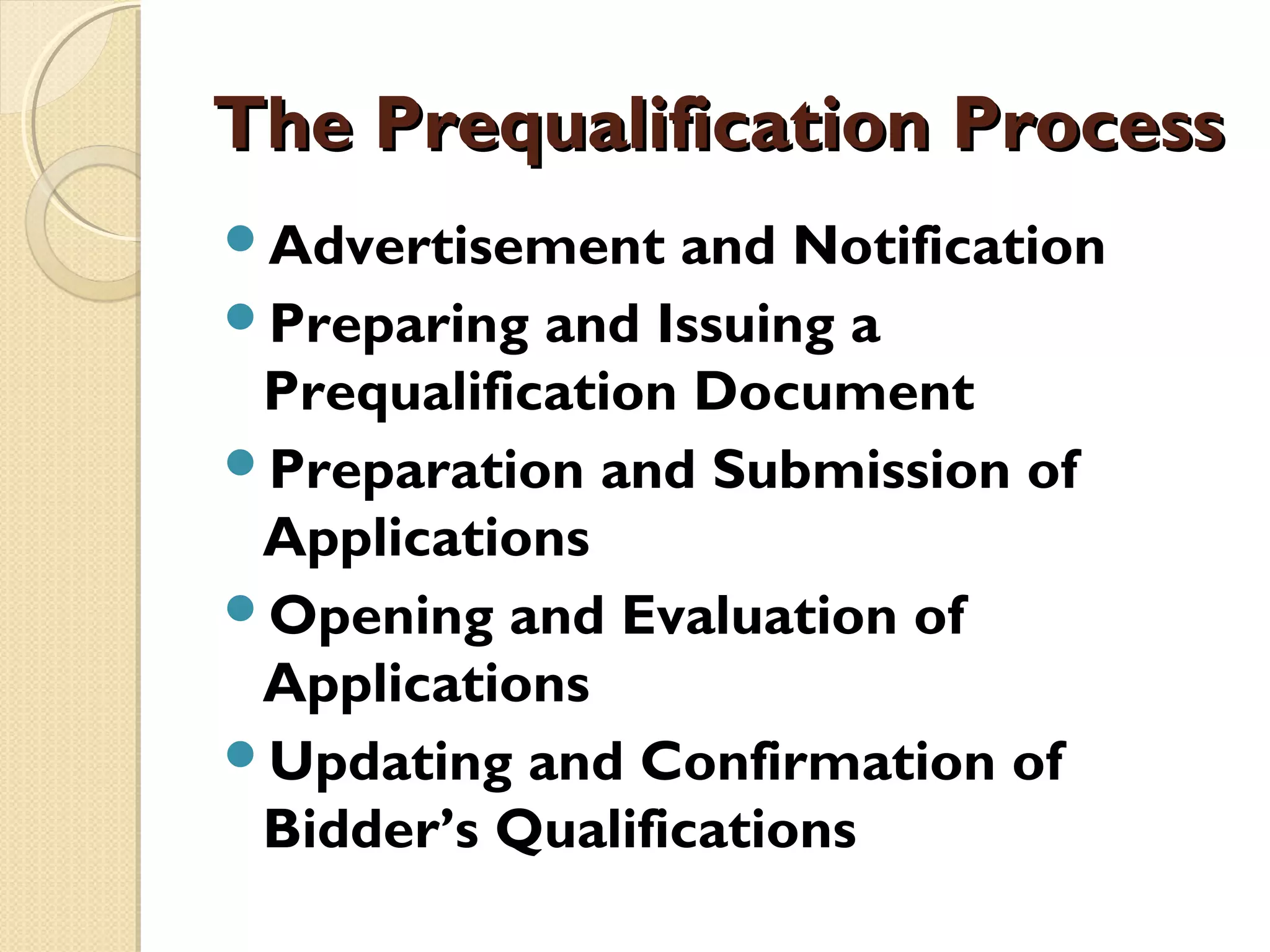
TThhee PPrreeqquuaalliiffiiccaattiioonn PPrroocceessss 
Advertisement and Notification 
Preparing and Issuing a 
Prequalification Document 
Preparation and Submission of 
Applications 
Opening and Evaluation of 
Applications 
Updating and Confirmation of 
Bidder’s Qualifications
AAddvveerrttiisseemmeenntt aanndd 
NNoottiiffiiccaattiioonn 
 The Invitation for Prequalification (IFP) shall be advertised in ADB’s “ADB 
Business Opportunities” as well as in a newspaper of general circulation in 
the borrower’s country (at least one English-language newspaper if 
available). 
 A copy of the IFP shall be submitted to ADB for approval and for 
publication in the “ADB Business Opportunities” in accordance with the 
provisions of the Loan Agreement and the Guidelines for Procurement 
under ADB Loans. 
 For large or specialized contracts, ADB may additionally require that the 
IFP be advertised in well-known technical magazines or trade publications, 
or in newspapers of wide international circulation, in sufficient time to 
enable prospective Bidders to prepare and submit Applications.
PPrreeppaarriinngg aanndd IIssssuuiinngg aa 
PPrreeqquuaalliiffiiccaattiioonn DDooccuummeenntt 
The Employer is responsible for preparing and issuing the Prequalification Document. 
 The Employer shall use ADB’s Standard Procurement Document for the 
Prequalification of Bidders, as this is a mandatory requirement for contracts to be 
financed by ADB. 
 The Employer shall prepare the Prequalification Document using the published 
version of the SPD without suppressing or adding text to Section I. Instructions 
to Applicants (ITA). All information and data particular to each individual 
prequalification process must be provided by the Employer in the following sections 
of the Prequalification Document: 
◦ Section II. Application Data Sheet 
◦ Section III. Qualification Criteria 
◦ Section IV. Application Forms 
◦ Section V. Eligible Countries 
◦ Section VI. Scope of Contract.
PPrreeppaarriinngg aanndd IIssssuuiinngg aa 
PPrreeqquuaalliiffiiccaattiioonn DDooccuummeenntt 
 The Employer shall allow Applicants a minimum period of 42 days to 
◦ – study the Prequalification Document; 
◦ – prepare complete and responsive Applications, and 
◦ – submit their Applications.
Preparation aanndd SSuubbmmiissssiioonn ooff 
AApppplliiccaattiioonnss 
The Applicant is solely responsible for the preparation and submission of its 
Application. During this stage, the Employer shall 
 promptly respond to requests for clarifications from Applicants and 
amend, as needed, the Prequalification Document, 
 amend the Prequalification Document only with the prior approval of 
ADB.
OOppeenniinngg aanndd EEvvaalluuaattiioonn ooff 
AApppplliiccaattiioonnss 
The Employer is responsible for the opening and evaluation of applications, 
which is a critical event in the prequalification process. The Employer shall 
appoint experienced staff to conduct the evaluation of applications. 
Mistakes committed at evaluation may later prompt complaints from 
Applicants, requiring re-evaluation of the applications, with consequent 
delays and waste of resources. 
The Employer, in observance of best practices, shall 
 maintain the evaluation process strictly confidential, 
 reject any attempts or pressures to distort the outcome of the evaluation, 
including fraud and corruption, 
 strictly apply only and all of the qualification criteria specified in the 
Prequalification Document, and 
 notify all applicants in writing of the names of those applicants who have 
been prequalified.
UUppddaattiinngg aanndd CCoonnffiirrmmaattiioonn ooff 
BBiiddddeerr’’ss QQuuaalliiffiiccaattiioonnss 
Information pertaining to a bidder’s eligibility, pending litigation, and financial 
situation shall be updated during bidding. Additional qualifying 
requirements not examined during prequalification such as 
 current contract commitments; 
 cash flow capacity; 
 equipment to be allocated for the particular contract; and 
 personnel to be fielded for the particular contract, 
shall form part of the bidding document and will be assessed during bid 
evaluation.
PPoosstt qquuaalliiffiiccaattiioonn 
 For the procurement of simple and unsophisticated works 
contracts the Employer may apply post-qualification by requiring 
bidders to submit the information pertaining to their qualification 
together with their bids. In this event, it will be necessary to 
ensure that a bidder’s risk of having its bid rejected on grounds of 
qualification is remote if due diligence is exercised by the bidder 
during bid preparation. 
 For that purpose, clear-cut, fail-pass qualification criteria need to 
be specified by the Executing Agency in both the Invitation for Bids 
as well as the Bidding Document in order to enable bidders to 
make an informed decision whether to pursue a specific contract 
and, if so, either as a single entity or in joint venture.
Cp 2 selection of contractor - pq and post q

Cp 2 selection of contractor - pq and post q

  • 1.
    SSeelleeccttiioonn ooff CCoonnttrraaccttoorr–– PPrreeqquuaalliiffiiccaattiioonn aanndd ppoosstt qquuaalliiffiiccaattiioonn Prepared and Presented by: Prof. Khem Dallakoti
  • 2.
    PPrree--qquuaalliiffiiccaattiioonn  ADB’sProcurement Guidelines require prequalification for large or complex works contracts, or in any other circumstances in which the high costs of preparing detailed bids could discourage competition, such as custom-designed equipment, industrial plant, specialized services, some complex information and technology contracts and contracts to be let under turnkey, design and build, or management contracting. Prequalification is followed by a closed competitive bidding procedure in which only those firms meeting specified prequalification criteria are invited to submit a bid. Prequalification should not be used for limiting competition to a predetermined number of potential bidders. All applicants meeting the specified criteria shall be allowed to bid.
  • 3.
    RReeqquuiirreemmeenntt ffoorr pprreeqquuaalliiffiiccaattiioonn  The successful execution of contracts for large buildings, civil engineering, supply and installation, turnkey, and design-and-build projects requires that contracts are awarded only to firms, or combinations of firms, that are suitably experienced in the type of work and construction technology involved, that are financially and managerially sound, and that can provide all the equipment required in a timely manner. The assessment by an implementing agency of the suitability of firms to carry out a particular contract prior to being invited to submit a bid is a process called prequalification.  Prequalification is followed by a closed competitive bidding procedure in which only those firms meeting specified prequalification criteria are invited to submit a bid. Prequalification should not be used for limiting competition to a predetermined number of potential bidders. All applicants meeting the specified criteria shall be allowed to bid.
  • 4.
    BBeenneeffiittss ooff PPrreeqquuaalliiffiiccaattiioonn  the process enables prospective bidders, who may be insufficiently qualified on their own, to avoid the expense of bidding, or to form a joint venture that may give a better chance of success;  with prequalification, well qualified firms will price their bids with the knowledge that they are competing against other qualified bidders meeting realistic minimum competence criteria, and with the assurance that inadequately qualified competitors will be excluded from submitting unrealistically low bids, leading contractors are encouraged to bid;  prequalification enables Executing Agencies to assess the interest from qualified firms generated by the contract and, in the event that only a limited number of applications are received, to make any necessary adjustments in the procurement process;
  • 5.
    BBeenneeffiittss ooff PPrreeqquuaalliiffiiccaattiioonn  it helps to expose potential conflicts of interest of an applicant with other parties involved in this prequalification process;  it reduces the amount of work and time involved by Executing Agencies in evaluating bids from unqualified contractors;  it encourages local firms to form joint ventures with other local or international firms, thereby benefiting from their resources and experience; 2 Introduction User’s Guide Prequalification of Bidders ADB Standard Prequalification Document  it enables the Executing Agencies to assess the likelihood of contractors’ eligibility for domestic bidder price preference in borrowing countries where this is applicable; and  it reduces significantly, if not eliminates, problems of rejection associated with low-priced bids submitted by bidders of doubtful capability.
  • 6.
    DDiissaaddvvaannttaaggeess ooff PPrreeqquuaalliiffiiccaattiioonn  scheduling, for example, undertaking the prequalification process while bid documents are being prepared;  • the Executing Agencies are required to review all prequalification applications whereas under postqualification the review of the qualifications can be reduced to the lowest evaluated bidder only; and  • collusion and the possibility of price-rigging is easier among a limited number of identified bidders, particularly if they are of the same nationality
  • 7.
    TThhee PPrreeqquuaalliiffiiccaattiioonn PPrroocceessss Advertisement and Notification Preparing and Issuing a Prequalification Document Preparation and Submission of Applications Opening and Evaluation of Applications Updating and Confirmation of Bidder’s Qualifications
  • 8.
    AAddvveerrttiisseemmeenntt aanndd NNoottiiffiiccaattiioonn  The Invitation for Prequalification (IFP) shall be advertised in ADB’s “ADB Business Opportunities” as well as in a newspaper of general circulation in the borrower’s country (at least one English-language newspaper if available).  A copy of the IFP shall be submitted to ADB for approval and for publication in the “ADB Business Opportunities” in accordance with the provisions of the Loan Agreement and the Guidelines for Procurement under ADB Loans.  For large or specialized contracts, ADB may additionally require that the IFP be advertised in well-known technical magazines or trade publications, or in newspapers of wide international circulation, in sufficient time to enable prospective Bidders to prepare and submit Applications.
  • 9.
    PPrreeppaarriinngg aanndd IIssssuuiinnggaa PPrreeqquuaalliiffiiccaattiioonn DDooccuummeenntt The Employer is responsible for preparing and issuing the Prequalification Document.  The Employer shall use ADB’s Standard Procurement Document for the Prequalification of Bidders, as this is a mandatory requirement for contracts to be financed by ADB.  The Employer shall prepare the Prequalification Document using the published version of the SPD without suppressing or adding text to Section I. Instructions to Applicants (ITA). All information and data particular to each individual prequalification process must be provided by the Employer in the following sections of the Prequalification Document: ◦ Section II. Application Data Sheet ◦ Section III. Qualification Criteria ◦ Section IV. Application Forms ◦ Section V. Eligible Countries ◦ Section VI. Scope of Contract.
  • 10.
    PPrreeppaarriinngg aanndd IIssssuuiinnggaa PPrreeqquuaalliiffiiccaattiioonn DDooccuummeenntt  The Employer shall allow Applicants a minimum period of 42 days to ◦ – study the Prequalification Document; ◦ – prepare complete and responsive Applications, and ◦ – submit their Applications.
  • 11.
    Preparation aanndd SSuubbmmiissssiioonnooff AApppplliiccaattiioonnss The Applicant is solely responsible for the preparation and submission of its Application. During this stage, the Employer shall  promptly respond to requests for clarifications from Applicants and amend, as needed, the Prequalification Document,  amend the Prequalification Document only with the prior approval of ADB.
  • 12.
    OOppeenniinngg aanndd EEvvaalluuaattiioonnooff AApppplliiccaattiioonnss The Employer is responsible for the opening and evaluation of applications, which is a critical event in the prequalification process. The Employer shall appoint experienced staff to conduct the evaluation of applications. Mistakes committed at evaluation may later prompt complaints from Applicants, requiring re-evaluation of the applications, with consequent delays and waste of resources. The Employer, in observance of best practices, shall  maintain the evaluation process strictly confidential,  reject any attempts or pressures to distort the outcome of the evaluation, including fraud and corruption,  strictly apply only and all of the qualification criteria specified in the Prequalification Document, and  notify all applicants in writing of the names of those applicants who have been prequalified.
  • 13.
    UUppddaattiinngg aanndd CCoonnffiirrmmaattiioonnooff BBiiddddeerr’’ss QQuuaalliiffiiccaattiioonnss Information pertaining to a bidder’s eligibility, pending litigation, and financial situation shall be updated during bidding. Additional qualifying requirements not examined during prequalification such as  current contract commitments;  cash flow capacity;  equipment to be allocated for the particular contract; and  personnel to be fielded for the particular contract, shall form part of the bidding document and will be assessed during bid evaluation.
  • 14.
    PPoosstt qquuaalliiffiiccaattiioonn For the procurement of simple and unsophisticated works contracts the Employer may apply post-qualification by requiring bidders to submit the information pertaining to their qualification together with their bids. In this event, it will be necessary to ensure that a bidder’s risk of having its bid rejected on grounds of qualification is remote if due diligence is exercised by the bidder during bid preparation.  For that purpose, clear-cut, fail-pass qualification criteria need to be specified by the Executing Agency in both the Invitation for Bids as well as the Bidding Document in order to enable bidders to make an informed decision whether to pursue a specific contract and, if so, either as a single entity or in joint venture.