


PESTIGE INSTITUTE OF ENGINEERING MANAGEMENT &
RESEARCH, INDORE
Online Internship on
“BIM & Skill Development”
Presentation on
@S_Kirar
What is the difference between Tender and
Contract?
 Tender: A tender formally means an invitation to trade
under the terms of offer.
 Contract: A contract is the term used for when the
parties have reached agreement.
Tender
 It is an invitation from the owner to the
contractor to execute some work at specified
cost in specified time.
 It is published in the form of tender notice in
news papers, notice boards, online etc.
according to the cost of works.
Classification of tenders:
1. Open tender:
- An oral talk or written document between the
engineer and the contractor.
- For certain small job. Or
- Sometimes it is advertised.
2. Sealed tender:
- Invited for important or huge projects;
- Wide publicity is given;
- Always written documents are made.
Classification of tenders:
3. Limited tender:
- Only a selected no. of contractors are invited
to quote their rates.
4. Single tender:
- Invitation is given to only one firm to render a
service by quoting their rates.
- If the quoted rates are high, it will be
negotiated prior to the agreement of the
contract.
Classification of tenders:
5. Rate contract:
- Usually adopted for supply of materials,
machine, tools & plant, etc. (items to the store)
- It specified the supply at a fixed rate during the
period of contract.
- Quantity is not mentioned.
Short Tender Notice:
When work is to be completed very quickly Or
no contractor prefers to accept the work (the tender
is floated)
Then a notice with short duration is again
published by the client. Such a tender notice is
called “Short Tender Notice”
The terms and conditions remain the same as
that for ordinary tender notice.
TENDER NOTICE OR NOTICE
INVITING TENDER:
 The Tender Notice is a brief description of the job being
tendered which is to be published in Newspapers and on
the Internet.
 The Internet is a very cost effective way of publishing
the tenders.
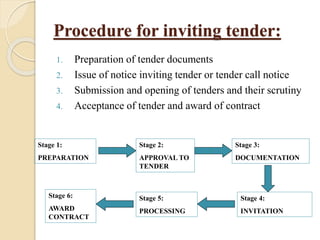
Procedure for inviting tender:
1. Preparation of tender documents
2. Issue of notice inviting tender or tender call notice
3. Submission and opening of tenders and their scrutiny
4. Acceptance of tender and award of contract
Stage 2:
APPROVAL TO
TENDER
Stage 1:
PREPARATION
Stage 3:
DOCUMENTATION
Stage 4:
INVITATION
Stage 5:
PROCESSING
Stage 6:
AWARD
CONTRACT
Information to be given in a tender
notice:
1. Name of the department inviting tender
2. Name of work and location
3. Designation of officer inviting tender
4. Last date and time of receipt of tender
5. Period of availability of tender document
6. Cost of tender document
7. Time of completion and type of contract
8. Earnest Money Deposit to be paid
9. Date, Time and Place of opening the tender
10. Designation of the officer opening the tender
Guidelines to fulfill in the Tender System:
 The capacity, past credentials and financial
status of the tendered is thoroughly investigated
before awarding the contract. These aspects
should be commented in detail along with the
tender documents.
 The rates should be quoted in the numbers and
words without any corrections. To take
advantage of any possible increase in statutory
taxes & duties, the tax component such as excise
duty, Sales Tax, Works Contract Tax, etc. should
be clearly indicated.
Guidelines to fulfill in the Tender System:
 Tenderers should not quote many special
conditions as some of them may have financial
implications, did this can be added to your
quoted cost. Also it creates confusion and
creates room for manipulative forces.
 The rates quoted for individual items should be
realistic and should not be abnormal and
unworkable.
Quotation
 For small jobs, the owner/engineer gives an
offer to the contractor for quoting rates for
works and supplies required.
 No EMD is required with a quotion.
Earnest Money Deposit (EMD)
 It is the amount of money to be deposited along with the
tender document to the department by the contractors
quoting a tender.
 This money is a guarantee against the refusal of ant
contractor to take up the work after the acceptance of his
tender. In case of refusal, this amount is forfeited.
 EMD of contractors whose tenders are not accepted will
be refunded.
 1% - 2% of the estimated cost of work is the Earnest
Money Deposited.
Liquidated Damages
 It is the amount of compensation payable by a
contractor to the owner due to delayed
construction.
 This amount of compensation is not related with
real damage. This does not relieve the contractor
from his obligations and liabilities under the
contract.
 In case if a part of the project or premise is used
by the owner before its completion, the amount
to be paid is reduced in proportion to the value
of the part that has been utilized, after issuing
the certificate of occupancy.
Unliquidated Damages
 It is the amount of compensation payable when
a contract is broken.
 The party who suffers such a breach is entitled
to receive this amount from the party who has
broken the contract.
Contract
 Contract: A contract is a legally binding
document that recognizes and governs the rights
and duties of the parties to the agreement.
 Contract Document: When the tender of a
contractor is accepted, an agreement between
the contractor and the owner takes place and the
documents defining the rights and obligations of
the owner and the contractor are attached to the
agreement bond and this is called contract
document.
Classification of Contracts:
1. Lump-sum contract
2. Cost plus a fixed percentage contract
3. Cost plus a fixed fee contract
4. Percentage rate contract
5. Item rate contract
6. Labour contract
7. Joint venture contract
8. Turn-key contract
9. Indirect lump-sum contract for flats or bungalows
10. BOT system
11. Target contract
Tender & Tender Notice

Tender & Tender Notice

  • 1.
    PESTIGE INSTITUTE OFENGINEERING MANAGEMENT & RESEARCH, INDORE Online Internship on “BIM & Skill Development” Presentation on @S_Kirar
  • 2.
    What is thedifference between Tender and Contract?  Tender: A tender formally means an invitation to trade under the terms of offer.  Contract: A contract is the term used for when the parties have reached agreement.
  • 3.
    Tender  It isan invitation from the owner to the contractor to execute some work at specified cost in specified time.  It is published in the form of tender notice in news papers, notice boards, online etc. according to the cost of works.
  • 4.
    Classification of tenders: 1.Open tender: - An oral talk or written document between the engineer and the contractor. - For certain small job. Or - Sometimes it is advertised. 2. Sealed tender: - Invited for important or huge projects; - Wide publicity is given; - Always written documents are made.
  • 5.
    Classification of tenders: 3.Limited tender: - Only a selected no. of contractors are invited to quote their rates. 4. Single tender: - Invitation is given to only one firm to render a service by quoting their rates. - If the quoted rates are high, it will be negotiated prior to the agreement of the contract.
  • 6.
    Classification of tenders: 5.Rate contract: - Usually adopted for supply of materials, machine, tools & plant, etc. (items to the store) - It specified the supply at a fixed rate during the period of contract. - Quantity is not mentioned.
  • 7.
    Short Tender Notice: Whenwork is to be completed very quickly Or no contractor prefers to accept the work (the tender is floated) Then a notice with short duration is again published by the client. Such a tender notice is called “Short Tender Notice” The terms and conditions remain the same as that for ordinary tender notice.
  • 8.
    TENDER NOTICE ORNOTICE INVITING TENDER:  The Tender Notice is a brief description of the job being tendered which is to be published in Newspapers and on the Internet.  The Internet is a very cost effective way of publishing the tenders.
  • 9.
    Procedure for invitingtender: 1. Preparation of tender documents 2. Issue of notice inviting tender or tender call notice 3. Submission and opening of tenders and their scrutiny 4. Acceptance of tender and award of contract Stage 2: APPROVAL TO TENDER Stage 1: PREPARATION Stage 3: DOCUMENTATION Stage 4: INVITATION Stage 5: PROCESSING Stage 6: AWARD CONTRACT
  • 10.
    Information to begiven in a tender notice: 1. Name of the department inviting tender 2. Name of work and location 3. Designation of officer inviting tender 4. Last date and time of receipt of tender 5. Period of availability of tender document 6. Cost of tender document 7. Time of completion and type of contract 8. Earnest Money Deposit to be paid 9. Date, Time and Place of opening the tender 10. Designation of the officer opening the tender
  • 11.
    Guidelines to fulfillin the Tender System:  The capacity, past credentials and financial status of the tendered is thoroughly investigated before awarding the contract. These aspects should be commented in detail along with the tender documents.  The rates should be quoted in the numbers and words without any corrections. To take advantage of any possible increase in statutory taxes & duties, the tax component such as excise duty, Sales Tax, Works Contract Tax, etc. should be clearly indicated.
  • 12.
    Guidelines to fulfillin the Tender System:  Tenderers should not quote many special conditions as some of them may have financial implications, did this can be added to your quoted cost. Also it creates confusion and creates room for manipulative forces.  The rates quoted for individual items should be realistic and should not be abnormal and unworkable.
  • 13.
    Quotation  For smalljobs, the owner/engineer gives an offer to the contractor for quoting rates for works and supplies required.  No EMD is required with a quotion.
  • 14.
    Earnest Money Deposit(EMD)  It is the amount of money to be deposited along with the tender document to the department by the contractors quoting a tender.  This money is a guarantee against the refusal of ant contractor to take up the work after the acceptance of his tender. In case of refusal, this amount is forfeited.  EMD of contractors whose tenders are not accepted will be refunded.  1% - 2% of the estimated cost of work is the Earnest Money Deposited.
  • 15.
    Liquidated Damages  Itis the amount of compensation payable by a contractor to the owner due to delayed construction.  This amount of compensation is not related with real damage. This does not relieve the contractor from his obligations and liabilities under the contract.  In case if a part of the project or premise is used by the owner before its completion, the amount to be paid is reduced in proportion to the value of the part that has been utilized, after issuing the certificate of occupancy.
  • 16.
    Unliquidated Damages  Itis the amount of compensation payable when a contract is broken.  The party who suffers such a breach is entitled to receive this amount from the party who has broken the contract.
  • 17.
    Contract  Contract: Acontract is a legally binding document that recognizes and governs the rights and duties of the parties to the agreement.  Contract Document: When the tender of a contractor is accepted, an agreement between the contractor and the owner takes place and the documents defining the rights and obligations of the owner and the contractor are attached to the agreement bond and this is called contract document.
  • 18.
    Classification of Contracts: 1.Lump-sum contract 2. Cost plus a fixed percentage contract 3. Cost plus a fixed fee contract 4. Percentage rate contract 5. Item rate contract 6. Labour contract 7. Joint venture contract 8. Turn-key contract 9. Indirect lump-sum contract for flats or bungalows 10. BOT system 11. Target contract