107/04/2014 Whole Work Teams & Human Scale
Whole Work Teams and
Human Scale
207/04/2014 Whole Work Teams & Human Scale
Natural Human
Social Unit Sizes
307/04/2014 Whole Work Teams & Human Scale
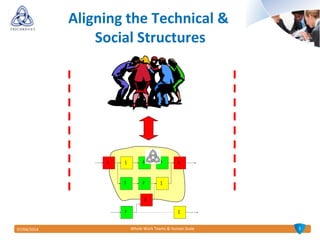
Aligning the Technical &
Social Structures
R
P
SPP
RPPS
S
R
507/04/2014 Whole Work Teams & Human Scale
607/04/2014 Whole Work Teams & Human Scale
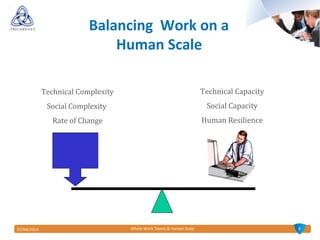
Balancing Work on a
Human Scale
Technical Complexity
Social Complexity
Rate of Change
Technical Capacity
Social Capacity
Human Resilience
807/04/2014 Whole Work Teams & Human Scale
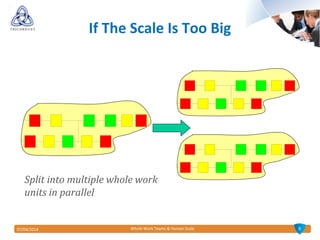
If The Scale Is Too Big
Split into multiple whole work
units in parallel
907/04/2014 Whole Work Teams & Human Scale
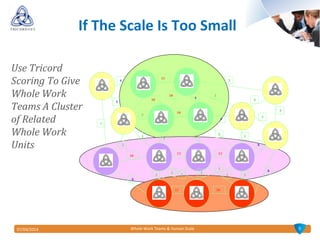
If The Scale Is Too Small
10
11
10
10
10
1011
1312
8
9
5
6
8
1
3
2
3
3
3
3
4
4
3
3
3
2
2
1
3
1
3
2 3
6
8
Use Tricord
Scoring To Give
Whole Work
Teams A Cluster
of Related
Whole Work
Units
1007/04/2014 Whole Work Teams & Human Scale
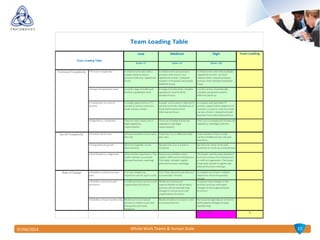
Low Medium High
Score =2 Score =6 Score = 10
• Process complexity A wholework unit with a
simple, linear primary
process with one 'significant
event'
A whole work unit primary
process with oneor two
significant events', a limited
number ofchannels and simple
feedback loops
A wholework unit with multiple
'significant events', an inter-
related, multi-channel primary
process with multiple feeedback
loops.
• Rangeofequipment used A small range of stableand
familiar equipment used
A rangeof moderately complex
equipment used in fairly
standard ways.
A wide variety of technically
complexequipment used in
different patterns
• Complexity of control
system
A simple paperwork or IT
system is used to control a
small variety of data
A paper work and/or tailored IT
system controls alimited set of
local and business level
information flows.
A complex and specialist IT
system, supported by paperwork
systems, is used to control a wide
variety of inter-related local and
business level information flows.
• Regulatory complexity Thereis only abasic set of
legal regulatory
requirements.
There are standard external
regulatory and legal
requirements.
Thereare acomplexset of external
regualtory and legal controls.
• Variety of job roles All team members have same
job role
Team has 2 or 3 different team
job roles
Team members havea wide
variety of different job role and
functions
• Geographical spread All work together in one
physical area
Spread over 2 or 3 areas or
locations
Spread over many areas and
locations or work as a virtual team
• Workinghours alignment All work the samehours. The
leader attends occasional
planned business meetings
Some team members have
slightly different working hours.
The leader attends regular
planned business meetings.
The leader and the team members
work an variety of working hours
or shift arrangements. The leader
frequently attend irregular and
planned business metings.
• Stability ofobjectives and
plan
3 or less simple key
objectives set for up to ayear
3 to 7 key objectves set that are
occasionally revised
A complex set of inter-related
objectives which frequently
change
• Stability ofprocess and
structure
A stable primary process and
organisation structure
Moderate continuous
improvements to the primary
process and occasional step
changes to the process and
organisation structure
Frequent step changes to the
primary process and major
changes to the organisational
structure
• Stability ofteam membership Moderateto low labour
turnover within a year and
infrequent new team
members
Moderate labour turnover with
occasional leavers
Particularly high labour turnover
and frequent changes in team
membership
Totals /100 0
Team Loading Table
Rate of Change
Social Complexity
Technical Complexity
Team Loading Table
Team Loading
1107/04/2014 Whole Work Teams & Human Scale
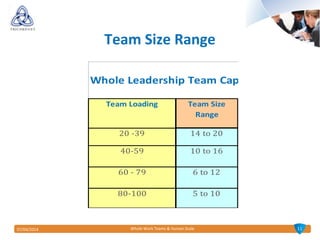
Team Size Range
Whole Leadership Team Capacity
Team Loading Team Size
Range
20 -39 14 to 20
40-59 10 to 16
60 - 79 6 to 12
80-100 5 to 10
1207/04/2014 Whole Work Teams & Human Scale
Human Scale For The
Department or Site
1307/04/2014 Whole Work Teams & Human Scale
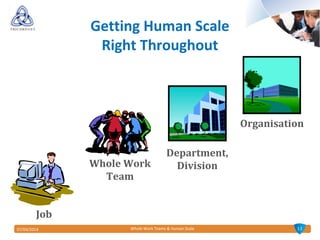
Getting Human Scale
Right Throughout
Job
Organisation
Whole Work
Team
Department,
Division
1407/04/2014 Whole Work Teams & Human Scale
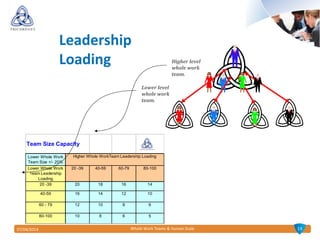
Team Size Capacity
Lower Whole Work
Team Size +/- 20%
Lower Whole Work
Team Leadership
Loading
20 -39 40-59 60-79 80-100
20 -39 20 18 16 14
40-59 16 14 12 10
60 - 79 12 10 8 6
80-100 10 8 6 5
Higher Whole WorkTeam Leadership Loading
Higher level
whole work
team.
Lower level
whole work
team.
Leadership
Loading
1507/04/2014 Whole Work Teams & Human Scale
Human Scale –
Community Level
10
11
10
10
10
1011
1312
8
9
5
6
8
1
3
2
3
3
3
3
4
4
3
3
3
2
2
1
3
1
3
2 3
6
8
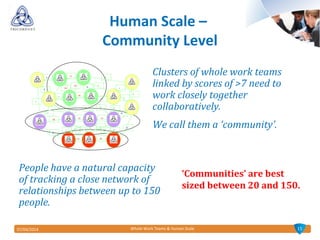
Clusters of whole work teams
linked by scores of >7 need to
work closely together
collaboratively.
We call them a ‘community’.
People have a natural capacity
of tracking a close network of
relationships between up to 150
people.
‘Communities’ are best
sized between 20 and 150.
1607/04/2014 Whole Work Teams & Human Scale
Human Scale For The
Individual
1707/04/2014 Whole Work Teams & Human Scale
Human Scale &
Job Design
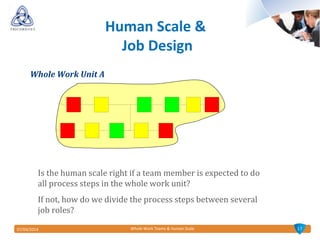
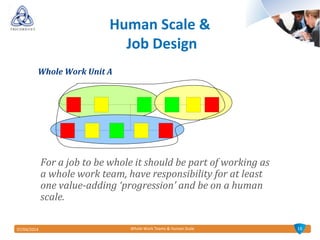
Whole Work Unit A
Is the human scale right if a team member is expected to do
all process steps in the whole work unit?
If not, how do we divide the process steps between several
job roles?
1807/04/2014 Whole Work Teams & Human Scale
Human Scale &
Job Design
Whole Work Unit A
For a job to be whole it should be part of working as
a whole work team, have responsibility for at least
one value-adding ‘progression’ and be on a human
scale.
1907/04/2014 Whole Work Teams & Human Scale
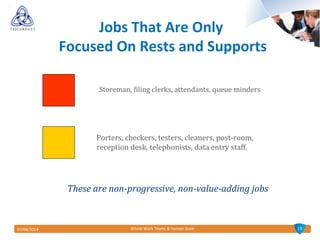
Jobs That Are Only
Focused On Rests and Supports
Storeman, filing clerks, attendants, queue minders
Porters, checkers, testers, cleaners, post-room,
reception desk, telephonists, data entry staff.
These are non-progressive, non-value-adding jobs
2007/04/2014 Whole Work Teams & Human Scale
Back up slides
2107/04/2014 Whole Work Teams & Human Scale
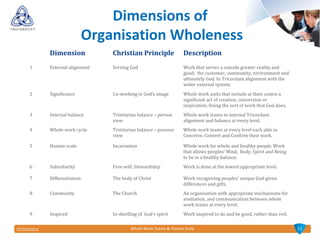
Dimensions of
Organisation Wholeness
Dimension Christian Principle Description
1 External alignment Serving God Work that serves a outside greater reality and
good; the customer, community, environment and
ultimately God. In Tricordant alignment with the
wider external system.
2 Significance Co-working in God’s image Whole work units that include at their centre a
significant act of creation, conversion or
inspiration. Doing the sort of work that God does.
3 Internal balance Trinitarian balance – person
view
Whole work teams in internal Tricordant
alignment and balance at every level.
4 Whole work cycle Trinitarian balance – process
view
Whole work teams at every level each able to
Conceive, Convert and Confirm their work.
5 Human scale Incarnation Whole work for whole and healthy people. Work
that allows peoples’ Mind, Body, Spirit and Being
to be in a healthy balance.
6 Subsidiarity Free-will. Stewardship Work is done at the lowest appropriate level.
7 Differentiation The body of Christ Work recognising peoples’ unique God-given
differences and gifts.
8 Community The Church An organisation with appropriate mechanisms for
mediation, and communication between whole
work teams at every level.
9 Inspired In-dwelling of God’s spirit Work inspired to do and be good, rather than evil.
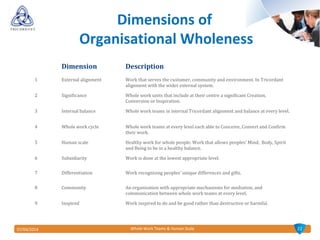
2207/04/2014 Whole Work Teams & Human Scale
Dimensions of
Organisational Wholeness
Dimension Description
1 External alignment Work that serves the customer, community and environment. In Tricordant
alignment with the wider external system.
2 Significance Whole work units that include at their centre a significant Creation,
Conversion or Inspiration.
3 Internal balance Whole work teams in internal Tricordant alignment and balance at every level.
4 Whole work cycle Whole work teams at every level each able to Conceive, Convert and Confirm
their work.
5 Human scale Healthy work for whole people. Work that allows peoples’ Mind, Body, Spirit
and Being to be in a healthy balance.
6 Subsidiarity Work is done at the lowest appropriate level.
7 Differentiation Work recognising peoples’ unique differences and gifts.
8 Community An organisation with appropriate mechanisms for mediation, and
communication between whole work teams at every level.
9 Inspired Work inspired to do and be good rather than destructive or harmful.

Pp slide set 5 whole work teams and human scale

  • 1.
    107/04/2014 Whole WorkTeams & Human Scale Whole Work Teams and Human Scale
  • 2.
    207/04/2014 Whole WorkTeams & Human Scale Natural Human Social Unit Sizes
  • 3.
    307/04/2014 Whole WorkTeams & Human Scale Aligning the Technical & Social Structures R P SPP RPPS S R
  • 4.
    507/04/2014 Whole WorkTeams & Human Scale
  • 5.
    607/04/2014 Whole WorkTeams & Human Scale Balancing Work on a Human Scale Technical Complexity Social Complexity Rate of Change Technical Capacity Social Capacity Human Resilience
  • 6.
    807/04/2014 Whole WorkTeams & Human Scale If The Scale Is Too Big Split into multiple whole work units in parallel
  • 7.
    907/04/2014 Whole WorkTeams & Human Scale If The Scale Is Too Small 10 11 10 10 10 1011 1312 8 9 5 6 8 1 3 2 3 3 3 3 4 4 3 3 3 2 2 1 3 1 3 2 3 6 8 Use Tricord Scoring To Give Whole Work Teams A Cluster of Related Whole Work Units
  • 8.
    1007/04/2014 Whole WorkTeams & Human Scale Low Medium High Score =2 Score =6 Score = 10 • Process complexity A wholework unit with a simple, linear primary process with one 'significant event' A whole work unit primary process with oneor two significant events', a limited number ofchannels and simple feedback loops A wholework unit with multiple 'significant events', an inter- related, multi-channel primary process with multiple feeedback loops. • Rangeofequipment used A small range of stableand familiar equipment used A rangeof moderately complex equipment used in fairly standard ways. A wide variety of technically complexequipment used in different patterns • Complexity of control system A simple paperwork or IT system is used to control a small variety of data A paper work and/or tailored IT system controls alimited set of local and business level information flows. A complex and specialist IT system, supported by paperwork systems, is used to control a wide variety of inter-related local and business level information flows. • Regulatory complexity Thereis only abasic set of legal regulatory requirements. There are standard external regulatory and legal requirements. Thereare acomplexset of external regualtory and legal controls. • Variety of job roles All team members have same job role Team has 2 or 3 different team job roles Team members havea wide variety of different job role and functions • Geographical spread All work together in one physical area Spread over 2 or 3 areas or locations Spread over many areas and locations or work as a virtual team • Workinghours alignment All work the samehours. The leader attends occasional planned business meetings Some team members have slightly different working hours. The leader attends regular planned business meetings. The leader and the team members work an variety of working hours or shift arrangements. The leader frequently attend irregular and planned business metings. • Stability ofobjectives and plan 3 or less simple key objectives set for up to ayear 3 to 7 key objectves set that are occasionally revised A complex set of inter-related objectives which frequently change • Stability ofprocess and structure A stable primary process and organisation structure Moderate continuous improvements to the primary process and occasional step changes to the process and organisation structure Frequent step changes to the primary process and major changes to the organisational structure • Stability ofteam membership Moderateto low labour turnover within a year and infrequent new team members Moderate labour turnover with occasional leavers Particularly high labour turnover and frequent changes in team membership Totals /100 0 Team Loading Table Rate of Change Social Complexity Technical Complexity Team Loading Table Team Loading
  • 9.
    1107/04/2014 Whole WorkTeams & Human Scale Team Size Range Whole Leadership Team Capacity Team Loading Team Size Range 20 -39 14 to 20 40-59 10 to 16 60 - 79 6 to 12 80-100 5 to 10
  • 10.
    1207/04/2014 Whole WorkTeams & Human Scale Human Scale For The Department or Site
  • 11.
    1307/04/2014 Whole WorkTeams & Human Scale Getting Human Scale Right Throughout Job Organisation Whole Work Team Department, Division
  • 12.
    1407/04/2014 Whole WorkTeams & Human Scale Team Size Capacity Lower Whole Work Team Size +/- 20% Lower Whole Work Team Leadership Loading 20 -39 40-59 60-79 80-100 20 -39 20 18 16 14 40-59 16 14 12 10 60 - 79 12 10 8 6 80-100 10 8 6 5 Higher Whole WorkTeam Leadership Loading Higher level whole work team. Lower level whole work team. Leadership Loading
  • 13.
    1507/04/2014 Whole WorkTeams & Human Scale Human Scale – Community Level 10 11 10 10 10 1011 1312 8 9 5 6 8 1 3 2 3 3 3 3 4 4 3 3 3 2 2 1 3 1 3 2 3 6 8 Clusters of whole work teams linked by scores of >7 need to work closely together collaboratively. We call them a ‘community’. People have a natural capacity of tracking a close network of relationships between up to 150 people. ‘Communities’ are best sized between 20 and 150.
  • 14.
    1607/04/2014 Whole WorkTeams & Human Scale Human Scale For The Individual
  • 15.
    1707/04/2014 Whole WorkTeams & Human Scale Human Scale & Job Design Whole Work Unit A Is the human scale right if a team member is expected to do all process steps in the whole work unit? If not, how do we divide the process steps between several job roles?
  • 16.
    1807/04/2014 Whole WorkTeams & Human Scale Human Scale & Job Design Whole Work Unit A For a job to be whole it should be part of working as a whole work team, have responsibility for at least one value-adding ‘progression’ and be on a human scale.
  • 17.
    1907/04/2014 Whole WorkTeams & Human Scale Jobs That Are Only Focused On Rests and Supports Storeman, filing clerks, attendants, queue minders Porters, checkers, testers, cleaners, post-room, reception desk, telephonists, data entry staff. These are non-progressive, non-value-adding jobs
  • 18.
    2007/04/2014 Whole WorkTeams & Human Scale Back up slides
  • 19.
    2107/04/2014 Whole WorkTeams & Human Scale Dimensions of Organisation Wholeness Dimension Christian Principle Description 1 External alignment Serving God Work that serves a outside greater reality and good; the customer, community, environment and ultimately God. In Tricordant alignment with the wider external system. 2 Significance Co-working in God’s image Whole work units that include at their centre a significant act of creation, conversion or inspiration. Doing the sort of work that God does. 3 Internal balance Trinitarian balance – person view Whole work teams in internal Tricordant alignment and balance at every level. 4 Whole work cycle Trinitarian balance – process view Whole work teams at every level each able to Conceive, Convert and Confirm their work. 5 Human scale Incarnation Whole work for whole and healthy people. Work that allows peoples’ Mind, Body, Spirit and Being to be in a healthy balance. 6 Subsidiarity Free-will. Stewardship Work is done at the lowest appropriate level. 7 Differentiation The body of Christ Work recognising peoples’ unique God-given differences and gifts. 8 Community The Church An organisation with appropriate mechanisms for mediation, and communication between whole work teams at every level. 9 Inspired In-dwelling of God’s spirit Work inspired to do and be good, rather than evil.
  • 20.
    2207/04/2014 Whole WorkTeams & Human Scale Dimensions of Organisational Wholeness Dimension Description 1 External alignment Work that serves the customer, community and environment. In Tricordant alignment with the wider external system. 2 Significance Whole work units that include at their centre a significant Creation, Conversion or Inspiration. 3 Internal balance Whole work teams in internal Tricordant alignment and balance at every level. 4 Whole work cycle Whole work teams at every level each able to Conceive, Convert and Confirm their work. 5 Human scale Healthy work for whole people. Work that allows peoples’ Mind, Body, Spirit and Being to be in a healthy balance. 6 Subsidiarity Work is done at the lowest appropriate level. 7 Differentiation Work recognising peoples’ unique differences and gifts. 8 Community An organisation with appropriate mechanisms for mediation, and communication between whole work teams at every level. 9 Inspired Work inspired to do and be good rather than destructive or harmful.

Editor's Notes

  • #5 Whatever scale you are looking at, every socio-technical system is built up from the integration of sub-systems. This is true at the level of a small satellite work unit, a large plc corporation or a whole national economy. We can build up an aligned and balanced system from its organisational sub-systems only if the sub-systems are designed in the right way. They need to have certain characteristics such as being fit for purpose, being aligned to the neighbouring elements. being under control, being self-limiting and within their remit, being self-managing. An analogy is that of an organism such as an animal being made up of organs and in turn of cells. The organism will only be fit and healthy if its organs and in turn its cells are healthy. They must perform heir function well, be stable, not be diseased, not be cancerous, etc.