07/04/2014 Integrated Leadership 1
Integrated Leadership
07/04/2014 Integrated Leadership
“Leaders who choose only people who mirror
themselves are likely to find their
organisations tilting in one direction, missing
one or more essential capabilities to survive in
a changing complex world.”
2
“In Praise of the
Incomplete Leader”
(HBR 2007)
07/04/2014 Integrated Leadership 3
Our Leadership
Message
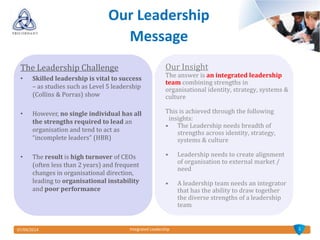
The Leadership Challenge
• Skilled leadership is vital to success
– as studies such as Level 5 leadership
(Collins & Porras) show
• However, no single individual has all
the strengths required to lead an
organisation and tend to act as
“incomplete leaders” (HBR)
• The result is high turnover of CEOs
(often less than 2 years) and frequent
changes in organisational direction,
leading to organisational instability
and poor performance
Our Insight
The answer is an integrated leadership
team combining strengths in
organisational identity, strategy, systems &
culture
This is achieved through the following
insights:
• The Leadership needs breadth of
strengths across identity, strategy,
systems & culture
• Leadership needs to create alignment
of organisation to external market /
need
• A leadership team needs an integrator
that has the ability to draw together
the diverse strengths of a leadership
team
07/04/2014 Integrated Leadership 4
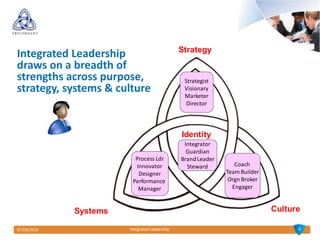
Strategy
Systems Culture
Identity
Strategist
Visionary
Marketer
Director
Coach
Team Builder
Orgn Broker
Engager
Process Ldr
Innovator
Designer
Performance
Manager
Integrator
Guardian
BrandLeader
Steward
Integrated Leadership
draws on a breadth of
strengths across purpose,
strategy, systems & culture
07/04/2014 Integrated Leadership
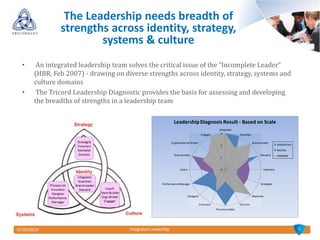
• An integrated leadership team solves the critical issue of the “Incomplete Leader”
(HBR, Feb 2007) - drawing on diverse strengths across identity, strategy, systems and
culture domains
• The Tricord Leadership Diagnostic provides the basis for assessing and developing
the breadths of strengths in a leadership team
5
The Leadership needs breadth of
strengths across identity, strategy,
systems & culture
0
1
2
3
Integrator
Guardian
Brand Leader
Steward
Visionary
Strategist
Marketer
Director
ProcessLeader
Innovator
Designer
Performance Manager
Coach
Team Builder
Organisational Broker
Engager
LeadershipDiagnosis Result - Based on Scale
SAMANTHA
RACHEL
ANDREW
07/04/2014 Integrated Leadership
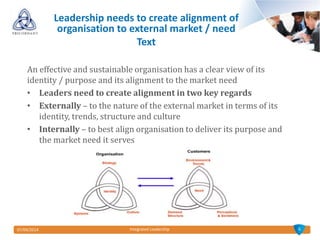
An effective and sustainable organisation has a clear view of its
identity / purpose and its alignment to the market need
• Leaders need to create alignment in two key regards
• Externally – to the nature of the external market in terms of its
identity, trends, structure and culture
• Internally – to best align organisation to deliver its purpose and
the market need it serves
6
Leadership needs to create alignment of
organisation to external market / need
Text
07/04/2014 Integrated Leadership
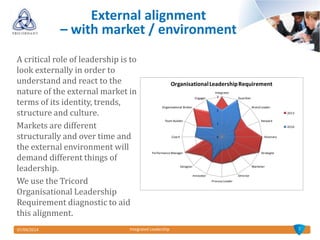
A critical role of leadership is to
look externally in order to
understand and react to the
nature of the external market in
terms of its identity, trends,
structure and culture.
Markets are different
structurally and over time and
the external environment will
demand different things of
leadership.
We use the Tricord
Organisational Leadership
Requirement diagnostic to aid
this alignment.
7
External alignment
– with market / environment
0
1
2
3
Integrator
Guardian
Brand Leader
Steward
Visionary
Strategist
Marketer
Director
ProcessLeader
Innovator
Designer
Performance Manager
Coach
Team Builder
Organisational Broker
Engager
OrganisationalLeadershipRequirement
2013
2010
07/04/2014 Integrated Leadership
Strategy
Systems Culture
Identity
Strategy
Systems Culture
Identity
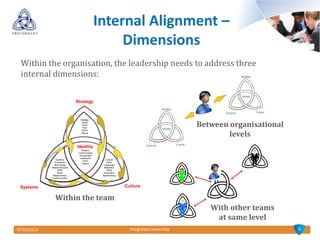
Within the organisation, the leadership needs to address three
internal dimensions:
8
Internal Alignment –
Dimensions
Strategy
Systems Culture
Strategy
Goals
Aims
Plan
Ethics
Values
Culture
Spirit
Language
Motivation
Ethos
Evaluation
Teamworking
Systems
Processes
Technology
People Structure
Skills
Roles
Measurement
Communication
Reason
Core Purpose
Uniqueness
Leadership
Unity
History
Identity
Within the team
Between organisational
levels
With other teams
at same level
07/04/2014 Integrated Leadership
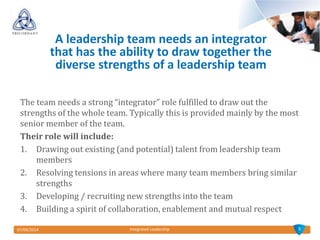
The team needs a strong “integrator” role fulfilled to draw out the
strengths of the whole team. Typically this is provided mainly by the most
senior member of the team.
Their role will include:
1. Drawing out existing (and potential) talent from leadership team
members
2. Resolving tensions in areas where many team members bring similar
strengths
3. Developing / recruiting new strengths into the team
4. Building a spirit of collaboration, enablement and mutual respect
9
A leadership team needs an integrator
that has the ability to draw together the
diverse strengths of a leadership team
07/04/2014 Integrated Leadership
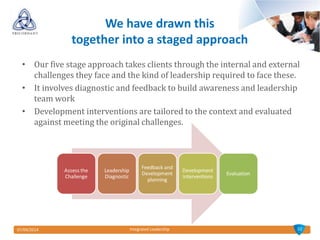
• Our five stage approach takes clients through the internal and external
challenges they face and the kind of leadership required to face these.
• It involves diagnostic and feedback to build awareness and leadership
team work
• Development interventions are tailored to the context and evaluated
against meeting the original challenges.
10
We have drawn this
together into a staged approach
Assess the
Challenge
Leadership
Diagnostic
Feedback and
Development
planning
Development
interventions
Evaluation
07/04/2014 Integrated Leadership
Please fill in the questionnaire (beforehand).
Look at group profile.
Please consider the following as a group
• What are the strengths of you as a leadership?
• Where might there be gaps?
• Where might conflict arise?
• Who might be a good integrator for the team?
11
Having a go as a group ....

Pp slide set 7 integrated leadership

  • 1.
    07/04/2014 Integrated Leadership1 Integrated Leadership
  • 2.
    07/04/2014 Integrated Leadership “Leaderswho choose only people who mirror themselves are likely to find their organisations tilting in one direction, missing one or more essential capabilities to survive in a changing complex world.” 2 “In Praise of the Incomplete Leader” (HBR 2007)
  • 3.
    07/04/2014 Integrated Leadership3 Our Leadership Message The Leadership Challenge • Skilled leadership is vital to success – as studies such as Level 5 leadership (Collins & Porras) show • However, no single individual has all the strengths required to lead an organisation and tend to act as “incomplete leaders” (HBR) • The result is high turnover of CEOs (often less than 2 years) and frequent changes in organisational direction, leading to organisational instability and poor performance Our Insight The answer is an integrated leadership team combining strengths in organisational identity, strategy, systems & culture This is achieved through the following insights: • The Leadership needs breadth of strengths across identity, strategy, systems & culture • Leadership needs to create alignment of organisation to external market / need • A leadership team needs an integrator that has the ability to draw together the diverse strengths of a leadership team
  • 4.
    07/04/2014 Integrated Leadership4 Strategy Systems Culture Identity Strategist Visionary Marketer Director Coach Team Builder Orgn Broker Engager Process Ldr Innovator Designer Performance Manager Integrator Guardian BrandLeader Steward Integrated Leadership draws on a breadth of strengths across purpose, strategy, systems & culture
  • 5.
    07/04/2014 Integrated Leadership •An integrated leadership team solves the critical issue of the “Incomplete Leader” (HBR, Feb 2007) - drawing on diverse strengths across identity, strategy, systems and culture domains • The Tricord Leadership Diagnostic provides the basis for assessing and developing the breadths of strengths in a leadership team 5 The Leadership needs breadth of strengths across identity, strategy, systems & culture 0 1 2 3 Integrator Guardian Brand Leader Steward Visionary Strategist Marketer Director ProcessLeader Innovator Designer Performance Manager Coach Team Builder Organisational Broker Engager LeadershipDiagnosis Result - Based on Scale SAMANTHA RACHEL ANDREW
  • 6.
    07/04/2014 Integrated Leadership Aneffective and sustainable organisation has a clear view of its identity / purpose and its alignment to the market need • Leaders need to create alignment in two key regards • Externally – to the nature of the external market in terms of its identity, trends, structure and culture • Internally – to best align organisation to deliver its purpose and the market need it serves 6 Leadership needs to create alignment of organisation to external market / need Text
  • 7.
    07/04/2014 Integrated Leadership Acritical role of leadership is to look externally in order to understand and react to the nature of the external market in terms of its identity, trends, structure and culture. Markets are different structurally and over time and the external environment will demand different things of leadership. We use the Tricord Organisational Leadership Requirement diagnostic to aid this alignment. 7 External alignment – with market / environment 0 1 2 3 Integrator Guardian Brand Leader Steward Visionary Strategist Marketer Director ProcessLeader Innovator Designer Performance Manager Coach Team Builder Organisational Broker Engager OrganisationalLeadershipRequirement 2013 2010
  • 8.
    07/04/2014 Integrated Leadership Strategy SystemsCulture Identity Strategy Systems Culture Identity Within the organisation, the leadership needs to address three internal dimensions: 8 Internal Alignment – Dimensions Strategy Systems Culture Strategy Goals Aims Plan Ethics Values Culture Spirit Language Motivation Ethos Evaluation Teamworking Systems Processes Technology People Structure Skills Roles Measurement Communication Reason Core Purpose Uniqueness Leadership Unity History Identity Within the team Between organisational levels With other teams at same level
  • 9.
    07/04/2014 Integrated Leadership Theteam needs a strong “integrator” role fulfilled to draw out the strengths of the whole team. Typically this is provided mainly by the most senior member of the team. Their role will include: 1. Drawing out existing (and potential) talent from leadership team members 2. Resolving tensions in areas where many team members bring similar strengths 3. Developing / recruiting new strengths into the team 4. Building a spirit of collaboration, enablement and mutual respect 9 A leadership team needs an integrator that has the ability to draw together the diverse strengths of a leadership team
  • 10.
    07/04/2014 Integrated Leadership •Our five stage approach takes clients through the internal and external challenges they face and the kind of leadership required to face these. • It involves diagnostic and feedback to build awareness and leadership team work • Development interventions are tailored to the context and evaluated against meeting the original challenges. 10 We have drawn this together into a staged approach Assess the Challenge Leadership Diagnostic Feedback and Development planning Development interventions Evaluation
  • 11.
    07/04/2014 Integrated Leadership Pleasefill in the questionnaire (beforehand). Look at group profile. Please consider the following as a group • What are the strengths of you as a leadership? • Where might there be gaps? • Where might conflict arise? • Who might be a good integrator for the team? 11 Having a go as a group ....

Editor's Notes

  • #2 Tricordant Limited is a whole systems organisation development consultancy founded by our three principles; Alastair Mitchell-Baker, Simon Thane and Irwin Bidgood. Tricordant also works with a wide network of associates capable of covering a wide area of specialism and able to combine for major projects. The three principles bring to the company historical skills in Health Service Management, Manufacturing and the IT industry. Our shared passion is equipping companies to be whole. This means the organisation becomes sustainably successful and robust, delighting customers and are healthy places for ‘whole people’ to work. Our desire is to co-work with clients so that they develop a positive spiral of improvement within the organisation. Between us we have more than 25 years experience of working actively on whole systems level organisational problems in a wide range of areas including Health; Government, the Service sector, Utilities and Manufacturing. The following presentation represents an approach to equipping organisations to be whole.
  • #5 The Tricord describes all aspects of an organisation that heed to be aligned for the whole to be healthy. Identity: Each organisational unit should know who it is, where it comes from and what makes it unique. This understanding is built upon its history, cultural rituals and accumulated knowledge. The organisation’s identity represents the reason for the organisations existance and its unchanging core purpose. Concept: Each organisational unit should have a unique concept of its current purpose and what it wants to achieve. It should have a strategic plan of how to achieve it. The Concept includes a strategy to realise the unchanging core purpose interpreted in current times and the current market. It provides a clear vision and an effective set of values and ethics which are central to the organisation’s culture, whether this is written down or not. Embodiment: The above Concept then needs to be delivered on the ground. This is done by the organisation through processes which are capable of delivering the purpose and which are responsive to customer demand. These are embodied in technology, equipment, procedures, rules and policies, etc. At the most fundamental level the organisation is embodied in its people. All this is aligned as a whole socio-technical system. Inspiration: The organisation is brought alive by the energy and spirit of its people. They come to identify with the company and to be passionate about its purpose. Work groups are transformed into teams. Managers act as leaders. The whole socio-technical system is motivated to deliver the concept with excellence. The organisation is thus inspired. It is the synergistic alignment of the three outer dimensions of the Tricord synergistically acting in balance around the central core that is both the whole organisational system and the source of organisational wholeness. When one part of the Tricord is absent or unaligned then the organisation will tend to be dysfunctional, under-producing, cost-adding, de-motivated and incapable. If all dimensions of the Tricord are present and synergistically aligned with each other then the organisation will be whole, productive, vibrant, capable, competitive and successful.
  • #7 Collins and Porras is key source of research – built to last and good to great. For example, 3M, define their purpose as “solving unsolved problems innovatively” and have produced innovative products that express this purpose and meet a market need. We address this alignment as part of our leadership approach, using the Tricord Leadership Requirement Diagnostic (see right below), to define the leadership requirement across the domains both now and in the future.
  • #8 Collins and Porras is key source of research – built to last and good to great. For example, 3M, define their purpose as “solving unsolved problems innovatively” and have produced innovative products that express this purpose and meet a market need. We address this alignment as part of our leadership approach, using the Tricord Leadership Requirement Diagnostic (see right below), to define the leadership requirement across the domains both now and in the future.
  • #9 Collins and Porras is key source of research – built to last and good to great. For example, 3M, define their purpose as “solving unsolved problems innovatively” and have produced innovative products that express this purpose and meet a market need. We address this alignment as part of our leadership approach, using the Tricord Leadership Requirement Diagnostic (see right below), to define the leadership requirement across the domains both now and in the future.