07/04/2014 Workforce Planning 1
Workforce Planning
07/04/2014 Workforce Planning
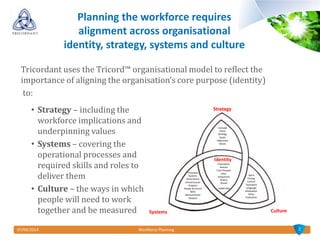
Tricordant uses the Tricord™ organisational model to reflect the
importance of aligning the organisation’s core purpose (identity)
to:
2
Planning the workforce requires
alignment across organisational
identity, strategy, systems and culture
Strategy
Systems Culture
Concept
Vision
Strategy
Goals
Objectives
Values
Spirit
Energy
Culture
Teamwork
Language
Motivation
Ethos
Evaluation
Processes
Systems
Governance
Infrastructure
Projects
People Structure
Skills
Measurement
Reward
Foundation
Reason
Core Purpose
Ethic
Uniqueness
History
Brand
Leadership
Identity
• Strategy – including the
workforce implications and
underpinning values
• Systems – covering the
operational processes and
required skills and roles to
deliver them
• Culture – the ways in which
people will need to work
together and be measured
07/04/2014 Workforce Planning
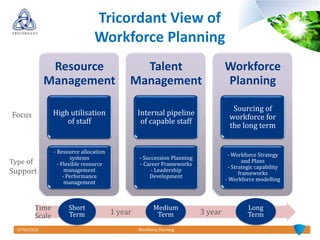
Tricordant View of
Workforce Planning
Resource
Management
High utilisation
of staff
- Resource allocation
systems
- Flexible resource
management
- Performance
management
Talent
Management
Internal pipeline
of capable staff
- Succession Planning
- Career Frameworks
- Leadership
Development
Workforce
Planning
Sourcing of
workforce for
the long term
- Workforce Strategy
and Plans
- Strategic capability
frameworks
- Workforce modelling
Focus
Type of
Support
Short
Term
Medium
Term
Long
Term
Time
Scale
1 year 3 year
07/04/2014 Workforce Planning
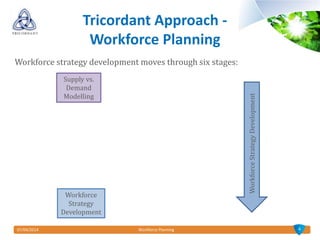
Workforce strategy development moves through six stages:
4
Tricordant Approach -
Workforce Planning
WorkforceStrategyDevelopment
Supply vs.
Demand
Modelling
Workforce
Strategy
Development
07/04/2014 Workforce Planning 5
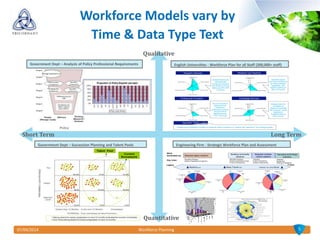
Workforce Models vary by
Time & Data Type Text
Qualitative
Short Term Long Term
Research-led Teaching Strategy
0%
10%
20%
30%
40%
PUBLIC RESEARCH
PRIVATE RESEARCH
PUBLIC TEACHING
PRIVATE TEACHING
ACADEMIC ENTERPRISE
OTHER SERVICES
Research Intensive Strategy
0%
5%
10%
15%
20%
25%
PUBLIC RESEARCH
PRIVATE RESEARCH
PUBLIC TEACHING
PRIVATE TEACHING
ACADEMIC ENTERPRISE
OTHER SERVICES
Research Intensive Research Led Teaching
Professional Formation Strategy
0%
10%
20%
30%
40%
50%
PUBLIC RESEARCH
PRIVATE RESEARCH
PUBLIC TEACHING
PRIVATE TEACHING
ACADEMIC ENTERPRISE
OTHER SERVICES
Professional Formation
Knowledge Services Strategy
0%
5%
10%
15%
20%
25%
30%
PUBLIC RESEARCH
PRIVATE RESEARCH
PUBLIC TEACHING
PRIVATE TEACHING
ACADEMIC ENTERPRISE
OTHER SERVICES
Knowledge Services
Specialist / Niche
Discipline based and
internationally
recognised research
with research income
making up 40%-50%
of income
Discipline based
teaching underpinned
by strong research
capabilities, with
teaching making up
60%+ of income
Strategy based on
translation of
research knowledge
into business / social
application.
Supplemented by
other income.
Focus on needs of
employers and
individual’s
professional careers
through CPD &
lifelong learning
(75%+ teaching)
Typically small institutions focussed on particular areas of practice e.g. creative arts, agriculture. No archetypal profile.
English Universities - Workforce Plan for all Staff (300,000+ staff)
ASSURANCE
8%
INSTALL
5%
PROJ ENG
20%
SIGNAL DESIGN
15%SYSTEMS APPS
ENG
7%
SYSTEMS ENG
35%
TEST
5%
RESEARCH
5%
ASSURANCE
4%
INSTALL
17%
PROJ ENG
10%
SIGNAL DESIGN
42%
SYSTEMS APPS
ENG
9%
SYSTEMS ENG
6%
TEST
12%
Future
Mainline now Mass Transit now
Legacy
Potential mix of the future
ASSURANCE
8%
INSTALL
5%
PROJ ENG
18%
SIGNAL DESIGN
28%
SYSTEMS APPS
ENG
3%
SYSTEMS ENG
32%
TEST
6%
Work
dominated by:
Key roles:
Bespoke legacy systems
Signalling Designer
Systems Applications Engineers
Building commodity
solutions
Signalling Designer
Systems Applications Engs.
Product Development
Bespoke complex
control systems
Integrator
Project Engineering
Systems Engineering
Disruptive technology
solutions
Integrator
Researcher
Systems Engineering
Engineering Firm - Strategic Workforce Plan and Assessment
Design / Project Engineering Actuals vs Ideal Integrator
0
1
2
3
4
Product Knowledge
Systems Knowledge
Industry Knowledge
Customer Focus***
Effective Communication***
Engineering Safety
Safety-Quality-Environment
Installation Management
Installation Delivery
Component Testing
System Testing
Requirements Analysis & System Specification
Schema Design
Systems Thinking
Problem Option Analysis
Subcontract Management
Decision Making
Engineering Process
People Management***
Planning***
Monitoring & Change Control***
Risk Management***
Commercial Awareness***
Sense Making
Innovation / Creativity
Calculated Risk Taking
Direction Setting
Act with Integrity
Display Adaptability
Demonstrate Interest in Others
Exhibit self-awareness and develop oneself
Drive for Results
Integrator Ideal Profile
Senior Project Eng Manager
Systems Engineering Manager
Design Performance Manager
Government Dept – Succession Planning and Talent Pools
Quantitative
Current
Successors
Talent Pool
= Strong desire for career progression in next 12 months (indicated by number in brackets)
= Don’t have strong desire for career progression in next 12 months
Government Dept – Analysis of Policy Professional Requirements
07/04/2014 Workforce Planning
The funding body wanted a 10-15 year high level
workforce plan for both academic and support staff
across the English higher education system.
6
English Universities
Long Term Workforce Plan
07/04/2014 Workforce Planning 7
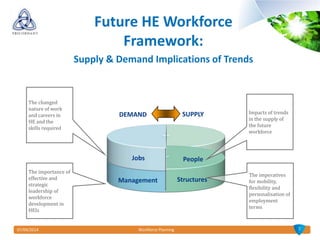
Future HE Workforce
Framework:
Supply & Demand Implications of Trends
StructuresManagement
PeopleJobs
The imperatives
for mobility,
flexibility and
personalisation of
employment
terms
Impacts of trends
in the supply of
the future
workforce
The importance of
effective and
strategic
leadership of
workforce
development in
HEIs
The changed
nature of work
and careers in
HE and the
skills required
SUPPLYDEMAND
07/04/2014 Workforce Planning 8
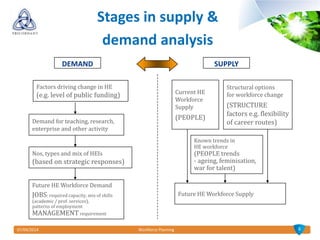
Stages in supply &
demand analysis
Factors driving change in HE
(e.g. level of public funding)
Demand for teaching, research,
enterprise and other activity
Nos, types and mix of HEIs
(based on strategic responses)
Future HE Workforce Demand
JOBS: required capacity, mix of skills
(academic / prof. services),
patterns of employment
MANAGEMENT requirement
Current HE
Workforce
Supply
(PEOPLE)
Structural options
for workforce change
(STRUCTURE
factors e.g. flexibility
of career routes)
Future HE Workforce Supply
DEMAND SUPPLY
Known trends in
HE workforce
(PEOPLE trends
- ageing, feminisation,
war for talent)
07/04/2014 Workforce Planning 9
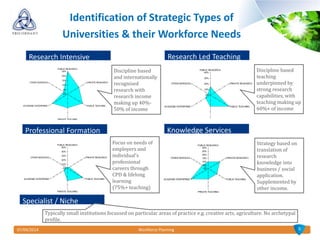
Identification of Strategic Types of
Universities & their Workforce Needs
Research-led Teaching Strategy
0%
10%
20%
30%
40%
PUBLIC RESEARCH
PRIVATE RESEARCH
PUBLIC TEACHING
PRIVATE TEACHING
ACADEMIC ENTERPRISE
OTHER SERVICES
Research Intensive Strategy
0%
5%
10%
15%
20%
25%
PUBLIC RESEARCH
PRIVATE RESEARCH
PUBLIC TEACHING
PRIVATE TEACHING
ACADEMIC ENTERPRISE
OTHER SERVICES
Professional Formation Strategy
0%
10%
20%
30%
40%
50%
PUBLIC RESEARCH
PRIVATE RESEARCH
PUBLIC TEACHING
PRIVATE TEACHING
ACADEMIC ENTERPRISE
OTHER SERVICES
Professional Formation
Knowledge Services Strategy
0%
5%
10%
15%
20%
25%
30%
PUBLIC RESEARCH
PRIVATE RESEARCH
PUBLIC TEACHING
PRIVATE TEACHING
ACADEMIC ENTERPRISE
OTHER SERVICES
Knowledge Services
Specialist / Niche
Discipline based
and internationally
recognised
research with
research income
making up 40%-
50% of income
Discipline based
teaching
underpinned by
strong research
capabilities, with
teaching making up
60%+ of income
Strategy based on
translation of
research
knowledge into
business / social
application.
Supplemented by
other income.
Focus on needs of
employers and
individual’s
professional
careers through
CPD & lifelong
learning
(75%+ teaching)
Typically small institutions focussed on particular areas of practice e.g. creative arts, agriculture. No archetypal
profile.
Research Intensive Research Led Teaching
07/04/2014 Workforce Planning 10
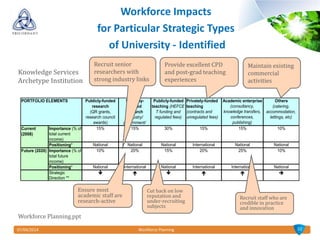
Workforce Impacts
for Particular Strategic Types
of University - Identified
Workforce Planning.ppt
Publicly-funded
research
(QR grants,
research council
awards)
Privately-
funded
research
(industry/
government/
overseas)
Publicly-funded
teaching (HEFCE
T funding and
regulated fees)
Privately-funded
teaching
(contracts and
unregulated fees)
Academic enterprise
(consultancy,
knowledge transfers,
conferences,
publishing)
Others
(catering,
accommodation,
lettings, etc)
Importance (% of
total current
income)
15% 15% 30% 15% 15% 10%
Positioning* National National National International National National
Importance (% of
total future
income)
10% 20% 15% 20% 25% 10%
Positioning* National International National International International National
Strategic
Direction **
   
Future (2020)
 
Current
(2008)
PORTFOLIO ELEMENTS
Ensure most
academic staff are
research-active
Recruit senior
researchers with
strong industry links
Cut back on low
reputation and
under-recruiting
subjects
Provide excellent CPD
and post-grad teaching
experiences
Recruit staff who are
credible in practice
and innovation
Knowledge Services
Archetype Institution
Maintain existing
commercial
activities
07/04/2014 Workforce Planning
1. Do the three timescales and foci of workforce
planning make sense?
2. Are the six stages of workforce strategy development
both helpful and logical?
3. How do case studies help demonstrate and show our
understanding of workforce planning?
4. What is missing from our workforce planning offer?
(e.g. WP decision support / analysis tool)
11
Questions for you

Pp slide set 13 workforce planning

  • 1.
    07/04/2014 Workforce Planning1 Workforce Planning
  • 2.
    07/04/2014 Workforce Planning Tricordantuses the Tricord™ organisational model to reflect the importance of aligning the organisation’s core purpose (identity) to: 2 Planning the workforce requires alignment across organisational identity, strategy, systems and culture Strategy Systems Culture Concept Vision Strategy Goals Objectives Values Spirit Energy Culture Teamwork Language Motivation Ethos Evaluation Processes Systems Governance Infrastructure Projects People Structure Skills Measurement Reward Foundation Reason Core Purpose Ethic Uniqueness History Brand Leadership Identity • Strategy – including the workforce implications and underpinning values • Systems – covering the operational processes and required skills and roles to deliver them • Culture – the ways in which people will need to work together and be measured
  • 3.
    07/04/2014 Workforce Planning TricordantView of Workforce Planning Resource Management High utilisation of staff - Resource allocation systems - Flexible resource management - Performance management Talent Management Internal pipeline of capable staff - Succession Planning - Career Frameworks - Leadership Development Workforce Planning Sourcing of workforce for the long term - Workforce Strategy and Plans - Strategic capability frameworks - Workforce modelling Focus Type of Support Short Term Medium Term Long Term Time Scale 1 year 3 year
  • 4.
    07/04/2014 Workforce Planning Workforcestrategy development moves through six stages: 4 Tricordant Approach - Workforce Planning WorkforceStrategyDevelopment Supply vs. Demand Modelling Workforce Strategy Development
  • 5.
    07/04/2014 Workforce Planning5 Workforce Models vary by Time & Data Type Text Qualitative Short Term Long Term Research-led Teaching Strategy 0% 10% 20% 30% 40% PUBLIC RESEARCH PRIVATE RESEARCH PUBLIC TEACHING PRIVATE TEACHING ACADEMIC ENTERPRISE OTHER SERVICES Research Intensive Strategy 0% 5% 10% 15% 20% 25% PUBLIC RESEARCH PRIVATE RESEARCH PUBLIC TEACHING PRIVATE TEACHING ACADEMIC ENTERPRISE OTHER SERVICES Research Intensive Research Led Teaching Professional Formation Strategy 0% 10% 20% 30% 40% 50% PUBLIC RESEARCH PRIVATE RESEARCH PUBLIC TEACHING PRIVATE TEACHING ACADEMIC ENTERPRISE OTHER SERVICES Professional Formation Knowledge Services Strategy 0% 5% 10% 15% 20% 25% 30% PUBLIC RESEARCH PRIVATE RESEARCH PUBLIC TEACHING PRIVATE TEACHING ACADEMIC ENTERPRISE OTHER SERVICES Knowledge Services Specialist / Niche Discipline based and internationally recognised research with research income making up 40%-50% of income Discipline based teaching underpinned by strong research capabilities, with teaching making up 60%+ of income Strategy based on translation of research knowledge into business / social application. Supplemented by other income. Focus on needs of employers and individual’s professional careers through CPD & lifelong learning (75%+ teaching) Typically small institutions focussed on particular areas of practice e.g. creative arts, agriculture. No archetypal profile. English Universities - Workforce Plan for all Staff (300,000+ staff) ASSURANCE 8% INSTALL 5% PROJ ENG 20% SIGNAL DESIGN 15%SYSTEMS APPS ENG 7% SYSTEMS ENG 35% TEST 5% RESEARCH 5% ASSURANCE 4% INSTALL 17% PROJ ENG 10% SIGNAL DESIGN 42% SYSTEMS APPS ENG 9% SYSTEMS ENG 6% TEST 12% Future Mainline now Mass Transit now Legacy Potential mix of the future ASSURANCE 8% INSTALL 5% PROJ ENG 18% SIGNAL DESIGN 28% SYSTEMS APPS ENG 3% SYSTEMS ENG 32% TEST 6% Work dominated by: Key roles: Bespoke legacy systems Signalling Designer Systems Applications Engineers Building commodity solutions Signalling Designer Systems Applications Engs. Product Development Bespoke complex control systems Integrator Project Engineering Systems Engineering Disruptive technology solutions Integrator Researcher Systems Engineering Engineering Firm - Strategic Workforce Plan and Assessment Design / Project Engineering Actuals vs Ideal Integrator 0 1 2 3 4 Product Knowledge Systems Knowledge Industry Knowledge Customer Focus*** Effective Communication*** Engineering Safety Safety-Quality-Environment Installation Management Installation Delivery Component Testing System Testing Requirements Analysis & System Specification Schema Design Systems Thinking Problem Option Analysis Subcontract Management Decision Making Engineering Process People Management*** Planning*** Monitoring & Change Control*** Risk Management*** Commercial Awareness*** Sense Making Innovation / Creativity Calculated Risk Taking Direction Setting Act with Integrity Display Adaptability Demonstrate Interest in Others Exhibit self-awareness and develop oneself Drive for Results Integrator Ideal Profile Senior Project Eng Manager Systems Engineering Manager Design Performance Manager Government Dept – Succession Planning and Talent Pools Quantitative Current Successors Talent Pool = Strong desire for career progression in next 12 months (indicated by number in brackets) = Don’t have strong desire for career progression in next 12 months Government Dept – Analysis of Policy Professional Requirements
  • 6.
    07/04/2014 Workforce Planning Thefunding body wanted a 10-15 year high level workforce plan for both academic and support staff across the English higher education system. 6 English Universities Long Term Workforce Plan
  • 7.
    07/04/2014 Workforce Planning7 Future HE Workforce Framework: Supply & Demand Implications of Trends StructuresManagement PeopleJobs The imperatives for mobility, flexibility and personalisation of employment terms Impacts of trends in the supply of the future workforce The importance of effective and strategic leadership of workforce development in HEIs The changed nature of work and careers in HE and the skills required SUPPLYDEMAND
  • 8.
    07/04/2014 Workforce Planning8 Stages in supply & demand analysis Factors driving change in HE (e.g. level of public funding) Demand for teaching, research, enterprise and other activity Nos, types and mix of HEIs (based on strategic responses) Future HE Workforce Demand JOBS: required capacity, mix of skills (academic / prof. services), patterns of employment MANAGEMENT requirement Current HE Workforce Supply (PEOPLE) Structural options for workforce change (STRUCTURE factors e.g. flexibility of career routes) Future HE Workforce Supply DEMAND SUPPLY Known trends in HE workforce (PEOPLE trends - ageing, feminisation, war for talent)
  • 9.
    07/04/2014 Workforce Planning9 Identification of Strategic Types of Universities & their Workforce Needs Research-led Teaching Strategy 0% 10% 20% 30% 40% PUBLIC RESEARCH PRIVATE RESEARCH PUBLIC TEACHING PRIVATE TEACHING ACADEMIC ENTERPRISE OTHER SERVICES Research Intensive Strategy 0% 5% 10% 15% 20% 25% PUBLIC RESEARCH PRIVATE RESEARCH PUBLIC TEACHING PRIVATE TEACHING ACADEMIC ENTERPRISE OTHER SERVICES Professional Formation Strategy 0% 10% 20% 30% 40% 50% PUBLIC RESEARCH PRIVATE RESEARCH PUBLIC TEACHING PRIVATE TEACHING ACADEMIC ENTERPRISE OTHER SERVICES Professional Formation Knowledge Services Strategy 0% 5% 10% 15% 20% 25% 30% PUBLIC RESEARCH PRIVATE RESEARCH PUBLIC TEACHING PRIVATE TEACHING ACADEMIC ENTERPRISE OTHER SERVICES Knowledge Services Specialist / Niche Discipline based and internationally recognised research with research income making up 40%- 50% of income Discipline based teaching underpinned by strong research capabilities, with teaching making up 60%+ of income Strategy based on translation of research knowledge into business / social application. Supplemented by other income. Focus on needs of employers and individual’s professional careers through CPD & lifelong learning (75%+ teaching) Typically small institutions focussed on particular areas of practice e.g. creative arts, agriculture. No archetypal profile. Research Intensive Research Led Teaching
  • 10.
    07/04/2014 Workforce Planning10 Workforce Impacts for Particular Strategic Types of University - Identified Workforce Planning.ppt Publicly-funded research (QR grants, research council awards) Privately- funded research (industry/ government/ overseas) Publicly-funded teaching (HEFCE T funding and regulated fees) Privately-funded teaching (contracts and unregulated fees) Academic enterprise (consultancy, knowledge transfers, conferences, publishing) Others (catering, accommodation, lettings, etc) Importance (% of total current income) 15% 15% 30% 15% 15% 10% Positioning* National National National International National National Importance (% of total future income) 10% 20% 15% 20% 25% 10% Positioning* National International National International International National Strategic Direction **     Future (2020)   Current (2008) PORTFOLIO ELEMENTS Ensure most academic staff are research-active Recruit senior researchers with strong industry links Cut back on low reputation and under-recruiting subjects Provide excellent CPD and post-grad teaching experiences Recruit staff who are credible in practice and innovation Knowledge Services Archetype Institution Maintain existing commercial activities
  • 11.
    07/04/2014 Workforce Planning 1.Do the three timescales and foci of workforce planning make sense? 2. Are the six stages of workforce strategy development both helpful and logical? 3. How do case studies help demonstrate and show our understanding of workforce planning? 4. What is missing from our workforce planning offer? (e.g. WP decision support / analysis tool) 11 Questions for you