SHARE your experiences and LEARN from others
Peter Totterdill
ALCHEMY
Workplace Innovation
and The Fifth Element
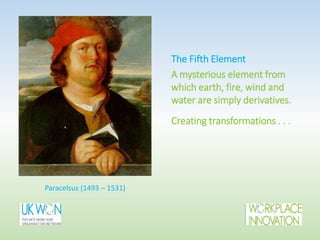
Paracelsus (1493 – 1531)
The Fifth Element
A mysterious element from
which earth, fire, wind and
water are simply derivatives.
Creating transformations . . .
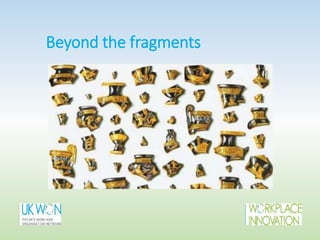
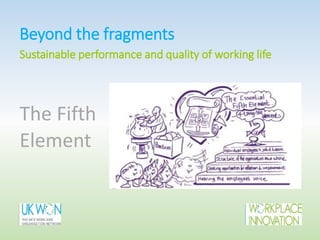
Beyond the fragments
The Fifth
Element
Beyond the fragments
Sustainable performance and quality of working life
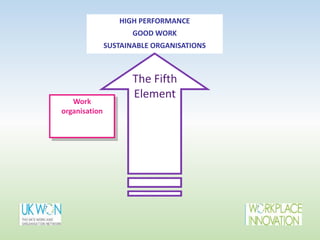
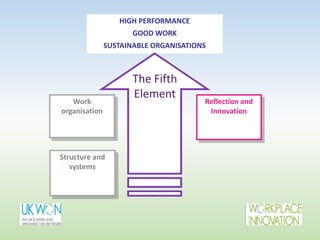
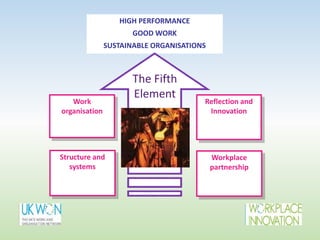
HIGH PERFORMANCE
GOOD WORK
SUSTAINABLE ORGANISATIONS
Work
organisation
The Fifth
Element
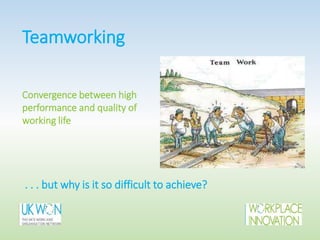
Convergence between high
performance and quality of
working life
. . . but why is it so difficult to achieve?
Teamworking
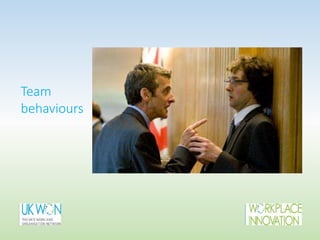
Team
behaviours
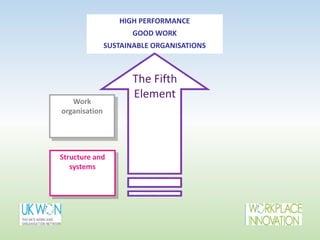
HIGH PERFORMANCE
GOOD WORK
SUSTAINABLE ORGANISATIONS
Work
organisation
Structure and
systems
The Fifth
Element
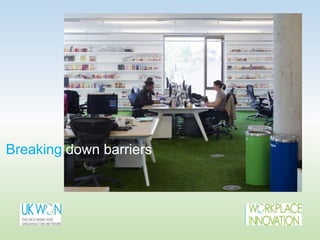
Breaking down barriers
HIGH PERFORMANCE
GOOD WORK
SUSTAINABLE ORGANISATIONS
Work
organisation
Structure and
systems
Reflection and
Innovation
The Fifth
Element
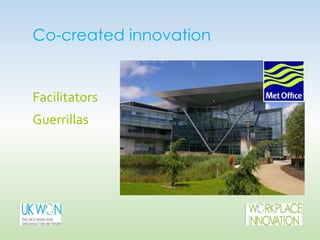
Co-created innovation
Facilitators
Guerrillas
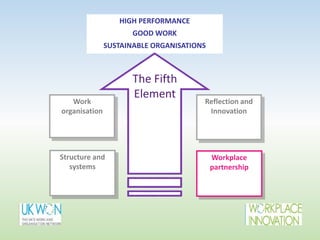
HIGH PERFORMANCE
GOOD WORK
SUSTAINABLE ORGANISATIONS
Work
organisation
Structure and
systems
Workplace
partnership
Reflection and
Innovation
The Fifth
Element
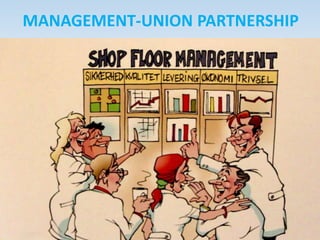
MANAGEMENT-UNION PARTNERSHIP
LEADERSHIP
Quick Guide to Leadership Theory
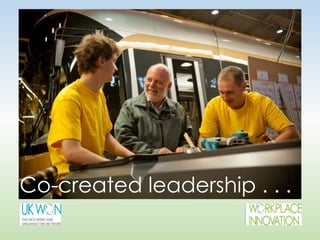
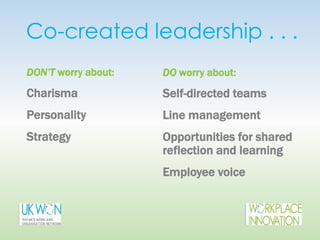
Co-created leadership . . .
DON’T worry about:
Charisma
Personality
Strategy
DO worry about:
Self-directed teams
Line management
Opportunities for shared
reflection and learning
Employee voice
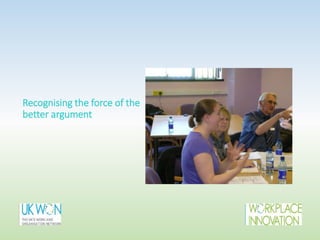
Recognising the force of the
better argument
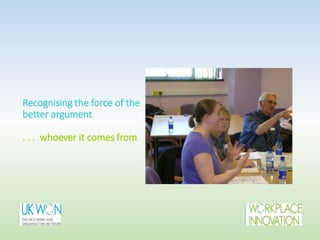
Recognising the force of the
better argument
. . . whoever it comes from
HIGH PERFORMANCE
GOOD WORK
SUSTAINABLE ORGANISATIONS
Work
organisation
Structure and
systems
Workplace
partnership
Reflection and
Innovation
The Fifth
Element
HIGH PERFORMANCE
GOOD WORK
SUSTAINABLE ORGANISATIONS
Work
organisation
Structure and
systems
Workplace
partnership
Reflection and
Innovation
The Fifth
Element
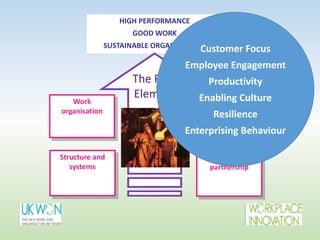
Customer Focus
Employee Engagement
Productivity
Enabling Culture
Resilience
Enterprising Behaviour
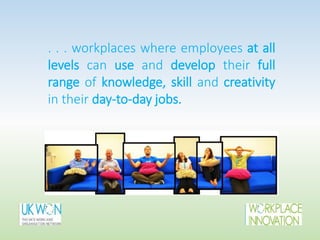
. . . workplaces where employees at all
levels can use and develop their full
range of knowledge, skill and creativity
in their day-to-day jobs.
So how can
EUWIN
promote
workplace
innovation?
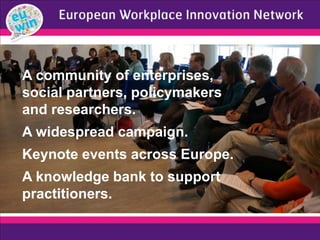
A community of enterprises,
social partners, policymakers
and researchers.
A widespread campaign.
Keynote events across Europe.
A knowledge bank to support
practitioners.
. . . and become a EUWIN Ambassador!
Join euwin at http://tiny.cc/rh6juw
peter.totterdill@ukwon.net
www.goodworkplaces.net
33
Workplace Innovation
for
quality jobs
and
organisational performance
Frank Pot
“Gipuzkoa Workplace Innovation”, San Sebastian, 7 May 2015
Concept workplace innovation used by
• Eurofound, Dublin (2005 – recent EWCS, ECS, cases)
• European Economic and Social Committee (opinion 2011)
• European Commission (since 10 October 2012)
• EU OSHA, Bilbao (since 2012)
• European Parliament (18 December 2013)
• IndustriAll ( Manifesto 2 April 2014)
• English translation of Finnish, Flemish, Dutch and Basque
programmes
• National tripartite initiatives in UK and Ireland
• OECD (also ‘innovative workplaces’)
• Number of institutes in USA
34
35
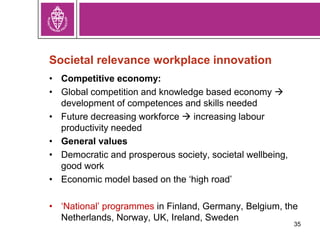
Societal relevance workplace innovation
• Competitive economy:
• Global competition and knowledge based economy 
development of competences and skills needed
• Future decreasing workforce  increasing labour
productivity needed
• General values
• Democratic and prosperous society, societal wellbeing,
good work
• Economic model based on the ‘high road’
• ‘National’ programmes in Finland, Germany, Belgium, the
Netherlands, Norway, UK, Ireland, Sweden
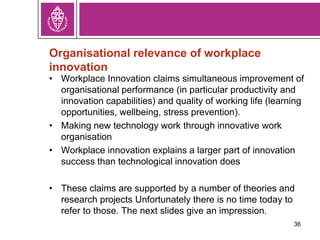
Organisational relevance of workplace
innovation
• Workplace Innovation claims simultaneous improvement of
organisational performance (in particular productivity and
innovation capabilities) and quality of working life (learning
opportunities, wellbeing, stress prevention).
• Making new technology work through innovative work
organisation
• Workplace innovation explains a larger part of innovation
success than technological innovation does
• These claims are supported by a number of theories and
research projects Unfortunately there is no time today to
refer to those. The next slides give an impression.
36
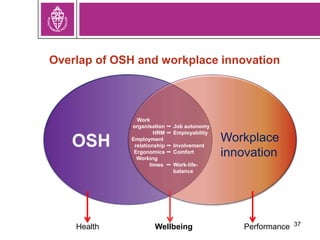
37
Overlap of OSH and workplace innovation
Workplace
innovation
Health Wellbeing Performance
Work
organisation 
HRM 
Employment
relationship 
Ergonomics 
Working
times 
Job autonomy
Employability
Involvement
Comfort
Work-life-
balance
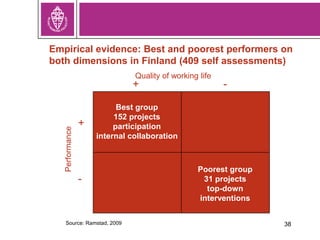
38
Empirical evidence: Best and poorest performers on
both dimensions in Finland (409 self assessments)
Poorest group
31 projects
top-down
interventions
Best group
152 projects
participation
internal collaboration
Performance
+
-
Source: Ramstad, 2009
Quality of working life
+ -
39
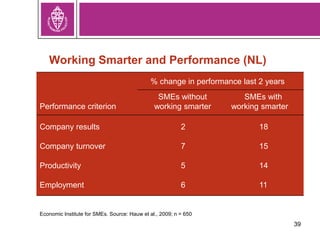
Working Smarter and Performance (NL)
Performance criterion
SMEs without
working smarter
SMEs with
working smarter
Company results 2 18
Company turnover 7 15
Productivity 5 14
Employment 6 11
Economic Institute for SMEs. Source: Hauw et al., 2009; n = 650
% change in performance last 2 years
40
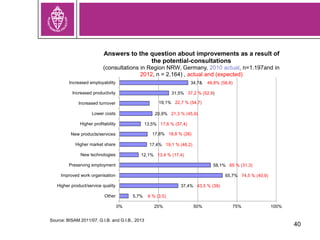
Source: BISAM 2011/07, G.I.B. and G.I.B., 2013
5,7% 6 % (3,5)
37,4% 43,5 % (39)
65,7% 74,5 % (40,9)
58,1% 65 % (31,3)
12,1% 13,4 % (17,4)
17,4% 19,1 % (46,2)
17,8% 18,8 % (26)
13,5% 17,6 % (57,4)
20,9% 21,3 % (45,9)
19,1% 22,7 % (54,7)
31,5% 37,2 % (52,9)
34,7& 48,8% (56,8)
0% 25% 50% 75% 100%
Other
Higher product/service quality
Improved work organisation
Preserving employment
New technologies
Higher market share
New products/services
Higher profitability
Lower costs
Increased turnover
Increased productivity
Increased employability
Answers to the question about improvements as a result of
the potential-consultations
(consultations in Region NRW, Germany, 2010 actual, n=1.197and in
2012, n = 2.164) , actual and (expected)
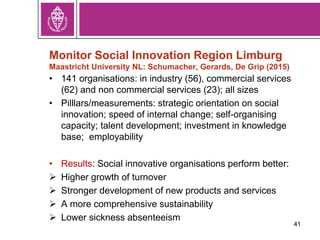
Monitor Social Innovation Region Limburg
Maastricht University NL: Schumacher, Gerards, De Grip (2015)
• 141 organisations: in industry (56), commercial services
(62) and non commercial services (23); all sizes
• Pilllars/measurements: strategic orientation on social
innovation; speed of internal change; self-organising
capacity; talent development; investment in knowledge
base; employability
• Results: Social innovative organisations perform better:
 Higher growth of turnover
 Stronger development of new products and services
 A more comprehensive sustainability
 Lower sickness absenteeism
41
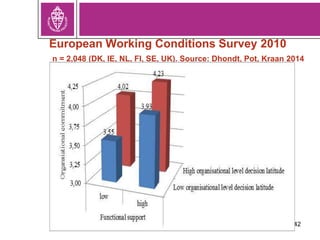
European Working Conditions Survey 2010
n = 2,048 (DK, IE, NL, FI, SE, UK). Source: Dhondt, Pot, Kraan 2014
42
43
Case Bronkhorst
Bronkhorst HIGH-TECH
in Ruurlo, the Netherlands
• Develops and produces thermal mass flow meters and
controllers (about 275 employees)
• Clients all over the world; surface treatment, process
industry, life sciences, automotive, bio-technology, etc.
• Continuous innovation of product technology and
manufacturing process
http://www.bronkhorst.com
44
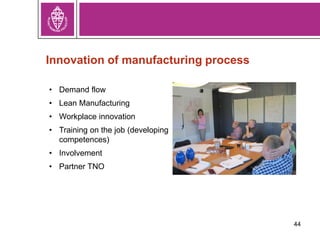
Innovation of manufacturing process
• Demand flow
• Lean Manufacturing
• Workplace innovation
• Training on the job (developing
competences)
• Involvement
• Partner TNO
45
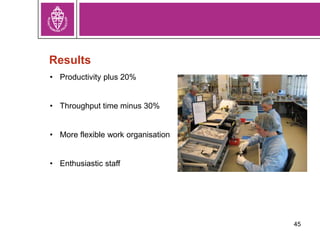
Results
• Productivity plus 20%
• Throughput time minus 30%
• More flexible work organisation
• Enthusiastic staff
Tourism SME’s in Catalonia
• Co-innovation results into increasing income and optimising
resources (n = 500).
• Co-innovative factors being:
 Internet use (input endowment and operational and
marketing activities
 Radically innovative products and services
 Work organisation factors (worker autonomy with regard to
proposing objectives and with regard to organising tasks,
teamwork and multi-role work practices
Source: Torrent, Ficapal-Cusi et al., 2015
46
Discussion
• Concept ‘workplace innovation’ has gained policy profile.
• Core characteristic: direct employee participation reflecting
combined interventions in work organisation, HRM, work
relations and supportive technologies
• All research shows wide variety of better performance
• Quality jobs contribute to competitiveness through higher
productivity and innovation capability. Win-win outcomes as
a creative convergence rather than a trade-off
• Research on organisational level focusses more on
performance than on QWL, which is mostly investigated on
individual level
• National or regional programmes can be supportive; social
partners should be leading, governments and research
institutes supporting
47
Next slides only if there is more time
48
49
Examples companies
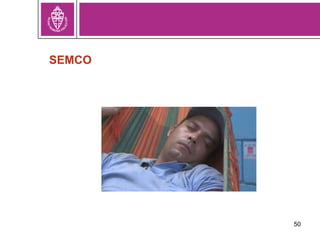
SEMCO
50
SEMCO principles and values
• 6 Encourage creativity, giving support to the bold;
• 7 Encourage everyone's participation and question
decisions that are imposed from the top down;
• 8 Maintain an informal and pleasant environment, with a
professional attitude and free of preconceptions;
• 9 Maintain safe working conditions and control industrial
processes to protect our personnel and the environment;
• 10 Have the humility to recognize our errors and
understanding that we can always improve.
51
SEMCO survival manual
• Only people who respect their followers can be leaders
• It makes no difference whether someone has a high ranking
or a humble position. Philosophy is based on active
involvement, participation and trust.
• Whenever possible we rotate people: Some people change
area and other people change business unit. This is another
development opportunity
• The Semco Group believes that constant relationships with
unions are healthy for the company and the employees
• Flexible working hours where possible. Each person
controls their own working hours
• Occupational Safety is not only a company responsibility.
Keep your eyes open 52
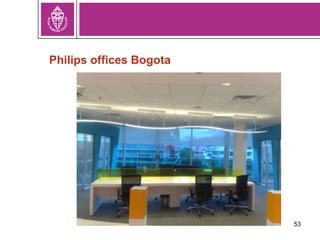
Philips offices Bogota
53
From traditional to new work styles at Philips
• Slow, cumbersome
dissemination of knowledge.
• Complex, systematic,
orthodox and rigid work
structure
• Barriers separating units
and departments, even in
the same building.
• Communication forms: mail,
telephone, fax and e-mail.
•
• Face-to-face collaboration
• Instantaneous, multi access
knowledge sharing.
• Simple, flexible, mobile, fast
and unconventional work
structures
• Cross functional
collaboration and open
transparent spaces.
• Chat, group instant
messaging, video
conferencing and VoIP.
• Virtual teaming
54
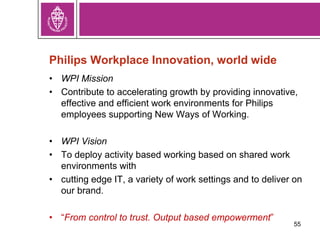
Philips Workplace Innovation, world wide
• WPI Mission
• Contribute to accelerating growth by providing innovative,
effective and efficient work environments for Philips
employees supporting New Ways of Working.
• WPI Vision
• To deploy activity based working based on shared work
environments with
• cutting edge IT, a variety of work settings and to deliver on
our brand.
• “From control to trust. Output based empowerment”
55
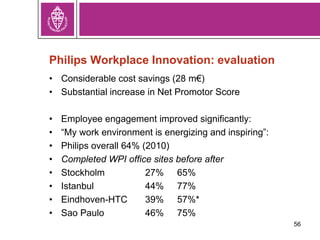
Philips Workplace Innovation: evaluation
• Considerable cost savings (28 m€)
• Substantial increase in Net Promotor Score
• Employee engagement improved significantly:
• “My work environment is energizing and inspiring”:
• Philips overall 64% (2010)
• Completed WPI office sites before after
• Stockholm 27% 65%
• Istanbul 44% 77%
• Eindhoven-HTC 39% 57%*
• Sao Paulo 46% 75%
56
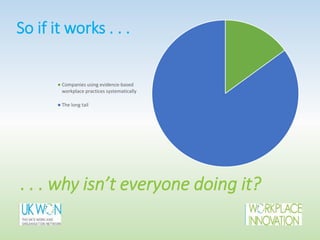
So if it works . . .
. . . why isn’t everyone doing it?
Companies using evidence-based
workplace practices systematically
The long tail
SHARE your experiences and LEARN from others
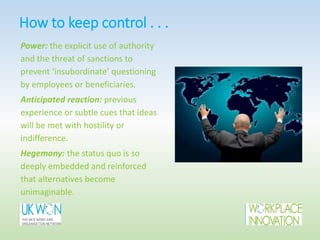
How to keep control . . .
Power: the explicit use of authority
and the threat of sanctions to
prevent ‘insubordinate’ questioning
by employees or beneficiaries.
Anticipated reaction: previous
experience or subtle cues that ideas
will be met with hostility or
indifference.
Hegemony: the status quo is so
deeply embedded and reinforced
that alternatives become
unimaginable.
The Fifth Element Quick Quiz
In my organisation . . .
1. We have regular team meetings around
current and planned work in which
everybody gets to have their say.
Strongly Disagree 1 2 3 4 Strongly Agree
The Fifth Element Quick Quiz
In my organisation . . .
2. Line managers are good at providing
constructive feedback and helping
everyone to realise their full potential.
Strongly Disagree 1 2 3 4 Strongly Agree
The Fifth Element Quick Quiz
In my organisation . . .
3. Employees at every level take part in
regular opportunities to reflect on what
has gone well and what can be improved.
Strongly Disagree 1 2 3 4 Strongly Agree
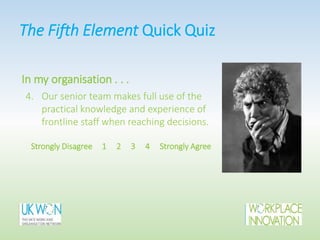
The Fifth Element Quick Quiz
In my organisation . . .
4. Our senior team makes full use of the
practical knowledge and experience of
frontline staff when reaching decisions.
Strongly Disagree 1 2 3 4 Strongly Agree
The Fifth Element Quick Quiz
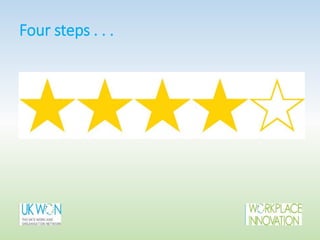
Four steps . . .
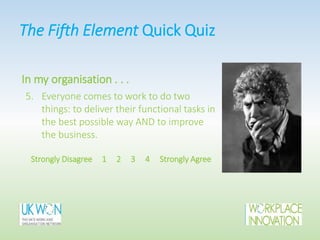
In my organisation . . .
5. Everyone comes to work to do two
things: to deliver their functional tasks in
the best possible way AND to improve
the business.
Strongly Disagree 1 2 3 4 Strongly Agree
The Fifth Element Quick Quiz
Ulma Embedded Solutions S. Coop
EderfillBecker S. Coop
Lortek S. Coop
Datik
The Fifth Element in Practice

Peter Totterdill_EUWIN

  • 1.
    SHARE your experiencesand LEARN from others
  • 2.
  • 3.
    Paracelsus (1493 –1531) The Fifth Element A mysterious element from which earth, fire, wind and water are simply derivatives. Creating transformations . . .
  • 4.
  • 5.
    The Fifth Element Beyond thefragments Sustainable performance and quality of working life
  • 6.
    HIGH PERFORMANCE GOOD WORK SUSTAINABLEORGANISATIONS Work organisation The Fifth Element
  • 8.
    Convergence between high performanceand quality of working life . . . but why is it so difficult to achieve? Teamworking
  • 9.
  • 10.
    HIGH PERFORMANCE GOOD WORK SUSTAINABLEORGANISATIONS Work organisation Structure and systems The Fifth Element
  • 11.
  • 13.
    HIGH PERFORMANCE GOOD WORK SUSTAINABLEORGANISATIONS Work organisation Structure and systems Reflection and Innovation The Fifth Element
  • 16.
  • 17.
    HIGH PERFORMANCE GOOD WORK SUSTAINABLEORGANISATIONS Work organisation Structure and systems Workplace partnership Reflection and Innovation The Fifth Element
  • 18.
  • 19.
  • 20.
  • 21.
    Quick Guide toLeadership Theory
  • 22.
  • 23.
    Co-created leadership .. . DON’T worry about: Charisma Personality Strategy DO worry about: Self-directed teams Line management Opportunities for shared reflection and learning Employee voice
  • 24.
    Recognising the forceof the better argument
  • 25.
    Recognising the forceof the better argument . . . whoever it comes from
  • 26.
    HIGH PERFORMANCE GOOD WORK SUSTAINABLEORGANISATIONS Work organisation Structure and systems Workplace partnership Reflection and Innovation The Fifth Element
  • 27.
    HIGH PERFORMANCE GOOD WORK SUSTAINABLEORGANISATIONS Work organisation Structure and systems Workplace partnership Reflection and Innovation The Fifth Element Customer Focus Employee Engagement Productivity Enabling Culture Resilience Enterprising Behaviour
  • 28.
    . . .workplaces where employees at all levels can use and develop their full range of knowledge, skill and creativity in their day-to-day jobs.
  • 29.
  • 30.
    A community ofenterprises, social partners, policymakers and researchers. A widespread campaign. Keynote events across Europe. A knowledge bank to support practitioners.
  • 31.
    . . .and become a EUWIN Ambassador! Join euwin at http://tiny.cc/rh6juw
  • 32.
  • 33.
    33 Workplace Innovation for quality jobs and organisationalperformance Frank Pot “Gipuzkoa Workplace Innovation”, San Sebastian, 7 May 2015
  • 34.
    Concept workplace innovationused by • Eurofound, Dublin (2005 – recent EWCS, ECS, cases) • European Economic and Social Committee (opinion 2011) • European Commission (since 10 October 2012) • EU OSHA, Bilbao (since 2012) • European Parliament (18 December 2013) • IndustriAll ( Manifesto 2 April 2014) • English translation of Finnish, Flemish, Dutch and Basque programmes • National tripartite initiatives in UK and Ireland • OECD (also ‘innovative workplaces’) • Number of institutes in USA 34
  • 35.
    35 Societal relevance workplaceinnovation • Competitive economy: • Global competition and knowledge based economy  development of competences and skills needed • Future decreasing workforce  increasing labour productivity needed • General values • Democratic and prosperous society, societal wellbeing, good work • Economic model based on the ‘high road’ • ‘National’ programmes in Finland, Germany, Belgium, the Netherlands, Norway, UK, Ireland, Sweden
  • 36.
    Organisational relevance ofworkplace innovation • Workplace Innovation claims simultaneous improvement of organisational performance (in particular productivity and innovation capabilities) and quality of working life (learning opportunities, wellbeing, stress prevention). • Making new technology work through innovative work organisation • Workplace innovation explains a larger part of innovation success than technological innovation does • These claims are supported by a number of theories and research projects Unfortunately there is no time today to refer to those. The next slides give an impression. 36
  • 37.
    37 Overlap of OSHand workplace innovation Workplace innovation Health Wellbeing Performance Work organisation  HRM  Employment relationship  Ergonomics  Working times  Job autonomy Employability Involvement Comfort Work-life- balance
  • 38.
    38 Empirical evidence: Bestand poorest performers on both dimensions in Finland (409 self assessments) Poorest group 31 projects top-down interventions Best group 152 projects participation internal collaboration Performance + - Source: Ramstad, 2009 Quality of working life + -
  • 39.
    39 Working Smarter andPerformance (NL) Performance criterion SMEs without working smarter SMEs with working smarter Company results 2 18 Company turnover 7 15 Productivity 5 14 Employment 6 11 Economic Institute for SMEs. Source: Hauw et al., 2009; n = 650 % change in performance last 2 years
  • 40.
    40 Source: BISAM 2011/07,G.I.B. and G.I.B., 2013 5,7% 6 % (3,5) 37,4% 43,5 % (39) 65,7% 74,5 % (40,9) 58,1% 65 % (31,3) 12,1% 13,4 % (17,4) 17,4% 19,1 % (46,2) 17,8% 18,8 % (26) 13,5% 17,6 % (57,4) 20,9% 21,3 % (45,9) 19,1% 22,7 % (54,7) 31,5% 37,2 % (52,9) 34,7& 48,8% (56,8) 0% 25% 50% 75% 100% Other Higher product/service quality Improved work organisation Preserving employment New technologies Higher market share New products/services Higher profitability Lower costs Increased turnover Increased productivity Increased employability Answers to the question about improvements as a result of the potential-consultations (consultations in Region NRW, Germany, 2010 actual, n=1.197and in 2012, n = 2.164) , actual and (expected)
  • 41.
    Monitor Social InnovationRegion Limburg Maastricht University NL: Schumacher, Gerards, De Grip (2015) • 141 organisations: in industry (56), commercial services (62) and non commercial services (23); all sizes • Pilllars/measurements: strategic orientation on social innovation; speed of internal change; self-organising capacity; talent development; investment in knowledge base; employability • Results: Social innovative organisations perform better:  Higher growth of turnover  Stronger development of new products and services  A more comprehensive sustainability  Lower sickness absenteeism 41
  • 42.
    European Working ConditionsSurvey 2010 n = 2,048 (DK, IE, NL, FI, SE, UK). Source: Dhondt, Pot, Kraan 2014 42
  • 43.
    43 Case Bronkhorst Bronkhorst HIGH-TECH inRuurlo, the Netherlands • Develops and produces thermal mass flow meters and controllers (about 275 employees) • Clients all over the world; surface treatment, process industry, life sciences, automotive, bio-technology, etc. • Continuous innovation of product technology and manufacturing process http://www.bronkhorst.com
  • 44.
    44 Innovation of manufacturingprocess • Demand flow • Lean Manufacturing • Workplace innovation • Training on the job (developing competences) • Involvement • Partner TNO
  • 45.
    45 Results • Productivity plus20% • Throughput time minus 30% • More flexible work organisation • Enthusiastic staff
  • 46.
    Tourism SME’s inCatalonia • Co-innovation results into increasing income and optimising resources (n = 500). • Co-innovative factors being:  Internet use (input endowment and operational and marketing activities  Radically innovative products and services  Work organisation factors (worker autonomy with regard to proposing objectives and with regard to organising tasks, teamwork and multi-role work practices Source: Torrent, Ficapal-Cusi et al., 2015 46
  • 47.
    Discussion • Concept ‘workplaceinnovation’ has gained policy profile. • Core characteristic: direct employee participation reflecting combined interventions in work organisation, HRM, work relations and supportive technologies • All research shows wide variety of better performance • Quality jobs contribute to competitiveness through higher productivity and innovation capability. Win-win outcomes as a creative convergence rather than a trade-off • Research on organisational level focusses more on performance than on QWL, which is mostly investigated on individual level • National or regional programmes can be supportive; social partners should be leading, governments and research institutes supporting 47
  • 48.
    Next slides onlyif there is more time 48
  • 49.
  • 50.
  • 51.
    SEMCO principles andvalues • 6 Encourage creativity, giving support to the bold; • 7 Encourage everyone's participation and question decisions that are imposed from the top down; • 8 Maintain an informal and pleasant environment, with a professional attitude and free of preconceptions; • 9 Maintain safe working conditions and control industrial processes to protect our personnel and the environment; • 10 Have the humility to recognize our errors and understanding that we can always improve. 51
  • 52.
    SEMCO survival manual •Only people who respect their followers can be leaders • It makes no difference whether someone has a high ranking or a humble position. Philosophy is based on active involvement, participation and trust. • Whenever possible we rotate people: Some people change area and other people change business unit. This is another development opportunity • The Semco Group believes that constant relationships with unions are healthy for the company and the employees • Flexible working hours where possible. Each person controls their own working hours • Occupational Safety is not only a company responsibility. Keep your eyes open 52
  • 53.
  • 54.
    From traditional tonew work styles at Philips • Slow, cumbersome dissemination of knowledge. • Complex, systematic, orthodox and rigid work structure • Barriers separating units and departments, even in the same building. • Communication forms: mail, telephone, fax and e-mail. • • Face-to-face collaboration • Instantaneous, multi access knowledge sharing. • Simple, flexible, mobile, fast and unconventional work structures • Cross functional collaboration and open transparent spaces. • Chat, group instant messaging, video conferencing and VoIP. • Virtual teaming 54
  • 55.
    Philips Workplace Innovation,world wide • WPI Mission • Contribute to accelerating growth by providing innovative, effective and efficient work environments for Philips employees supporting New Ways of Working. • WPI Vision • To deploy activity based working based on shared work environments with • cutting edge IT, a variety of work settings and to deliver on our brand. • “From control to trust. Output based empowerment” 55
  • 56.
    Philips Workplace Innovation:evaluation • Considerable cost savings (28 m€) • Substantial increase in Net Promotor Score • Employee engagement improved significantly: • “My work environment is energizing and inspiring”: • Philips overall 64% (2010) • Completed WPI office sites before after • Stockholm 27% 65% • Istanbul 44% 77% • Eindhoven-HTC 39% 57%* • Sao Paulo 46% 75% 56
  • 57.
    So if itworks . . . . . . why isn’t everyone doing it? Companies using evidence-based workplace practices systematically The long tail
  • 58.
    SHARE your experiencesand LEARN from others
  • 59.
    How to keepcontrol . . . Power: the explicit use of authority and the threat of sanctions to prevent ‘insubordinate’ questioning by employees or beneficiaries. Anticipated reaction: previous experience or subtle cues that ideas will be met with hostility or indifference. Hegemony: the status quo is so deeply embedded and reinforced that alternatives become unimaginable.
  • 60.
  • 61.
    In my organisation. . . 1. We have regular team meetings around current and planned work in which everybody gets to have their say. Strongly Disagree 1 2 3 4 Strongly Agree The Fifth Element Quick Quiz
  • 62.
    In my organisation. . . 2. Line managers are good at providing constructive feedback and helping everyone to realise their full potential. Strongly Disagree 1 2 3 4 Strongly Agree The Fifth Element Quick Quiz
  • 63.
    In my organisation. . . 3. Employees at every level take part in regular opportunities to reflect on what has gone well and what can be improved. Strongly Disagree 1 2 3 4 Strongly Agree The Fifth Element Quick Quiz
  • 64.
    In my organisation. . . 4. Our senior team makes full use of the practical knowledge and experience of frontline staff when reaching decisions. Strongly Disagree 1 2 3 4 Strongly Agree The Fifth Element Quick Quiz
  • 65.
  • 66.
    In my organisation. . . 5. Everyone comes to work to do two things: to deliver their functional tasks in the best possible way AND to improve the business. Strongly Disagree 1 2 3 4 Strongly Agree The Fifth Element Quick Quiz
  • 67.
    Ulma Embedded SolutionsS. Coop EderfillBecker S. Coop Lortek S. Coop Datik The Fifth Element in Practice