Business Communication
Sneha
In this Module…
•Basics of Communication
•Verbal / Non Verbal Communication
•Communications Planning
•Modes of Communication:
 Writing Emails & Letters
 In Person, Presentations & Meetings
In this Module…
•Difficult & Conflict Communications
•Giving & Getting a Feedback
Basics of Communication
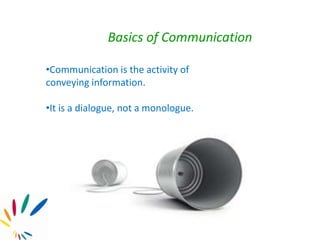
•Communication is the activity of
conveying information.
•It is a dialogue, not a monologue.
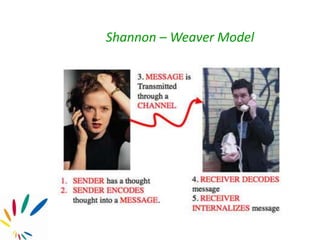
Shannon – Weaver Model
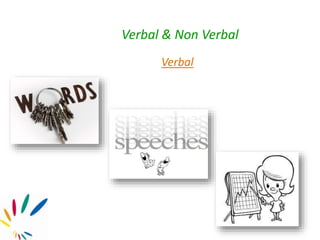
Verbal & Non Verbal
Verbal
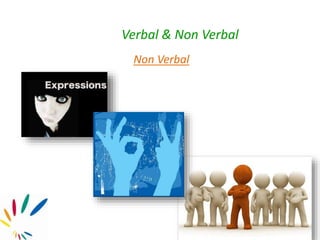
Verbal & Non Verbal
Non Verbal
Verbal & Non Verbal
Communications Planning
• Understand your Objectives
• Understand your Audiences
• Plan Communications Messages & Channels
• Market your Message!
Keep it Simple…Less is More
Be:
Clear
Concise
Concrete
Correct
Coherent
Complete
Courteous
Communicating in Person,
Presentations & Meetings
 Making a Great First Impression
 Body Language / Understanding Non-Verbal
Communication
 Active Listening
 Prepare a Checklist
Communicating in Person,
Presentations & Meetings
 Ensure Your Words Are Always Understood
 At meetings, establish an Objective and
Stick to It
 Use Time Wisely
Making a Great First
Impression…
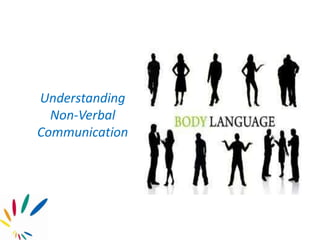
Understanding
Non-Verbal
Communication
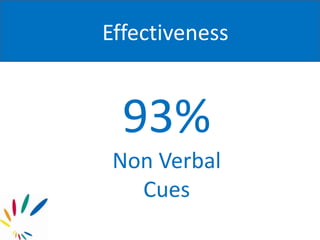
Effectiveness
93%
Non Verbal
Cues
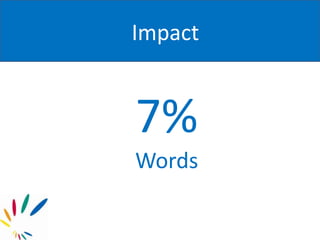
Impact
7%
Words
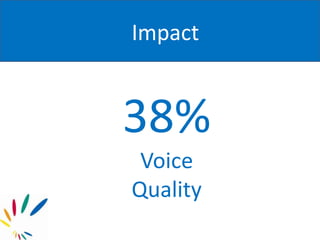
Impact
38%
Voice
Quality
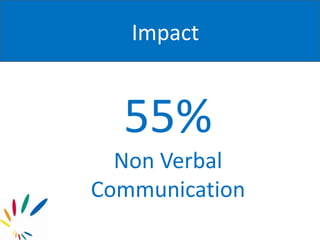
Impact
55%
Non Verbal
Communication
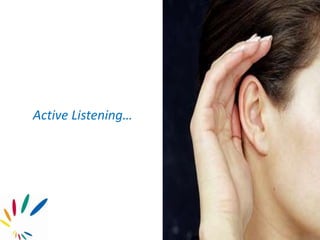
Active Listening…
Active Listening involves…
•Pay Attention
•Show that you are listening
•Provide Feedback
•Defer Judgment
•Respond Appropriately
Communicating in Writing
Etiquettes
A Company needs to set etiquette rules for 3
reasons:
1. Professionalism
2. Efficiency
3. Protection
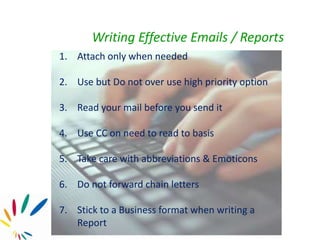
Writing Effective Emails / Reports
1. Do not write in CAPITALS
2. Use a meaningful Subject
3. Be concise & to the point
4. Use proper spelling, grammar & punctuation
5. Answer Swiftly
6. Use active instead of passive
1. Attach only when needed
2. Use but Do not over use high priority option
3. Read your mail before you send it
4. Use CC on need to read to basis
5. Take care with abbreviations & Emoticons
6. Do not forward chain letters
7. Stick to a Business format when writing a
Report
Writing Effective Emails / Reports
Etiquettes
•Telephone courtesy enhances customer service
•Speak clearly
•Use positive words and phrases
•Cultivate a pleasant voice
•Enquire whether it is an appropriate time to call
Communications at Presentations &
Meetings…
For effective Presentations &
Meetings…
• Good eye contact is important for effective
presentations.
• Know your audience.
• Productive Meetings require good listening &
respect for new ideas.
• They take up a minimum amount of time.
• They leave participants feeling that a sensible
process has been followed.
Difficult & Conflict Conversations
• Conflicts can erupt when opinions are not
communicated with sensitivity
• Diffusing a conflict requires a calm approach
• Differing priorities can lead to conflicts
• Confronting a conflict is necessary to resolve it
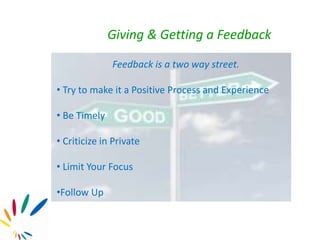
Giving & Getting a Feedback
Feedback is a two way street.
• Try to make it a Positive Process and Experience
• Be Timely
• Criticize in Private
• Limit Your Focus
•Follow Up
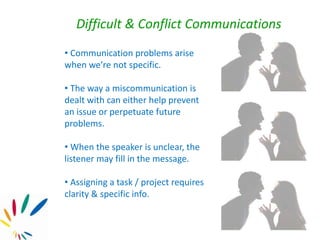
• Communication problems arise
when we’re not specific.
• The way a miscommunication is
dealt with can either help prevent
an issue or perpetuate future
problems.
• When the speaker is unclear, the
listener may fill in the message.
• Assigning a task / project requires
clarity & specific info.
Difficult & Conflict Communications
•Writes well
•Listens for words & feelings
•Speaks well
•Shows concern for others
•Encourages feedback
•Asks open ended questions
•Has a positive attitude
A Good Communicator…
“To effectively communicate, we must realize that
we are all different in the way we perceive the
world and use this understanding as a guide to
our communication with others.”
- Anthony Robbins
(American advisor to leaders)

Business communication

Editor's Notes

  • #10 Planning / Structuring your Communications… Whether you need to communicate general day-to-day information or "big news" about major changes in your organization, the best communications start with some good planning. The first step is to put yourself in the shoes of your audience. What do they need to know, and want to hear? What's their preferred way of receiving information? What will stop them listening to what you have to say? And how will you know that they have got the message? Understand Your Objectives Be clear about your overall communication objectives. What do you want to achieve, when and why? Record your overall objectives in your plan. Understand Your Audiences Now identify and list your different audiences. This can initially seem quite difficult. But it helps you identify who to communicate with and why. Drill down into your communication objectives and clarify specific objectives for each audience. A good way to do this is to think about the audience's needs – what do they need and want to know from you? List all the objectives (there may be several) for each audience in your plan. Plan Communications Messages and Channels Before starting on the detail of your plan, first jot down all the possible communications channels you could use. Think broadly and creatively! You probably already use lots of great ways to communicate in your company, and some new ones may help get your message across. Here is a list to get you started: Email Newsletter Teleconference Notice boards Posters Lunchtime meeting Launch event Team meeting Using existing channels with the right message at the right time is an effective and familiar way to reach your audience. Try to plan your communications so that individuals receive the right information and are not confused by the different messages they receive. Getting the right messages across in the right way Market Your Message! Good corporate communications is very much like good marketing. You have a message (product) that you need to ‘sell’ to your audience (customers). If they are going to ‘buy it’, you must package the message so that they can understand it and pay attention to it. You must make sure the value and benefit outweigh any downsides (the ‘price’ you are asking them to pay). And you must reach the audience through the right communication channels. Then, following the communications (promotion), you must be able to measure the effectiveness and how well the message is ‘bought’.
  • #11 BE: Clear When writing or speaking to someone, be clear about your goal or message. What is your purpose in communicating with this person? If you're not sure, then your audience won't be sure either. Concise When you're concise in your communication, you stick to the point and keep it brief. Your audience doesn't want to read six sentences when you could communicate your message in three. Concrete When your message is concrete, then your audience has a clear picture of what you're telling them. There are details (but not too many!) and vivid facts, and there's laser like focus. Your message is solid. Correct When your communication is correct, it fits your audience. And correct communication is also error-free communication. Coherent When your communication is coherent, it's logical. All points are connected and relevant to the main topic, and the tone and flow of the text is consistent. Complete In a complete message, the audience has everything they need to be informed and, if applicable, take action. It should have relevant info. Courteous Courteous communication is friendly, open, and honest. There are no hidden insults or passive-aggressive tones. You keep your reader's viewpoint in mind, and you're empathetic to their needs.
  • #12 Communicating in Person… Making a Great First Impression Body Language / Understanding Non-Verbal Communication
  • #13 Communicating in Person… Making a Great First Impression Body Language / Understanding Non-Verbal Communication
  • #14 Communicating in Person… Making a Great First Impression You have just a few seconds to make a good first impression and it's almost impossible ever to change it. So it's worth giving each new encounter your best shot. Much of what you need to do to make a good impression is common sense. But with a little extra thought and preparation, you can hone your intuitive style and make every first impression not just good but great.
  • #15 Communicating in Person… Body Language / Understanding Non-Verbal Communication Body language impacts a great deal of how we communicate, and can reflect quite accurately what's going on inside us. Body language includes body movements and gestures (legs, arms, hands, head and torso), posture, muscle tension, eye contact, skin coloring (flushed red), even people's breathing rate and perspiration. Additionally, the tone of voice, the rate of speech and the pitch of the voice all add to the words that are being used. It is important to recognize that body language may vary between individuals, and between different cultures and nationalities. It is therefore essential to verify and confirm the signals that you are reading, by questioning the individual and getting to know the person. Typical things to look for in confident people include: Posture – standing tall with shoulders back Eye contact – solid with a "smiling" face Gestures with hands and arms – purposeful and deliberate Speech – slow and clear Tone of voice – moderate to low