Volume 8   •   Issue 4   •   2010

The journal for technology product management and marketing professionals
                                                                                              ®


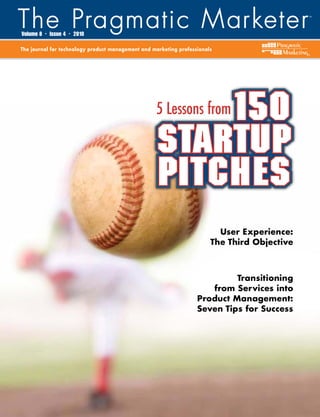
                                                        150
                                                   5 Lessons from

                                                    startup
                                                    pitches
                                                                          User Experience:
                                                                        The Third Objective


                                                                            Transitioning
                                                                      from Services into
                                                                   Product Management:
                                                                   Seven Tips for Success
Executive Briefing
                                            The proven way to create effective
                                        product management and marketing teams.
•	Review	key	concepts	of	the	Pragmatic	Marketing	Framework,		
  the	worldwide	standard	for	product	management	and	marketing.
                                                                                                                         Business                       Marketing
                                                                                                                                         Positioning
                                                                                                                           Plan                           Plan

•	Learn	techniques	leaders	can	use	to	accelerate	adoption.	                                                                                                               Pragmatic	
                                                                                                                                                                          Marketing	
                                                                                            Market        Market                          Buying        Customer
                                                                                                                          Pricing
                                                                                           Problems      Definition                       Process      Acquisition

•	Designed	specifically	for	senior	management.                                             Win/Loss      Distribution   Buy, Build        Buyer         Customer
                                                                                                                                                                          Framework
                                                                                           Analysis       Strategy      or Partner       Personas       Retention


                                                                                           Distinctive    Product         Product          User           Program
                                                                                          Competence      Portfolio     Profitability    Personas      Effectiveness
                                                                              STRATEGIC


                                                                                                                                                                                                    TACTICAL
                                                                                           MARKET        STRATEGY       BUSINESS         PLANNING       PROGRAMS       READINESS     SUPPORT


                                                                                          Competitive      Product                                        Launch         Sales      Presentations
                                                                                                                        Innovation      Requirements
                                                                                          Landscape       Roadmap                                          Plan         Process       & Demos
                                           eaders
                                 ed In L te success
                          of Tunpany CEOs creahy most fail)
                               m            w
                             gy co          (and                                          Technology                                       Use           Thought                     “Special“
    The      How te
                     chnolo
                                                                                          Assessment                                     Scenarios      Leadership
                                                                                                                                                                       Collateral
                                                                                                                                                                                       Calls


                                                                                                                                           Status         Lead           Sales         Event
                                                       ott                                                                               Dashboard      Generation       Tools        Support
                                                rman Sc
                                         vid Mee
                               Myers & Da
                 g Stull, Phil
          by Crai
                                                                                                                                                        Referrals &     Channel       Channel


              Get a free e-book at
                                                                                                                                                        References      Training      Support


                                                                                                                                                       ©	1993-2010	Pragmatic	Marketing
    PragmaticMarketing.com/secrets

                                                              PragmaticMarketing.com/seminars
                                            Call (800) 816-7861 to conduct this seminar at your office
Inside this issue:          Volume 8 Issue 4 • 2010


     Creator of the world’s most popular
                                                                                              4     5 Lessons from 150 Startup Pitches
product management and marketing seminars                                                           By Jason Cohen
                                                                                                    Obtaining hundreds of thousands or
   About Pragmatic Marketing®                                                                       even millions of dollars from investors
   Since 1993, Pragmatic Marketing has                                                              is not as simple as knocking on the
   conducted product management and                                                                 door and asking for money. It takes
   marketing training for 5,000 companies                                                           careful planning and a focus on
   in 23 countries. Our team of industry                                                            presenting your request in the best
   thought-leaders produce blogs, webinars,                                                         possible light. Are you making errors
   podcasts, and publications read by more                                                          in your business pitch?
   than 100,000 every year.


          The Pragmatic Marketer ™
                    8910 E. Raintree Drive
                    Scottsdale, AZ 85260
                 Pragmatic	Marketing,	Inc.                       20   User Experience: The Third Objective
                                                                      By Larry Marine and Sean Van Tyne
             Craig	Stull	/	Founder	and	CEO	
                                                                      Conventional wisdom holds that the true
          Kristyn	Benmoussa	/	Editor-in-Chief	                        measure of your product success is in
          Graham	Joyce	/	Managing	Editor                              how well it meets your business and
         —————————————————                                            marketing objectives. But what about
           Interested in contributing an article?                     the third objective—user experience?
             PragmaticMarketing.com/submit

   No part of this publication may be reproduced, stored in
   any retrieval system, or transmitted, in any form or by any
   means, electronic, mechanical photocopying, recording
   or otherwise, without the prior written permission of the
   publisher.

   Other product and/or company names mentioned in this
   journal may be trademarks or registered trademarks of
                                                                            26    Transitioning from Services into Product
   their respective companies and are the sole property                           Management: Seven Tips for Success
   of their respective owners. The Pragmatic Marketer,
   a Pragmatic Marketing publication, shall not be liable                           By Steve Tennant
   regardless of the cause, for any errors, inaccuracies,
   omissions, or other defects in, or untimeliness or                                   Many product managers transfer into product
   unauthenticity of, the information contained within this                               management from the consulting, customer,
   magazine. Pragmatic Marketing makes no representations,                                or professional services unit within the same
   warranties, or guarantees as to the results obtained from
   the use of this information and shall not be liable for any                            company. Not all people make this transition
   third-party claims or losses of any kind, including lost                             successfully. Use these tips to be on your way
   profits, and punitive damages.
                                                                                      to becoming a successful product manager.

   The Pragmatic Marketer is a trademark of Pragmatic
   Marketing, Inc. Printed in the U.S.A. All rights reserved.
   ISSN 1938-9752 (Print)
   ISSN 1938-9760 (Online)


                                                                                       The Pragmatic Marketer   •   Volume 8, Issue 4, 2010   •   3
150
5 Lessons from


startup
pitches                                      By Jason Cohen


4   •   The Pragmatic Marketer   •   Volume 8, Issue 4, 2010
A re you starting a company?
Looking to grow? Many founders
turn to venture capital firms, angel
investors or incubators as a source
of funding.   But obtaining hundreds of thousands or even millions of dollars
              is not as simple as knocking on the door and asking for money.
              It takes careful planning and a focus on presenting your request
              in the best possible light. One that shows you have a serious
              proposition deserving of the investor’s time and money.

              I work at a startup incubator and review hundreds of pitches a
              year. Most are on paper and video but some are invited to pitch in
              person. Over the course of these presentations, some interesting
              patterns emerge:

              •	 Everyone makes the same types of errors
              •	 The errors are not specific to raising capital but with the
                 business concept or the founder’s attitude
              •	 Those who avoided just one of these errors stood
                 out from the crowd


                                                The Pragmatic Marketer   •   Volume 8, Issue 4, 2010   •   5
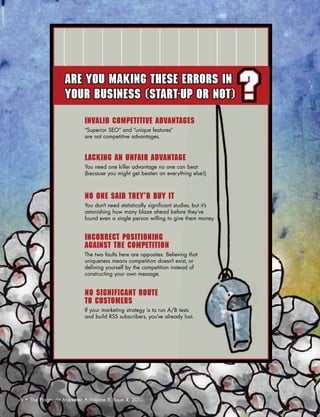
Are you making these errors in
                    your business (start-up or not)                                        ?
                             Invalid competitive advantages
                             “Superior	SEO”	and	“unique	features”		
                             are	not	competitive	advantages.	


                             Lacking an unfair advantagE
                             You	need	one	killer	advantage	no	one	can	beat	
                                                                       beat
                             (because	you	might	get	beaten	on	everything	else!).
                                                              everything else!).


                             No one said they’d buy it
                             You	don’t	need	statistically	significant	studies,	but	it’s	
                                                                      studies, but it’s
                             astonishing	how	many	blaze	ahead	before	they’ve	
                                                                    before they’ve
                             found	even	a	single	person	willing	to	give	them	money.
                                                                           them money.


                             Incorrect positioning
                             against the competition
                             The	two	faults	here	are	opposites:	Believing	that	
                                                                Believing that
                             uniqueness	means	competition	doesn’t	exist,	or		
                                                                    exist, or
                             defining	yourself	by	the	competition	instead	of	
                                                                  instead of
                             constructing	your	own	message.	


                             No significant route
                             to customers
                             If	your	marketing	strategy	is	to	run	A/B	tests		
                                                                       tests
                             and	build	RSS	subscribers,	you’ve	already	lost.	
                                                                 already lost.


6
	 	 •	 The	Pragmatic	Marketer	 •	 Volume	8,	Issue	4,	2010
5 Lessons from 150 Startup Pitches


Error                                      holdings. Every mp3 player uses
                                           multiple patents, but that didn’t stop
                                                                                      passion? But in this context it’s like
                                                                                      saying, “My children are going to be
Invalid competitive advantages             Apple from winning.                        more successful because I love them
                                                                                      more than you love yours.”
Every pitch I see has a section on
competitive advantages, and nearly         We’re better at SEO
every time the claimed competitive         and social media                           We’re cheaper
advantage is not, particularly when        80% of Americans believe they are          It’s not bad to be cheaper. The
everyone else claims the same              better-than-average drivers. Can’t be      key is you cannot compete solely
advantage as you!                          true, right? Well 80% of folks I meet      on price because all a competitor
                                           tell me they’re better than average        has to do is lower their price.
The following are not competitive          at SEO, Twitter, and “building             Established companies can destroy
advantages:                                communities” (whatever that means).        you with the “loss leader” strategy.
                                                                                      Remember when Microsoft put
                                           Social media and SEO is ever-              hundreds of developers on Internet
We have feature “x”
                                           changing quicksand. You’re on top          Explorer and gave it away for
This is an advantage only until            of Google today, gone tomorrow.            free, destroying the market for
others copy it, so it’s not a long-        Other companies being good—or              web browsers?
term protection against competition.       better—is completely outside your
Indeed, the next company can
observe what works and what
doesn’t, and then improve on
                                           control, so claiming you have a
                                           sustainable advantage is poppycock.        LESSON
your innovation.                                                                      So where does that leave us?
                                           We have three PhDs/MBAs
We have the most features                  The landscape of successful                You live in the era of a flat world
                                           startups is littered with people           where millions of people have
It’s common for older products to          lacking post-graduate education. If
compete on having more features                                                       access to technology, education,
                                           you’ve lived in the software world         and a powerful sales, marketing,
than newer, competing products.            you know what they teach you in
The trouble is, customers rarely                                                      and communication platform
                                           school is often irrelevant, so who         (the Internet).
want more features, they want the          cares what degree you hold? In all
right features. As everyone adds           the interviews you’ve read about
features, products reach critical mass                                                You live in the era where the
                                           founders’ success, how many credit         most powerful programming
where all have 80% of the features         their MBA program? How many
customers want, and then having                                                       frameworks and tools are free, local
                                           even have MBAs? It’s not bad to            broadband and high-availability
“more” is no longer an interesting         have a degree, but neither is it a
selling point.                                                                        servers are cheap, and world-class
                                           significant advantage.                     people are willing to work 60
We’re patenting our features                                                          hours/week in exchange for free
                                           We work hard                               food and the chance to be part
“No one can compete with my blog           and we’re passionate                       of a cool new startup.
because it’s copyrighted.” Silly, right?   You hear about guys working 30
                                           hours per week (or less), so you           There’s too much energy, availability,
That’s what it sounds like when            figure if you work a “healthy” 70          intelligence and opportunity in
claiming a software patent will            hours per week, you’ll win! But            the world to hide behind outdated
protect you from competition.              working harder is not, in fact,            notions of intellectual property.
Except in certain industries (e.g.         smarter. And even if you could
food, drug, medical), I’m unaware          work 70 on-task hours per
of companies who stave off quality                                                    Almost anything can be copied. In
                                           week, that’s still blown away by           fact, I’d claim that anything of any
         competitors through patent        10 developers at a well-funded             value will be copied. It should be
                                           company or even 10 passionate              part of your business plan that other
                                           open source developers working
                                           part-time. And who doesn’t have            people will copy you.


                                                                        The Pragmatic Marketer   •   Volume 8, Issue 4, 2010   •   7
5 Lessons from 150 Startup Pitches


Error                                       No, wait, I’m sorry, the real question
                                            is: What are you going to do when        LESSON
Lacking an unfair advantage                 there are four totally free, open-       The only real competitive advantage
                                            source competitors?                      is that which cannot be copied and
Fortunately there’s plenty of                                                        cannot be bought.
ways to have true advantages                No, wait, I forgot, actually the
that competition cannot readily             question is: What happens when           Like what?
overcome. Unfortunately, they’re            employee #2 makes off with your
difficult and rare. And you thought         code and roadmap and marketing
creating and running a successful,          data and customer list and starts        Insider information
untouchable startup was easy?               selling your stuff world-wide at         The only way to consistently make
                                            one-tenth the price?                     money on Wall Street is to have
How would you answer “What if a                                                      insider information! Although it’s
big company copies your idea and            The good news: There are answers         illegal (and people occasionally go
develops the same website as yours          to all these questions!                  to jail for it), those in the know will
after your website goes public?”                                                     tell you it’s not uncommon. But,
                                                                                     using intimate knowledge of an
                                            The bad news: Almost no one
                                                                                     industry and the specific pain points
Not the right question! The one             I talk to has good answers, but
                                                                                     within an industry is a perfectly
you should answer is: What are              they think they do. And that’s
                                                                                     legal unfair advantage.
you doing now knowing that a big            fatal, because it means they’re not
company will copy your idea?                working towards remedying that
                                            situation. Which means when one          Here’s a real-world example. Adriana
                                            of the above scenarios happens,          has been a psychiatrist for 10 years;
No, wait, the real question is: What
                                            it will be too late.                     she understands the ins and outs
are you going to do when another
                                                                                     of that business. During a lull in
smart, scrappy startup copies your
                                                                                     her practice she got an opportunity
idea, and gets $10M in funding, and         Anything that can be copied
                                                                                     to shift gears completely and
is thrice featured on TechCrunch?           will be copied, including features,
                                                                                     ended up leading software product
                                            marketing material, and pricing.
                                                                                     development teams. (Turns out that
                                                     Anything you read on
                                                                                     for big-business project management
                                                      popular blogs is also read
                                                                                     it’s more valuable to be a sensible
                                                      by everyone else. You
                                                                                     thinker and counselor than to be
                                                      don’t have an “edge” just
                                                                                     an expert in debugging legacy
                                                     because you’re passionate,
                                                                                     C++ code.)
                                                     hard-working, or “lean.”
                                                                                     Now Adriana has an epiphany:
                                                                                     In her opinion, traditional
                                                                                     practice-management software for
                                                                                     psychiatrists is not very good; she
                                                                                     knows both the pain points and
                                                                                     the existing software first-hand. But
                                                                                     now she has the vision and ability
                                                                                     to design her own software.

                                                                                     Adriana holds a unique position:
                                                                                     Expert in the industry and able
                                                                                     to “geek out” with her target
                                                                                     customer, yet capable of leading
                                                                                     a product team. Even if someone
                                                                                     saw Adriana’s product after the
                                                                                     fact, it’s almost impossible to find a
                                                                                     person—or even assemble a team—
                                                                                     with more integrated knowledge.
                                                                                     At best, they could copy. Of course
                                                                                     by then Adriana has moved on
                                                                                     to version two.


8
	 	 •	 The	Pragmatic	Marketer	 •	 Volume	8,	Issue	4,	2010
5 Lessons from 150 Startup Pitches


Single-minded, uncompromising           However it’s not enough for a                To remain un-copyable, your One
obsession with One Thing                feature to merely be unique because          Thing needs to be not just central
A “Unique Feature” could be a           it’s still easily duplicated. Rather, this   to your existence, but also difficult
competitive advantage in some           requires unwavering devotion to the          to achieve. Google’s algorithm,
circumstances. Some examples            One Thing that is (a) hard, and (b)          combined with the hardware and
of a feature being a company’s          you refuse to lose, no matter what.          software to implement a search of
primary advantage are:                                                               millions of websites in 0.2 seconds,
                                        Google has spent hundreds of                 is hard to replicate; it took hundreds
•	 Google’s search algorithm was        millions of dollars on their search          (thousands?) of really smart people
  just better, therefore they won the   algorithm, the single biggest focus          at Microsoft and Yahoo years to
  eyeballs, therefore they were able    of the company even today, a                 catch up. 37signals’ platform—a
  to monetize. Sure, others are good    decade after they decided that was           blog with ~140k followers and
  now, but the advantage lasted         their One Thing. They refuse to be           a best-selling book—is nearly
  long enough.                          beaten by competitors or black-hat           impossible to build even with a
                                        hackers, whatever it takes.                  full-time army of insightful writers.
•	 Photodex is a little company
  you’ve never heard of where           37signals can build simple software          Being “hard to do” is still a true
  I worked in the 90’s. We made         and earn three million customers             advantage, particularly when you
  an image browser with thumbnail       because they absolutely will not             devote your primary energy to it.
  previews so you didn’t have to        compromise on their philosophy
  open each file individually to see    of simplicity, transparency, and             Personal authority
  what it was. Our advantage was        owning their own company, and                Chris Brogan commands thousands
                                        that’s something millions of people          of dollars for a single day of
  speed. Not the best, not the most
                                        respect and support.                         consulting in an industry (social
  stable, didn’t read the most
                                                                                     media marketing) where all the
  formats, didn’t have the most
                                                                                     information you need is already
  features, just “fastest.” For many                                                 online and free. Joel Spolsky
  users of that product, speed wins.                                                 makes millions of dollars from bug
                                                                                     tracking software—an industry with
                                                                                     hundreds of competitors and little
                                                                                     innovation. How can you earn this
                                                                                     overwhelming advantage?

                                                                                     Unfortunately all this “authority”
                                                                                     takes years of expensive effort, and
                                                                                     even then success is probably due
                                                                                     as much to luck as anything else.
                                                                                     So is it worthwhile? Yes, exactly
                                                                                     because it takes years of effort
                                                                                     and a little luck.

                                                                                     Authority cannot be purchased
                                                                                     You can’t raise VC money and then
                                                                                     “have authority” in a year. A big
                                                                                     company cannot just decide they
                                                                                     want to be the thought-leader
                                                                                     in their field. Even a pack of
                                                                                     hyper-intelligent geeks cannot
                                                                                     automatically become authorities
                                                                                     because it’s not about how well
                                                                                     you can code.


                                                                       The Pragmatic Marketer   •   Volume 8, Issue 4, 2010   •   9
5 Lessons from 150 Startup Pitches


But how does authority convert                   In each case, the founders were          As a company becomes successful
to revenue?                                      super-smart, had complementary           it gains momentum, which means
                                                 skill sets, worked well together (or     it’s going in one direction with
Here’s a personal example: I                     well enough to reach important           one philosophy. Like physical
give talks on peer code review                   success milestones), and as a team       momentum, change becomes
at conferences. My competition                   represented a unique, powerful, and      harder to affect.
pays thousands of dollars for a                  (in retrospect) unstoppable force.
booth, then spends thousands                                                              Of course the world is changing,
advertising to attendees begging                 Of course that’s easy to see in          and in particular your customers
them to visit the booth, then                    retrospect, and retrospect is a          are changing. Normally this leaves
gives sales pitches at the booth                 terrible teacher, but the principle      room for the next competitor, but if
to passersby who are also being                  can work for any startup, especially     you’re already entrenched you can
bombarded by other pitches and                   when your goals are more modest          leverage your existing status, insider
distracted by the general hubbub.                than being the next Google.              knowledge, and revenue stream as
                                                                                          long as you’re willing to change too.
Whereas, because I’m a known                     Of course a Dream Team doesn’t
authority on code review and                     guarantee success but it significantly   You have more money, you’re
software development, I get to talk              reduces the risk of a startup, and       better known, you have existing
for an entire hour to a captive,                 is difficult for the competition         happy customers to help spread the
undistracted group of 100 people,                to duplicate.                            word, you have employees to build
self-selected as interested in code                                                       new things, and you have more
review. After the talk, many people              This is especially true when             experience with what customers
want to chat one-on-one. Some head               someone on the team is already           actually do and need, which means
straight to the booth to get a demo;             successful in their field, e.g. with     you should have the best insight.
for many I give a private demo of                a massively successful blog, or big
the product on sofas in the hallway.             startup success, or a ridiculous         Any new competitor would kill
It’s not unusual to get several sales            Rolodex. Since those are the kinds       for just one of these advantages.
over the next three months from                  of competitive advantages that can’t     If you’re not using them, how silly
people who saw me speak.                         be bought or consistently created,       is that? Companies don’t get killed
                                                 having that person on the team is        by competition; they usually find
Now add to that the effect of a blog             by proxy a killer advantage.             creative ways to commit suicide.
that tens of thousands of people
read? And the effect on sales of my              Existing customers                       Imitation might be the sincerest form
book on code review?                             Everyone you’ve ever sold to             of flattery, but it still stings when
                                                 possesses the most valuable market       someone does it to you.
Earning authority is expensive and               research imaginable, and it’s the one
time-consuming, no doubt. But it’s               thing a new competitor absolutely        Of course you can still battle it out
also an overwhelming, untouchable                will not have.                           in the marketplace, but you need
competitive advantage.                                                                    something that can’t be duplicated,
                                                 This is kind of a cheat, because         something they could never beat
The dream team                                   everyone says “I listen to my            you on, then hang your hat on that
The tech startup world is littered               customers,” which (nowadays) is just     and don’t look back.
with famous killer teams: Gates &                as overused as “We’re passionate,”
Allen, Steve & Steve, Page & Brin,               but it’s true that if you’re actively
Fried & Heinemeier Hanson.                       learning from your customers and
                                                 you never stop moving, creating,
                                                  innovating, and learning, that puts
                                                    you ahead of most companies in
                                                      the world.


10   •   The Pragmatic Marketer   •   Volume 8, Issue 4, 2010
Product Launch Essentials                                            ™


           Plan and execute a successful product launch
Are your product launch efforts focused on deliverables rather than results?

Launching a product is more than following a simple checklist. A successful product launch is the
culmination of many, carefully planned steps by a focused, coordinated team. Even good products can
fail because of organizational issues, misunderstanding of roles and responsibilities, and a lack of a
strategic approach to guide efforts.

• Learn a repeatable product launch process to shorten the launch planning cycle, get the resources
  needed, and know what to expect at every step.

• Understand the seven product launch strategies your team can use
  to maximize sales velocity.

• Measure product launch progress with indicators that identify unforeseen
  issues before they become big problems.


                               Get a free e-book at                                                            Daniel
                                                                                                                        s


                          PragmaticMarketing.com/launch
                                                                                                          id
                                                                                                   By Dav


  Download a complete agenda and register at   PragmaticMarketing.com/seminars
              Call (800) 816-7861 to conduct this seminar at your office
5 Lessons from 150 Startup Pitches


Error                                             “I’m scratching my own itch.
                                                  Since I’m my own target
                                                                                            “My customers can’t understand
                                                                                            mock-ups. I have to build it first.”
No one said they’d buy it                         customer, I already know                  You shouldn’t need screenshots or
                                                  what to build.”                           slides to convince someone in your
Of hundreds of startup pitches I’ve
heard, almost none had unearthed                  Oh! I didn’t realize your typical         target market that what you’re doing
ten people willing to say, “If you                customer is observant enough to           is compelling. If your concept is so
build this product, I’ll give you $X.”            recognize monetizable pain, creative      esoteric you can’t describe it in 30
                                                  enough to invent products, able to        seconds, it’s either too complex or
                                                  convince others to work for free and      you don’t understand it yourself.
Meditate on this: Hundreds of
                                                  invest money and time with you,
people ready to quit their day jobs,
                                                  and passionate enough to quit their       Even if I concede that some folks
burn up savings, risk personal
                                                  job to pursue unproven ideas.             can’t grok mock-ups, remember
reputation, toil 70 hours per week,
absorb as much stress as having a                                                           that your first customers will by
baby (believe me, I’ve done both)....             By definition, if you’re a startup        definition be early-adopters who are
all without identifying even ten                  founder you’re explicitly not             OK with alpha software. If you can’t
people actually willing to pay for                your customer.                            find a few of those and get them
what they’re peddling.                                                                      excited about your product, maybe
                                                  “Scratching your own itch” is just        your product isn’t exciting.
Short-sighted, no? If you can’t find              a start. It’s the spark of inspiration,
ten people who say they’ll buy, your              not the strategy. It’s the grain of       “I’m not good at sales/marketing;
company is dead before it starts.                 sand tickling the oyster, not the         I need to build a product so
                                                  pearl. In fact I challenge you to find    compelling it sells itself.”
                                                  one founder of a real business who        The world is filled with decent
                                                  thinks “I’m the customer” is the only     products that make no money!
                                                  market validation you need.               If your goal is a business (not a
                                                                                            hobby), building charming, novel
                                                  “There are millions of potential          software isn’t enough.
                                                  customers, so it doesn’t matter
                                                  what only ten of them think.              You and I know you have the ability
                                                  I need to just start; later I can         to build cool new software. We
                                                  survey and learn something                agree that will be fun and exciting.
                                                  statistically significant.”               But that’s not going to create
                                                  If there are millions, it’s trivial       a business.
                                                  to find ten. If you can’t find
                                                  even ten, then either there’s not         Writing code is what you love, so
                                                  millions or those millions aren’t         you myopically decide that’s what
                                                  interested in you.                        you’ll do. But what you should do
                                                                                            is just the opposite: Attack the part
                                                  Businesses don’t start with millions      of the business you’re least sure of,
                                                  of customers, they start with one,        you’re least qualified for.
                                                  then ten, then a hundred, and
                                                   then a thousand. But most don’t          If you’re still not convinced, think
                                                   get past ten.                            of it as project risk management.
                                                                                            In a big software project do you
                                                    If you haven’t gotten ten to            tackle the high-risk, ill-defined stuff
                                                      at least say they’ll buy, where       first, or do you postpone that to
                                                        do you get your hubris to           the end? Obviously you address the
                                                          proclaim that thousands           unpredictable stuff first—most of the
                                                           actually will buy?               project risk is due to the unknown,


12   •   The Pragmatic Marketer   •   Volume 8, Issue 4, 2010
5 Lessons from 150 Startup Pitches


so the earlier you can sort out
uncertainty the more time you have
to deal with the consequences.

I’m making the same argument,
except the “high-risk unknown” is
“everything that’s not code.” Your
code will be good enough; it’s the
other stuff that will probably sink
your ship—unable to find customers
or unable to convince the target
audience they should open their
wallets.

No sense in postponing it.

“My friend/brother/co-worker/
dentist thinks it’s a great idea.”        Error                                    •	 “No one is doing it like we are.”

Your mother thinks you’re smart           Incorrect positioning                      Of course you’re going to position
and good-looking, but that doesn’t        against the competition                    your company with a unique
mean I do.                                                                           offering: exclusive features, a
                                          After seeing hundreds of startup           distinctive culture, a refreshing
It doesn’t matter what non-               pitches, I can tell you the two most       pricing plan, an innovative sales
entrepreneurs think because               common errors in positioning a             strategy, etc. But uniqueness
they’re not versed in product/            company against competition are,           doesn’t imply lack of competition!
market fit or squeezing blood             strangely, opposites:
from evanescent budgets. In fact                                                   •	 “There’s no competition because
it only barely matters what real                                                     this is an industry that has
entrepreneurs think, because they’re      •	 Claiming you have no competition
                                                                                     never used software to solve
not expert in your problem domain,        •	 Defining your company’s offering        this problem.”
they might have outdated notions,
                                            and positioning by combining “the
they might be biased against certain                                                 I know that sounds like a good
ideas and technology, and they              best” traits of six competitors.
                                                                                     thing, but what this also implies
carry baggage from good and bad           This isn’t just a problem when             is you’ll have to convince people
experiences (due as much to timing        pitching—it’s a problem with you           to trust software, and that’s a
and luck as anything else).               defining who your customers are,           disadvantage. You’re competing
                                          what they want, and your role in the       against the status quo.
LESSON                                    marketplace.
                                                                                   •	 “There’s no competition
                                          Let’s break down the ways these            because people haven’t realized
The only thing that matters                                                          it’s a problem.”
is that people are willing to             fallacies manifest and what you
give you money!                           can do instead.
                                                                                     If they don’t already know they
                                                                                     have the pain, the sales process is
Business “experts” can argue all          There is no competition
                                                                                     going to be excruciating. There’s a
day that it makes no sense to buy         Here’s what I hear and think:              word for that—evangelism—which
shoes over the Internet, but as long                                                 conjures other words: Expensive,
as people give Zappos $1 billion          •	 “I have no competitors.”                difficult, time-consuming.
per year, it doesn’t matter what
experts say.                                Either you’re ignorant of
                                            direct competition, or you’re
When ten people say they’ll give            not considering alternate solutions
you money if you build this thing,
                                            like “build it yourself.”
that’s the only validation that counts.


                                                                    The Pragmatic Marketer   •   Volume 8, Issue 4, 2010   •   13
5 Lessons from 150 Startup Pitches


Defining your company                            •	 “We’re just like competitor X,         So how do you look inward to
by the competition                                  only we’re Y.”                         establish your company, contrasting
Your company is defined by its own                                                         with the competition but not letting
strengths, values, customers, and                   In this case you’re betting your       the competition dictate your identity?
products, not by how it compares                    future on the fact that Y is
with other companies. You need                      overwhelmingly compelling to a         •	 We’re targeting the market
a strong position, something                        large market segment. X                  segment defined by X, Y, and Z.
that would be equally clear and                     automatically has advantages over        We’ve spoken with 20 potential
compelling even if competitors                      you (brand, customers, revenue,          customers who match at least two
didn’t exist.                                       inside knowledge, a team,                of those criteria, and they agree
                                                    momentum), so Y had better be            our product is exactly what they
Here’s some ways this mistake                       brain-exploding awesome. Oh,             need and none of our competitors
manifests:                                          and it’d better be impossible            are doing an acceptable job
                                                    for X to implement Y—or even             addressing their issues.
•	 “We combine the best traits of our               one-third of Y—themselves. Talk
  competitors, letting them show the                about putting your fate in others’     •	 Our company has core value X
  way to our success.”                              hands!                                   that we exude everywhere from
                                                                                             our SEO to our tech support to
  I like the idea that you can learn                                                         our product. (Example value:
                                                 •	 “We’re the same as X, only cheaper.”
  from the mistakes and successes                                                            Simplicity. A simple product with
  of similar companies, but                         Being cheaper is a strategy, but         few features, low-cost, pain-point
  “combining the best” misses the                   it can’t be your only strategy. It’s     obvious, not tackling complex
  point. There are specific tradeoffs               too easy for competitors to change       problems, focused on making
  each of those companies are                       price or offer deals. Typically          life easier rather than on saving
  making; things you see as “not                    the best customers aren’t price-         money.) We own this value
  best” might in fact be best for their             sensitive anyway, so you’re              because we’re completely
  target market. Why are you so                     actually biting off a less desirable     committed; this is the one point
  sure your notion of “best” will                   segment of the market. Often this        on which we will never
  result in enough customers who                    claim is paired with “We’ll do 70%       compromise. Our customers know
  not only agree with you, but are                  of the features for 50% of the           it and value this too, which is why
  so convinced they’re willing to                   price,” but supplying less for less      it doesn’t matter what features,
  switch to you?                                    is not inspirational.                    prices, or advertisement our
                                                                                             competitors have.
•	 The rubric.

  A chart with one row for each
  “feature” and one column for each
  of six “competitors.” There’s
  checks and X’s everywhere, except
  of course a glowing, highlighted
  column representing your
  company which just happens to
  be full of checks. Do you really
  expect someone to believe this?


14   •   The Pragmatic Marketer   •   Volume 8, Issue 4, 2010
5 Lessons from 150 Startup Pitches


•	 This is the competitive matrix.
  Note that each player in this space    LESSON                                    •	 Our target customer has
                                                                                     traditionally solved this pain
  is targeting a different market        If you’re tempted to argue that             themselves or just lived with the
  segment, as is clear from feature      you’re the exception, here’s how            pain rather than paying for relief.
  selection, pricing, and advertising/   to elucidate the advantages you’re          A combination of newly-available
  messaging. We, too, are targeting      seeing, but in a way that actually          technology and modern mindset
  a niche; as you can see our            makes sense as a business strategy:         makes this the right time for a
  offering is consistent with owning                                                 new software play.
  that niche, and doesn’t overlap        •	 We’ve carved out a niche specific
                                           enough that no one is actively          •	 It’s true this industry hasn’t yet
  significantly with competitors. It
  would be difficult for any of them       targeting. There are similar              seen a software solution, but that’s
  to “switch” into our niche, because      competitors A, B, and C, but              not because they hate computers,
  as you can see they’d have to            they’re not targeting this niche          but rather that it hasn’t been
  change the product, pricing, and         because of X, and would be                possible to address that market
  their company’s persona; that’s a        hard for them to switch into this         with software. Now it is because
  risk we’re willing to take.              niche because of Y. In fact, it’s         (pick one):
                                           quite possible that we’d end up             − We’ve built an improbable team
•	 We’re going after competitor X.         partnering with or being bought
  We know they already have a                                                           that spans geeks and industry
                                           by A, B, or C because our idea is            insiders.
  ton of advantages over us—               similar but out of their reach.
  well-known, well understood, and                                                     − New hardware/networks have
  a deep feature list. However they      •	 We’ve identified a market too               just appeared which makes this
  haven’t done anything new in             small for the large, established             possible.
  three years and we have evidence         players to address, but big enough
  their customer base is not happy.        to build a company. Because the             − New attitudes enables new
  Not only that, they’re famous for        800-pound gorilla is inefficient at          workflows (e.g. ubiquity of
  annoying attributes A, B, and C          building new software, it can’t go           Facebook even among
  (Examples: buggy, slow, confusing,       after a market unless there’s a              traditional technophobes).
  expensive, bad tech support). We         billion dollars at stake. We think
                                                                                       − This industry is commoditized
  see huge opportunity in their            there’s a solid business to be
                                                                                        so giving a player the slightest
  wake of destruction, vacuuming           made in this hundred-million-
                                                                                        edge is a big deal.
  up their customers with our              dollar market. However, where
  overwhelming advantage. They             the giant can’t afford to build this        − This industry is just now
  can’t do this themselves because         from scratch, if we show good                starting to show tangible signs
  they’re too big to turn the ship,        growth and profits we would                  of embracing technology.
  and anyway the past three years          be an obvious acquisition
                                           target for them.                            − We have three lead customers
  have shown they’re not
  able to change.                                                                       signed up as alpha testers;
                                         •	 We’ve created technology so                 if we make them successful the
                                           different from the incumbents that           case studies will be all the
                                           we’re changing the conversation              evangelism we’ll need.
                                           about how people solve this pain.

                                           Though it’s different, your solution
                                           is very easy to describe and use
                                           (e.g. the way Netflix changed
                                           movie watching at home).


                                                                    The Pragmatic Marketer   •   Volume 8, Issue 4, 2010   •   15
5 Lessons from 150 Startup Pitches


Error
No significant route
to customers
Ask a technical founder about his
startup, and he’ll proudly describe
his stunning software—simple,
compelling, useful, fun. Then he’ll
describe his cutting-edge platform—
cloud-based, scalable, distributed
version control, continuous                      The obvious problem is every new        buttons. Buttons are good—but
integration, one-click-deploy.                   startup on Earth says exactly these     they don’t make your product
Maybe you’ll even get a                          things. Nowadays the “strategy”         intrinsically viral.
wobbly demo.                                     above sounds like:
                                                                                         Which is OK—not all products need
“Great,” I always exclaim, sharing                  “We’ll have a website so people      to be viral! But if it’s not viral you
the thrill of modern software                       can read about us.”                  still need a killer method of finding
development, “so how will people                                                         customers, and if it is supposed to
find out about this brilliant product?”             “We’ll have an email address so      be viral it better be encoded in the
                                                    people can communicate with us       DNA of the application, not bolted
Cue silence… Then a smile breaks                    without picking up the phone.”       on as an afterthought.
across the founder’s face:
                                                 Yes, you’re going to do those things,   Frightening honesty
  “We’re going to A/B-test AdWords               but since millions of other people      Balsamiq Mockups is a popular
   campaigns until we discover                   are doing that too, you’re still        wire-framing tool. What sets
   our hook.”                                    invisible. No visibility = fail.        them apart isn’t prescient feature
                                                                                         selection or bug-free releases, it’s

                                                 LESSON
  “We’re going to A/B-test our                                                           their startling transparency. Revenue
   landing pages until the right                                                         figures are published even when
   message appears.”                                                                     they were still pathetic. The founder
                                                 So what can you do to rise above        pledged loudly and eagerly to give
                                                 the cacophony that is the Internet?     away lots of free copies to non-
  “We’re better than everyone
   else at SEO.”                                                                         profits, and he revealed all his
                                                 Infection built-in, not bolt-on         (remarkably effective) marketing
                                                 WhenBusy lets people schedule           strategy even though it meant
  “A friend of mine knows how
                                                 meetings in currently-available         competitors would learn them too.
   to get popular on Twitter.”
                                                 time-slots without having to share
                                                 your calendar. Instead of trading       He didn’t just have an “authentic
  “We’re going to get reviews                    emails with lists of available
   on blogs.”                                                                            voice,” he made public promises.
                                                 time-slots, you send the link           That’s compelling.
                                                 to your calendar page and the
  “We’re going to start with our                 other person uses the product to
   own network and grow it                                                               He didn’t just “tell it like it is,”
                                                 schedule a meeting. This is the         he gave up his marketing secrets
   from there.”                                  viral step: Having trialed the tool,    and opened his company books.
                                                 the stranger might use it herself,      That’s newsworthy.
  “We’re going to use an affiliate               then more people find out about
   program so our customers sell                 it, and so forth.
   it for us.”                                                                           This isn’t merely “being human”
                                                                                         it’s almost too much honesty!
                                                 Note that at no point did I say “a
  “We’re putting a ‘Retweet’ button              button lets people ‘like’ this on
  inside the product to encourage                                                        In a world where everyone and their
                                                 Facebook.” I know of no companies
  viral growth.”                                                                         brother is “joining the conversation,”
                                                 who have “gone viral” because of
                                                                                         you have to truly bare your soul
                                                                                         if you want to compete on the


16   •   The Pragmatic Marketer   •   Volume 8, Issue 4, 2010
5 Lessons from 150 Startup Pitches


transparency front. It’s not for               better lead quality, a more efficient         It’s always fun to tell a journalist
everyone, and I’m not suggesting               conversion rate, and straightforward          like you that we enable software
it ought to be, but there’s no sense           trials with minimal tech support. Of          developers to review each other’s
in going half-way.                             course it’s not quite that simple but         code because your reaction is
                                               it’s a step in the right direction.           always: “Wait a minute, you’re
Tell a story                                                                                 seriously telling me they don’t
The number one mistake founders                At first when someone asked                   do this already?” The idea
make when trying to generate press             what my company’s tool suite was,             of editing and review is so
is talking about what the company              I would say:                                  embedded in your industry you
does rather than telling a compelling                                                        can’t imagine life without it, and
story. Without a powerful narrative,             Smart Bear makes data-mining                you’re right! You know better
your chances of getting big                      tools for version control systems.          than anyone how another set of
press and enthusiastic users who                                                             eyeballs finds important problems.
spread the word are somewhere                  It’s a description so esoteric that,
around zero.                                   although accurate, not even a                 Of course two heads are
                                               hardcore geek would have any idea             better than one, but developers
It took me five years to figure out            what it is, much less why it’s useful.        traditionally work in isolation,
(a) I needed a story and (b) what                                                            mainly because there’s a dearth
the story was. It’s hard. But one              Years later, when it was clear that           of tools which help teams bridge
story beats a pile of AdWords                  code review software became                   the social gap of an ocean,
A/B tests.                                     our sole focus, I got better at               integrate with incumbent tools,
                                               describing it:                                and are lightweight enough to
                                                                                             still be fun and relevant.
Advertising   [transmogrification]   Revenue
                                                 You know how Word has “track
                                                 changes” where you can make                 That’s what we do: Bring
I know that nowadays marketing is
                                                 modifications and comments and              the benefits of peer review
about “relationships” and “authority”
                                                 show them to someone else? We               to software development.
and other things which cost time
but not money. But don’t be so                   do that for software developers,
quick to throw out the idea of                   integrating with their tools instead     Now the reason for excitement
spending money to make money.                    of Word and working within their         is clear: We’re transforming how
Advertising isn’t dead; you can                  standard practices.                      software is created, applying the age
still buy eyeballs. I’m not talking                                                       old techniques of peer review to an
about “triage” strategies like                 Better, yes, and for a while I             industry that needs it but where it’s
buying AdWords linking to a page               thought I nailed it, but still no          traditionally too hard to do.
of ads, I’m just pointing out that             press. Eventually (thanks to helpful
most companies don’t depend                    journalists) I realized I was still just
on “joining the conversation” to               describing what it is rather than
                                                                                          That’s	a	story!
acquire customers.                             why anyone cares. I left it up to the      Follow these simple guidelines and
                                               reader to figure out why they should       set yourself apart from the masses
It sounds simple: The average                  get excited.                               who continue to make the errors
cost of acquiring a customer is $C                                                        identified in this article. With a little
(advertising, sales, support, doing            Eventually I developed stories like        time and careful preparation, your
demos) and the lifetime revenue you            the following, each tuned to a             pitch for funding should impress
get from that customer is $R, so if            certain category of listener. Here’s       investors and hopefully you get the
C < R you have a business. C can               the one for the journalists:               financial support to begin the next
be driven down with cheaper ads,                                                          phase of your company’s plan.


                 Jason Cohen has started four companies (including WPEngine
                 and Smart Bear), both funded and bootstrapped, ran three
                 to millions in revenue, and sold two. He is the author of Best
                 Kept Secrets of Peer Code Review. A geek-turned-entrepreneur,
                 he now blogs about startups at http://blog.asmartbear.com


                                                                           The Pragmatic Marketer   •   Volume 8, Issue 4, 2010   •   17
Are your product management and marketing teams
                overloaded with tactical activities, spending too much
                 time supporting Development and Sales rather than
                             focusing on strategic issues?

            The Pragmatic Marketing Framework                ™


                                           Business                       Marketing
                                                           Positioning
                                             Plan                           Plan


               Market       Market                          Buying        Customer
                                            Pricing
              Problems     Definition                       Process      Acquisition


              Win/Loss     Distribution   Buy, Build        Buyer         Customer
              Analysis      Strategy      or Partner       Personas       Retention


             Distinctive    Product         Product          User           Program
            Competence      Portfolio     Profitability    Personas      Effectiveness
STRATEGIC


                                                                                                                               TACTICAL
              MARKET       STRATEGY       BUSINESS         PLANNING      PROGRAMS        READINESS          SUPPORT


             Competitive     Product                                        Launch         Sales          Presentations
                                          Innovation      Requirements
             Landscape      Roadmap                                          Plan         Process           & Demos


            Technology                                       Use           Thought                          “Special“
                                                                                         Collateral
            Assessment                                     Scenarios      Leadership                          Calls


                                                             Status         Lead           Sales              Event
                                                           Dashboard      Generation       Tools             Support


                                                                          Referrals &     Channel            Channel
                                                                          References      Training           Support

                                                                                             ©	1993-2010	Pragmatic	Marketing


                                          Visit PragmaticMarketing.com or call (800) 816-7861
Seminars
Living in an Agile World™                                Requirements That Work™
 Strategies for product management                        Methods for creating straightforward product
 when Development goes agile.                             plans that product managers can write and
                                                          developers embrace.

Practical Product Management®
 Principles of the Pragmatic Marketing Framework,        Effective Product Marketing™
 the industry standard for managing and marketing         Repeatable, go-to-market process to design,
 technology products.                                     execute, and measure high-impact marketing
                                                          programs.

Pragmatic Roadmapping™
 Techniques to plan, consolidate and communicate         Product Launch Essentials™
 product strategy to multiple audiences.                  Assess organizational readiness and define team
                                                          responsibilities for a successful product launch.


Executive Briefings
Designed specifically for senior management,
Executive Briefings discuss how to organize
Product Management and Marketing
departments for optimal effectiveness
and accountability.


  In	addition	to	the	extensive	published	schedule,	training	can	be	conducted	
 onsite	at	your	office,	saving	travel	time	and	costs	for	attendees,	and	allowing	
           a	much	more	focused	discussion	on	internal,	critical	issues.

                   Pragmatic Marketing’s seminars have been attended by more than
                       60,000 product management and marketing professionals.
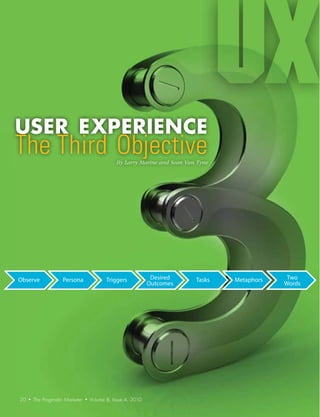
USER EXPERIENCE
                                                                                     UX
The Third Objective                              By Larry Marine and Sean Van Tyne


Observe               Persona                Triggers            Desired     Tasks   Metaphors    Two
                                                                Outcomes                         Words


20   •   The Pragmatic Marketer   •   Volume 8, Issue 4, 2010
3
                                                                                                             UX
Conventional wisdom holds that        Business, marketing, and UX           Define your user
the true measure of your product      objectives are complementary and      experience objective
success is in how well it meets       support each other. Marketing
your business and marketing           objectives directly impact UX         To create your user experience
objectives. But what about the        objectives in that marketing          objective you must first have
third objective—user experience?      strategy defines target markets,      a clear understanding of your
Apple, for example, has developed     which includes target customers       business and marketing objectives.
a reputation very different from      and users of the experience.          There are plenty of books and
Microsoft. Which one would            Moreover, UX objectives help          articles on this subject. Decide on
you say succeeds at setting and       refine the target market. And as      one key business objective and
meeting successful user experience    much as business objectives guide     one key marketing objective when
objectives?                           marketing objectives, they guide      defining your first user-experience
                                      UX objectives, too. In many cases,    objective.
How is a user experience objective    UX objectives refine both business
different from a business or          and marketing objectives.             User experience objectives must
marketing objective? Common                                                 align with your users’ needs.
business objectives focus on          For example, we conducted             Successful UX objectives are borne
increasing revenue or decreasing      research with a client to uncover     from a deep understanding of
costs. Marketing objectives focus     ways they could attract their         your users’ environment. Applying
on increasing market share and        competitors’ customers and            proven user-centered design
deepening existing relationships.     identified a more lucrative and       methods provides a straightforward
While necessary objectives, they      unmet need within the customer        approach to gaining insight that
focus more on the business and        organizations, but not in the IT      accurately defines your objective.
product. User experience is about     department, where all of the
managing the customer side            competitor products were focused.     There are seven steps in defining
of the equation.                      This new opportunity was closely      your user experience objectives.
                                      related to the existing product       While the insight that defines your
User experience (UX) isn’t a warm     offering and merely required a        objective can occur in any of the
and fuzzy superlative such as “easy   focus on a different user group.      following steps, you never know
to use,” or “delightful.” A good      This new insight transformed          which step it will be, or if separate
UX objective needs to be much         both business objectives (reduce      insight from each step combine to
more specific and measurable, like    costs) and the marketing objective    form your objective. So you must
business and marketing objectives.    (attract competitors’ customers).     commit to the whole process. But,
                                      The company was able to change        don’t go into analysis paralysis.
                                      business and marketing direction,     At this stage, all you want are
                                      increase revenue by expanding an      insights, words, metaphors, etc.,
                                      immature market-base, and now         that suggest what the key users’
                                      dominate their market.                desired experience is or should be.


                                                              The Pragmatic Marketer   •   Volume 8, Issue 4, 2010   •   21
UX
3
                       User Experience: The Third Objective


                       Observe             Observe     Persona        Persona Triggers         Triggers Desired       Desired        Tasks
                                                                                                       Outcomes roles cute
                                                                                                                     Outcomes
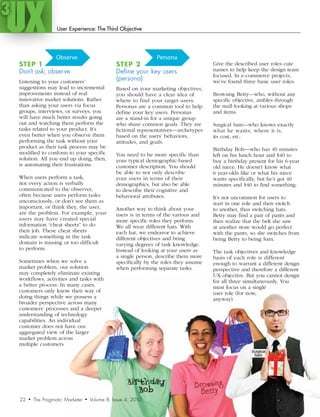
    STEP 1	                                          STEP 2	                                 Give the described user
    Don’t	ask,	observe                               Define	your	key	users	                  names to help keep the design team
                                                                                             focused. In e-commerce projects,
    Listening to your customers’
                                                     (persona)                               we’ve found three basic user roles:
    suggestions may lead to incremental              Based on your marketing objectives,
    improvements instead of real                     you should have a clear idea of         Browsing Betty—who, without any
    innovative market solutions. Rather              where to find your target users.        specific objective, ambles through
    than asking your users via focus                 Personas are a common tool to help      the mall looking at various shops
    groups, interviews, or surveys, you              define your key users. Personas         and items.
    will have much better results going              are a stand-in for a unique group
    out and watching them perform the                who share common goals. They are        Surgical Sam—who knows exactly
    tasks related to your product. It’s              fictional representatives—archetypes    what he wants, where it is,
    even better when you observe them                based on the users’ behaviors,          its cost, etc.
    performing the task without your                 attitudes, and goals.
    product as their task process may be                                                     Birthday Bob—who has 40 minutes
    modified to conform to your specific             You need to be more specific than       left on his lunch hour and $40 to
    solution. All you end up doing, then,            your typical demographic-based          buy a birthday present for his 6-year
    is automating their frustrations.                customer description. You should        old niece. He doesn’t know what
                                                     be able to not only describe            6 year-olds like or what his niece
    When users perform a task,                       your users in terms of their            wants specifically, but he’s got 40
    not every action is verbally                     demographics, but also be able          minutes and $40 to find something.
    communicated to the observer,                    to describe their cognitive and
    often because users perform tasks                behavioral attributes.                  It’s not uncommon for users to
    unconsciously, or don’t see them as                                                      start in one role and then switch
    important, or think they, the user,              Another way to think about your         to another, thus switching hats.
    are the problem. For example, your               users is in terms of the various and    Betty may find a pair of pants and
    users may have created special                   more specific roles they perform.       then realize that the belt she saw
    information “cheat sheets” to do                 We all wear different hats. With        at another store would go perfect
    their job. These cheat sheets                    each hat, we endeavor to achieve        with the pants, so she switches from
    indicate something in the task                   different objectives and bring          being Betty to being Sam.
    domain is missing or too difficult               varying degrees of task knowledge.
    to perform.                                      Instead of looking at your users as     The task objectives and knowledge
                                                     a single person, describe them more     basis of each role is different
    Sometimes when we solve a                        specifically by the roles they assume   enough to warrant a different design
    market problem, our solution                     when performing separate tasks.         perspective and therefore a different
    may completely eliminate existing                                                        UX objective. But you cannot design
    workflows, activities and tasks with                                                     for all three simultaneously. You
    a better process. In many cases,                                                         must focus on a single
    customers only know their way of                                                         user role (for now,
    doing things while we possess a                                                          anyway).
    broader perspective across many
    customers’ processes and a deeper
    understanding of technology
    capabilities. An individual
    customer does not have our
    aggregated view of the larger
    market problem across
    multiple customers.


    22   •   The Pragmatic Marketer   •   Volume 8, Issue 4, 2010
User Experience: The Third Objective
                                                                                                                        3
                                                                                                                           UX
    Persona Triggers Triggers
Persona                                       Desired
                         Triggers Desired Desired                  Tasks           Tasks Metaphors Metaphors
                                                                               Tasks             Metaphors
                                            Outcomes
                                OutcomesOutcomes
       STEP 3	                                  STEP 5	                                   STEP 6	
       Define	your	customers’	triggers          Define	tasks                              Understand	your		
       Every task begins with a trigger         Users perform a series of tasks in
                                                                                          customers’	metaphors
       event. Wouldn’t it be nice to know       order to achieve an objective or          People typically use shorthand terms
       your target customers’ triggers?         desired outcome. While this step          to discuss their tasks. Rather than
       That’s why observation is so much        can be rather involved, you need to       telling someone to “open up the
       more informative than self-reporting     describe the key steps of the task
                                                                                               Two        TwoTwo
                                                                                          word processor, choose the XYZ
                                                                                              Words      WordsWords
       mechanisms. Most users are not           domain from a 10,000-foot level to        Corp Memo Template, using Times
       aware of what triggers an activity.      get a handle on how users’ perceive       New Roman, 12 pt. font, write a
       They more often describe what            their tasks.                              memorandum to the engineering
       triggers them to use your product,                                                 group regarding this decision.”
       but the real trigger event often         You should be able to describe            They simply say “draft a memo to
       occurs much earlier than perceived.      their tasks without specifying your       Engineering.” These shortcuts are
                                                solution, again to avoid automating       often metaphors and metaphors
       Good design is about managing user       their frustrations. Too often we          suggest objectives.
       expectations. Expectations are a         see high-level task analyses
       key component of the trigger event       justifying a company’s solution           Understanding your customers’
       and may point to a user experience       rather than describing the user’s         metaphors helps you understand
       objective. The appropriate focus on      problem domain.                           their objectives from their
       this objective allows you to manage                                                perspective, in their language.
       your users’ expectations.                For example, our first step in            Knowing their language is
                                                designing what has become a very          especially important in
                                                successful online florist website         the next step.
                                                involved observing men buying
 Triggers                Desired                flowers at flower shops, not Metaphors
                                                      Tasks
                        Outcomes
       STEP 4                                   online. What we learned from our
                                                observational research of the high-
       Understand	your	customers’	              level tasks was that the triggers,
       desired	outcomes                         outcomes, and task drivers were
       Users turn to your product to solve      very different from what was
       a problem and have a solution in         supported by the online florist sites
       mind. Typically that solution is just    at that time. This ensured we were
                                                not going to merely automate the   Two
       a part of the desired outcome. For                                       Words
       example, buying flowers online is        current frustrations.
       not the desired outcome. Getting
       out of the doghouse because you          That observational insight led to the
       forgot your anniversary is. These        design approach that supported the
       end-result outcomes are one of           highest average conversion rate on
       the more predominant factors in          the web!
       defining your user experience
       objectives.

       The desired outcome rarely has
       anything to do with your product.
       It is more likely related to something
       generic to the users’ needs. The trick
       is identifying what those needs are
       and how your product can serve
       those needs.


                                                                           The Pragmatic Marketer   •   Volume 8, Issue 4, 2010   •   23
3
 UX
Tasks                     Metaphors

                           User Experience: The Third Objective


                              Two
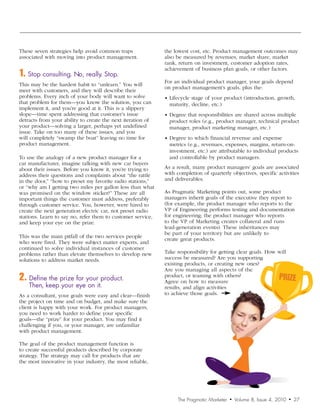
        STEP 7               Words                       money. When the lab director signed    Summary
        Two	words                                        off on the test results, she was
                                                         putting her license and potentially    User experience is about managing
        This is the hard part. Your user                 someone’s life on the line. She had    the customer side of the equation.
        research provides information                    to trust every result before signing   A good UX objective needs to
        to derive a two-word statement                   off on it.                             be specific and measurable just
        that clearly defines your key UX                                                        like good business or marketing
        objective. Why two words? Because                This client’s UX objective became      objectives. To create your user
        it forces you to be very specific.               “Generate Trust.”                      experience objective you must
        Vague objectives drive vague                                                            have a clear understanding of your
        results. Your objective must be                  This two-word objective guided our     business and marketing objectives
        a direct and concise target, not                 design efforts. One design decision    and align with your users’ needs.
        a mission statement.                             revolved around whether to reduce
                                                         the time to complete the task or to    There are seven steps in defining
        For example, a recent medical                    increase the accuracy and eliminate    your user experience objectives.
        device client was experiencing                   errors. Designing for speed often      While the insight that defines your
        lackluster sales of their large-scale            involves the tacit agreement that      objective can occur in any of these
        blood screening systems. Our                     errors will occur. In the case of      steps, you never know which step
        research identified the system                   generating trust, errors were not      it will be, or if separate insight from
        was composed of various dissimilar               an option, so we instead opted         each step combine to form your
        and techie products and interfaces.              for a design paradigm of ensuring      objective, so you must commit to
        In the process of testing blood                  accuracy—sometimes at the expense      the whole process when defining a
        samples, lab techs have to endure a              of speed.                              successful user experience objective.
        dozen quirky interfaces. Errors were
        common, and though recoverable,                  What two-word statement best           At NASA, during the 1960’s, you
        they created doubt in the validity of                                                   could ask anyone—an astronaut,
                                                         typifies your objective?
        the test. If in any doubt, the sample                                                   a flight surgeon, a janitor pushing
        had to be rerun, wasting time and                                                       a broom down the hall at 3 am—
                                                                                                what they were doing there and
                                                                                                they would all answer “going to the
                                                                                                moon.” When everyone on your
                                                                                                team shares a singular focus (your
                            A 20-year veteran in the consulting world, Larry                    two-word objective), great things are
                            Marine is a leading expert in product design, having                not only possible, but probable.
                            designed over 200 projects, with many achieving
                            market dominance success. Larry has worked with
                            many types of products, such as enterprise software,
                            websites, and medical devices, in various types of
                            development organizations from waterfall to stage-gate
                            to agile. Contact Larry at LMarine@IntuitiveDesign.com

                            Sean Van Tyne is the User Experience Director for
                            FICO where he provides leadership for teams across the
                            US, UK, and Asia.Visit Sean at www.seanvantyne.com


        24   •   The Pragmatic Marketer   •   Volume 8, Issue 4, 2010
PragmaticMarketing.com
    Stay current with industry best practices

                  Review 10 years of
             Annual Product Management
             and Marketing Survey results


                Watch a webinar by one
                of today’s industry experts


          Read articles on product management,
            marketing and leadership strategies


                Subscribe to blogs by
           Pragmatic Marketing thought-leaders


                 Participate in online
             networking through LinkedIn,
                 Facebook and Twitter


                Purchase books, clothing
                    and merchandise
Transitioning from                                                   Many product managers transfer into product
                                                                     management from the consulting, customer, or
                                                                     professional services unit within the same company.
Services into Product                                                Over the years, I have observed dozens of people who
                                                                     made this transition—some successfully, and some not.
Management By Steve Tennant                                          A friend is making just such a transfer and provided the
                                                                     inspiration for this article.


SEVEN TIPS FOR SUCCESS                                           She had been working as director of client services,
                                                                 managing several consultants across her geographic
                                                                 region. She has a great network of two hundred
                                                                 customers who like and respect her. Presented with
                                                                   a promotion to a position in product management,
                                                                      she accepted the role. She is now responsible for
                                                                        product management for the very services and
                                          Product     Management          software she used to service clients.

                                                                        She makes her promotion at the same time two
                                          Client Services            junior colleagues were fired by the product management
                                                                     executive. These two product managers were client
                                                                              services superstars who transferred into product
                                                                              management a year ago. What can she do to
                                                                             ensure her fate is different a year from now?

                                                                        While transition from consulting to product
                                                                      management may feel familiar, the behaviors that
                                                                     make you an excellent client services consultant can
                                                                     work against you becoming a great product manager.
                                                                     The work a consultant thrives on—like listening to
                                                                     customers, reacting to, and solving their problems—
                                                                     can actually sow the seeds of your demise in product
                                                                     management. Consultants have a leg up on their peers
                                                                      coming into product management from other functions.
                                                                       They already understand the customer issues your
                                                                         company’s products and services are meant to
                                                                          address. They understand the nuances and details
                                                                            product managers with sales and engineering
                                                                             backgrounds would die for, based on years of
                                                                                first-hand experience implementing or using
                                                                                        products and services.

                                                                                       But there’s the trap. This familiarity is
                                                                                     a mirage for new product managers. In
                                                                                fact, your success depends on sidestepping
                                                                       common transition pitfalls in your new role, unlearning
                                                                     some consulting habits, and quickly learning unfamiliar
                                                                     new product management skills.


 26   •   The Pragmatic Marketer   •   Volume 8, Issue 4, 2010
These seven strategies help avoid common traps               the lowest cost, etc. Product management outcomes may
associated with moving into product management.              also be measured by revenues, market share, market
                                                             rank, return on investment, customer adoption rates,
                                                             achievement of business plan goals, or other factors.
1.	Stop	consulting.	No,	really.	Stop.
                                                             For an individual product manager, your goals depend
This may be the hardest habit to “unlearn.” You will
                                                             on product management’s goals, plus the:
meet with customers, and they will describe their
problems. Every inch of your body will want to solve         •	 Lifecycle stage of your product (introduction, growth,
that problem for them—you know the solution, you can           maturity, decline, etc.)
implement it, and you’re good at it. This is a slippery
slope—time spent addressing that customer’s issue            •	 Degree that responsibilities are shared across multiple
detracts from your ability to create the next iteration of     product roles (e.g., product manager, technical product
your product—solving a larger, perhaps yet undefined           manager, product marketing manager, etc.)
issue. Take on too many of these issues, and you
will completely “swamp the boat” leaving no time for         •	 Degree to which financial revenue and expense
product management.                                            metrics (e.g., revenues, expenses, margins, return-on-
                                                               investment, etc.) are attributable to individual products
To use the analogy of a new product manager for a              and controllable by product managers.
car manufacturer, imagine talking with new car buyers
about their issues. Before you know it, you’re trying to     As a result, many product managers’ goals are associated
address their questions and complaints about “the rattle     with completion of quarterly objectives, specific activities
in the door,” “how to preset my favorite radio stations,”    and deliverables.
or “why am I getting two miles per gallon less than what
was promised on the window sticker?” These are all           As Pragmatic Marketing points out, some product
important things the customer must address, preferably       managers inherit goals of the executive they report to
through customer service. You, however, were hired to        (for example, the product manager who reports to the
create the next generation electric car, not preset radio    VP of Engineering performs testing and documentation
stations. Learn to say no, refer them to customer service,   for engineering; the product manager who reports
and keep your eye on the prize.                              to the VP of Marketing creates collateral and runs
                                                             lead-generation events). These inheritances may
                                                             be part of your territory but are unlikely to
This was the main pitfall of the two services people
                                                             create great products.
who were fired. They were subject matter experts, and
continued to solve individual instances of customer
problems rather than elevate themselves to develop new       Take responsibility for getting clear goals. How will
solutions to address market needs.                           success be measured? Are you supporting
                                                             existing products, or creating new ones?
                                                             Are you managing all aspects of the
2.		Define	the	prize	for	your	product.		                     product, or teaming with others?
                                                             Agree on how to measure
                                                                                                                  PRIZE
    Then,	keep	your	eye	on	it.                               results, and align activities
As a consultant, your goals were easy and clear—finish       to achieve those goals.
the project on time and on budget, and make sure the
client is happy with your work. For product managers,
you need to work harder to define your specific
goals—the “prize” for your product. You may find it
challenging if you, or your manager, are unfamiliar
with product management.

The goal of the product management function is
to create successful products described by corporate
strategy. The strategy may call for products that are
the most innovative in your industry, the most reliable,


                                                                  The Pragmatic Marketer   •   Volume 8, Issue 4, 2010   •   27
Transitioning from Services into Product Management: Seven Tips for Success


3.	Shift	from	“commander”	to	“collaborator.”                    4.		Ramp	up	your	new		
On project teams, in many cases the project manager has
                                                                    product	management	skills.	Fast.
a command and control reporting structure giving them           Although you may feel
control of resources needed for the project’s success. In       comfortable being with the
the hierarchy of the project, “what they say goes.” Not so      same company and with your
for a product team. If you don’t believe me, just go into       level of domain knowledge,
your first meeting and tell the engineers and sales people      you have a huge set of
what to do in the same tone that worked so well with            product management
your project team. Product managers typically have very         skills to learn. You might
few of the product’s key resources reporting directly to        have previously written
them. You must still lead, but through influence rather         specifications for a custom
than authority. You’ll need to influence sales people           software or technology
to take a chance introducing your new product to its            solution, but that’s radically
first customers. You’ll need to explain to engineers why        different than collecting and
creating Feature X is more valuable than Feature Y based        processing input from 20 - 30
on your research. You’ll need to teach trainers to update       representative buyers in the
their training materials, and convince analysts why your        market. You may have prepared
product is the strongest in the industry. You’ll need to        materials to support specific sales
collaborate with customers to understand their needs and        opportunities, but probably not
create products to address them.                                messaging to apply to the majority
                                                                of sales situations. The list goes on.
Leading through influence can be learned, but for most
people, it is more time consuming and requires you to           In fact, product managers
create evidence to support your recommendations. If             tend to perform 30 - 50
you ran projects or groups where you                            different activities,
                just showed up and                              resulting in a job with
                directed the team,                              huge variety of required
                you’ll need to develop                          skills. Examples include
                your collaboration and                          conducting win/loss analysis,
                influence muscles—                              prioritizing new business and market opportunities,
                and gather market                               specifying pricing, developing financial models, defining
                evidence you’ll need to                         personas, sizing markets, forecasting sales, executing
                influence others.                               proven new product processes, conducting competitive
                                                                analysis, building and iterating product prototypes,
                                                                creating product positioning and messaging, managing
                                                                product launches, and developing sales tools and
                                                                training. The list goes on, and most of the activities
                                                                are new to consultants.

                                                                Depending on your product or service, you may
                                                                also find yourself managing third-party partnerships,
                                                                preparing services training, and participating in analyst
                                                                and media relations programs. While these new skills
                                                                are not difficult, many can be like asking a swimmer
                                                                to become a water skier. Sure, both involve water and
                                                                swimsuits, but the similarities end pretty soon thereafter.
                                                                As you probably learned as a consultant, 80/20 rules
                                                                apply for each activity. There are a handful of pitfalls for
                                                                any activity, and a handful of tips for success to help you
                                                                get the job done well. Why re-invent the wheel when
                                                                you can benefit from the experience of others?


28   •   The Pragmatic Marketer   •   Volume 8, Issue 4, 2010
Transitioning from Services into Product Management: Seven Tips for Success


5.	Shift	your	focus	from	“customer”	to	“market.”              •	Most existing customers have a difficult time
                                                                articulating a solution anything significantly different
As a product manager, I suggest you stop listening so           than what they are using today. As Henry Ford said,
much to your customers—again, the opposite of what              “If I’d asked my customers what they wanted, they’d
your consulting instincts tell you. As a consultant, you        have said a faster horse.” Customers are typically
focused on a handful of accounts and tried your best to         poor at defining solutions because they are unaware
meet their needs. Usually succeeded when your client            of what’s possible, and have rarely studied what’s
described the kind of solution they needed—and you              available in the market beyond their initial
could go build it. As a product manager, that strategy          selection decision.
will have you win the battle (and create a great custom
product for one customer) but lose the war (no winning        •	 Customers are unlikely to sense disruptive technical
product for your market). Too often, the loudest voices         trends and ask you to respond to them proactively.
a product manager hears, and therefore listens to, are          Google did not create Google Docs because people
the customers. As a product manager, while customers            using their search engine asked, “Hey, could I also
are an important constituent, they are not your most            store my documents with you?” Google did it because
important constituent.
                                                                they saw the coming technical trend of cloud
                                                                computing and opportunity to disrupt the Microsoft
Here’s why:
                                                                Office franchise of PC-based spreadsheets and
•	 You need many more data points for a representative          Word documents.
  sample of your market—sure, you can include some            So rather than listening just to customers, you’ll want
  customers—but include non-customers and customers           to listen to a balance of:
  of your competitors also. Basing your solution on a
  handful of customer accounts is highly risky, because       •	 People who have bought from you (customers)
  your inputs are more likely to misrepresent
                                                              •	 People who have bought from your competitors
  the broader market.
                                                                (competitors’ customers)
•	 Customers are unlikely to tell you how to attract
                                                              •	 People who have never bought from you or your
  additional non-customers. Your customer already
                                                                competitors (prospective customers)
  bought from you, so by definition, they believed your
  solution beat the competition. They are unlikely to         •	 People who have a sense of new disruptive technical
  know what additional capabilities you need to attract         trends—frequently experts and analysts outside your
  the next set of customers—especially customers who            company, in “fringe” areas
  you are not attracting now.
                                                              •	 Your competitors
•	 If you continue to listen to customers, you are more
  likely to add depth to existing functions and features,
  rather than breadth to your solutions for new or
  adjacent markets. Apple did not create their iPad
  because iPhone customers were asking for a
  larger device, they created a new device for a
  new adjacent market—people who want a
  simple, more casual computing experience
  (and had not bought a desktop computer or
  MacBook laptop). Yet, if you ask iPhone
  customers, there’s a long list of additional things
  they still want the product to do (a better
  network, longer battery life, enterprise
  Microsoft Outlook integration, app to
  make julienne fries, etc.)


                                              Customer                              Market

                                                                   The Pragmatic Marketer   •   Volume 8, Issue 4, 2010   •   29
Transitioning from Services into Product Management: Seven Tips for Success


6.		Solve	the	problems	of	your	buyers		                         7.	No w,	get	out	of	the	building.
     and	users,	not	implementation	consultants.                 The people who dominate your inbox and voice mail
Because you are familiar with so many problems                  are not going to provide the most valuable interactions.
customers experienced—and have experienced many of              In fact, your most valuable meetings are unlikely to
them personally—you assume you are well positioned              take place inside the company’s four walls. Instead of
to develop solutions to solve these problems. Herein            responding to others’ requests for meetings, create your
lies another common pitfall—developing solutions for            problems and solution hypotheses and create a list of
implementers or administrators, but not addressing the          representative companies in your target market, and get
needs of economic buyers or primary business users.             out of the building to talk with them.
Frequently, the problems that made your life miserable
as a consultant lack sufficient importance to your buyers,      For B2B markets, focus first on the needs of buyers, their
and are unable to generate sufficient revenue to cover          evaluation and buying process, and the needs of your
development and sales costs.                                    sales department. Once those needs are understood,
                                                                focus on end users. For consumer markets, the needs of
For example, for a product where configuration is a             end users—who are typically also buyers of your product
huge issue, a former consultant might love the idea of a        or service—should be considered up front.
configuration wizard, because it would make their old
job much easier. A configuration tool streamlines how           Your skills as a project manager will serve you well,
quickly the solution can be implemented, but apart from         because as a product manager, you have a portfolio
a faster implementation, does not change the problem,           of projects to manage. Your success hinges on
the ultimate solution, or its long-term value proposition       understanding your prospective customer’s needs and
—so while it may offer a temporary competitive                  how your solution addresses them better than anyone
advantage, it’s unlikely to be a game changer, unless           else—which you also know better than most. Use these
your buyer is willing to pay sufficiently more for shorter      strengths to your advantage—combined
implementation times to cover incremental costs.                with the tips above—and you’ll
Meanwhile, your product is vulnerable to a competitive          be well on your way to
product manager focused on meeting the buyer’s                  becoming a successful
higher priority needs.                                          product manager.

Similarly, an online benefits solution that “makes data         Best of luck
entry simpler,” while attractive to the end user, may not       on your new
be attractive to a CFO trying to lower health care costs.       journey!
You might have the best user interface, but if you’re
not meeting the buyer’s business need, no one is
going to use it.

Widen your zoom lens by 10x to 100x to find the
bigger problems buyers are willing to spend money on.
Focus your attention on services that are important and
currently unsatisfied for your buyers, then users. Speak
to the organ grinder, not the monkey, my friend!


                Steve Tennant is managing director of Tennant Consulting, a management and marketing consulting firm in
                the San Francisco Bay Area. Since 2001, Tennant Consulting has helped information technology companies
                grow through consulting and advisory services to attract customers and investors. The result? Clients save
                money by avoiding common pitfalls, and increase revenues faster by making products and services that
                customers want to buy. Steve has run and consulted to management and product teams across the IT industry
                from venture-backed startups to the Fortune 100. To contact Steve, visit www.tennantconsulting.com


30   •   The Pragmatic Marketer   •   Volume 8, Issue 4, 2010
Training at
                            Your Office
                          Sign up for the home
                            team advantage

                              Want Pragmatic Marketing
                              to come to you?

                              Benefits

                              •	Ensure	everyone	learns	at	the	same	level	from	
                                start	to	finish
                                          	
                              •	Focus	on	the	material	most	relevant	to	your	
                                company	
                              •	More	of	your	staff	can	attend	
                              •	Discuss	proprietary	issues	in	complete	
                                confidentiality
                                    	
                              •	Save	money	on	travel	expenses	by	having	our	
                                instructor	come	to	you

                              Team Development

                              •	Your	entire	group	will	become	more	productive
                              •	Everyone	will	use	consistent	methods	and	speak	
                                the	same	language
                              •	The	skills	learned	are	practiced	during	the	
                                training	session	—	all	seminars	are	highly	
                                interactive	and	encourage	participation


         PragmaticMarketing.com/onsite
Call (800) 816-7861 to conduct a seminar at your office
Seminar Calendar
  Call (800) 816-7861 or go to PragmaticMarketing.com to register!
  Practical Product Management ®	                                                 Requirements That Work™                                        Effective Product Marketing™
   Introduces a framework that gives product managers the                  Provides a repeatable method for writing clear requirements    Delivers practical tools and processes for product
   tools to deliver market-driven products that people want                your team will read and use. It discusses techniques for       marketing, industry marketing and marketing
   to buy. Focuses on the practical aspects of juggling daily              prioritizing and organizing market requirements and            communication managers who want to improve
   tactical demands of supporting the channel with strategic               clarifies the roles for team members. This approach            their strategic contribution and align with the sales
   activities necessary to become expert on the market.                    enables organizations to deliver solutions that sell.          organization. Learn how to build a repeatable process
                                                                                                                                          to develop, execute and measure go-to-market strategies
   December 6 - 7 (8)*.......... Boston (Bedford), MA                      December 8 ................Boston (Bedford), MA                that ensure product success.
   December 6 - 7 (8)*.......... Tampa, FL                                 December 8 ................Tampa, FL
   December 7 - 8 (9)*.......... Phoenix (Scottsdale), AZ                  December 9 ................Phoenix (Scottsdale), AZ            December 6 - 7 .............San Francisco (Burlingame), CA
   December 13 - 14 (15)* ... San Francisco (Burlingame), CA               December 15 ..............San Francisco (Burlingame), CA       February 2 - 3 ..............Atlanta, GA
   December 14 - 15 (16)* .... Philadelphia, PA                            December 16 ..............Philadelphia, PA                     March 21 - 22 ...............Boston (Downtown), MA
   January 19 - 20 ................ Orange County (Irvine), CA             February 2 ..................Atlanta, GA
   January 24 - 25 ................ Boston (Bedford), MA                   February 24 ................Denver (Littleton), CO
   January 24 - 25 ................ San Francisco (Burlingame), CA         February 24 .................Santa Clara, CA
   January 31 - 1 (2)* .......... Atlanta, GA                              February 25 ................Toronto, ON, Canada
   February 22 - 23 (24)* ..... Denver (Littleton), CO                     March 2 ......................Boston (Downtown), MA
   February 22 - 23 (24)* ..... Santa Clara, CA                            March 2 ......................San Francisco (Burlingame), CA
                                                                                                                                                Product Launch Essentials™
   February 23 - 24 (25)* ..... Toronto, ON, Canada                        March 23 ....................Chicago, IL                       AssessEffective Product Marketing
                                                                                                                                                 organizational readiness and define team
   February 28 - 1 (2)* ......... Boston (Downtown), MA                    March 30 .....................New York, NY                     responsibilities for a successful product launch.
   February 28 - 1 (2)* ......... San Francisco (Burlingame), CA
   March 14 - 15 ................... Seattle, WA                                                                                          December 8 ..................San Francisco (Burlingame), CA
   March 21 - 22 (23)* ......... Chicago, IL                                                                                              March 23 ......................Boston (Downtown), MA
   March 28 - 29 (30)* ......... New York, NY
   *Day 3 is Requirements That Work

A discount is available for groups of three or more.                  Living in an Agile World™
 Don’t see a date or location that works for you?
Let Pragmatic Marketing come to your company!                        Shows how product management can ensure an Agile                     December 16 ..San Francisco (Burlingame), CA
     Call (800) 816-7861 for more information.                       development team remains aligned to company strategy.                January 26 ....Boston (Bedford), MA
                                                                     From creating user stories grounded in market problems to
                                                                     managing a backlog prioritized with market evidence.

The Pragmatic Marketer Volume 8 Issue 4

  • 1.
    Volume 8 • Issue 4 • 2010 The journal for technology product management and marketing professionals ® 150 5 Lessons from startup pitches User Experience: The Third Objective Transitioning from Services into Product Management: Seven Tips for Success
  • 2.
    Executive Briefing The proven way to create effective product management and marketing teams. • Review key concepts of the Pragmatic Marketing Framework, the worldwide standard for product management and marketing. Business Marketing Positioning Plan Plan • Learn techniques leaders can use to accelerate adoption. Pragmatic Marketing Market Market Buying Customer Pricing Problems Definition Process Acquisition • Designed specifically for senior management. Win/Loss Distribution Buy, Build Buyer Customer Framework Analysis Strategy or Partner Personas Retention Distinctive Product Product User Program Competence Portfolio Profitability Personas Effectiveness STRATEGIC TACTICAL MARKET STRATEGY BUSINESS PLANNING PROGRAMS READINESS SUPPORT Competitive Product Launch Sales Presentations Innovation Requirements Landscape Roadmap Plan Process & Demos eaders ed In L te success of Tunpany CEOs creahy most fail) m w gy co (and Technology Use Thought “Special“ The How te chnolo Assessment Scenarios Leadership Collateral Calls Status Lead Sales Event ott Dashboard Generation Tools Support rman Sc vid Mee Myers & Da g Stull, Phil by Crai Referrals & Channel Channel Get a free e-book at References Training Support © 1993-2010 Pragmatic Marketing PragmaticMarketing.com/secrets PragmaticMarketing.com/seminars Call (800) 816-7861 to conduct this seminar at your office
  • 3.
    Inside this issue: Volume 8 Issue 4 • 2010 Creator of the world’s most popular 4 5 Lessons from 150 Startup Pitches product management and marketing seminars By Jason Cohen Obtaining hundreds of thousands or About Pragmatic Marketing® even millions of dollars from investors Since 1993, Pragmatic Marketing has is not as simple as knocking on the conducted product management and door and asking for money. It takes marketing training for 5,000 companies careful planning and a focus on in 23 countries. Our team of industry presenting your request in the best thought-leaders produce blogs, webinars, possible light. Are you making errors podcasts, and publications read by more in your business pitch? than 100,000 every year. The Pragmatic Marketer ™ 8910 E. Raintree Drive Scottsdale, AZ 85260 Pragmatic Marketing, Inc. 20 User Experience: The Third Objective By Larry Marine and Sean Van Tyne Craig Stull / Founder and CEO Conventional wisdom holds that the true Kristyn Benmoussa / Editor-in-Chief measure of your product success is in Graham Joyce / Managing Editor how well it meets your business and ————————————————— marketing objectives. But what about Interested in contributing an article? the third objective—user experience? PragmaticMarketing.com/submit No part of this publication may be reproduced, stored in any retrieval system, or transmitted, in any form or by any means, electronic, mechanical photocopying, recording or otherwise, without the prior written permission of the publisher. Other product and/or company names mentioned in this journal may be trademarks or registered trademarks of 26 Transitioning from Services into Product their respective companies and are the sole property Management: Seven Tips for Success of their respective owners. The Pragmatic Marketer, a Pragmatic Marketing publication, shall not be liable By Steve Tennant regardless of the cause, for any errors, inaccuracies, omissions, or other defects in, or untimeliness or Many product managers transfer into product unauthenticity of, the information contained within this management from the consulting, customer, magazine. Pragmatic Marketing makes no representations, or professional services unit within the same warranties, or guarantees as to the results obtained from the use of this information and shall not be liable for any company. Not all people make this transition third-party claims or losses of any kind, including lost successfully. Use these tips to be on your way profits, and punitive damages. to becoming a successful product manager. The Pragmatic Marketer is a trademark of Pragmatic Marketing, Inc. Printed in the U.S.A. All rights reserved. ISSN 1938-9752 (Print) ISSN 1938-9760 (Online) The Pragmatic Marketer • Volume 8, Issue 4, 2010 • 3
  • 4.
    150 5 Lessons from startup pitches By Jason Cohen 4 • The Pragmatic Marketer • Volume 8, Issue 4, 2010
  • 5.
    A re youstarting a company? Looking to grow? Many founders turn to venture capital firms, angel investors or incubators as a source of funding. But obtaining hundreds of thousands or even millions of dollars is not as simple as knocking on the door and asking for money. It takes careful planning and a focus on presenting your request in the best possible light. One that shows you have a serious proposition deserving of the investor’s time and money. I work at a startup incubator and review hundreds of pitches a year. Most are on paper and video but some are invited to pitch in person. Over the course of these presentations, some interesting patterns emerge: • Everyone makes the same types of errors • The errors are not specific to raising capital but with the business concept or the founder’s attitude • Those who avoided just one of these errors stood out from the crowd The Pragmatic Marketer • Volume 8, Issue 4, 2010 • 5
  • 6.
    Are you makingthese errors in your business (start-up or not) ? Invalid competitive advantages “Superior SEO” and “unique features” are not competitive advantages. Lacking an unfair advantagE You need one killer advantage no one can beat beat (because you might get beaten on everything else!). everything else!). No one said they’d buy it You don’t need statistically significant studies, but it’s studies, but it’s astonishing how many blaze ahead before they’ve before they’ve found even a single person willing to give them money. them money. Incorrect positioning against the competition The two faults here are opposites: Believing that Believing that uniqueness means competition doesn’t exist, or exist, or defining yourself by the competition instead of instead of constructing your own message. No significant route to customers If your marketing strategy is to run A/B tests tests and build RSS subscribers, you’ve already lost. already lost. 6 • The Pragmatic Marketer • Volume 8, Issue 4, 2010
  • 7.
    5 Lessons from150 Startup Pitches Error holdings. Every mp3 player uses multiple patents, but that didn’t stop passion? But in this context it’s like saying, “My children are going to be Invalid competitive advantages Apple from winning. more successful because I love them more than you love yours.” Every pitch I see has a section on competitive advantages, and nearly We’re better at SEO every time the claimed competitive and social media We’re cheaper advantage is not, particularly when 80% of Americans believe they are It’s not bad to be cheaper. The everyone else claims the same better-than-average drivers. Can’t be key is you cannot compete solely advantage as you! true, right? Well 80% of folks I meet on price because all a competitor tell me they’re better than average has to do is lower their price. The following are not competitive at SEO, Twitter, and “building Established companies can destroy advantages: communities” (whatever that means). you with the “loss leader” strategy. Remember when Microsoft put Social media and SEO is ever- hundreds of developers on Internet We have feature “x” changing quicksand. You’re on top Explorer and gave it away for This is an advantage only until of Google today, gone tomorrow. free, destroying the market for others copy it, so it’s not a long- Other companies being good—or web browsers? term protection against competition. better—is completely outside your Indeed, the next company can observe what works and what doesn’t, and then improve on control, so claiming you have a sustainable advantage is poppycock. LESSON your innovation. So where does that leave us? We have three PhDs/MBAs We have the most features The landscape of successful You live in the era of a flat world startups is littered with people where millions of people have It’s common for older products to lacking post-graduate education. If compete on having more features access to technology, education, you’ve lived in the software world and a powerful sales, marketing, than newer, competing products. you know what they teach you in The trouble is, customers rarely and communication platform school is often irrelevant, so who (the Internet). want more features, they want the cares what degree you hold? In all right features. As everyone adds the interviews you’ve read about features, products reach critical mass You live in the era where the founders’ success, how many credit most powerful programming where all have 80% of the features their MBA program? How many customers want, and then having frameworks and tools are free, local even have MBAs? It’s not bad to broadband and high-availability “more” is no longer an interesting have a degree, but neither is it a selling point. servers are cheap, and world-class significant advantage. people are willing to work 60 We’re patenting our features hours/week in exchange for free We work hard food and the chance to be part “No one can compete with my blog and we’re passionate of a cool new startup. because it’s copyrighted.” Silly, right? You hear about guys working 30 hours per week (or less), so you There’s too much energy, availability, That’s what it sounds like when figure if you work a “healthy” 70 intelligence and opportunity in claiming a software patent will hours per week, you’ll win! But the world to hide behind outdated protect you from competition. working harder is not, in fact, notions of intellectual property. Except in certain industries (e.g. smarter. And even if you could food, drug, medical), I’m unaware work 70 on-task hours per of companies who stave off quality Almost anything can be copied. In week, that’s still blown away by fact, I’d claim that anything of any competitors through patent 10 developers at a well-funded value will be copied. It should be company or even 10 passionate part of your business plan that other open source developers working part-time. And who doesn’t have people will copy you. The Pragmatic Marketer • Volume 8, Issue 4, 2010 • 7
  • 8.
    5 Lessons from150 Startup Pitches Error No, wait, I’m sorry, the real question is: What are you going to do when LESSON Lacking an unfair advantage there are four totally free, open- The only real competitive advantage source competitors? is that which cannot be copied and Fortunately there’s plenty of cannot be bought. ways to have true advantages No, wait, I forgot, actually the that competition cannot readily question is: What happens when Like what? overcome. Unfortunately, they’re employee #2 makes off with your difficult and rare. And you thought code and roadmap and marketing creating and running a successful, data and customer list and starts Insider information untouchable startup was easy? selling your stuff world-wide at The only way to consistently make one-tenth the price? money on Wall Street is to have How would you answer “What if a insider information! Although it’s big company copies your idea and The good news: There are answers illegal (and people occasionally go develops the same website as yours to all these questions! to jail for it), those in the know will after your website goes public?” tell you it’s not uncommon. But, using intimate knowledge of an The bad news: Almost no one industry and the specific pain points Not the right question! The one I talk to has good answers, but within an industry is a perfectly you should answer is: What are they think they do. And that’s legal unfair advantage. you doing now knowing that a big fatal, because it means they’re not company will copy your idea? working towards remedying that situation. Which means when one Here’s a real-world example. Adriana of the above scenarios happens, has been a psychiatrist for 10 years; No, wait, the real question is: What it will be too late. she understands the ins and outs are you going to do when another of that business. During a lull in smart, scrappy startup copies your her practice she got an opportunity idea, and gets $10M in funding, and Anything that can be copied to shift gears completely and is thrice featured on TechCrunch? will be copied, including features, ended up leading software product marketing material, and pricing. development teams. (Turns out that Anything you read on for big-business project management popular blogs is also read it’s more valuable to be a sensible by everyone else. You thinker and counselor than to be don’t have an “edge” just an expert in debugging legacy because you’re passionate, C++ code.) hard-working, or “lean.” Now Adriana has an epiphany: In her opinion, traditional practice-management software for psychiatrists is not very good; she knows both the pain points and the existing software first-hand. But now she has the vision and ability to design her own software. Adriana holds a unique position: Expert in the industry and able to “geek out” with her target customer, yet capable of leading a product team. Even if someone saw Adriana’s product after the fact, it’s almost impossible to find a person—or even assemble a team— with more integrated knowledge. At best, they could copy. Of course by then Adriana has moved on to version two. 8 • The Pragmatic Marketer • Volume 8, Issue 4, 2010
  • 9.
    5 Lessons from150 Startup Pitches Single-minded, uncompromising However it’s not enough for a To remain un-copyable, your One obsession with One Thing feature to merely be unique because Thing needs to be not just central A “Unique Feature” could be a it’s still easily duplicated. Rather, this to your existence, but also difficult competitive advantage in some requires unwavering devotion to the to achieve. Google’s algorithm, circumstances. Some examples One Thing that is (a) hard, and (b) combined with the hardware and of a feature being a company’s you refuse to lose, no matter what. software to implement a search of primary advantage are: millions of websites in 0.2 seconds, Google has spent hundreds of is hard to replicate; it took hundreds • Google’s search algorithm was millions of dollars on their search (thousands?) of really smart people just better, therefore they won the algorithm, the single biggest focus at Microsoft and Yahoo years to eyeballs, therefore they were able of the company even today, a catch up. 37signals’ platform—a to monetize. Sure, others are good decade after they decided that was blog with ~140k followers and now, but the advantage lasted their One Thing. They refuse to be a best-selling book—is nearly long enough. beaten by competitors or black-hat impossible to build even with a hackers, whatever it takes. full-time army of insightful writers. • Photodex is a little company you’ve never heard of where 37signals can build simple software Being “hard to do” is still a true I worked in the 90’s. We made and earn three million customers advantage, particularly when you an image browser with thumbnail because they absolutely will not devote your primary energy to it. previews so you didn’t have to compromise on their philosophy open each file individually to see of simplicity, transparency, and Personal authority what it was. Our advantage was owning their own company, and Chris Brogan commands thousands that’s something millions of people of dollars for a single day of speed. Not the best, not the most respect and support. consulting in an industry (social stable, didn’t read the most media marketing) where all the formats, didn’t have the most information you need is already features, just “fastest.” For many online and free. Joel Spolsky users of that product, speed wins. makes millions of dollars from bug tracking software—an industry with hundreds of competitors and little innovation. How can you earn this overwhelming advantage? Unfortunately all this “authority” takes years of expensive effort, and even then success is probably due as much to luck as anything else. So is it worthwhile? Yes, exactly because it takes years of effort and a little luck. Authority cannot be purchased You can’t raise VC money and then “have authority” in a year. A big company cannot just decide they want to be the thought-leader in their field. Even a pack of hyper-intelligent geeks cannot automatically become authorities because it’s not about how well you can code. The Pragmatic Marketer • Volume 8, Issue 4, 2010 • 9
  • 10.
    5 Lessons from150 Startup Pitches But how does authority convert In each case, the founders were As a company becomes successful to revenue? super-smart, had complementary it gains momentum, which means skill sets, worked well together (or it’s going in one direction with Here’s a personal example: I well enough to reach important one philosophy. Like physical give talks on peer code review success milestones), and as a team momentum, change becomes at conferences. My competition represented a unique, powerful, and harder to affect. pays thousands of dollars for a (in retrospect) unstoppable force. booth, then spends thousands Of course the world is changing, advertising to attendees begging Of course that’s easy to see in and in particular your customers them to visit the booth, then retrospect, and retrospect is a are changing. Normally this leaves gives sales pitches at the booth terrible teacher, but the principle room for the next competitor, but if to passersby who are also being can work for any startup, especially you’re already entrenched you can bombarded by other pitches and when your goals are more modest leverage your existing status, insider distracted by the general hubbub. than being the next Google. knowledge, and revenue stream as long as you’re willing to change too. Whereas, because I’m a known Of course a Dream Team doesn’t authority on code review and guarantee success but it significantly You have more money, you’re software development, I get to talk reduces the risk of a startup, and better known, you have existing for an entire hour to a captive, is difficult for the competition happy customers to help spread the undistracted group of 100 people, to duplicate. word, you have employees to build self-selected as interested in code new things, and you have more review. After the talk, many people This is especially true when experience with what customers want to chat one-on-one. Some head someone on the team is already actually do and need, which means straight to the booth to get a demo; successful in their field, e.g. with you should have the best insight. for many I give a private demo of a massively successful blog, or big the product on sofas in the hallway. startup success, or a ridiculous Any new competitor would kill It’s not unusual to get several sales Rolodex. Since those are the kinds for just one of these advantages. over the next three months from of competitive advantages that can’t If you’re not using them, how silly people who saw me speak. be bought or consistently created, is that? Companies don’t get killed having that person on the team is by competition; they usually find Now add to that the effect of a blog by proxy a killer advantage. creative ways to commit suicide. that tens of thousands of people read? And the effect on sales of my Existing customers Imitation might be the sincerest form book on code review? Everyone you’ve ever sold to of flattery, but it still stings when possesses the most valuable market someone does it to you. Earning authority is expensive and research imaginable, and it’s the one time-consuming, no doubt. But it’s thing a new competitor absolutely Of course you can still battle it out also an overwhelming, untouchable will not have. in the marketplace, but you need competitive advantage. something that can’t be duplicated, This is kind of a cheat, because something they could never beat The dream team everyone says “I listen to my you on, then hang your hat on that The tech startup world is littered customers,” which (nowadays) is just and don’t look back. with famous killer teams: Gates & as overused as “We’re passionate,” Allen, Steve & Steve, Page & Brin, but it’s true that if you’re actively Fried & Heinemeier Hanson. learning from your customers and you never stop moving, creating, innovating, and learning, that puts you ahead of most companies in the world. 10 • The Pragmatic Marketer • Volume 8, Issue 4, 2010
  • 11.
    Product Launch Essentials ™ Plan and execute a successful product launch Are your product launch efforts focused on deliverables rather than results? Launching a product is more than following a simple checklist. A successful product launch is the culmination of many, carefully planned steps by a focused, coordinated team. Even good products can fail because of organizational issues, misunderstanding of roles and responsibilities, and a lack of a strategic approach to guide efforts. • Learn a repeatable product launch process to shorten the launch planning cycle, get the resources needed, and know what to expect at every step. • Understand the seven product launch strategies your team can use to maximize sales velocity. • Measure product launch progress with indicators that identify unforeseen issues before they become big problems. Get a free e-book at Daniel s PragmaticMarketing.com/launch id By Dav Download a complete agenda and register at PragmaticMarketing.com/seminars Call (800) 816-7861 to conduct this seminar at your office
  • 12.
    5 Lessons from150 Startup Pitches Error “I’m scratching my own itch. Since I’m my own target “My customers can’t understand mock-ups. I have to build it first.” No one said they’d buy it customer, I already know You shouldn’t need screenshots or what to build.” slides to convince someone in your Of hundreds of startup pitches I’ve heard, almost none had unearthed Oh! I didn’t realize your typical target market that what you’re doing ten people willing to say, “If you customer is observant enough to is compelling. If your concept is so build this product, I’ll give you $X.” recognize monetizable pain, creative esoteric you can’t describe it in 30 enough to invent products, able to seconds, it’s either too complex or convince others to work for free and you don’t understand it yourself. Meditate on this: Hundreds of invest money and time with you, people ready to quit their day jobs, and passionate enough to quit their Even if I concede that some folks burn up savings, risk personal job to pursue unproven ideas. can’t grok mock-ups, remember reputation, toil 70 hours per week, absorb as much stress as having a that your first customers will by baby (believe me, I’ve done both).... By definition, if you’re a startup definition be early-adopters who are all without identifying even ten founder you’re explicitly not OK with alpha software. If you can’t people actually willing to pay for your customer. find a few of those and get them what they’re peddling. excited about your product, maybe “Scratching your own itch” is just your product isn’t exciting. Short-sighted, no? If you can’t find a start. It’s the spark of inspiration, ten people who say they’ll buy, your not the strategy. It’s the grain of “I’m not good at sales/marketing; company is dead before it starts. sand tickling the oyster, not the I need to build a product so pearl. In fact I challenge you to find compelling it sells itself.” one founder of a real business who The world is filled with decent thinks “I’m the customer” is the only products that make no money! market validation you need. If your goal is a business (not a hobby), building charming, novel “There are millions of potential software isn’t enough. customers, so it doesn’t matter what only ten of them think. You and I know you have the ability I need to just start; later I can to build cool new software. We survey and learn something agree that will be fun and exciting. statistically significant.” But that’s not going to create If there are millions, it’s trivial a business. to find ten. If you can’t find even ten, then either there’s not Writing code is what you love, so millions or those millions aren’t you myopically decide that’s what interested in you. you’ll do. But what you should do is just the opposite: Attack the part Businesses don’t start with millions of the business you’re least sure of, of customers, they start with one, you’re least qualified for. then ten, then a hundred, and then a thousand. But most don’t If you’re still not convinced, think get past ten. of it as project risk management. In a big software project do you If you haven’t gotten ten to tackle the high-risk, ill-defined stuff at least say they’ll buy, where first, or do you postpone that to do you get your hubris to the end? Obviously you address the proclaim that thousands unpredictable stuff first—most of the actually will buy? project risk is due to the unknown, 12 • The Pragmatic Marketer • Volume 8, Issue 4, 2010
  • 13.
    5 Lessons from150 Startup Pitches so the earlier you can sort out uncertainty the more time you have to deal with the consequences. I’m making the same argument, except the “high-risk unknown” is “everything that’s not code.” Your code will be good enough; it’s the other stuff that will probably sink your ship—unable to find customers or unable to convince the target audience they should open their wallets. No sense in postponing it. “My friend/brother/co-worker/ dentist thinks it’s a great idea.” Error • “No one is doing it like we are.” Your mother thinks you’re smart Incorrect positioning Of course you’re going to position and good-looking, but that doesn’t against the competition your company with a unique mean I do. offering: exclusive features, a After seeing hundreds of startup distinctive culture, a refreshing It doesn’t matter what non- pitches, I can tell you the two most pricing plan, an innovative sales entrepreneurs think because common errors in positioning a strategy, etc. But uniqueness they’re not versed in product/ company against competition are, doesn’t imply lack of competition! market fit or squeezing blood strangely, opposites: from evanescent budgets. In fact • “There’s no competition because it only barely matters what real this is an industry that has entrepreneurs think, because they’re • Claiming you have no competition never used software to solve not expert in your problem domain, • Defining your company’s offering this problem.” they might have outdated notions, and positioning by combining “the they might be biased against certain I know that sounds like a good ideas and technology, and they best” traits of six competitors. thing, but what this also implies carry baggage from good and bad This isn’t just a problem when is you’ll have to convince people experiences (due as much to timing pitching—it’s a problem with you to trust software, and that’s a and luck as anything else). defining who your customers are, disadvantage. You’re competing what they want, and your role in the against the status quo. LESSON marketplace. • “There’s no competition Let’s break down the ways these because people haven’t realized The only thing that matters it’s a problem.” is that people are willing to fallacies manifest and what you give you money! can do instead. If they don’t already know they have the pain, the sales process is Business “experts” can argue all There is no competition going to be excruciating. There’s a day that it makes no sense to buy Here’s what I hear and think: word for that—evangelism—which shoes over the Internet, but as long conjures other words: Expensive, as people give Zappos $1 billion • “I have no competitors.” difficult, time-consuming. per year, it doesn’t matter what experts say. Either you’re ignorant of direct competition, or you’re When ten people say they’ll give not considering alternate solutions you money if you build this thing, like “build it yourself.” that’s the only validation that counts. The Pragmatic Marketer • Volume 8, Issue 4, 2010 • 13
  • 14.
    5 Lessons from150 Startup Pitches Defining your company • “We’re just like competitor X, So how do you look inward to by the competition only we’re Y.” establish your company, contrasting Your company is defined by its own with the competition but not letting strengths, values, customers, and In this case you’re betting your the competition dictate your identity? products, not by how it compares future on the fact that Y is with other companies. You need overwhelmingly compelling to a • We’re targeting the market a strong position, something large market segment. X segment defined by X, Y, and Z. that would be equally clear and automatically has advantages over We’ve spoken with 20 potential compelling even if competitors you (brand, customers, revenue, customers who match at least two didn’t exist. inside knowledge, a team, of those criteria, and they agree momentum), so Y had better be our product is exactly what they Here’s some ways this mistake brain-exploding awesome. Oh, need and none of our competitors manifests: and it’d better be impossible are doing an acceptable job for X to implement Y—or even addressing their issues. • “We combine the best traits of our one-third of Y—themselves. Talk competitors, letting them show the about putting your fate in others’ • Our company has core value X way to our success.” hands! that we exude everywhere from our SEO to our tech support to I like the idea that you can learn our product. (Example value: • “We’re the same as X, only cheaper.” from the mistakes and successes Simplicity. A simple product with of similar companies, but Being cheaper is a strategy, but few features, low-cost, pain-point “combining the best” misses the it can’t be your only strategy. It’s obvious, not tackling complex point. There are specific tradeoffs too easy for competitors to change problems, focused on making each of those companies are price or offer deals. Typically life easier rather than on saving making; things you see as “not the best customers aren’t price- money.) We own this value best” might in fact be best for their sensitive anyway, so you’re because we’re completely target market. Why are you so actually biting off a less desirable committed; this is the one point sure your notion of “best” will segment of the market. Often this on which we will never result in enough customers who claim is paired with “We’ll do 70% compromise. Our customers know not only agree with you, but are of the features for 50% of the it and value this too, which is why so convinced they’re willing to price,” but supplying less for less it doesn’t matter what features, switch to you? is not inspirational. prices, or advertisement our competitors have. • The rubric. A chart with one row for each “feature” and one column for each of six “competitors.” There’s checks and X’s everywhere, except of course a glowing, highlighted column representing your company which just happens to be full of checks. Do you really expect someone to believe this? 14 • The Pragmatic Marketer • Volume 8, Issue 4, 2010
  • 15.
    5 Lessons from150 Startup Pitches • This is the competitive matrix. Note that each player in this space LESSON • Our target customer has traditionally solved this pain is targeting a different market If you’re tempted to argue that themselves or just lived with the segment, as is clear from feature you’re the exception, here’s how pain rather than paying for relief. selection, pricing, and advertising/ to elucidate the advantages you’re A combination of newly-available messaging. We, too, are targeting seeing, but in a way that actually technology and modern mindset a niche; as you can see our makes sense as a business strategy: makes this the right time for a offering is consistent with owning new software play. that niche, and doesn’t overlap • We’ve carved out a niche specific enough that no one is actively • It’s true this industry hasn’t yet significantly with competitors. It would be difficult for any of them targeting. There are similar seen a software solution, but that’s to “switch” into our niche, because competitors A, B, and C, but not because they hate computers, as you can see they’d have to they’re not targeting this niche but rather that it hasn’t been change the product, pricing, and because of X, and would be possible to address that market their company’s persona; that’s a hard for them to switch into this with software. Now it is because risk we’re willing to take. niche because of Y. In fact, it’s (pick one): quite possible that we’d end up − We’ve built an improbable team • We’re going after competitor X. partnering with or being bought We know they already have a that spans geeks and industry by A, B, or C because our idea is insiders. ton of advantages over us— similar but out of their reach. well-known, well understood, and − New hardware/networks have a deep feature list. However they • We’ve identified a market too just appeared which makes this haven’t done anything new in small for the large, established possible. three years and we have evidence players to address, but big enough their customer base is not happy. to build a company. Because the − New attitudes enables new Not only that, they’re famous for 800-pound gorilla is inefficient at workflows (e.g. ubiquity of annoying attributes A, B, and C building new software, it can’t go Facebook even among (Examples: buggy, slow, confusing, after a market unless there’s a traditional technophobes). expensive, bad tech support). We billion dollars at stake. We think − This industry is commoditized see huge opportunity in their there’s a solid business to be so giving a player the slightest wake of destruction, vacuuming made in this hundred-million- edge is a big deal. up their customers with our dollar market. However, where overwhelming advantage. They the giant can’t afford to build this − This industry is just now can’t do this themselves because from scratch, if we show good starting to show tangible signs they’re too big to turn the ship, growth and profits we would of embracing technology. and anyway the past three years be an obvious acquisition target for them. − We have three lead customers have shown they’re not able to change. signed up as alpha testers; • We’ve created technology so if we make them successful the different from the incumbents that case studies will be all the we’re changing the conversation evangelism we’ll need. about how people solve this pain. Though it’s different, your solution is very easy to describe and use (e.g. the way Netflix changed movie watching at home). The Pragmatic Marketer • Volume 8, Issue 4, 2010 • 15
  • 16.
    5 Lessons from150 Startup Pitches Error No significant route to customers Ask a technical founder about his startup, and he’ll proudly describe his stunning software—simple, compelling, useful, fun. Then he’ll describe his cutting-edge platform— cloud-based, scalable, distributed version control, continuous The obvious problem is every new buttons. Buttons are good—but integration, one-click-deploy. startup on Earth says exactly these they don’t make your product Maybe you’ll even get a things. Nowadays the “strategy” intrinsically viral. wobbly demo. above sounds like: Which is OK—not all products need “Great,” I always exclaim, sharing “We’ll have a website so people to be viral! But if it’s not viral you the thrill of modern software can read about us.” still need a killer method of finding development, “so how will people customers, and if it is supposed to find out about this brilliant product?” “We’ll have an email address so be viral it better be encoded in the people can communicate with us DNA of the application, not bolted Cue silence… Then a smile breaks without picking up the phone.” on as an afterthought. across the founder’s face: Yes, you’re going to do those things, Frightening honesty “We’re going to A/B-test AdWords but since millions of other people Balsamiq Mockups is a popular campaigns until we discover are doing that too, you’re still wire-framing tool. What sets our hook.” invisible. No visibility = fail. them apart isn’t prescient feature selection or bug-free releases, it’s LESSON “We’re going to A/B-test our their startling transparency. Revenue landing pages until the right figures are published even when message appears.” they were still pathetic. The founder So what can you do to rise above pledged loudly and eagerly to give the cacophony that is the Internet? away lots of free copies to non- “We’re better than everyone else at SEO.” profits, and he revealed all his Infection built-in, not bolt-on (remarkably effective) marketing WhenBusy lets people schedule strategy even though it meant “A friend of mine knows how meetings in currently-available competitors would learn them too. to get popular on Twitter.” time-slots without having to share your calendar. Instead of trading He didn’t just have an “authentic “We’re going to get reviews emails with lists of available on blogs.” voice,” he made public promises. time-slots, you send the link That’s compelling. to your calendar page and the “We’re going to start with our other person uses the product to own network and grow it He didn’t just “tell it like it is,” schedule a meeting. This is the he gave up his marketing secrets from there.” viral step: Having trialed the tool, and opened his company books. the stranger might use it herself, That’s newsworthy. “We’re going to use an affiliate then more people find out about program so our customers sell it, and so forth. it for us.” This isn’t merely “being human” it’s almost too much honesty! Note that at no point did I say “a “We’re putting a ‘Retweet’ button button lets people ‘like’ this on inside the product to encourage In a world where everyone and their Facebook.” I know of no companies viral growth.” brother is “joining the conversation,” who have “gone viral” because of you have to truly bare your soul if you want to compete on the 16 • The Pragmatic Marketer • Volume 8, Issue 4, 2010
  • 17.
    5 Lessons from150 Startup Pitches transparency front. It’s not for better lead quality, a more efficient It’s always fun to tell a journalist everyone, and I’m not suggesting conversion rate, and straightforward like you that we enable software it ought to be, but there’s no sense trials with minimal tech support. Of developers to review each other’s in going half-way. course it’s not quite that simple but code because your reaction is it’s a step in the right direction. always: “Wait a minute, you’re Tell a story seriously telling me they don’t The number one mistake founders At first when someone asked do this already?” The idea make when trying to generate press what my company’s tool suite was, of editing and review is so is talking about what the company I would say: embedded in your industry you does rather than telling a compelling can’t imagine life without it, and story. Without a powerful narrative, Smart Bear makes data-mining you’re right! You know better your chances of getting big tools for version control systems. than anyone how another set of press and enthusiastic users who eyeballs finds important problems. spread the word are somewhere It’s a description so esoteric that, around zero. although accurate, not even a Of course two heads are hardcore geek would have any idea better than one, but developers It took me five years to figure out what it is, much less why it’s useful. traditionally work in isolation, (a) I needed a story and (b) what mainly because there’s a dearth the story was. It’s hard. But one Years later, when it was clear that of tools which help teams bridge story beats a pile of AdWords code review software became the social gap of an ocean, A/B tests. our sole focus, I got better at integrate with incumbent tools, describing it: and are lightweight enough to still be fun and relevant. Advertising [transmogrification] Revenue You know how Word has “track changes” where you can make That’s what we do: Bring I know that nowadays marketing is modifications and comments and the benefits of peer review about “relationships” and “authority” show them to someone else? We to software development. and other things which cost time but not money. But don’t be so do that for software developers, quick to throw out the idea of integrating with their tools instead Now the reason for excitement spending money to make money. of Word and working within their is clear: We’re transforming how Advertising isn’t dead; you can standard practices. software is created, applying the age still buy eyeballs. I’m not talking old techniques of peer review to an about “triage” strategies like Better, yes, and for a while I industry that needs it but where it’s buying AdWords linking to a page thought I nailed it, but still no traditionally too hard to do. of ads, I’m just pointing out that press. Eventually (thanks to helpful most companies don’t depend journalists) I realized I was still just on “joining the conversation” to describing what it is rather than That’s a story! acquire customers. why anyone cares. I left it up to the Follow these simple guidelines and reader to figure out why they should set yourself apart from the masses It sounds simple: The average get excited. who continue to make the errors cost of acquiring a customer is $C identified in this article. With a little (advertising, sales, support, doing Eventually I developed stories like time and careful preparation, your demos) and the lifetime revenue you the following, each tuned to a pitch for funding should impress get from that customer is $R, so if certain category of listener. Here’s investors and hopefully you get the C < R you have a business. C can the one for the journalists: financial support to begin the next be driven down with cheaper ads, phase of your company’s plan. Jason Cohen has started four companies (including WPEngine and Smart Bear), both funded and bootstrapped, ran three to millions in revenue, and sold two. He is the author of Best Kept Secrets of Peer Code Review. A geek-turned-entrepreneur, he now blogs about startups at http://blog.asmartbear.com The Pragmatic Marketer • Volume 8, Issue 4, 2010 • 17
  • 18.
    Are your productmanagement and marketing teams overloaded with tactical activities, spending too much time supporting Development and Sales rather than focusing on strategic issues? The Pragmatic Marketing Framework ™ Business Marketing Positioning Plan Plan Market Market Buying Customer Pricing Problems Definition Process Acquisition Win/Loss Distribution Buy, Build Buyer Customer Analysis Strategy or Partner Personas Retention Distinctive Product Product User Program Competence Portfolio Profitability Personas Effectiveness STRATEGIC TACTICAL MARKET STRATEGY BUSINESS PLANNING PROGRAMS READINESS SUPPORT Competitive Product Launch Sales Presentations Innovation Requirements Landscape Roadmap Plan Process & Demos Technology Use Thought “Special“ Collateral Assessment Scenarios Leadership Calls Status Lead Sales Event Dashboard Generation Tools Support Referrals & Channel Channel References Training Support © 1993-2010 Pragmatic Marketing Visit PragmaticMarketing.com or call (800) 816-7861
  • 19.
    Seminars Living in anAgile World™ Requirements That Work™ Strategies for product management Methods for creating straightforward product when Development goes agile. plans that product managers can write and developers embrace. Practical Product Management® Principles of the Pragmatic Marketing Framework, Effective Product Marketing™ the industry standard for managing and marketing Repeatable, go-to-market process to design, technology products. execute, and measure high-impact marketing programs. Pragmatic Roadmapping™ Techniques to plan, consolidate and communicate Product Launch Essentials™ product strategy to multiple audiences. Assess organizational readiness and define team responsibilities for a successful product launch. Executive Briefings Designed specifically for senior management, Executive Briefings discuss how to organize Product Management and Marketing departments for optimal effectiveness and accountability. In addition to the extensive published schedule, training can be conducted onsite at your office, saving travel time and costs for attendees, and allowing a much more focused discussion on internal, critical issues. Pragmatic Marketing’s seminars have been attended by more than 60,000 product management and marketing professionals.
  • 20.
    USER EXPERIENCE UX The Third Objective By Larry Marine and Sean Van Tyne Observe Persona Triggers Desired Tasks Metaphors Two Outcomes Words 20 • The Pragmatic Marketer • Volume 8, Issue 4, 2010
  • 21.
    3 UX Conventional wisdom holds that Business, marketing, and UX Define your user the true measure of your product objectives are complementary and experience objective success is in how well it meets support each other. Marketing your business and marketing objectives directly impact UX To create your user experience objectives. But what about the objectives in that marketing objective you must first have third objective—user experience? strategy defines target markets, a clear understanding of your Apple, for example, has developed which includes target customers business and marketing objectives. a reputation very different from and users of the experience. There are plenty of books and Microsoft. Which one would Moreover, UX objectives help articles on this subject. Decide on you say succeeds at setting and refine the target market. And as one key business objective and meeting successful user experience much as business objectives guide one key marketing objective when objectives? marketing objectives, they guide defining your first user-experience UX objectives, too. In many cases, objective. How is a user experience objective UX objectives refine both business different from a business or and marketing objectives. User experience objectives must marketing objective? Common align with your users’ needs. business objectives focus on For example, we conducted Successful UX objectives are borne increasing revenue or decreasing research with a client to uncover from a deep understanding of costs. Marketing objectives focus ways they could attract their your users’ environment. Applying on increasing market share and competitors’ customers and proven user-centered design deepening existing relationships. identified a more lucrative and methods provides a straightforward While necessary objectives, they unmet need within the customer approach to gaining insight that focus more on the business and organizations, but not in the IT accurately defines your objective. product. User experience is about department, where all of the managing the customer side competitor products were focused. There are seven steps in defining of the equation. This new opportunity was closely your user experience objectives. related to the existing product While the insight that defines your User experience (UX) isn’t a warm offering and merely required a objective can occur in any of the and fuzzy superlative such as “easy focus on a different user group. following steps, you never know to use,” or “delightful.” A good This new insight transformed which step it will be, or if separate UX objective needs to be much both business objectives (reduce insight from each step combine to more specific and measurable, like costs) and the marketing objective form your objective. So you must business and marketing objectives. (attract competitors’ customers). commit to the whole process. But, The company was able to change don’t go into analysis paralysis. business and marketing direction, At this stage, all you want are increase revenue by expanding an insights, words, metaphors, etc., immature market-base, and now that suggest what the key users’ dominate their market. desired experience is or should be. The Pragmatic Marketer • Volume 8, Issue 4, 2010 • 21
  • 22.
    UX 3 User Experience: The Third Objective Observe Observe Persona Persona Triggers Triggers Desired Desired Tasks Outcomes roles cute Outcomes STEP 1 STEP 2 Give the described user Don’t ask, observe Define your key users names to help keep the design team focused. In e-commerce projects, Listening to your customers’ (persona) we’ve found three basic user roles: suggestions may lead to incremental Based on your marketing objectives, improvements instead of real you should have a clear idea of Browsing Betty—who, without any innovative market solutions. Rather where to find your target users. specific objective, ambles through than asking your users via focus Personas are a common tool to help the mall looking at various shops groups, interviews, or surveys, you define your key users. Personas and items. will have much better results going are a stand-in for a unique group out and watching them perform the who share common goals. They are Surgical Sam—who knows exactly tasks related to your product. It’s fictional representatives—archetypes what he wants, where it is, even better when you observe them based on the users’ behaviors, its cost, etc. performing the task without your attitudes, and goals. product as their task process may be Birthday Bob—who has 40 minutes modified to conform to your specific You need to be more specific than left on his lunch hour and $40 to solution. All you end up doing, then, your typical demographic-based buy a birthday present for his 6-year is automating their frustrations. customer description. You should old niece. He doesn’t know what be able to not only describe 6 year-olds like or what his niece When users perform a task, your users in terms of their wants specifically, but he’s got 40 not every action is verbally demographics, but also be able minutes and $40 to find something. communicated to the observer, to describe their cognitive and often because users perform tasks behavioral attributes. It’s not uncommon for users to unconsciously, or don’t see them as start in one role and then switch important, or think they, the user, Another way to think about your to another, thus switching hats. are the problem. For example, your users is in terms of the various and Betty may find a pair of pants and users may have created special more specific roles they perform. then realize that the belt she saw information “cheat sheets” to do We all wear different hats. With at another store would go perfect their job. These cheat sheets each hat, we endeavor to achieve with the pants, so she switches from indicate something in the task different objectives and bring being Betty to being Sam. domain is missing or too difficult varying degrees of task knowledge. to perform. Instead of looking at your users as The task objectives and knowledge a single person, describe them more basis of each role is different Sometimes when we solve a specifically by the roles they assume enough to warrant a different design market problem, our solution when performing separate tasks. perspective and therefore a different may completely eliminate existing UX objective. But you cannot design workflows, activities and tasks with for all three simultaneously. You a better process. In many cases, must focus on a single customers only know their way of user role (for now, doing things while we possess a anyway). broader perspective across many customers’ processes and a deeper understanding of technology capabilities. An individual customer does not have our aggregated view of the larger market problem across multiple customers. 22 • The Pragmatic Marketer • Volume 8, Issue 4, 2010
  • 23.
    User Experience: TheThird Objective 3 UX Persona Triggers Triggers Persona Desired Triggers Desired Desired Tasks Tasks Metaphors Metaphors Tasks Metaphors Outcomes OutcomesOutcomes STEP 3 STEP 5 STEP 6 Define your customers’ triggers Define tasks Understand your Every task begins with a trigger Users perform a series of tasks in customers’ metaphors event. Wouldn’t it be nice to know order to achieve an objective or People typically use shorthand terms your target customers’ triggers? desired outcome. While this step to discuss their tasks. Rather than That’s why observation is so much can be rather involved, you need to telling someone to “open up the more informative than self-reporting describe the key steps of the task Two TwoTwo word processor, choose the XYZ Words WordsWords mechanisms. Most users are not domain from a 10,000-foot level to Corp Memo Template, using Times aware of what triggers an activity. get a handle on how users’ perceive New Roman, 12 pt. font, write a They more often describe what their tasks. memorandum to the engineering triggers them to use your product, group regarding this decision.” but the real trigger event often You should be able to describe They simply say “draft a memo to occurs much earlier than perceived. their tasks without specifying your Engineering.” These shortcuts are solution, again to avoid automating often metaphors and metaphors Good design is about managing user their frustrations. Too often we suggest objectives. expectations. Expectations are a see high-level task analyses key component of the trigger event justifying a company’s solution Understanding your customers’ and may point to a user experience rather than describing the user’s metaphors helps you understand objective. The appropriate focus on problem domain. their objectives from their this objective allows you to manage perspective, in their language. your users’ expectations. For example, our first step in Knowing their language is designing what has become a very especially important in successful online florist website the next step. involved observing men buying Triggers Desired flowers at flower shops, not Metaphors Tasks Outcomes STEP 4 online. What we learned from our observational research of the high- Understand your customers’ level tasks was that the triggers, desired outcomes outcomes, and task drivers were Users turn to your product to solve very different from what was a problem and have a solution in supported by the online florist sites mind. Typically that solution is just at that time. This ensured we were not going to merely automate the Two a part of the desired outcome. For Words example, buying flowers online is current frustrations. not the desired outcome. Getting out of the doghouse because you That observational insight led to the forgot your anniversary is. These design approach that supported the end-result outcomes are one of highest average conversion rate on the more predominant factors in the web! defining your user experience objectives. The desired outcome rarely has anything to do with your product. It is more likely related to something generic to the users’ needs. The trick is identifying what those needs are and how your product can serve those needs. The Pragmatic Marketer • Volume 8, Issue 4, 2010 • 23
  • 24.
    3 UX Tasks Metaphors User Experience: The Third Objective Two STEP 7 Words money. When the lab director signed Summary Two words off on the test results, she was putting her license and potentially User experience is about managing This is the hard part. Your user someone’s life on the line. She had the customer side of the equation. research provides information to trust every result before signing A good UX objective needs to to derive a two-word statement off on it. be specific and measurable just that clearly defines your key UX like good business or marketing objective. Why two words? Because This client’s UX objective became objectives. To create your user it forces you to be very specific. “Generate Trust.” experience objective you must Vague objectives drive vague have a clear understanding of your results. Your objective must be This two-word objective guided our business and marketing objectives a direct and concise target, not design efforts. One design decision and align with your users’ needs. a mission statement. revolved around whether to reduce the time to complete the task or to There are seven steps in defining For example, a recent medical increase the accuracy and eliminate your user experience objectives. device client was experiencing errors. Designing for speed often While the insight that defines your lackluster sales of their large-scale involves the tacit agreement that objective can occur in any of these blood screening systems. Our errors will occur. In the case of steps, you never know which step research identified the system generating trust, errors were not it will be, or if separate insight from was composed of various dissimilar an option, so we instead opted each step combine to form your and techie products and interfaces. for a design paradigm of ensuring objective, so you must commit to In the process of testing blood accuracy—sometimes at the expense the whole process when defining a samples, lab techs have to endure a of speed. successful user experience objective. dozen quirky interfaces. Errors were common, and though recoverable, What two-word statement best At NASA, during the 1960’s, you they created doubt in the validity of could ask anyone—an astronaut, typifies your objective? the test. If in any doubt, the sample a flight surgeon, a janitor pushing had to be rerun, wasting time and a broom down the hall at 3 am— what they were doing there and they would all answer “going to the moon.” When everyone on your team shares a singular focus (your A 20-year veteran in the consulting world, Larry two-word objective), great things are Marine is a leading expert in product design, having not only possible, but probable. designed over 200 projects, with many achieving market dominance success. Larry has worked with many types of products, such as enterprise software, websites, and medical devices, in various types of development organizations from waterfall to stage-gate to agile. Contact Larry at LMarine@IntuitiveDesign.com Sean Van Tyne is the User Experience Director for FICO where he provides leadership for teams across the US, UK, and Asia.Visit Sean at www.seanvantyne.com 24 • The Pragmatic Marketer • Volume 8, Issue 4, 2010
  • 25.
    PragmaticMarketing.com Stay current with industry best practices Review 10 years of Annual Product Management and Marketing Survey results Watch a webinar by one of today’s industry experts Read articles on product management, marketing and leadership strategies Subscribe to blogs by Pragmatic Marketing thought-leaders Participate in online networking through LinkedIn, Facebook and Twitter Purchase books, clothing and merchandise
  • 26.
    Transitioning from Many product managers transfer into product management from the consulting, customer, or professional services unit within the same company. Services into Product Over the years, I have observed dozens of people who made this transition—some successfully, and some not. Management By Steve Tennant A friend is making just such a transfer and provided the inspiration for this article. SEVEN TIPS FOR SUCCESS She had been working as director of client services, managing several consultants across her geographic region. She has a great network of two hundred customers who like and respect her. Presented with a promotion to a position in product management, she accepted the role. She is now responsible for product management for the very services and Product Management software she used to service clients. She makes her promotion at the same time two Client Services junior colleagues were fired by the product management executive. These two product managers were client services superstars who transferred into product management a year ago. What can she do to ensure her fate is different a year from now? While transition from consulting to product management may feel familiar, the behaviors that make you an excellent client services consultant can work against you becoming a great product manager. The work a consultant thrives on—like listening to customers, reacting to, and solving their problems— can actually sow the seeds of your demise in product management. Consultants have a leg up on their peers coming into product management from other functions. They already understand the customer issues your company’s products and services are meant to address. They understand the nuances and details product managers with sales and engineering backgrounds would die for, based on years of first-hand experience implementing or using products and services. But there’s the trap. This familiarity is a mirage for new product managers. In fact, your success depends on sidestepping common transition pitfalls in your new role, unlearning some consulting habits, and quickly learning unfamiliar new product management skills. 26 • The Pragmatic Marketer • Volume 8, Issue 4, 2010
  • 27.
    These seven strategieshelp avoid common traps the lowest cost, etc. Product management outcomes may associated with moving into product management. also be measured by revenues, market share, market rank, return on investment, customer adoption rates, achievement of business plan goals, or other factors. 1. Stop consulting. No, really. Stop. For an individual product manager, your goals depend This may be the hardest habit to “unlearn.” You will on product management’s goals, plus the: meet with customers, and they will describe their problems. Every inch of your body will want to solve • Lifecycle stage of your product (introduction, growth, that problem for them—you know the solution, you can maturity, decline, etc.) implement it, and you’re good at it. This is a slippery slope—time spent addressing that customer’s issue • Degree that responsibilities are shared across multiple detracts from your ability to create the next iteration of product roles (e.g., product manager, technical product your product—solving a larger, perhaps yet undefined manager, product marketing manager, etc.) issue. Take on too many of these issues, and you will completely “swamp the boat” leaving no time for • Degree to which financial revenue and expense product management. metrics (e.g., revenues, expenses, margins, return-on- investment, etc.) are attributable to individual products To use the analogy of a new product manager for a and controllable by product managers. car manufacturer, imagine talking with new car buyers about their issues. Before you know it, you’re trying to As a result, many product managers’ goals are associated address their questions and complaints about “the rattle with completion of quarterly objectives, specific activities in the door,” “how to preset my favorite radio stations,” and deliverables. or “why am I getting two miles per gallon less than what was promised on the window sticker?” These are all As Pragmatic Marketing points out, some product important things the customer must address, preferably managers inherit goals of the executive they report to through customer service. You, however, were hired to (for example, the product manager who reports to the create the next generation electric car, not preset radio VP of Engineering performs testing and documentation stations. Learn to say no, refer them to customer service, for engineering; the product manager who reports and keep your eye on the prize. to the VP of Marketing creates collateral and runs lead-generation events). These inheritances may be part of your territory but are unlikely to This was the main pitfall of the two services people create great products. who were fired. They were subject matter experts, and continued to solve individual instances of customer problems rather than elevate themselves to develop new Take responsibility for getting clear goals. How will solutions to address market needs. success be measured? Are you supporting existing products, or creating new ones? Are you managing all aspects of the 2. Define the prize for your product. product, or teaming with others? Agree on how to measure PRIZE Then, keep your eye on it. results, and align activities As a consultant, your goals were easy and clear—finish to achieve those goals. the project on time and on budget, and make sure the client is happy with your work. For product managers, you need to work harder to define your specific goals—the “prize” for your product. You may find it challenging if you, or your manager, are unfamiliar with product management. The goal of the product management function is to create successful products described by corporate strategy. The strategy may call for products that are the most innovative in your industry, the most reliable, The Pragmatic Marketer • Volume 8, Issue 4, 2010 • 27
  • 28.
    Transitioning from Servicesinto Product Management: Seven Tips for Success 3. Shift from “commander” to “collaborator.” 4. Ramp up your new On project teams, in many cases the project manager has product management skills. Fast. a command and control reporting structure giving them Although you may feel control of resources needed for the project’s success. In comfortable being with the the hierarchy of the project, “what they say goes.” Not so same company and with your for a product team. If you don’t believe me, just go into level of domain knowledge, your first meeting and tell the engineers and sales people you have a huge set of what to do in the same tone that worked so well with product management your project team. Product managers typically have very skills to learn. You might few of the product’s key resources reporting directly to have previously written them. You must still lead, but through influence rather specifications for a custom than authority. You’ll need to influence sales people software or technology to take a chance introducing your new product to its solution, but that’s radically first customers. You’ll need to explain to engineers why different than collecting and creating Feature X is more valuable than Feature Y based processing input from 20 - 30 on your research. You’ll need to teach trainers to update representative buyers in the their training materials, and convince analysts why your market. You may have prepared product is the strongest in the industry. You’ll need to materials to support specific sales collaborate with customers to understand their needs and opportunities, but probably not create products to address them. messaging to apply to the majority of sales situations. The list goes on. Leading through influence can be learned, but for most people, it is more time consuming and requires you to In fact, product managers create evidence to support your recommendations. If tend to perform 30 - 50 you ran projects or groups where you different activities, just showed up and resulting in a job with directed the team, huge variety of required you’ll need to develop skills. Examples include your collaboration and conducting win/loss analysis, influence muscles— prioritizing new business and market opportunities, and gather market specifying pricing, developing financial models, defining evidence you’ll need to personas, sizing markets, forecasting sales, executing influence others. proven new product processes, conducting competitive analysis, building and iterating product prototypes, creating product positioning and messaging, managing product launches, and developing sales tools and training. The list goes on, and most of the activities are new to consultants. Depending on your product or service, you may also find yourself managing third-party partnerships, preparing services training, and participating in analyst and media relations programs. While these new skills are not difficult, many can be like asking a swimmer to become a water skier. Sure, both involve water and swimsuits, but the similarities end pretty soon thereafter. As you probably learned as a consultant, 80/20 rules apply for each activity. There are a handful of pitfalls for any activity, and a handful of tips for success to help you get the job done well. Why re-invent the wheel when you can benefit from the experience of others? 28 • The Pragmatic Marketer • Volume 8, Issue 4, 2010
  • 29.
    Transitioning from Servicesinto Product Management: Seven Tips for Success 5. Shift your focus from “customer” to “market.” • Most existing customers have a difficult time articulating a solution anything significantly different As a product manager, I suggest you stop listening so than what they are using today. As Henry Ford said, much to your customers—again, the opposite of what “If I’d asked my customers what they wanted, they’d your consulting instincts tell you. As a consultant, you have said a faster horse.” Customers are typically focused on a handful of accounts and tried your best to poor at defining solutions because they are unaware meet their needs. Usually succeeded when your client of what’s possible, and have rarely studied what’s described the kind of solution they needed—and you available in the market beyond their initial could go build it. As a product manager, that strategy selection decision. will have you win the battle (and create a great custom product for one customer) but lose the war (no winning • Customers are unlikely to sense disruptive technical product for your market). Too often, the loudest voices trends and ask you to respond to them proactively. a product manager hears, and therefore listens to, are Google did not create Google Docs because people the customers. As a product manager, while customers using their search engine asked, “Hey, could I also are an important constituent, they are not your most store my documents with you?” Google did it because important constituent. they saw the coming technical trend of cloud computing and opportunity to disrupt the Microsoft Here’s why: Office franchise of PC-based spreadsheets and • You need many more data points for a representative Word documents. sample of your market—sure, you can include some So rather than listening just to customers, you’ll want customers—but include non-customers and customers to listen to a balance of: of your competitors also. Basing your solution on a handful of customer accounts is highly risky, because • People who have bought from you (customers) your inputs are more likely to misrepresent • People who have bought from your competitors the broader market. (competitors’ customers) • Customers are unlikely to tell you how to attract • People who have never bought from you or your additional non-customers. Your customer already competitors (prospective customers) bought from you, so by definition, they believed your solution beat the competition. They are unlikely to • People who have a sense of new disruptive technical know what additional capabilities you need to attract trends—frequently experts and analysts outside your the next set of customers—especially customers who company, in “fringe” areas you are not attracting now. • Your competitors • If you continue to listen to customers, you are more likely to add depth to existing functions and features, rather than breadth to your solutions for new or adjacent markets. Apple did not create their iPad because iPhone customers were asking for a larger device, they created a new device for a new adjacent market—people who want a simple, more casual computing experience (and had not bought a desktop computer or MacBook laptop). Yet, if you ask iPhone customers, there’s a long list of additional things they still want the product to do (a better network, longer battery life, enterprise Microsoft Outlook integration, app to make julienne fries, etc.) Customer Market The Pragmatic Marketer • Volume 8, Issue 4, 2010 • 29
  • 30.
    Transitioning from Servicesinto Product Management: Seven Tips for Success 6. Solve the problems of your buyers 7. No w, get out of the building. and users, not implementation consultants. The people who dominate your inbox and voice mail Because you are familiar with so many problems are not going to provide the most valuable interactions. customers experienced—and have experienced many of In fact, your most valuable meetings are unlikely to them personally—you assume you are well positioned take place inside the company’s four walls. Instead of to develop solutions to solve these problems. Herein responding to others’ requests for meetings, create your lies another common pitfall—developing solutions for problems and solution hypotheses and create a list of implementers or administrators, but not addressing the representative companies in your target market, and get needs of economic buyers or primary business users. out of the building to talk with them. Frequently, the problems that made your life miserable as a consultant lack sufficient importance to your buyers, For B2B markets, focus first on the needs of buyers, their and are unable to generate sufficient revenue to cover evaluation and buying process, and the needs of your development and sales costs. sales department. Once those needs are understood, focus on end users. For consumer markets, the needs of For example, for a product where configuration is a end users—who are typically also buyers of your product huge issue, a former consultant might love the idea of a or service—should be considered up front. configuration wizard, because it would make their old job much easier. A configuration tool streamlines how Your skills as a project manager will serve you well, quickly the solution can be implemented, but apart from because as a product manager, you have a portfolio a faster implementation, does not change the problem, of projects to manage. Your success hinges on the ultimate solution, or its long-term value proposition understanding your prospective customer’s needs and —so while it may offer a temporary competitive how your solution addresses them better than anyone advantage, it’s unlikely to be a game changer, unless else—which you also know better than most. Use these your buyer is willing to pay sufficiently more for shorter strengths to your advantage—combined implementation times to cover incremental costs. with the tips above—and you’ll Meanwhile, your product is vulnerable to a competitive be well on your way to product manager focused on meeting the buyer’s becoming a successful higher priority needs. product manager. Similarly, an online benefits solution that “makes data Best of luck entry simpler,” while attractive to the end user, may not on your new be attractive to a CFO trying to lower health care costs. journey! You might have the best user interface, but if you’re not meeting the buyer’s business need, no one is going to use it. Widen your zoom lens by 10x to 100x to find the bigger problems buyers are willing to spend money on. Focus your attention on services that are important and currently unsatisfied for your buyers, then users. Speak to the organ grinder, not the monkey, my friend! Steve Tennant is managing director of Tennant Consulting, a management and marketing consulting firm in the San Francisco Bay Area. Since 2001, Tennant Consulting has helped information technology companies grow through consulting and advisory services to attract customers and investors. The result? Clients save money by avoiding common pitfalls, and increase revenues faster by making products and services that customers want to buy. Steve has run and consulted to management and product teams across the IT industry from venture-backed startups to the Fortune 100. To contact Steve, visit www.tennantconsulting.com 30 • The Pragmatic Marketer • Volume 8, Issue 4, 2010
  • 31.
    Training at Your Office Sign up for the home team advantage Want Pragmatic Marketing to come to you? Benefits • Ensure everyone learns at the same level from start to finish • Focus on the material most relevant to your company • More of your staff can attend • Discuss proprietary issues in complete confidentiality • Save money on travel expenses by having our instructor come to you Team Development • Your entire group will become more productive • Everyone will use consistent methods and speak the same language • The skills learned are practiced during the training session — all seminars are highly interactive and encourage participation PragmaticMarketing.com/onsite Call (800) 816-7861 to conduct a seminar at your office
  • 32.
    Seminar Calendar Call (800) 816-7861 or go to PragmaticMarketing.com to register! Practical Product Management ® Requirements That Work™ Effective Product Marketing™ Introduces a framework that gives product managers the Provides a repeatable method for writing clear requirements Delivers practical tools and processes for product tools to deliver market-driven products that people want your team will read and use. It discusses techniques for marketing, industry marketing and marketing to buy. Focuses on the practical aspects of juggling daily prioritizing and organizing market requirements and communication managers who want to improve tactical demands of supporting the channel with strategic clarifies the roles for team members. This approach their strategic contribution and align with the sales activities necessary to become expert on the market. enables organizations to deliver solutions that sell. organization. Learn how to build a repeatable process to develop, execute and measure go-to-market strategies December 6 - 7 (8)*.......... Boston (Bedford), MA December 8 ................Boston (Bedford), MA that ensure product success. December 6 - 7 (8)*.......... Tampa, FL December 8 ................Tampa, FL December 7 - 8 (9)*.......... Phoenix (Scottsdale), AZ December 9 ................Phoenix (Scottsdale), AZ December 6 - 7 .............San Francisco (Burlingame), CA December 13 - 14 (15)* ... San Francisco (Burlingame), CA December 15 ..............San Francisco (Burlingame), CA February 2 - 3 ..............Atlanta, GA December 14 - 15 (16)* .... Philadelphia, PA December 16 ..............Philadelphia, PA March 21 - 22 ...............Boston (Downtown), MA January 19 - 20 ................ Orange County (Irvine), CA February 2 ..................Atlanta, GA January 24 - 25 ................ Boston (Bedford), MA February 24 ................Denver (Littleton), CO January 24 - 25 ................ San Francisco (Burlingame), CA February 24 .................Santa Clara, CA January 31 - 1 (2)* .......... Atlanta, GA February 25 ................Toronto, ON, Canada February 22 - 23 (24)* ..... Denver (Littleton), CO March 2 ......................Boston (Downtown), MA February 22 - 23 (24)* ..... Santa Clara, CA March 2 ......................San Francisco (Burlingame), CA Product Launch Essentials™ February 23 - 24 (25)* ..... Toronto, ON, Canada March 23 ....................Chicago, IL AssessEffective Product Marketing organizational readiness and define team February 28 - 1 (2)* ......... Boston (Downtown), MA March 30 .....................New York, NY responsibilities for a successful product launch. February 28 - 1 (2)* ......... San Francisco (Burlingame), CA March 14 - 15 ................... Seattle, WA December 8 ..................San Francisco (Burlingame), CA March 21 - 22 (23)* ......... Chicago, IL March 23 ......................Boston (Downtown), MA March 28 - 29 (30)* ......... New York, NY *Day 3 is Requirements That Work A discount is available for groups of three or more. Living in an Agile World™ Don’t see a date or location that works for you? Let Pragmatic Marketing come to your company! Shows how product management can ensure an Agile December 16 ..San Francisco (Burlingame), CA Call (800) 816-7861 for more information. development team remains aligned to company strategy. January 26 ....Boston (Bedford), MA From creating user stories grounded in market problems to managing a backlog prioritized with market evidence.