RADIATION DETECTOR
TO DETECT THE RADIATIONS AND FREQUENCIES IN OUR SURROUNDINGS.
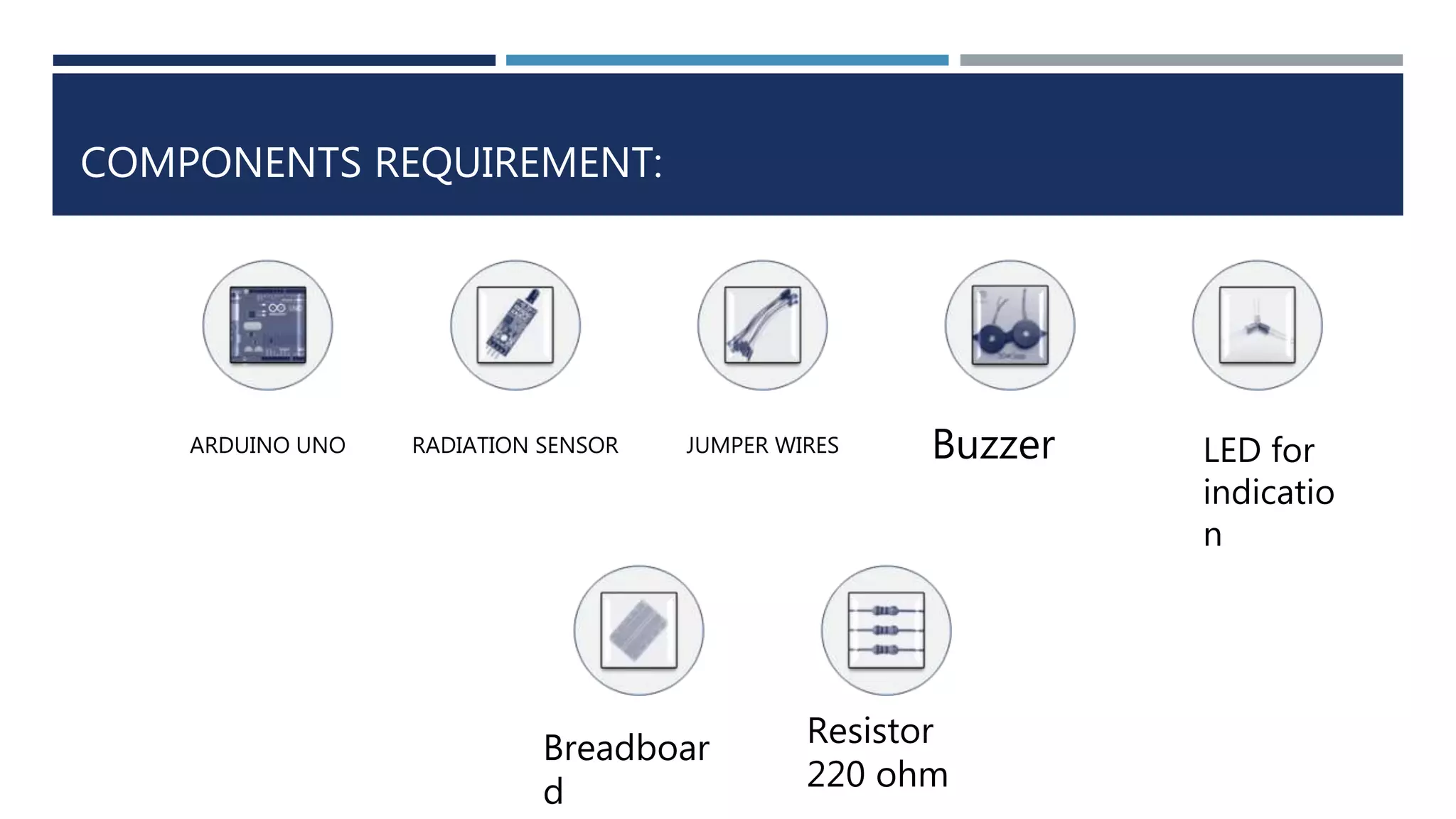
COMPONENTS REQUIREMENT:
ARDUINO UNO RADIATION SENSOR JUMPER WIRES Buzzer LED for
indicatio
n
Breadboar
d
Resistor
220 ohm
INTRODUCTION
 Specifications of components used in project:
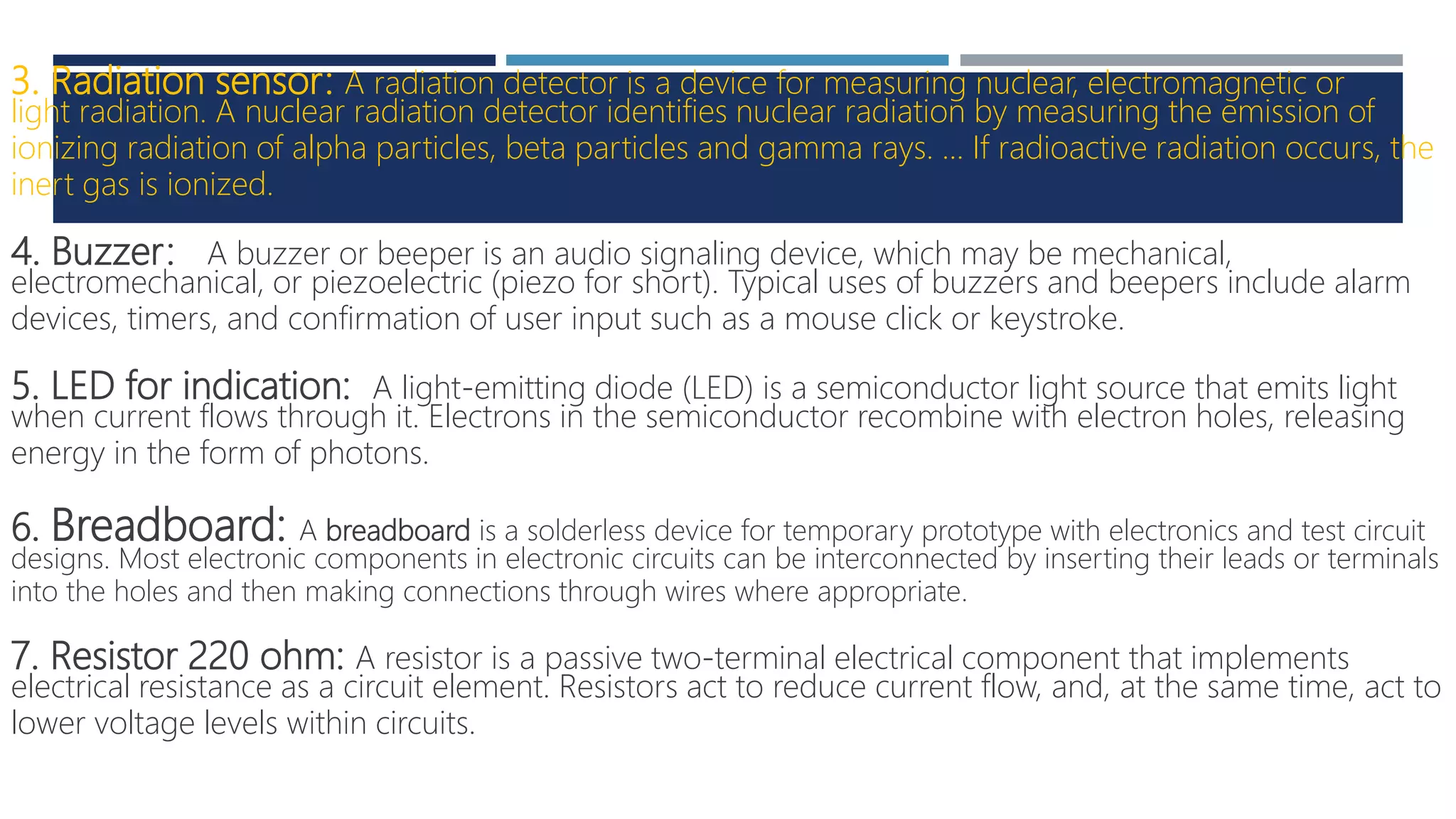
1. Arduino UNO: It is a CPU {Central Processing Unit} of the project, which is controlling all commands and play the required
functions. Arduino is consists of USB port, Power supply adaptor connector, 16MHz Quartz crystal Processor and based on
Mega 328. It contains 14 pins which can be use for input as well as for Output. It use 12C and SPI (Serial
Peripheral Interface) Communication System for communicate/ commands.
2. Jumper Wires: Wires for connecting the components all together. Its made up of steel wire
inside and insulating coating outside best for Arduino works and circuit board development.
3. Radiation sensor: A radiation detector is a device for measuring nuclear, electromagnetic or
light radiation. A nuclear radiation detector identifies nuclear radiation by measuring the emission of
ionizing radiation of alpha particles, beta particles and gamma rays. ... If radioactive radiation occurs, the
inert gas is ionized.
4. Buzzer: A buzzer or beeper is an audio signaling device, which may be mechanical,
electromechanical, or piezoelectric (piezo for short). Typical uses of buzzers and beepers include alarm
devices, timers, and confirmation of user input such as a mouse click or keystroke.
5. LED for indication: A light-emitting diode (LED) is a semiconductor light source that emits light
when current flows through it. Electrons in the semiconductor recombine with electron holes, releasing
energy in the form of photons.
6. Breadboard: A breadboard is a solderless device for temporary prototype with electronics and test circuit
designs. Most electronic components in electronic circuits can be interconnected by inserting their leads or terminals
into the holes and then making connections through wires where appropriate.
7. Resistor 220 ohm: A resistor is a passive two-terminal electrical component that implements
electrical resistance as a circuit element. Resistors act to reduce current flow, and, at the same time, act to
lower voltage levels within circuits.
 INTRODUCTIONOFMY PROJECT
This project is created to detect the radiations and
frequencies in our surroundings, by using small
components on small scale.
Affect of my project:
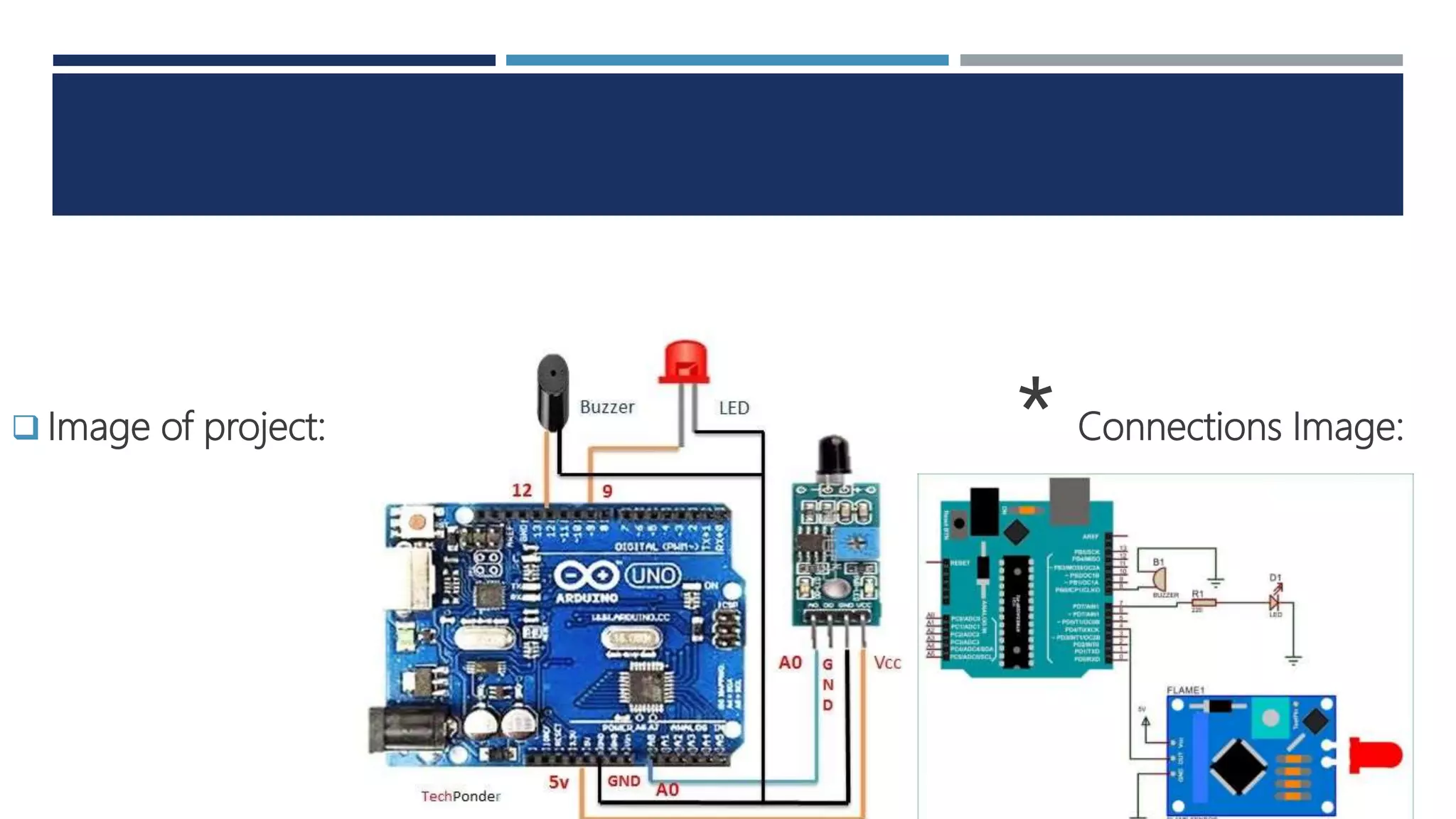
 Image of project: * Connections Image:
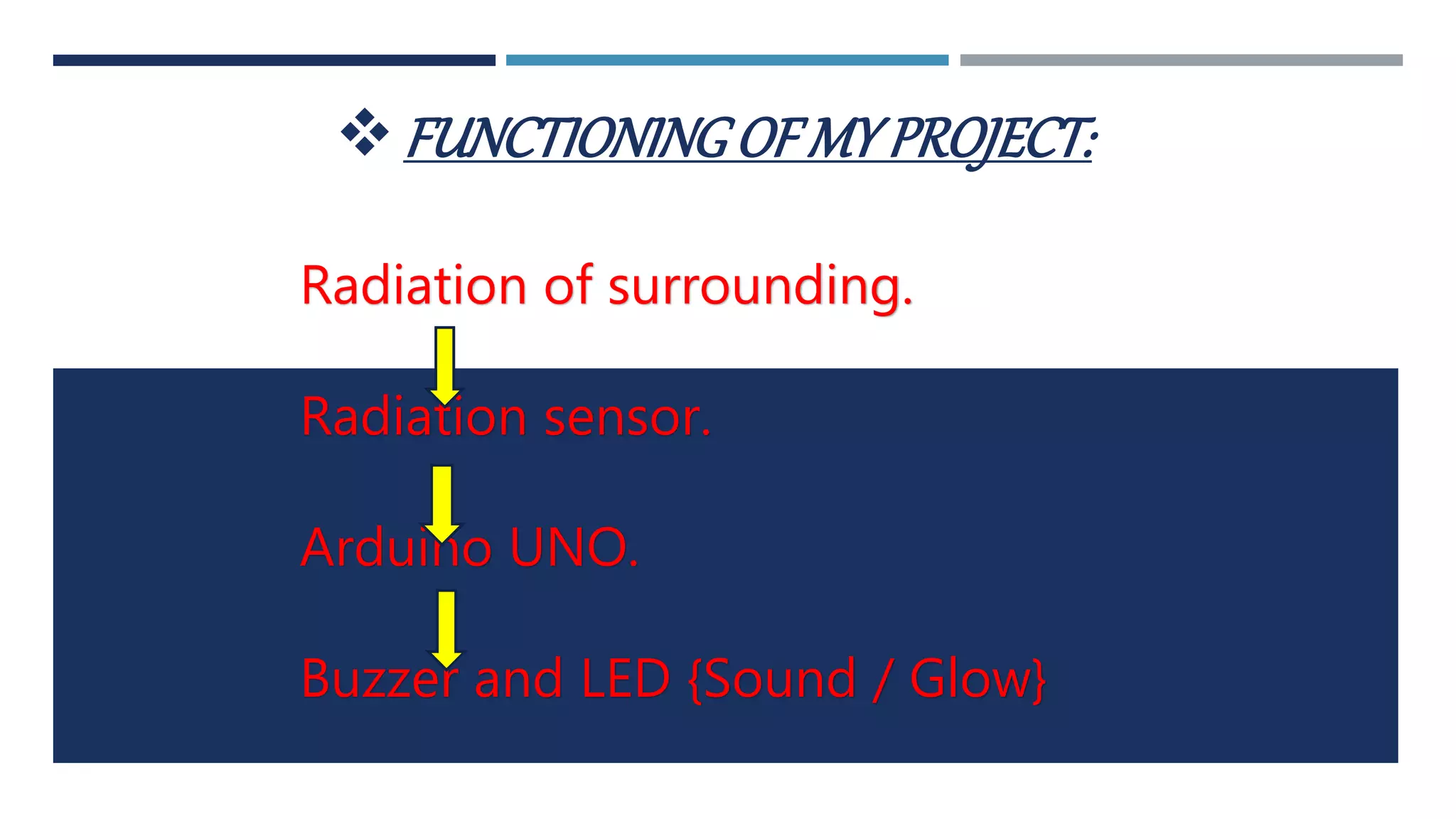
Radiation of surrounding.
Radiation sensor.
Arduino UNO.
Buzzer and LED {Sound / Glow}
FUNCTIONINGOFMYPROJECT:
CONCLUSION OF MY PROJECT:
This project is created to check the presence
of radiation and frequencies emitting from
devices, network providing towers and any
radiation-emitting sources.
It can detect Wi-Fi, Bluetooth, and many
other signals emitting from any source.
Reference:
oGoogle.
oYouTube.
oArduino project World.
PowerPoint Presentation on Radiation detector

PowerPoint Presentation on Radiation detector

  • 1.
    RADIATION DETECTOR TO DETECTTHE RADIATIONS AND FREQUENCIES IN OUR SURROUNDINGS.
  • 2.
    COMPONENTS REQUIREMENT: ARDUINO UNORADIATION SENSOR JUMPER WIRES Buzzer LED for indicatio n Breadboar d Resistor 220 ohm
  • 3.
    INTRODUCTION  Specifications ofcomponents used in project: 1. Arduino UNO: It is a CPU {Central Processing Unit} of the project, which is controlling all commands and play the required functions. Arduino is consists of USB port, Power supply adaptor connector, 16MHz Quartz crystal Processor and based on Mega 328. It contains 14 pins which can be use for input as well as for Output. It use 12C and SPI (Serial Peripheral Interface) Communication System for communicate/ commands. 2. Jumper Wires: Wires for connecting the components all together. Its made up of steel wire inside and insulating coating outside best for Arduino works and circuit board development.
  • 4.
    3. Radiation sensor:A radiation detector is a device for measuring nuclear, electromagnetic or light radiation. A nuclear radiation detector identifies nuclear radiation by measuring the emission of ionizing radiation of alpha particles, beta particles and gamma rays. ... If radioactive radiation occurs, the inert gas is ionized. 4. Buzzer: A buzzer or beeper is an audio signaling device, which may be mechanical, electromechanical, or piezoelectric (piezo for short). Typical uses of buzzers and beepers include alarm devices, timers, and confirmation of user input such as a mouse click or keystroke. 5. LED for indication: A light-emitting diode (LED) is a semiconductor light source that emits light when current flows through it. Electrons in the semiconductor recombine with electron holes, releasing energy in the form of photons. 6. Breadboard: A breadboard is a solderless device for temporary prototype with electronics and test circuit designs. Most electronic components in electronic circuits can be interconnected by inserting their leads or terminals into the holes and then making connections through wires where appropriate. 7. Resistor 220 ohm: A resistor is a passive two-terminal electrical component that implements electrical resistance as a circuit element. Resistors act to reduce current flow, and, at the same time, act to lower voltage levels within circuits.
  • 5.
     INTRODUCTIONOFMY PROJECT Thisproject is created to detect the radiations and frequencies in our surroundings, by using small components on small scale. Affect of my project:
  • 7.
     Image ofproject: * Connections Image:
  • 8.
    Radiation of surrounding. Radiationsensor. Arduino UNO. Buzzer and LED {Sound / Glow} FUNCTIONINGOFMYPROJECT:
  • 9.
    CONCLUSION OF MYPROJECT: This project is created to check the presence of radiation and frequencies emitting from devices, network providing towers and any radiation-emitting sources. It can detect Wi-Fi, Bluetooth, and many other signals emitting from any source.
  • 10.