POWERED EXOSKELETON
i-What is exoskeleton and how it works?
ii-History and application
iii-Practical examples
iv-Limitations and design issues
What is exoskeleton?
• An exoskeleton is a hard, protective outer-body
covering of an animal. Although exoskeletons
provide support they are not comprised of
bones.
Powered exoskeleton
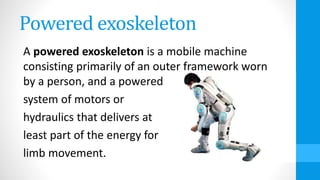
A powered exoskeleton is a mobile machine
consisting primarily of an outer framework worn
by a person, and a powered
system of motors or
hydraulics that delivers at
least part of the energy for
limb movement.
Powered exoskeleton
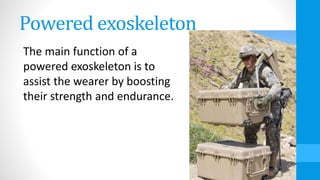
The main function of a
powered exoskeleton is to
assist the wearer by boosting
their strength and endurance.
Application
Powered exoskeletons are commonly designed for military use,
also in civilian areas, similar exoskeletons could be used to help
firefighters and other rescue workers survive dangerous
environments.
The medical field is another prime area for exoskeleton
technology, where it can be used for enhanced precision
during surgery, or as an assist to allow nurses to move heavy
patients. Exoskeletons could also be applied in the area of
rehabilitation of stroke or Spinal cord injury patients.
History
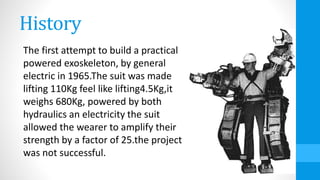
The first attempt to build a practical
powered exoskeleton, by general
electric in 1965.The suit was made
lifting 110Kg feel like lifting4.5Kg,it
weighs 680Kg, powered by both
hydraulics an electricity the suit
allowed the wearer to amplify their
strength by a factor of 25.the project
was not successful.
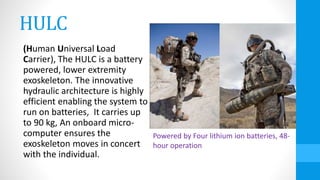
HULC
(Human Universal Load
Carrier), The HULC is a battery
powered, lower extremity
exoskeleton. The innovative
hydraulic architecture is highly
efficient enabling the system to
run on batteries, It carries up
to 90 kg, An onboard micro-
computer ensures the
exoskeleton moves in concert
with the individual.
Powered by Four lithium ion batteries, 48-
hour operation
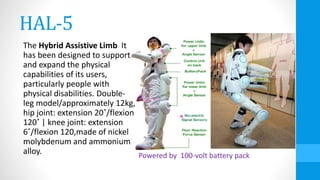
HAL-5
The Hybrid Assistive Limb It
has been designed to support
and expand the physical
capabilities of its users,
particularly people with
physical disabilities. Double-
leg model/approximately 12kg,
hip joint: extension 20˚/flexion
120˚ | knee joint: extension
6˚/flexion 120,made of nickel
molybdenum and ammonium
alloy. Powered by 100-volt battery pack
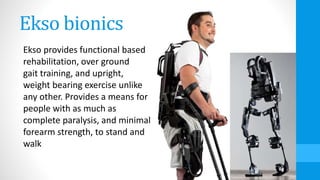
Ekso bionics
Ekso provides functional based
rehabilitation, over ground
gait training, and upright,
weight bearing exercise unlike
any other. Provides a means for
people with as much as
complete paralysis, and minimal
forearm strength, to stand and
walk
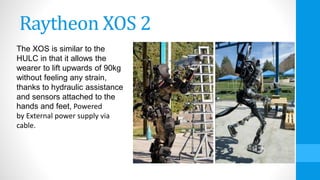
Raytheon XOS 2
The XOS is similar to the
HULC in that it allows the
wearer to lift upwards of 90kg
without feeling any strain,
thanks to hydraulic assistance
and sensors attached to the
hands and feet, Powered
by External power supply via
cable.
Limitations and design issues
Engineers of powered exoskeletons face a number of large
technological challenges to build a suit that is capable of
quick and agile movements, yet is also safe to operate
without extensive training.
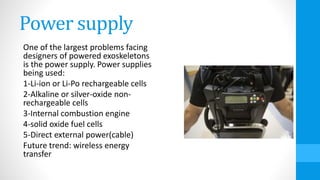
Power supply
One of the largest problems facing
designers of powered exoskeletons
is the power supply. Power supplies
being used:
1-Li-ion or Li-Po rechargeable cells
2-Alkaline or silver-oxide non-
rechargeable cells
3-Internal combustion engine
4-solid oxide fuel cells
5-Direct external power(cable)
Future trend: wireless energy
transfer
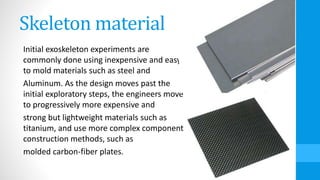
Skeleton material
Initial exoskeleton experiments are
commonly done using inexpensive and easy
to mold materials such as steel and
Aluminum. As the design moves past the
initial exploratory steps, the engineers move
to progressively more expensive and
strong but lightweight materials such as
titanium, and use more complex component
construction methods, such as
molded carbon-fiber plates.
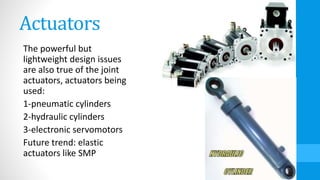
Actuators
The powerful but
lightweight design issues
are also true of the joint
actuators, actuators being
used:
1-pneumatic cylinders
2-hydraulic cylinders
3-electronic servomotors
Future trend: elastic
actuators like SMP
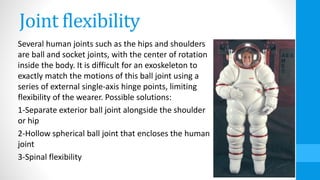
Joint flexibility
Several human joints such as the hips and shoulders
are ball and socket joints, with the center of rotation
inside the body. It is difficult for an exoskeleton to
exactly match the motions of this ball joint using a
series of external single-axis hinge points, limiting
flexibility of the wearer. Possible solutions:
1-Separate exterior ball joint alongside the shoulder
or hip
2-Hollow spherical ball joint that encloses the human
joint
3-Spinal flexibility
Power control and modulation
It is not enough to build a simple single-speed assist motor, with
forward/hold/reverse position controls and no on-board computer
control. Such a mechanism can be too fast for the user's desired
motion, with the assisted motion overshooting the desired position.
Sudden unexpected movements such as tripping or being pushed over
requires fast precise movements to recover and prevent falling over,
Fast and accurate assistive positioning is typically done using a range
of speeds controlled using computer position sensing of both the
exoskeleton and the wearer, so that the assistive motion only moves as
fast or as far as the motion of the wearer and does not overshoot or
undershoot.
Other possible problems
• Detection of unsafe/invalid motions
• Pinching and joint fouling
• Adaptation to user size variations
Powered exoskeleton2

Powered exoskeleton2

  • 2.
    POWERED EXOSKELETON i-What isexoskeleton and how it works? ii-History and application iii-Practical examples iv-Limitations and design issues
  • 3.
    What is exoskeleton? •An exoskeleton is a hard, protective outer-body covering of an animal. Although exoskeletons provide support they are not comprised of bones.
  • 4.
    Powered exoskeleton A poweredexoskeleton is a mobile machine consisting primarily of an outer framework worn by a person, and a powered system of motors or hydraulics that delivers at least part of the energy for limb movement.
  • 5.
    Powered exoskeleton The mainfunction of a powered exoskeleton is to assist the wearer by boosting their strength and endurance.
  • 6.
    Application Powered exoskeletons arecommonly designed for military use, also in civilian areas, similar exoskeletons could be used to help firefighters and other rescue workers survive dangerous environments. The medical field is another prime area for exoskeleton technology, where it can be used for enhanced precision during surgery, or as an assist to allow nurses to move heavy patients. Exoskeletons could also be applied in the area of rehabilitation of stroke or Spinal cord injury patients.
  • 7.
    History The first attemptto build a practical powered exoskeleton, by general electric in 1965.The suit was made lifting 110Kg feel like lifting4.5Kg,it weighs 680Kg, powered by both hydraulics an electricity the suit allowed the wearer to amplify their strength by a factor of 25.the project was not successful.
  • 8.
    HULC (Human Universal Load Carrier),The HULC is a battery powered, lower extremity exoskeleton. The innovative hydraulic architecture is highly efficient enabling the system to run on batteries, It carries up to 90 kg, An onboard micro- computer ensures the exoskeleton moves in concert with the individual. Powered by Four lithium ion batteries, 48- hour operation
  • 9.
    HAL-5 The Hybrid AssistiveLimb It has been designed to support and expand the physical capabilities of its users, particularly people with physical disabilities. Double- leg model/approximately 12kg, hip joint: extension 20˚/flexion 120˚ | knee joint: extension 6˚/flexion 120,made of nickel molybdenum and ammonium alloy. Powered by 100-volt battery pack
  • 10.
    Ekso bionics Ekso providesfunctional based rehabilitation, over ground gait training, and upright, weight bearing exercise unlike any other. Provides a means for people with as much as complete paralysis, and minimal forearm strength, to stand and walk
  • 11.
    Raytheon XOS 2 TheXOS is similar to the HULC in that it allows the wearer to lift upwards of 90kg without feeling any strain, thanks to hydraulic assistance and sensors attached to the hands and feet, Powered by External power supply via cable.
  • 12.
    Limitations and designissues Engineers of powered exoskeletons face a number of large technological challenges to build a suit that is capable of quick and agile movements, yet is also safe to operate without extensive training.
  • 13.
    Power supply One ofthe largest problems facing designers of powered exoskeletons is the power supply. Power supplies being used: 1-Li-ion or Li-Po rechargeable cells 2-Alkaline or silver-oxide non- rechargeable cells 3-Internal combustion engine 4-solid oxide fuel cells 5-Direct external power(cable) Future trend: wireless energy transfer
  • 14.
    Skeleton material Initial exoskeletonexperiments are commonly done using inexpensive and easy to mold materials such as steel and Aluminum. As the design moves past the initial exploratory steps, the engineers move to progressively more expensive and strong but lightweight materials such as titanium, and use more complex component construction methods, such as molded carbon-fiber plates.
  • 15.
    Actuators The powerful but lightweightdesign issues are also true of the joint actuators, actuators being used: 1-pneumatic cylinders 2-hydraulic cylinders 3-electronic servomotors Future trend: elastic actuators like SMP
  • 16.
    Joint flexibility Several humanjoints such as the hips and shoulders are ball and socket joints, with the center of rotation inside the body. It is difficult for an exoskeleton to exactly match the motions of this ball joint using a series of external single-axis hinge points, limiting flexibility of the wearer. Possible solutions: 1-Separate exterior ball joint alongside the shoulder or hip 2-Hollow spherical ball joint that encloses the human joint 3-Spinal flexibility
  • 17.
    Power control andmodulation It is not enough to build a simple single-speed assist motor, with forward/hold/reverse position controls and no on-board computer control. Such a mechanism can be too fast for the user's desired motion, with the assisted motion overshooting the desired position. Sudden unexpected movements such as tripping or being pushed over requires fast precise movements to recover and prevent falling over, Fast and accurate assistive positioning is typically done using a range of speeds controlled using computer position sensing of both the exoskeleton and the wearer, so that the assistive motion only moves as fast or as far as the motion of the wearer and does not overshoot or undershoot.
  • 18.
    Other possible problems •Detection of unsafe/invalid motions • Pinching and joint fouling • Adaptation to user size variations