Batch No.:10
Presented By
Manjunath sajjan (1rg12me030)
Shahabuddin (1rg12me047)
Nitin (1rg12me041)
Prathp S A (1rg12me044)
Project Guide
Assistant Prof. MS Supriya
Manjunath sajjan (1rg12me030)
Shahabuddin (1rg12me047)
Nitin (1rg12me041)
Prathp S A (1rg12me044)
Project Guide
Assistant Prof. MS Supriya
 A powered exoskeleton, also known as powered armor, exoframe, or
exosuit, is a mobile machine consisting primarily of an outer
framework (akin to an insect's exoskeleton) worn by a person, and
powered by a system of motors, hydraulics, pneumatics or levers that
delivers at least part of the energy for limb movement.
INTRODUCTION
Literature survey
 The first attempt to create a powered exoskeleton came in the
1960’s.
 The aim of this project is to develop the mechanical design and
produce the physical implementation of a robotic arm exoskeleton
that has the capability of assisting of lifting the load.
 outline the project requirements, broken down into kinematics,
torque and force, control, and safety.
WHAT IS THE NEED OF AN
EXOSKELETON?
It is a suit which assists the wearer by boosting their
strength and endurance. So it is used by paralyzed
patients for lifting.
It also gives the wearer superhuman powers. So it can
also be used in military and rescue fields.
Objective
The main objective is to reduce human effort while lifting the
weight.
Other than that, this mechanism in a robot, enables disabled people
to select this mechanism.
Also, this mechanism can be used in automobile industries. Where,
movement of large size body, which is manual in our project.
Solenoid valve
Compressed air reservoir
compressor
Structure
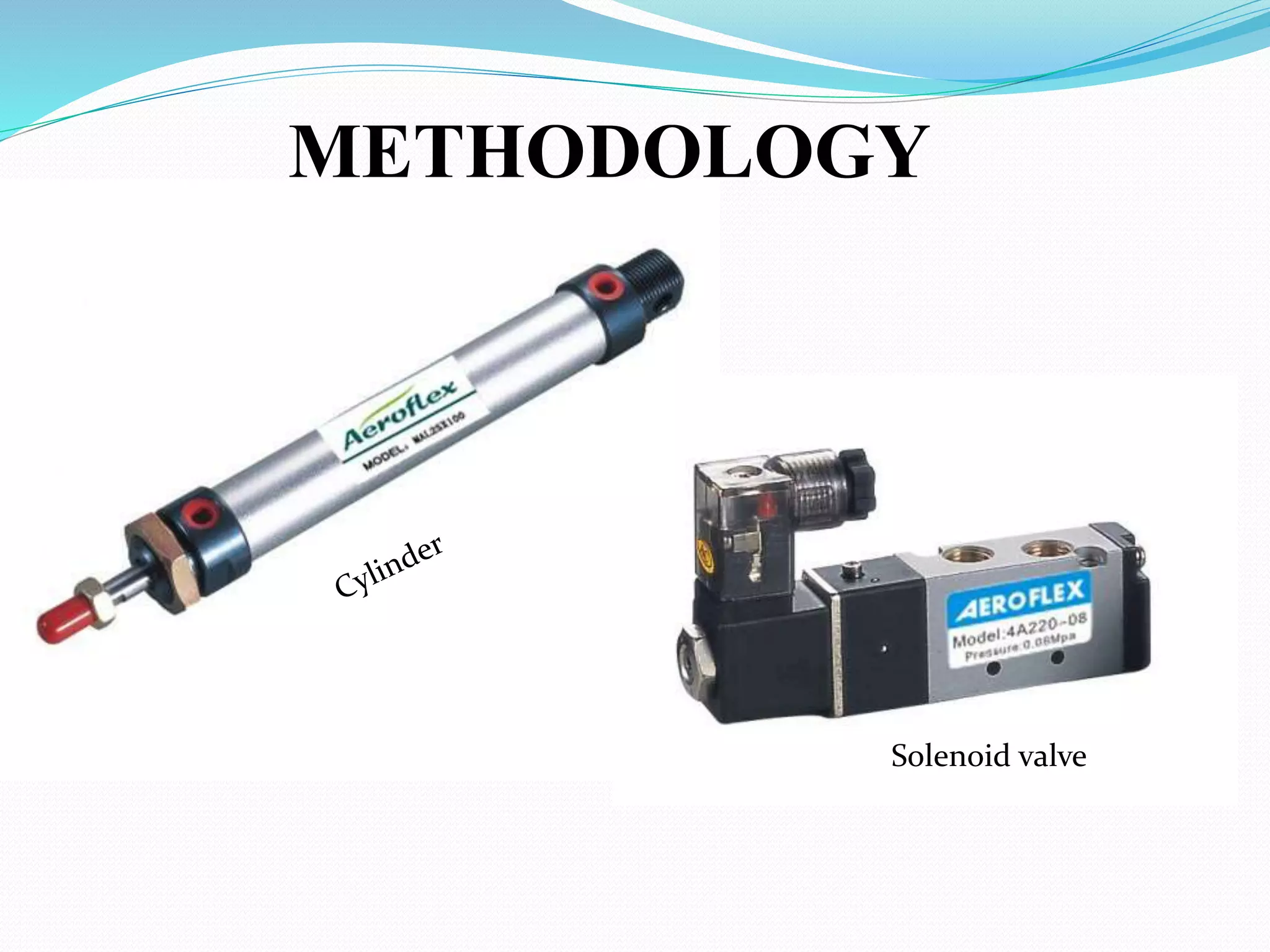
Cylinder
METHODOLOGY
Solenoid valve
It is an electromechanically operated valve. The valve is controlled
by an electric current through a solenoid: in the case of a two-port
valve the flow is switched on or off; in the case of a three-port
valve, the outflow is switched between the two outlet ports.
Solenoid valve
 The potential of using Carbon fibre is under research.
 It may be made of any light weight metals like aluminium, nickel,
titanium and hard plastics.
Main Parts
Solenoid valve
Compressed air reservoir
Power supply
Wrist band or control pad
Compressor
Cylinder
 One of the proposed main uses for an exoskeleton would be
enabling a soldier to carry heavy objects (80–300 kg) while running
or climbing stairs
 Another area of application could be medical care, nursing in
particular.
 wearable robot allows the wearer to lift 10 times as much as they
normally could.
Applications
Lifting heavy obstacles, victims and elderly .
Accelerate wearer’s daily activities and improve recovery.
 Support self-physical training.
 Another area of application could be medical care, nursing in
particular.
Advantages
RESCUE
 It can be used by firemen to go into risky and hazardous
environments for rescue operations.
 It can be used to rescue people from the remains of destroyed
buildings in an earthquake.
ENTERTAINMENT
 These suits can be used to perform superhuman stunts without
risking human lives.
 It can also be used as a preventive measure in extreme sports like
sky diving, Para gliding …
CONCLUSION
 To advance exoskeleton technology at the fastest rate possible, it is
critical that scientists and engineers document and share their
successes and failures with the research community.
 University and institute researchers can identify basic principles
governing human movement with robotic technologies (exoskeletons,
prostheses, etc.) with carefully designed experimental studies.

exoskeleton arms

  • 1.
    Batch No.:10 Presented By Manjunathsajjan (1rg12me030) Shahabuddin (1rg12me047) Nitin (1rg12me041) Prathp S A (1rg12me044) Project Guide Assistant Prof. MS Supriya
  • 2.
    Manjunath sajjan (1rg12me030) Shahabuddin(1rg12me047) Nitin (1rg12me041) Prathp S A (1rg12me044) Project Guide Assistant Prof. MS Supriya
  • 3.
     A poweredexoskeleton, also known as powered armor, exoframe, or exosuit, is a mobile machine consisting primarily of an outer framework (akin to an insect's exoskeleton) worn by a person, and powered by a system of motors, hydraulics, pneumatics or levers that delivers at least part of the energy for limb movement. INTRODUCTION
  • 4.
    Literature survey  Thefirst attempt to create a powered exoskeleton came in the 1960’s.  The aim of this project is to develop the mechanical design and produce the physical implementation of a robotic arm exoskeleton that has the capability of assisting of lifting the load.  outline the project requirements, broken down into kinematics, torque and force, control, and safety.
  • 5.
    WHAT IS THENEED OF AN EXOSKELETON? It is a suit which assists the wearer by boosting their strength and endurance. So it is used by paralyzed patients for lifting. It also gives the wearer superhuman powers. So it can also be used in military and rescue fields.
  • 7.
    Objective The main objectiveis to reduce human effort while lifting the weight. Other than that, this mechanism in a robot, enables disabled people to select this mechanism. Also, this mechanism can be used in automobile industries. Where, movement of large size body, which is manual in our project.
  • 8.
    Solenoid valve Compressed airreservoir compressor Structure Cylinder
  • 9.
  • 10.
    It is anelectromechanically operated valve. The valve is controlled by an electric current through a solenoid: in the case of a two-port valve the flow is switched on or off; in the case of a three-port valve, the outflow is switched between the two outlet ports. Solenoid valve  The potential of using Carbon fibre is under research.  It may be made of any light weight metals like aluminium, nickel, titanium and hard plastics.
  • 11.
    Main Parts Solenoid valve Compressedair reservoir Power supply Wrist band or control pad Compressor Cylinder
  • 12.
     One ofthe proposed main uses for an exoskeleton would be enabling a soldier to carry heavy objects (80–300 kg) while running or climbing stairs  Another area of application could be medical care, nursing in particular.  wearable robot allows the wearer to lift 10 times as much as they normally could. Applications
  • 13.
    Lifting heavy obstacles,victims and elderly . Accelerate wearer’s daily activities and improve recovery.  Support self-physical training.  Another area of application could be medical care, nursing in particular. Advantages
  • 14.
    RESCUE  It canbe used by firemen to go into risky and hazardous environments for rescue operations.  It can be used to rescue people from the remains of destroyed buildings in an earthquake.
  • 15.
    ENTERTAINMENT  These suitscan be used to perform superhuman stunts without risking human lives.  It can also be used as a preventive measure in extreme sports like sky diving, Para gliding …
  • 16.
    CONCLUSION  To advanceexoskeleton technology at the fastest rate possible, it is critical that scientists and engineers document and share their successes and failures with the research community.  University and institute researchers can identify basic principles governing human movement with robotic technologies (exoskeletons, prostheses, etc.) with carefully designed experimental studies.