Communication 303-50
Raymond Spalding
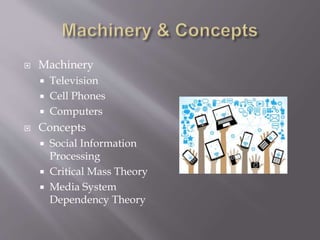
 Machinery
 Television
 Cell Phones
 Computers
 Concepts
 Social Information
Processing
 Critical Mass Theory
 Media System
Dependency Theory
 In 1923, an American inventor called
Charles Jenkins used the disk idea of
Nipkow to invent the first ever practical
mechanical television system.
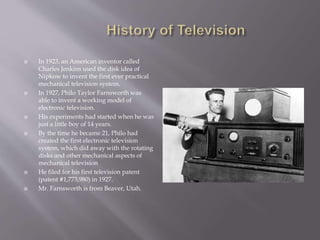
 In 1927, Philo Taylor Farnsworth was
able to invent a working model of
electronic television.
 His experiments had started when he was
just a little boy of 14 years.
 By the time he became 21, Philo had
created the first electronic television
system, which did away with the rotating
disks and other mechanical aspects of
mechanical television
 He filed for his first television patent
(patent #1,773,980) in 1927.
 Mr. Farnsworth is from Beaver, Utah.
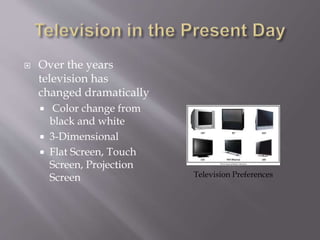
 Over the years
television has
changed dramatically
 Color change from
black and white
 3-Dimensional
 Flat Screen, Touch
Screen, Projection
Screen Television Preferences
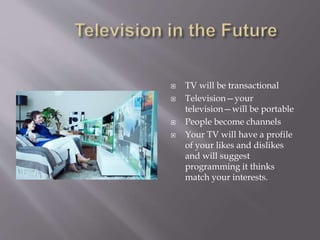
 TV will be transactional
 Television—your
television—will be portable
 People become channels
 Your TV will have a profile
of your likes and dislikes
and will suggest
programming it thinks
match your interests.
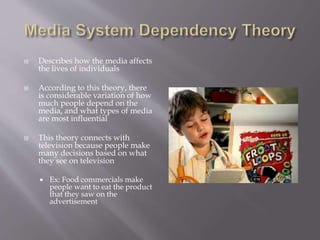
 Describes how the media affects
the lives of individuals
 According to this theory, there
is considerable variation of how
much people depend on the
media, and what types of media
are most influential
 This theory connects with
television because people make
many decisions based on what
they see on television
 Ex: Food commercials make
people want to eat the product
that they saw on the
advertisement
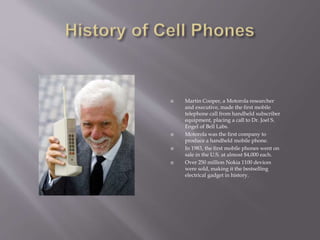
 Martin Cooper, a Motorola researcher
and executive, made the first mobile
telephone call from handheld subscriber
equipment, placing a call to Dr. Joel S.
Engel of Bell Labs.
 Motorola was the first company to
produce a handheld mobile phone.
 In 1983, the first mobile phones went on
sale in the U.S. at almost $4,000 each.
 Over 250 million Nokia 1100 devices
were sold, making it the bestselling
electrical gadget in history.
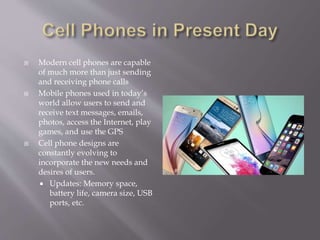
 Modern cell phones are capable
of much more than just sending
and receiving phone calls
 Mobile phones used in today’s
world allow users to send and
receive text messages, emails,
photos, access the Internet, play
games, and use the GPS
 Cell phone designs are
constantly evolving to
incorporate the new needs and
desires of users.
 Updates: Memory space,
battery life, camera size, USB
ports, etc.
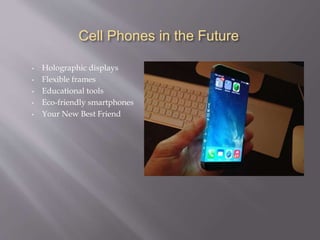
Cell Phones in the Future
• Holographic displays
• Flexible frames
• Educational tools
• Eco-friendly smartphones
• Your New Best Friend
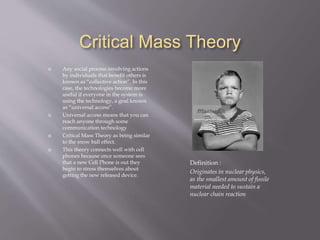
Critical Mass Theory
Definition :
Originates in nuclear physics,
as the smallest amount of fissile
material needed to sustain a
nuclear chain reaction
 Any social process involving actions
by individuals that benefit others is
known as “collective action”. In this
case, the technologies become more
useful if everyone in the system is
using the technology, a goal known
as “universal access”.
 Universal access means that you can
reach anyone through some
communication technology
 Critical Mass Theory as being similar
to the snow ball effect.
 This theory connects well with cell
phones because once someone sees
that a new Cell Phone is out they
begin to stress themselves about
getting the new released device.
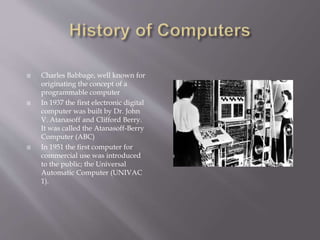
 Charles Babbage, well known for
originating the concept of a
programmable computer
 In 1937 the first electronic digital
computer was built by Dr. John
V. Atanasoff and Clifford Berry.
It was called the Atanasoff-Berry
Computer (ABC)
 In 1951 the first computer for
commercial use was introduced
to the public; the Universal
Automatic Computer (UNIVAC
1).
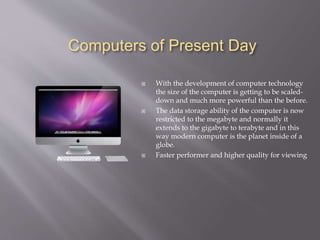
Computers of Present Day
 With the development of computer technology
the size of the computer is getting to be scaled-
down and much more powerful than the before.
 The data storage ability of the computer is now
restricted to the megabyte and normally it
extends to the gigabyte to terabyte and in this
way modern computer is the planet inside of a
globe.
 Faster performer and higher quality for viewing
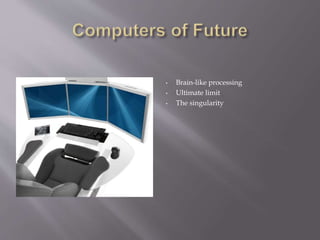
• Brain-like processing
• Ultimate limit
• The singularity
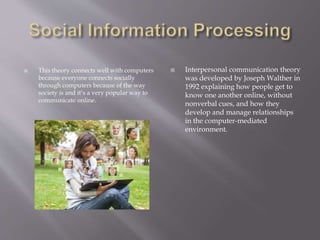
 This theory connects well with computers
because everyone connects socially
through computers because of the way
society is and it’s a very popular way to
communicate online.
 Interpersonal communication theory
was developed by Joseph Walther in
1992 explaining how people get to
know one another online, without
nonverbal cues, and how they
develop and manage relationships
in the computer-mediated
environment.
 Gathering this information about these three theories:
 Critical Mass Theory, Social Information Processing, and Media System Dependency Theory
showed me a lot more then I actually knew about technology.
 Technology has advanced over the years because it is consistently being remodeled and
improved every year due to mass production in society today.
 Technology has changed the world because of positive ties it has with society. Everyone uses
technology in some way to help them in their daily activities which was never the case in the
past.
 Technology will continue to change the world and continue to improve because it is a huge
part of everyone's lives and people depend on it for help.
 "The History Of Television." The History Of Television. Geno Jezek, 2006. Web. 09 Dec. 2016.
 "History of Mobile Phones." Wikipedia. Wikimedia Foundation, n.d. Web. 09 Dec. 2016.
 "WHat Is the Future Of Computers." Natalie Wolchover, 10 Sept. 2012. Web. 8 Dec. 2016.
 "Brief History Of Computer." Brief History Of Computer. Beverley Steitz, 2006. Web. 09 Dec.
2016.
 @uSwitchTech. "Future Phones - What to Expect from Future Mobile Phones." USwitch Mobile
Phone Deals. Catherine Hiley, 01 Dec. 2016. Web. 09 Dec. 2016.
 "What Is Media System Dependency Theory? Definition and Meaning."
BusinessDictionary.com. N.p., n.d. Web. 09 Dec. 2016.

Technology innovation 1

  • 1.
  • 2.
     Machinery  Television Cell Phones  Computers  Concepts  Social Information Processing  Critical Mass Theory  Media System Dependency Theory
  • 3.
     In 1923,an American inventor called Charles Jenkins used the disk idea of Nipkow to invent the first ever practical mechanical television system.  In 1927, Philo Taylor Farnsworth was able to invent a working model of electronic television.  His experiments had started when he was just a little boy of 14 years.  By the time he became 21, Philo had created the first electronic television system, which did away with the rotating disks and other mechanical aspects of mechanical television  He filed for his first television patent (patent #1,773,980) in 1927.  Mr. Farnsworth is from Beaver, Utah.
  • 4.
     Over theyears television has changed dramatically  Color change from black and white  3-Dimensional  Flat Screen, Touch Screen, Projection Screen Television Preferences
  • 5.
     TV willbe transactional  Television—your television—will be portable  People become channels  Your TV will have a profile of your likes and dislikes and will suggest programming it thinks match your interests.
  • 6.
     Describes howthe media affects the lives of individuals  According to this theory, there is considerable variation of how much people depend on the media, and what types of media are most influential  This theory connects with television because people make many decisions based on what they see on television  Ex: Food commercials make people want to eat the product that they saw on the advertisement
  • 7.
     Martin Cooper,a Motorola researcher and executive, made the first mobile telephone call from handheld subscriber equipment, placing a call to Dr. Joel S. Engel of Bell Labs.  Motorola was the first company to produce a handheld mobile phone.  In 1983, the first mobile phones went on sale in the U.S. at almost $4,000 each.  Over 250 million Nokia 1100 devices were sold, making it the bestselling electrical gadget in history.
  • 8.
     Modern cellphones are capable of much more than just sending and receiving phone calls  Mobile phones used in today’s world allow users to send and receive text messages, emails, photos, access the Internet, play games, and use the GPS  Cell phone designs are constantly evolving to incorporate the new needs and desires of users.  Updates: Memory space, battery life, camera size, USB ports, etc.
  • 9.
    Cell Phones inthe Future • Holographic displays • Flexible frames • Educational tools • Eco-friendly smartphones • Your New Best Friend
  • 10.
    Critical Mass Theory Definition: Originates in nuclear physics, as the smallest amount of fissile material needed to sustain a nuclear chain reaction  Any social process involving actions by individuals that benefit others is known as “collective action”. In this case, the technologies become more useful if everyone in the system is using the technology, a goal known as “universal access”.  Universal access means that you can reach anyone through some communication technology  Critical Mass Theory as being similar to the snow ball effect.  This theory connects well with cell phones because once someone sees that a new Cell Phone is out they begin to stress themselves about getting the new released device.
  • 11.
     Charles Babbage,well known for originating the concept of a programmable computer  In 1937 the first electronic digital computer was built by Dr. John V. Atanasoff and Clifford Berry. It was called the Atanasoff-Berry Computer (ABC)  In 1951 the first computer for commercial use was introduced to the public; the Universal Automatic Computer (UNIVAC 1).
  • 12.
    Computers of PresentDay  With the development of computer technology the size of the computer is getting to be scaled- down and much more powerful than the before.  The data storage ability of the computer is now restricted to the megabyte and normally it extends to the gigabyte to terabyte and in this way modern computer is the planet inside of a globe.  Faster performer and higher quality for viewing
  • 13.
    • Brain-like processing •Ultimate limit • The singularity
  • 14.
     This theoryconnects well with computers because everyone connects socially through computers because of the way society is and it’s a very popular way to communicate online.  Interpersonal communication theory was developed by Joseph Walther in 1992 explaining how people get to know one another online, without nonverbal cues, and how they develop and manage relationships in the computer-mediated environment.
  • 15.
     Gathering thisinformation about these three theories:  Critical Mass Theory, Social Information Processing, and Media System Dependency Theory showed me a lot more then I actually knew about technology.  Technology has advanced over the years because it is consistently being remodeled and improved every year due to mass production in society today.  Technology has changed the world because of positive ties it has with society. Everyone uses technology in some way to help them in their daily activities which was never the case in the past.  Technology will continue to change the world and continue to improve because it is a huge part of everyone's lives and people depend on it for help.
  • 16.
     "The HistoryOf Television." The History Of Television. Geno Jezek, 2006. Web. 09 Dec. 2016.  "History of Mobile Phones." Wikipedia. Wikimedia Foundation, n.d. Web. 09 Dec. 2016.  "WHat Is the Future Of Computers." Natalie Wolchover, 10 Sept. 2012. Web. 8 Dec. 2016.  "Brief History Of Computer." Brief History Of Computer. Beverley Steitz, 2006. Web. 09 Dec. 2016.  @uSwitchTech. "Future Phones - What to Expect from Future Mobile Phones." USwitch Mobile Phone Deals. Catherine Hiley, 01 Dec. 2016. Web. 09 Dec. 2016.  "What Is Media System Dependency Theory? Definition and Meaning." BusinessDictionary.com. N.p., n.d. Web. 09 Dec. 2016.