What is Communication?
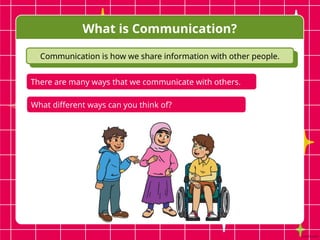
Communication is how we share information with other people.
There are many ways that we communicate with others.
What different ways can you think of?
How We Communicate
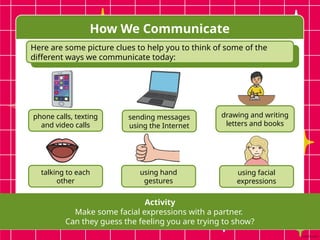
Here are some picture clues to help you to think of some of the
different ways we communicate today:
phone calls, texting
and video calls
sending messages
using the Internet
drawing and writing
letters and books
talking to each
other
using hand
gestures
using facial
expressions
Activity
Make some facial expressions with a partner.
Can they guess the feeling you are trying to show?
Communication in the Past
Some of the ways we communicate today
didn’t exist in the past.
Can you think of any ways people
communicated with each other before
modern technology (such as mobile
phones and computers)?
Talking
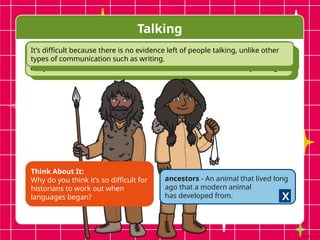
One thing that makes humans different from other species is that we can use
words to communicate with each other.
No one knows for certain how long people have used languages. Some
historians believe this happened around 50,000 years ago. Others believe
early ancestors of humans could talk to each other over 2 million years ago.
It’s difficult because there is no evidence left of people talking, unlike other
types of communication such as writing.
Think About It:
Why do you think it’s so difficult for
historians to work out when
languages began?
ancestors - An animal that lived long
ago that a modern animal
has developed from. X
Cave Painting
Thousands of years ago, cave paintings were used by many cultures all over
the world to communicate with other tribes who visited their site.
They used rocks, dirt and plants mixed with water to make the paint and
used their fingers or sticks to draw with.
A painting of a bull found in a cave in Indonesia.
It’s thought to be around 40,000 years old.
Pigeon Post
Homing pigeons are a breed of pigeon that are very skilled at finding their
way home from long distances. A message is tied around the bird’s leg. The
bird is then freed to return to the home of its owner.
Ancient Egyptians used them to
deliver letters from as early as 3000
BC.
They have been used by many people
all over the world throughout history.
Did You Know…?
Homing pigeons were also used
as military messengers during the
First and Second World Wars.
Postal Service
A postal service helps deliver mail that people send to each other. Today, we
can use postal services to send mail all across the world.
People have been using postal services for thousands of years.
Ancient Egyptians had their own postal service around 2000 BC.
People in China used people on horses to send their mail around 1000 BC.
Did You Know…?
King Charles II set up the General Post
Office in Britain in AD 1660. It
eventually became known as Royal
Mail.
Printing Press
In around 1436, a German man called
Johannes Gutenberg invented a
machine that could print many books
quickly.
Before this invention, most books were
written by hand, which took a very long
time. This meant that there weren’t
many books available to buy or read.
Did You Know…?
From as early as the 9th century, bookmakers in China had made making
books easier by using wooden blocks to print the text.
Telegraph
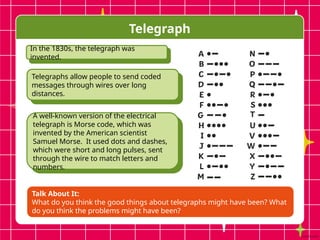
In the 1830s, the telegraph was
invented.
Talk About It:
What do you think the good things about telegraphs might have been? What
do you think the problems might have been?
Telegraphs allow people to send coded
messages through wires over long
distances.
A well-known version of the electrical
telegraph is Morse code, which was
invented by the American scientist
Samuel Morse. It used dots and dashes,
which were short and long pulses, sent
through the wire to match letters and
numbers.
Telephone
In the late 1800s, different inventors
began creating their own versions of
the first telephone.
A Scottish inventor called Alexander
Graham Bell was the first to patent
his telephone design.
Early telephones used wires to
transmit voices over long distances.
Today, telephone calls are mostly
made using satellites, which means
phones can be mobile and don’t need
to stay in a fixed place.
patent - To make a written
document that stops someone
from copying an inventor’s
design. X
Mobile Phones
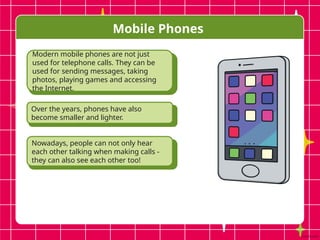
Modern mobile phones are not just
used for telephone calls. They can be
used for sending messages, taking
photos, playing games and accessing
the Internet.
Over the years, phones have also
become smaller and lighter.
Nowadays, people can not only hear
each other talking when making calls -
they can also see each other too!
Radio
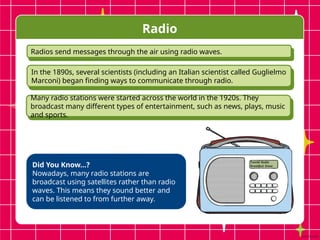
Radios send messages through the air using radio waves.
In the 1890s, several scientists (including an Italian scientist called Guglielmo
Marconi) began finding ways to communicate through radio.
Many radio stations were started across the world in the 1920s. They
broadcast many different types of entertainment, such as news, plays, music
and sports.
Did You Know…?
Nowadays, many radio stations are
broadcast using satellites rather than radio
waves. This means they sound better and
can be listened to from further away.
Television
The invention of the television in the 1920s was a breakthrough in
technology.
This was the first time sound and pictures could be sent together over the
air.
At first, television images were only displayed in black and white. It wasn’t
until the 1970s that people could see colour on the screen.
Internet
The Internet is a system that allows computers from all over the world to
connect with each other.
One of the earliest versions of the Internet was invented in the United
States in the 1960s to allow the government, businesses and colleges to
communicate more easily with each other.
In 1989, Tim Berners-Lee invented the the World Wide Web. This made it
easier for people to access information and communicate with each other
online using the computers in their homes.
Today, there are many popular ways to communicate over the Internet, such
as email, social networking and instant messaging.
Did You Know…?
The first email was
sent in 1971.
Communication in the Future
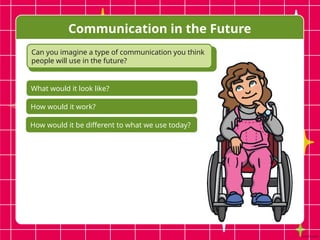
Can you imagine a type of communication you think
people will use in the future?
What would it look like?
How would it work?
How would it be different to what we use today?
Communication over Time PowerPoint.pptxs

Communication over Time PowerPoint.pptxs

  • 2.
    What is Communication? Communicationis how we share information with other people. There are many ways that we communicate with others. What different ways can you think of?
  • 3.
    How We Communicate Hereare some picture clues to help you to think of some of the different ways we communicate today: phone calls, texting and video calls sending messages using the Internet drawing and writing letters and books talking to each other using hand gestures using facial expressions Activity Make some facial expressions with a partner. Can they guess the feeling you are trying to show?
  • 4.
    Communication in thePast Some of the ways we communicate today didn’t exist in the past. Can you think of any ways people communicated with each other before modern technology (such as mobile phones and computers)?
  • 5.
    Talking One thing thatmakes humans different from other species is that we can use words to communicate with each other. No one knows for certain how long people have used languages. Some historians believe this happened around 50,000 years ago. Others believe early ancestors of humans could talk to each other over 2 million years ago. It’s difficult because there is no evidence left of people talking, unlike other types of communication such as writing. Think About It: Why do you think it’s so difficult for historians to work out when languages began? ancestors - An animal that lived long ago that a modern animal has developed from. X
  • 6.
    Cave Painting Thousands ofyears ago, cave paintings were used by many cultures all over the world to communicate with other tribes who visited their site. They used rocks, dirt and plants mixed with water to make the paint and used their fingers or sticks to draw with. A painting of a bull found in a cave in Indonesia. It’s thought to be around 40,000 years old.
  • 7.
    Pigeon Post Homing pigeonsare a breed of pigeon that are very skilled at finding their way home from long distances. A message is tied around the bird’s leg. The bird is then freed to return to the home of its owner. Ancient Egyptians used them to deliver letters from as early as 3000 BC. They have been used by many people all over the world throughout history. Did You Know…? Homing pigeons were also used as military messengers during the First and Second World Wars.
  • 8.
    Postal Service A postalservice helps deliver mail that people send to each other. Today, we can use postal services to send mail all across the world. People have been using postal services for thousands of years. Ancient Egyptians had their own postal service around 2000 BC. People in China used people on horses to send their mail around 1000 BC. Did You Know…? King Charles II set up the General Post Office in Britain in AD 1660. It eventually became known as Royal Mail.
  • 9.
    Printing Press In around1436, a German man called Johannes Gutenberg invented a machine that could print many books quickly. Before this invention, most books were written by hand, which took a very long time. This meant that there weren’t many books available to buy or read. Did You Know…? From as early as the 9th century, bookmakers in China had made making books easier by using wooden blocks to print the text.
  • 10.
    Telegraph In the 1830s,the telegraph was invented. Talk About It: What do you think the good things about telegraphs might have been? What do you think the problems might have been? Telegraphs allow people to send coded messages through wires over long distances. A well-known version of the electrical telegraph is Morse code, which was invented by the American scientist Samuel Morse. It used dots and dashes, which were short and long pulses, sent through the wire to match letters and numbers.
  • 11.
    Telephone In the late1800s, different inventors began creating their own versions of the first telephone. A Scottish inventor called Alexander Graham Bell was the first to patent his telephone design. Early telephones used wires to transmit voices over long distances. Today, telephone calls are mostly made using satellites, which means phones can be mobile and don’t need to stay in a fixed place. patent - To make a written document that stops someone from copying an inventor’s design. X
  • 12.
    Mobile Phones Modern mobilephones are not just used for telephone calls. They can be used for sending messages, taking photos, playing games and accessing the Internet. Over the years, phones have also become smaller and lighter. Nowadays, people can not only hear each other talking when making calls - they can also see each other too!
  • 13.
    Radio Radios send messagesthrough the air using radio waves. In the 1890s, several scientists (including an Italian scientist called Guglielmo Marconi) began finding ways to communicate through radio. Many radio stations were started across the world in the 1920s. They broadcast many different types of entertainment, such as news, plays, music and sports. Did You Know…? Nowadays, many radio stations are broadcast using satellites rather than radio waves. This means they sound better and can be listened to from further away.
  • 14.
    Television The invention ofthe television in the 1920s was a breakthrough in technology. This was the first time sound and pictures could be sent together over the air. At first, television images were only displayed in black and white. It wasn’t until the 1970s that people could see colour on the screen.
  • 15.
    Internet The Internet isa system that allows computers from all over the world to connect with each other. One of the earliest versions of the Internet was invented in the United States in the 1960s to allow the government, businesses and colleges to communicate more easily with each other. In 1989, Tim Berners-Lee invented the the World Wide Web. This made it easier for people to access information and communicate with each other online using the computers in their homes. Today, there are many popular ways to communicate over the Internet, such as email, social networking and instant messaging. Did You Know…? The first email was sent in 1971.
  • 16.
    Communication in theFuture Can you imagine a type of communication you think people will use in the future? What would it look like? How would it work? How would it be different to what we use today?