Why The Name PLCC
2
• The term PLCC abbreviates Power Line Carrier Communication since
conductors of Power Lines (132 kV, 220 kV, 400 kV and 765 kV Transmission
Lines) carry the high frequency communication signal also.
• In India the Power Frequency is 50 Hz & the Communication Frequency
ranges from 50 kHz to 500 kHz.
• A combination of Series Inductor (Line Trap) & Parallel Capacitor (Coupling
Capacitor) at both load as well source end are used, the combination of
Inductor & Capacitor discriminates between Power & Communication
Frequencies.
• Both end PLCCs communicate with each other and serve the purpose of
Monitoring & Protection of Transmission Line as well as Speech
Communication between both end Sub-Stations.
PLCC Familiarization
3
• Power line carrier communication is the method of transmitting information
using power network.
• The telephone communication system cannot be directly connected to the
high voltage lines, but PLCC facilitates the same.
• These usually consist of high voltage capacitor & inductor connected in
parallel used in conjunction with suitable line matching unit (LMU) for
matching the impedance of line to that of the coaxial cable connecting the
unit to the PLCC.
• LMU is a composite unit consisting of Drain Coil, Isolation transformer with
Lightning Arrester on its both the sides, a Tuning Device and an earth switch.
Tuning Device is the combination of R-L-C circuits which act as filter circuit.
LMU is also known as Coupling Device. Together with coupling capacitor,
LMU serves the purpose of connecting Audio/Radio frequency signals to
PLCC terminal and protection of the PLCC unit from the over voltages caused
due to transients on power system.
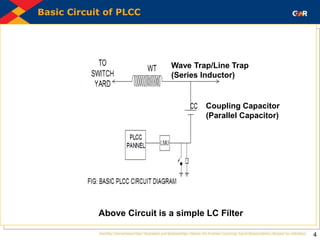
Basic Circuit of PLCC
4
Wave Trap/Line Trap
(Series Inductor)
Coupling Capacitor
(Parallel Capacitor)
Above Circuit is a simple LC Filter
Wave Trap and Coupling Capacitor
5
 The basic circuit of a PLCC consists of an Inductor connected in
series with the power circuit & a capacitor connected in parallel with
the power circuit.
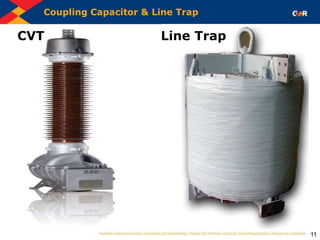
• Wave Trap (Line Trap)-This equipment is installed at sub stations for
trapping the high frequency communication signals sent on the line
from remote end substation and diverting them to the telecom panels
in the sub station control room.
• Coupling Capacitor- This equipment is used in the sub stations where
communication is done by AC Power Line. It offers very low
impedance to high frequency carrier signal and allows them to enter
into the line matching unit and blocks the low frequency signals.
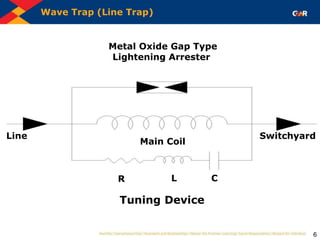
Wave Trap (Line Trap)
6
Metal Oxide Gap Type
Lightening Arrester
Main Coil
Line Switchyard
Tuning Device
R L C
Tuning Device
7
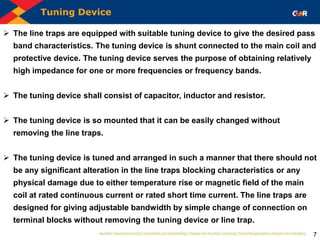
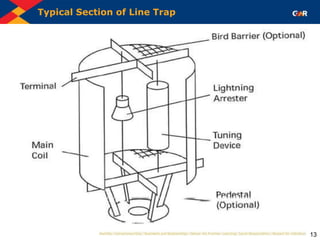
 The line traps are equipped with suitable tuning device to give the desired pass
band characteristics. The tuning device is shunt connected to the main coil and
protective device. The tuning device serves the purpose of obtaining relatively
high impedance for one or more frequencies or frequency bands.
 The tuning device shall consist of capacitor, inductor and resistor.
 The tuning device is so mounted that it can be easily changed without
removing the line traps.
 The tuning device is tuned and arranged in such a manner that there should not
be any significant alteration in the line traps blocking characteristics or any
physical damage due to either temperature rise or magnetic field of the main
coil at rated continuous current or rated short time current. The line traps are
designed for giving adjustable bandwidth by simple change of connection on
terminal blocks without removing the tuning device or line trap.
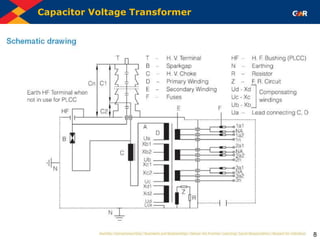
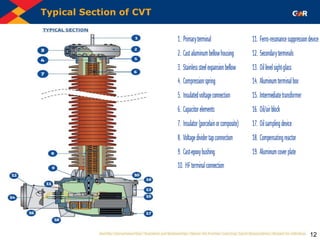
Capacitor Voltage Transformer
8
Function of Line Trap
9
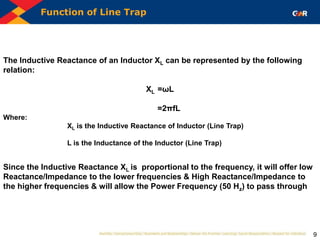
The Inductive Reactance of an Inductor XL can be represented by the following
relation:
XL =ωL
=2πfL
Where:
XL is the Inductive Reactance of Inductor (Line Trap)
L is the Inductance of the Inductor (Line Trap)
Since the Inductive Reactance XL is proportional to the frequency, it will offer low
Reactance/Impedance to the lower frequencies & High Reactance/Impedance to
the higher frequencies & will allow the Power Frequency (50 Hz) to pass through
Function of Coupling Capacitor
10
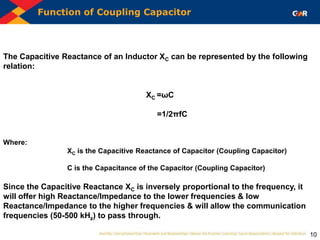
The Capacitive Reactance of an Inductor XC can be represented by the following
relation:
XC =ωC
=1/2πfC
Where:
XC is the Capacitive Reactance of Capacitor (Coupling Capacitor)
C is the Capacitance of the Capacitor (Coupling Capacitor)
Since the Capacitive Reactance XC is inversely proportional to the frequency, it
will offer high Reactance/Impedance to the lower frequencies & low
Reactance/Impedance to the higher frequencies & will allow the communication
frequencies (50-500 kHz) to pass through.
Coupling Capacitor & Line Trap
11
CVT Line Trap
Typical Section of CVT
12
Typical Section of Line Trap
13
Types of Coupling
14
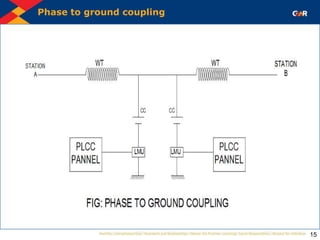
 Phase to ground coupling
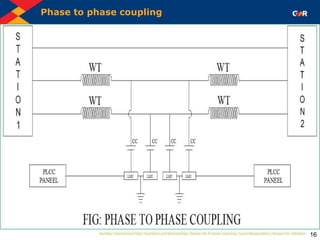
 Phase to phase coupling
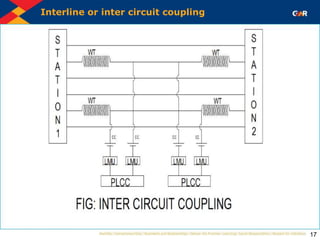
 Interline or inter circuit coupling
Phase to ground coupling
15
Phase to phase coupling
16
Interline or inter circuit coupling
17
Advantages of PLCC
18
• No separate wires are needed for communication purpose.
• Both communication and power transfer can be possible on same
circuit.
• Power lines provides the shortest route between the power station.
• Higher mechanical strength.
• Increased reliability.
• Lower attenuation over long distance.
• Implementation cost is low.
• Point to point communication.
• Load shading.
• Power line protection.
• Fault indicator.
Disadvantages of PLCC
19
• Interference are produced on associated communication lines. This
increases attenuation of signals.
• High voltage lines have transformer connections, which attenuate
carrier signals.
• Noise introduced in power lines carrying communication signals is
more than compared to telephone lines.
OPGW (Optical Ground Wire)
20
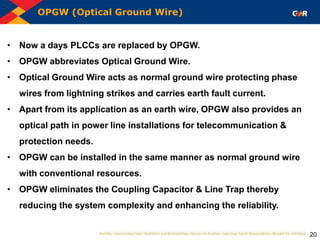
• Now a days PLCCs are replaced by OPGW.
• OPGW abbreviates Optical Ground Wire.
• Optical Ground Wire acts as normal ground wire protecting phase
wires from lightning strikes and carries earth fault current.
• Apart from its application as an earth wire, OPGW also provides an
optical path in power line installations for telecommunication &
protection needs.
• OPGW can be installed in the same manner as normal ground wire
with conventional resources.
• OPGW eliminates the Coupling Capacitor & Line Trap thereby
reducing the system complexity and enhancing the reliability.
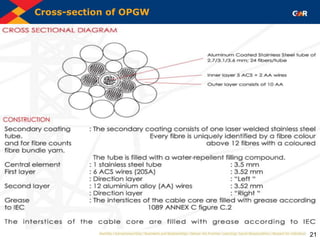
Cross-section of OPGW
21
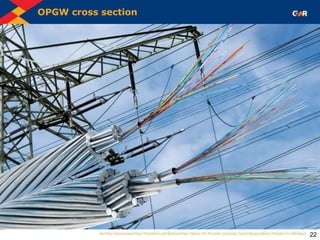
OPGW cross section
22
23

Power_Line_Carrier_Communication.pptx

  • 2.
    Why The NamePLCC 2 • The term PLCC abbreviates Power Line Carrier Communication since conductors of Power Lines (132 kV, 220 kV, 400 kV and 765 kV Transmission Lines) carry the high frequency communication signal also. • In India the Power Frequency is 50 Hz & the Communication Frequency ranges from 50 kHz to 500 kHz. • A combination of Series Inductor (Line Trap) & Parallel Capacitor (Coupling Capacitor) at both load as well source end are used, the combination of Inductor & Capacitor discriminates between Power & Communication Frequencies. • Both end PLCCs communicate with each other and serve the purpose of Monitoring & Protection of Transmission Line as well as Speech Communication between both end Sub-Stations.
  • 3.
    PLCC Familiarization 3 • Powerline carrier communication is the method of transmitting information using power network. • The telephone communication system cannot be directly connected to the high voltage lines, but PLCC facilitates the same. • These usually consist of high voltage capacitor & inductor connected in parallel used in conjunction with suitable line matching unit (LMU) for matching the impedance of line to that of the coaxial cable connecting the unit to the PLCC. • LMU is a composite unit consisting of Drain Coil, Isolation transformer with Lightning Arrester on its both the sides, a Tuning Device and an earth switch. Tuning Device is the combination of R-L-C circuits which act as filter circuit. LMU is also known as Coupling Device. Together with coupling capacitor, LMU serves the purpose of connecting Audio/Radio frequency signals to PLCC terminal and protection of the PLCC unit from the over voltages caused due to transients on power system.
  • 4.
    Basic Circuit ofPLCC 4 Wave Trap/Line Trap (Series Inductor) Coupling Capacitor (Parallel Capacitor) Above Circuit is a simple LC Filter
  • 5.
    Wave Trap andCoupling Capacitor 5  The basic circuit of a PLCC consists of an Inductor connected in series with the power circuit & a capacitor connected in parallel with the power circuit. • Wave Trap (Line Trap)-This equipment is installed at sub stations for trapping the high frequency communication signals sent on the line from remote end substation and diverting them to the telecom panels in the sub station control room. • Coupling Capacitor- This equipment is used in the sub stations where communication is done by AC Power Line. It offers very low impedance to high frequency carrier signal and allows them to enter into the line matching unit and blocks the low frequency signals.
  • 6.
    Wave Trap (LineTrap) 6 Metal Oxide Gap Type Lightening Arrester Main Coil Line Switchyard Tuning Device R L C
  • 7.
    Tuning Device 7  Theline traps are equipped with suitable tuning device to give the desired pass band characteristics. The tuning device is shunt connected to the main coil and protective device. The tuning device serves the purpose of obtaining relatively high impedance for one or more frequencies or frequency bands.  The tuning device shall consist of capacitor, inductor and resistor.  The tuning device is so mounted that it can be easily changed without removing the line traps.  The tuning device is tuned and arranged in such a manner that there should not be any significant alteration in the line traps blocking characteristics or any physical damage due to either temperature rise or magnetic field of the main coil at rated continuous current or rated short time current. The line traps are designed for giving adjustable bandwidth by simple change of connection on terminal blocks without removing the tuning device or line trap.
  • 8.
  • 9.
    Function of LineTrap 9 The Inductive Reactance of an Inductor XL can be represented by the following relation: XL =ωL =2πfL Where: XL is the Inductive Reactance of Inductor (Line Trap) L is the Inductance of the Inductor (Line Trap) Since the Inductive Reactance XL is proportional to the frequency, it will offer low Reactance/Impedance to the lower frequencies & High Reactance/Impedance to the higher frequencies & will allow the Power Frequency (50 Hz) to pass through
  • 10.
    Function of CouplingCapacitor 10 The Capacitive Reactance of an Inductor XC can be represented by the following relation: XC =ωC =1/2πfC Where: XC is the Capacitive Reactance of Capacitor (Coupling Capacitor) C is the Capacitance of the Capacitor (Coupling Capacitor) Since the Capacitive Reactance XC is inversely proportional to the frequency, it will offer high Reactance/Impedance to the lower frequencies & low Reactance/Impedance to the higher frequencies & will allow the communication frequencies (50-500 kHz) to pass through.
  • 11.
    Coupling Capacitor &Line Trap 11 CVT Line Trap
  • 12.
  • 13.
    Typical Section ofLine Trap 13
  • 14.
    Types of Coupling 14 Phase to ground coupling  Phase to phase coupling  Interline or inter circuit coupling
  • 15.
    Phase to groundcoupling 15
  • 16.
    Phase to phasecoupling 16
  • 17.
    Interline or intercircuit coupling 17
  • 18.
    Advantages of PLCC 18 •No separate wires are needed for communication purpose. • Both communication and power transfer can be possible on same circuit. • Power lines provides the shortest route between the power station. • Higher mechanical strength. • Increased reliability. • Lower attenuation over long distance. • Implementation cost is low. • Point to point communication. • Load shading. • Power line protection. • Fault indicator.
  • 19.
    Disadvantages of PLCC 19 •Interference are produced on associated communication lines. This increases attenuation of signals. • High voltage lines have transformer connections, which attenuate carrier signals. • Noise introduced in power lines carrying communication signals is more than compared to telephone lines.
  • 20.
    OPGW (Optical GroundWire) 20 • Now a days PLCCs are replaced by OPGW. • OPGW abbreviates Optical Ground Wire. • Optical Ground Wire acts as normal ground wire protecting phase wires from lightning strikes and carries earth fault current. • Apart from its application as an earth wire, OPGW also provides an optical path in power line installations for telecommunication & protection needs. • OPGW can be installed in the same manner as normal ground wire with conventional resources. • OPGW eliminates the Coupling Capacitor & Line Trap thereby reducing the system complexity and enhancing the reliability.
  • 21.
  • 22.
  • 23.