The Literary theory and Crit
icism
Prepared by
Makwana Monika
Department of English
• Modernism vs. postmodernism
 Name:- Makwana Monika
 Paper No:- 7 the Literary theory and Criticism
 Topic:-Modernism Vs. Postmodernism
 Roll no:- 21
 Enrollment No:- 2069108420190027
 Email I’d:- Makwanamonika76@gmail.com
 Submitted to:- S. B. Gardi department of English
Modern age Post-modern age
 Modernism is contrasts to t
his and is the movement fro
m late 19th to the 20th centu
ry.
 It celebrated ‘newness’ and
wanted art and music to refl
ect a new and contemporar
y society diminishing traditi
onal and old fashioned style
.
 Post-modernism is the radi
cal movement that devel
oped in the mid to late
20th century.
 This broad movement cov
ers the arts, philosophy, ar
chitecture, and the criticis
m of modernism.
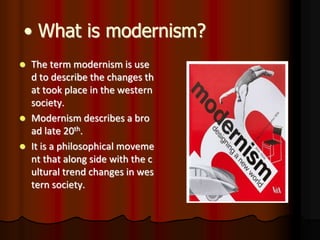
• What is modernism?
 The term modernism is use
d to describe the changes th
at took place in the western
society.
 Modernism describes a bro
ad late 20th.
 It is a philosophical moveme
nt that along side with the c
ultural trend changes in wes
tern society.
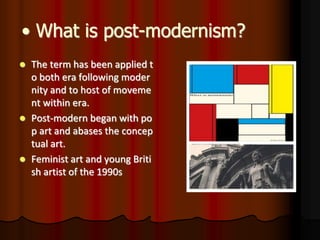
• What is post-modernism?
 The term has been applied t
o both era following moder
nity and to host of moveme
nt within era.
 Post-modern began with po
p art and abases the concep
tual art.
 Feminist art and young Briti
sh artist of the 1990s
• Modernism post-modernism
 Adherence to western heg
emonic values.
 Focus on the writer.
 Focus on interiority.
 Alienation
 Unreliable narrator
 Rejection of realism
 Literature is self-contained
.
 High- brow genres
 Rejection of literary conve
ntion.
 Idiosyncratic language
 Contrasts western hegemon
ic values.
 Focus on the reader
 Focus on exteriority
 Collective voices
 ironic narrator
 Ambivalence towards realis
m.
 Literature is open and intert
exual.
 Parody of high and low-bro
w genres.
 Simple language
• Modernism vs. post-modernism
 It was prevalent from late 19t
h century and early 20tyh cent
ury.
 It was influenced by the first
world war.
 It was based on using rational
and logical means to gain kno
wledge.
 It rejected realism
 It rejected the conventional st
yle of prose and poetry.
 It was prevalent from the m
id-twentieth century.
 It was influenced by the sec
ond world war.
 It was based on
an unscientific,
irrational.
 It rejected logical thinking
 It deliberately uses.
a mixture of conventional st
yles.
• Comparison between modernis
m and post-modernism
 both rejecting boundaries between high a
nd form of art: culture is only.
 Rejecting rigid genre distinctions.
 Reflexivity and self consciousness.
 Both were terms developed in the 20th cen
tury.
• Modernist post- modernist
 Virginia Woolf
 James Joyce
 T. S. Eliot
 Ezra pound
 Joseph Conrad
 Samuel bucket
 Marianne Moore
 Dorothy Richardson
 Bob Dylan
 John Berryman
 Italo Calvino
 Paul Auster
 Zadie smith
 Allen Ginsberg
 Doris Lessing
 William H. Grass
• Works of modernist
 Winesburg, Ohio
 Tradition and the individual talent
 The Waste Land
 The Great Gatsby
 The sun also Rises
 A farewell to arms
 The sound and the fury
 Light in August
• Works of post-modernist
 Catch-22
 Slaughterhouse five
 Lost in the funhouse
 The things they carried
 White noise
 Gravity’s rainbow
 The crying of lot 49
• conclusion
 New literature, art, and culture af
ter world war II created, analyzes
of those is known as postmoderni
sm. It is opposed modernism.
Paper:-7

Paper:-7

  • 1.
    The Literary theoryand Crit icism Prepared by Makwana Monika Department of English
  • 2.
    • Modernism vs.postmodernism  Name:- Makwana Monika  Paper No:- 7 the Literary theory and Criticism  Topic:-Modernism Vs. Postmodernism  Roll no:- 21  Enrollment No:- 2069108420190027  Email I’d:- Makwanamonika76@gmail.com  Submitted to:- S. B. Gardi department of English
  • 3.
    Modern age Post-modernage  Modernism is contrasts to t his and is the movement fro m late 19th to the 20th centu ry.  It celebrated ‘newness’ and wanted art and music to refl ect a new and contemporar y society diminishing traditi onal and old fashioned style .  Post-modernism is the radi cal movement that devel oped in the mid to late 20th century.  This broad movement cov ers the arts, philosophy, ar chitecture, and the criticis m of modernism.
  • 4.
    • What ismodernism?  The term modernism is use d to describe the changes th at took place in the western society.  Modernism describes a bro ad late 20th.  It is a philosophical moveme nt that along side with the c ultural trend changes in wes tern society.
  • 5.
    • What ispost-modernism?  The term has been applied t o both era following moder nity and to host of moveme nt within era.  Post-modern began with po p art and abases the concep tual art.  Feminist art and young Briti sh artist of the 1990s
  • 6.
    • Modernism post-modernism Adherence to western heg emonic values.  Focus on the writer.  Focus on interiority.  Alienation  Unreliable narrator  Rejection of realism  Literature is self-contained .  High- brow genres  Rejection of literary conve ntion.  Idiosyncratic language  Contrasts western hegemon ic values.  Focus on the reader  Focus on exteriority  Collective voices  ironic narrator  Ambivalence towards realis m.  Literature is open and intert exual.  Parody of high and low-bro w genres.  Simple language
  • 7.
    • Modernism vs.post-modernism  It was prevalent from late 19t h century and early 20tyh cent ury.  It was influenced by the first world war.  It was based on using rational and logical means to gain kno wledge.  It rejected realism  It rejected the conventional st yle of prose and poetry.  It was prevalent from the m id-twentieth century.  It was influenced by the sec ond world war.  It was based on an unscientific, irrational.  It rejected logical thinking  It deliberately uses. a mixture of conventional st yles.
  • 8.
    • Comparison betweenmodernis m and post-modernism  both rejecting boundaries between high a nd form of art: culture is only.  Rejecting rigid genre distinctions.  Reflexivity and self consciousness.  Both were terms developed in the 20th cen tury.
  • 9.
    • Modernist post-modernist  Virginia Woolf  James Joyce  T. S. Eliot  Ezra pound  Joseph Conrad  Samuel bucket  Marianne Moore  Dorothy Richardson  Bob Dylan  John Berryman  Italo Calvino  Paul Auster  Zadie smith  Allen Ginsberg  Doris Lessing  William H. Grass
  • 10.
    • Works ofmodernist  Winesburg, Ohio  Tradition and the individual talent  The Waste Land  The Great Gatsby  The sun also Rises  A farewell to arms  The sound and the fury  Light in August
  • 11.
    • Works ofpost-modernist  Catch-22  Slaughterhouse five  Lost in the funhouse  The things they carried  White noise  Gravity’s rainbow  The crying of lot 49
  • 12.
    • conclusion  Newliterature, art, and culture af ter world war II created, analyzes of those is known as postmoderni sm. It is opposed modernism.