A NEW POSTFUNCTIONAL APPROACH TO
PREPARE SECOND-ORDER NONLINEAR
OPTICAL POLYPHOPHAZENES CONTAINING
SULFONYL-BASED CHROMOPHORE
ZHEN LI,† CHENG HUANG,† JIANLI HUA,† JINGUI QIN,*,†
ZHOU YANG,‡ AND CHENG YE‡
DEPARTMENT OF CHEMISTRY, WUHAN UNIVERSITY, WUHAN
430072, CHINA, AND CENTER FOR MOLECULAR
SCIENCE, ORGANIC SOLIDS LAB., INSTITUTE OF CHEMISTRY,
THE CHINESE ACADEMY OF SCIENCE,
BEIJING 100080, CHINA
RECEIVED JULY 21, 2003; REVISED MANUSCRIPT RECEIVED
NOVEMBER 3, 2003
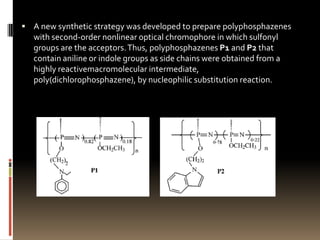
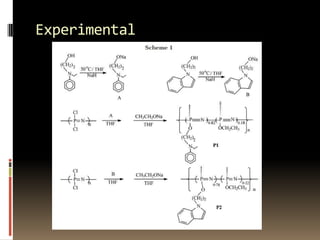
 A new synthetic strategy was developed to prepare polyphosphazenes
   with second-order nonlinear optical chromophore in which sulfonyl
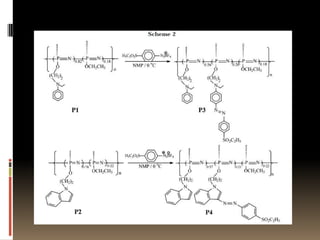
   groups are the acceptors. Thus, polyphosphazenes P1 and P2 that
   contain aniline or indole groups as side chains were obtained from a
   highly reactivemacromolecular intermediate,
   poly(dichlorophosphazene), by nucleophilic substitution reaction.
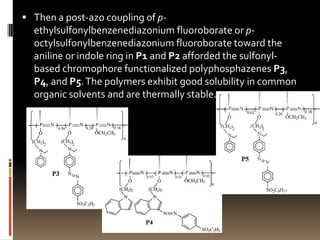
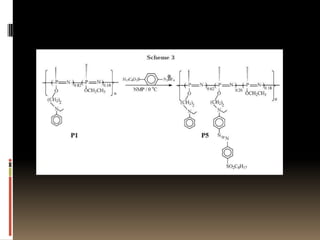
 Then a post-azo coupling of p-
  ethylsulfonylbenzenediazonium fluoroborate or p-
  octylsulfonylbenzenediazonium fluoroborate toward the
  aniline or indole ring in P1 and P2 afforded the sulfonyl-
  based chromophore functionalized polyphosphazenes P3,
  P4, and P5. The polymers exhibit good solubility in common
  organic solvents and are thermally stable.
 The maximum absorption appeared at about
 440 nm in P3, while that of P4 was at about
 393 nm, which were blue-shifted about 52
 and 32 nm, respectively, compared to the
 corresponding chromophores with nitro
 acceptor and resulted in a wider transparency
 window. The poled films of P3 and P4 exhibits
 a resonant d33 value of 27 and 18 pm/V,
 respectively, by second harmonic generation
 (SHG) measurements.
 Organic polymeric second-order nonlinear optical (NLO)
  materials have attracted steady interest due to their
  potential photonics applications and many advantages over
  single crystals.1-3 To meet the requirements of the practical
  application, the device-quality NLO materials should
  possess high stability and low optical loss, besides the large
  macroscopic optical nonlinearity. Polyphosphazenes are
  inorganic polymers with a backbone of alternating
  phosphorus and nitrogen atoms and two side groups linked
  to the phosphorus atoms. In recent years, they have
  attracted growing attention due to their unique range of
  unusual properties, such as high thermal and oxidative
  stability, optical transparency from 220 nm to the near-IR
  region of the backbone, and the ease of syntheses.
 Compared to the ordinarypolymers with only
  one functional side group per unit, the
  polyphosphazenes provide double sites for
  further functionalization.8-12 Furthermore,
  the pioneered studies by Allcock et al. and
  other     scientists   demonstrated     that
  polyphosphazenes could fulfill many of the
  requirements of the NLO active polymers and
  were promising candidates for the practical
  applications.
 On the other hand, while nitro and polycyanovinylgroups
  have been widely studied as acceptor groups in NLO, the
  sulfonyl group has not received much attention, though the
  sulfonyl groups possess strong acceptor properties. In
  addition, they are bifunctional groups, which permits
  greater freedom in the design of compounds for specific
  applications and allows more flexibility for synthetically
  tailoring the physical properties.
 According to the literature and our previous work, the
  chromophores        exhibited    similar   first molecular
  hyperpolarizability (â) when the nitro groups were replaced
  by the sulfonyl groups, but the sulfonyl compounds showed
  much wider transparency in visible region (with
  hypsochromic shift of 20-40 nm) and the synthetic
  flexibility.17-23 Until now, the reported polymers, which
  contain sulfonyl-based chromophores, were prepared by
  the direct polymerization or reaction of the sulfonylbased
  chromophore with functional polymers.
Experimental
Characterization

 In the IR spectra of P1-P5, the 1250-1200 cm-1
  bands were attributed to an intense P-N
  stretching vibration and the 750 cm-1 band to an
  in-phase P-N-P stretch. The new strong
  absorption bands appeared at about 1128 cm-1
  in the IR spectrum of P3-P5 were assignable to
  the absorption of the sulfonyl groups. This
  confirmed that the p-
  ethylsulfonylbenzenediazonium fluoroborate or
  p-octylsulfonylbenzenediazonium fluoroborate
  had reacted with the aniline or indole rings, and
  the sulfonyl groups were introduced into the
  polymer side chains successfully.
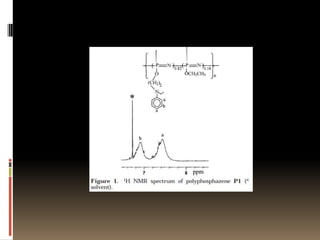
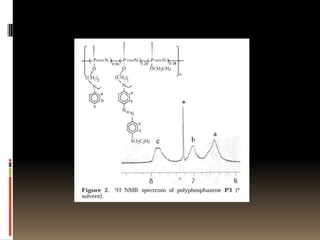
 Figures 1 and 2 show the 1H NMR spectrum of P1 and P3
  for examples and the assignment of peaks downfield for
  comparison. Some resonance peaks appearing downfield in
  Figure 2, which were due to the p-ethylsulfonyl phenyl
  moieties, also confirmed that the azo coupling reaction was
  successful and the azo chromophore really formed. The
  ratio of the two kinds of aniline groups in P3, aniline and
  sulfonylazoaniline moieties, was estimated to be 2.2:1 by
  analyzing the peaks of two protons in the range 6.4-6.8
  ppm and six sulfonylazo chromophore protons in the range
  7.6-8.0 ppm. By the same method, the ratio of the two
  kinds of aniline groups in P5, aniline and sulfonylazoaniline
  moieties, was estimated to be 3.1:1. The preparation of P2
  has been reported previously. The ratio of the two kinds of
  indole units in P4, indolyl and sulfonylazoindolyl moieties,
  was estimated to be 2.7:1 by analyzing the spectrum
  carefully.
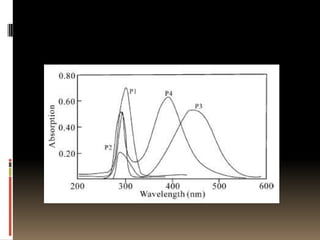
 P1-P5 have good solubility in common
  organic solvents, such as CHCl3, THF, DMSO,
  and DMF. Figure 3 showed the UV-vis spectra
  of them in the solution of THF. After the post-
  azo coupling reaction, a new strong
  absorptions maximum of the ð-ð* transition
  of indolebased chromophore appeared at
  about 440 nm in P3, while that of P4 was at
  about 393 nm.
 Three new polyphosphazenes P3-P5 with a high density of
  the sulfonyl-based chromophore are prepared by a novel
  two-step method. First, polyphosphazenes P1 and P2 that
  contain aniline and indole groups as side chains were
  obtained. Then a post-azo coupling of p-
  ethylsulfonylbenzenediazonium fluoroborate or p-
  octylsulfonylbenzenediazonium fluoroborate toward the
  aniline and indole ring in P1 and P2 afforded the sulfonyl-
  based chromophore-functionalized polyphosphazenes P3-
  P5. This synthetic route is simple, and the purification of
  the products was easy. It is believed that many other
  polymers containing sulfonyl-based chromophores for
  nonlinear optical applications could be prepared by this
  new and simple synthetic strategy. The polymers exhibit
  good solubility in common organic, such as CHCl3, THF,
  DMSO, and DMF.
 The maximum absorptions appeared at about
 440 nm in P3, while that of P4 was at about
 393 nm, which were blue-shifted about 52
 and 32 nm, respectively, compared to the
 corresponding chromophores with nitro
 acceptor. The poled film of P3 and P4 exhibits
 a resonant d33 value of 27 and 18 pm/V,
 respectively, by second harmonic generation
 (SHG) measurements.

Postfunctional approach to prepare second order nonlinear optical polyphophazenes

  • 1.
    A NEW POSTFUNCTIONALAPPROACH TO PREPARE SECOND-ORDER NONLINEAR OPTICAL POLYPHOPHAZENES CONTAINING SULFONYL-BASED CHROMOPHORE ZHEN LI,† CHENG HUANG,† JIANLI HUA,† JINGUI QIN,*,† ZHOU YANG,‡ AND CHENG YE‡ DEPARTMENT OF CHEMISTRY, WUHAN UNIVERSITY, WUHAN 430072, CHINA, AND CENTER FOR MOLECULAR SCIENCE, ORGANIC SOLIDS LAB., INSTITUTE OF CHEMISTRY, THE CHINESE ACADEMY OF SCIENCE, BEIJING 100080, CHINA RECEIVED JULY 21, 2003; REVISED MANUSCRIPT RECEIVED NOVEMBER 3, 2003
  • 2.
     A newsynthetic strategy was developed to prepare polyphosphazenes with second-order nonlinear optical chromophore in which sulfonyl groups are the acceptors. Thus, polyphosphazenes P1 and P2 that contain aniline or indole groups as side chains were obtained from a highly reactivemacromolecular intermediate, poly(dichlorophosphazene), by nucleophilic substitution reaction.
  • 3.
     Then apost-azo coupling of p- ethylsulfonylbenzenediazonium fluoroborate or p- octylsulfonylbenzenediazonium fluoroborate toward the aniline or indole ring in P1 and P2 afforded the sulfonyl- based chromophore functionalized polyphosphazenes P3, P4, and P5. The polymers exhibit good solubility in common organic solvents and are thermally stable.
  • 4.
     The maximumabsorption appeared at about 440 nm in P3, while that of P4 was at about 393 nm, which were blue-shifted about 52 and 32 nm, respectively, compared to the corresponding chromophores with nitro acceptor and resulted in a wider transparency window. The poled films of P3 and P4 exhibits a resonant d33 value of 27 and 18 pm/V, respectively, by second harmonic generation (SHG) measurements.
  • 5.
     Organic polymericsecond-order nonlinear optical (NLO) materials have attracted steady interest due to their potential photonics applications and many advantages over single crystals.1-3 To meet the requirements of the practical application, the device-quality NLO materials should possess high stability and low optical loss, besides the large macroscopic optical nonlinearity. Polyphosphazenes are inorganic polymers with a backbone of alternating phosphorus and nitrogen atoms and two side groups linked to the phosphorus atoms. In recent years, they have attracted growing attention due to their unique range of unusual properties, such as high thermal and oxidative stability, optical transparency from 220 nm to the near-IR region of the backbone, and the ease of syntheses.
  • 6.
     Compared tothe ordinarypolymers with only one functional side group per unit, the polyphosphazenes provide double sites for further functionalization.8-12 Furthermore, the pioneered studies by Allcock et al. and other scientists demonstrated that polyphosphazenes could fulfill many of the requirements of the NLO active polymers and were promising candidates for the practical applications.
  • 7.
     On theother hand, while nitro and polycyanovinylgroups have been widely studied as acceptor groups in NLO, the sulfonyl group has not received much attention, though the sulfonyl groups possess strong acceptor properties. In addition, they are bifunctional groups, which permits greater freedom in the design of compounds for specific applications and allows more flexibility for synthetically tailoring the physical properties.  According to the literature and our previous work, the chromophores exhibited similar first molecular hyperpolarizability (â) when the nitro groups were replaced by the sulfonyl groups, but the sulfonyl compounds showed much wider transparency in visible region (with hypsochromic shift of 20-40 nm) and the synthetic flexibility.17-23 Until now, the reported polymers, which contain sulfonyl-based chromophores, were prepared by the direct polymerization or reaction of the sulfonylbased chromophore with functional polymers.
  • 8.
  • 11.
    Characterization  In theIR spectra of P1-P5, the 1250-1200 cm-1 bands were attributed to an intense P-N stretching vibration and the 750 cm-1 band to an in-phase P-N-P stretch. The new strong absorption bands appeared at about 1128 cm-1 in the IR spectrum of P3-P5 were assignable to the absorption of the sulfonyl groups. This confirmed that the p- ethylsulfonylbenzenediazonium fluoroborate or p-octylsulfonylbenzenediazonium fluoroborate had reacted with the aniline or indole rings, and the sulfonyl groups were introduced into the polymer side chains successfully.
  • 12.
     Figures 1and 2 show the 1H NMR spectrum of P1 and P3 for examples and the assignment of peaks downfield for comparison. Some resonance peaks appearing downfield in Figure 2, which were due to the p-ethylsulfonyl phenyl moieties, also confirmed that the azo coupling reaction was successful and the azo chromophore really formed. The ratio of the two kinds of aniline groups in P3, aniline and sulfonylazoaniline moieties, was estimated to be 2.2:1 by analyzing the peaks of two protons in the range 6.4-6.8 ppm and six sulfonylazo chromophore protons in the range 7.6-8.0 ppm. By the same method, the ratio of the two kinds of aniline groups in P5, aniline and sulfonylazoaniline moieties, was estimated to be 3.1:1. The preparation of P2 has been reported previously. The ratio of the two kinds of indole units in P4, indolyl and sulfonylazoindolyl moieties, was estimated to be 2.7:1 by analyzing the spectrum carefully.
  • 15.
     P1-P5 havegood solubility in common organic solvents, such as CHCl3, THF, DMSO, and DMF. Figure 3 showed the UV-vis spectra of them in the solution of THF. After the post- azo coupling reaction, a new strong absorptions maximum of the ð-ð* transition of indolebased chromophore appeared at about 440 nm in P3, while that of P4 was at about 393 nm.
  • 17.
     Three newpolyphosphazenes P3-P5 with a high density of the sulfonyl-based chromophore are prepared by a novel two-step method. First, polyphosphazenes P1 and P2 that contain aniline and indole groups as side chains were obtained. Then a post-azo coupling of p- ethylsulfonylbenzenediazonium fluoroborate or p- octylsulfonylbenzenediazonium fluoroborate toward the aniline and indole ring in P1 and P2 afforded the sulfonyl- based chromophore-functionalized polyphosphazenes P3- P5. This synthetic route is simple, and the purification of the products was easy. It is believed that many other polymers containing sulfonyl-based chromophores for nonlinear optical applications could be prepared by this new and simple synthetic strategy. The polymers exhibit good solubility in common organic, such as CHCl3, THF, DMSO, and DMF.
  • 18.
     The maximumabsorptions appeared at about 440 nm in P3, while that of P4 was at about 393 nm, which were blue-shifted about 52 and 32 nm, respectively, compared to the corresponding chromophores with nitro acceptor. The poled film of P3 and P4 exhibits a resonant d33 value of 27 and 18 pm/V, respectively, by second harmonic generation (SHG) measurements.