REVISION SESSION
PHOTOSYNTHESIS
BOTANY INSIDER
• CHECK AUDIO AND VIDEO....
WHAT IS PHOTOSYNTHESIS?
Photo + Synthesis
LIGHT TO MAKE
To make something using light ..
OCCURS IN:
• Photosynthetic organisms :
PLANTS ALGAE
SOME BACTERIA ETC.
• Photosynthesis is a process in
which photosynthetic organisms
use light energy to
make(synthesize) organic
compounds .
• It is a PHYSIOCHEMICAL process.
Means, both physical and chemical factors are being
used in the process.
It is - anabolic process.
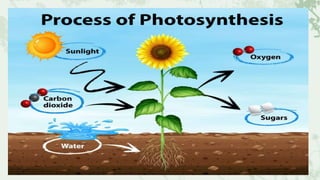
REQUIREMENTS
• WATER
• SUNLIGHT
• CARBON DIOXIDE
• CHLOROPHYLL-GREEN PIGMENT
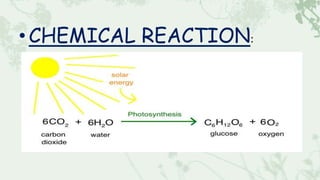
•CHEMICAL REACTION:
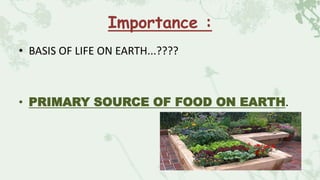
Importance :
• BASIS OF LIFE ON EARTH...????
• PRIMARY SOURCE OF FOOD ON EARTH.
• MAINTAIN OXYGEN EQUILIBRIUM IN
ENVIRONMENT.
ALSO MAKES-RESERVE OF ENERGY TO MAN AS- FUEL
(COAL,OIL,WOOD ETC..)
PHOTOSYNTHESIS
PART-2
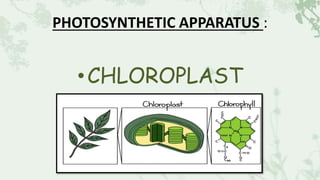
PHOTOSYNTHETIC APPARATUS :
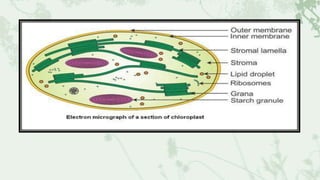
•CHLOROPLAST
ABOUT CHLOROPLAST
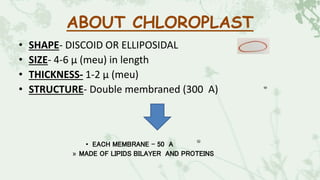
• SHAPE- DISCOID OR ELLIPOSIDAL
• SIZE- 4-6 μ (meu) in length
• THICKNESS- 1-2 μ (meu)
• STRUCTURE- Double membraned (300 A)
• EACH MEMBRANE – 50 A
» MADE OF LIPIDS BILAYER AND PROTEINS
PHOTOSYNTHETIC PIGMENTS
3 TYPES
CHLOROPHYLL
CAROTENOIDS
PHYCOBILINS
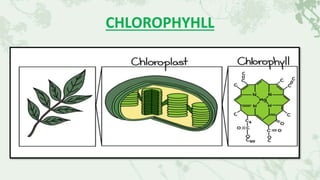
CHLOROPHYHLL
STRUCTURE
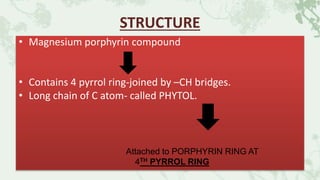
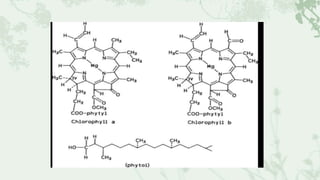
• Magnesium porphyrin compound
• Contains 4 pyrrol ring-joined by –CH bridges.
• Long chain of C atom- called PHYTOL.
Attached to PORPHYRIN RING AT
4TH PYRROL RING
DERIVATION
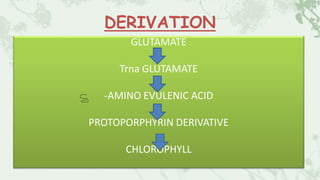
GLUTAMATE
Trna GLUTAMATE
-AMINO EVULENIC ACID
PROTOPORPHYRIN DERIVATIVE
CHLOROPHYLL
MOLECULAR FORMULA
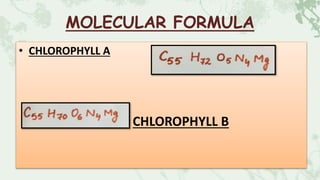
• CHLOROPHYLL A
•CHLOROPHYLL B
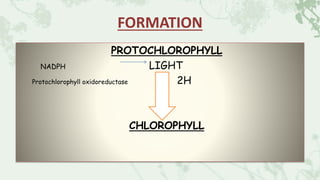
FORMATION
PROTOCHLOROPHYLL
NADPH LIGHT
Protochlorophyll oxidoreductase 2H
CHLOROPHYLL
CAROTENOIDS
• These are pigments in plants, algae, and photosynthetic
bacteria.
• Produce the bright yellow, red, and orange colors in
plants, vegetables, and fruits.
• CANNOT TRANSFER ENERGY DIRECTLY TO
PHOTOSYNTHETIC PATHWAY .
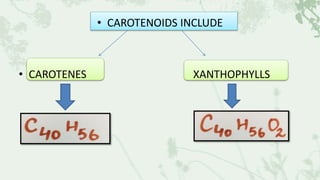
• CAROTENOIDS INCLUDE
• CAROTENES XANTHOPHYLLS
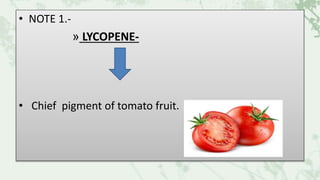
• NOTE 1.-
» LYCOPENE-
• Chief pigment of tomato fruit.
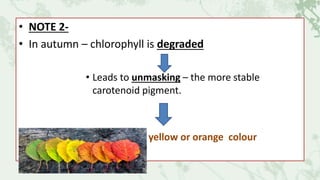
• NOTE 2-
• In autumn – chlorophyll is degraded
• Leads to unmasking – the more stable
carotenoid pigment.
• Gives bright yellow or orange colour
PHYCOBILINS
• Contain OPEN conjugated system of 4 Pyrrol ring.
• Lacks Mg and Phytol tail.
• Water soluble.
• Found in stroma.
• OCCUR ONLY IN CYANOBACTERIA AND
RHODOPHYTA.
RED DROP AND EMERSON
ENHANCEMENT EFFECT.
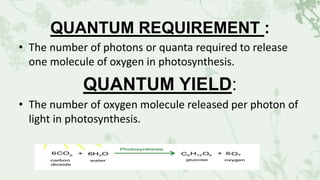
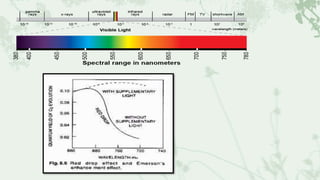
QUANTUM REQUIREMENT :
• The number of photons or quanta required to release
one molecule of oxygen in photosynthesis.
QUANTUM YIELD:
• The number of oxygen molecule released per photon of
light in photosynthesis.
ABOUT
• BY- ROBERT EMERSON AND LEWIS
• Experiment - determining the quantum yield of
photosynthesis in Chlorella – using monochromatic light of
different wavelength.
Sharp decline in quantum yield
At wavelength greater than 680nm
red part of spectrum.
THUS THE PHENOMENON CALLED –RED
DROP
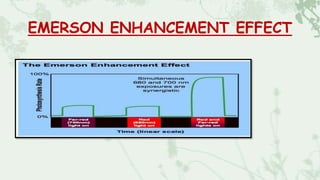
EMERSON ENHANCEMENT EFFECT
• RESULT-
• CHLORELLA when treated with a wavelength of
range 680-700nm – maximum quantum yield
obtained .
• There are 2 photosystems(PS) present
» PS I PS II
(700nm) (680 nm)
PHOTOSYSTEMS
ABOUT
• Presence of Photosystems -suggested by
Red drop and Emerson enhancement effect.
- Major role in photosynthesis.
- These are groups of photosynthetic pigments.
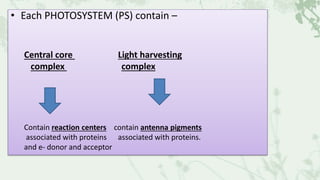
• Each PHOTOSYSTEM (PS) contain –
Central core Light harvesting
complex complex
Contain reaction centers contain antenna pigments
associated with proteins associated with proteins.
and e- donor and acceptor
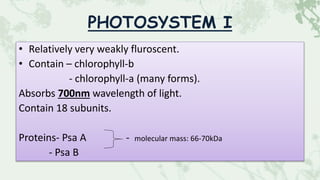
PHOTOSYSTEM I
• Relatively very weakly fluroscent.
• Contain – chlorophyll-b
- chlorophyll-a (many forms).
Absorbs 700nm wavelength of light.
Contain 18 subunits.
Proteins- Psa A - molecular mass: 66-70kDa
- Psa B
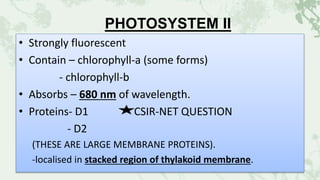
PHOTOSYSTEM II
• Strongly fluorescent
• Contain – chlorophyll-a (some forms)
- chlorophyll-b
• Absorbs – 680 nm of wavelength.
• Proteins- D1 CSIR-NET QUESTION
- D2
(THESE ARE LARGE MEMBRANE PROTEINS).
-localised in stacked region of thylakoid membrane.
PHOTOSYNTHESIS(part-4)
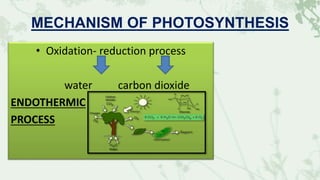
MECHANISM OF PHOTOSYNTHESIS
• Oxidation- reduction process
water carbon dioxide
ENDOTHERMIC
PROCESS
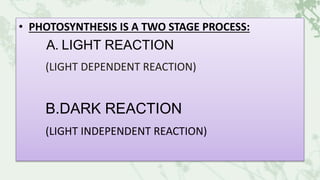
• PHOTOSYNTHESIS IS A TWO STAGE PROCESS:
A. LIGHT REACTION
(LIGHT DEPENDENT REACTION)
B.DARK REACTION
(LIGHT INDEPENDENT REACTION)
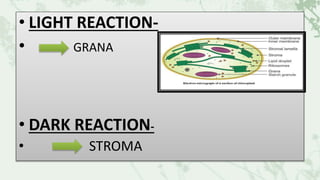
• LIGHT REACTION-
• GRANA
• DARK REACTION-
• STROMA
PHOTOSYNTHESIS (part-5)
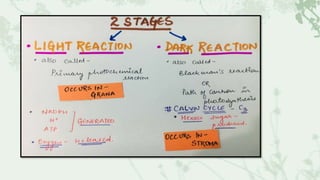
LIGHT REACTION
• OCCURS ONLY IN THE PRESENCE OF LIGHT
• LOCATION: GRANA (THYLAKOID)
• REQUIRES: NADPH and ATP
• ALSO CALLED – THYLAKOID REACTION
- PHOTOPHOSPHORYLATION.
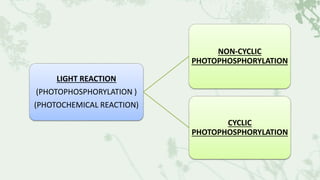
LIGHT REACTION
(PHOTOPHOSPHORYLATION )
(PHOTOCHEMICAL REACTION)
NON-CYCLIC
PHOTOPHOSPHORYLATION
CYCLIC
PHOTOPHOSPHORYLATION
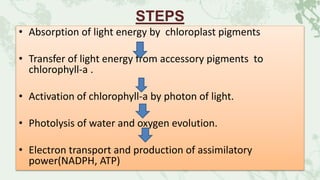
STEPS
• Absorption of light energy by chloroplast pigments
• Transfer of light energy from accessory pigments to
chlorophyll-a .
• Activation of chlorophyll-a by photon of light.
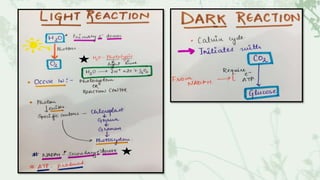
• Photolysis of water and oxygen evolution.
• Electron transport and production of assimilatory
power(NADPH, ATP)
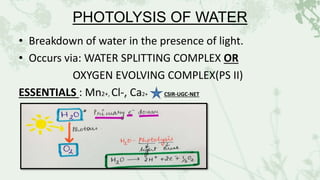
PHOTOLYSIS OF WATER
• Breakdown of water in the presence of light.
• Occurs via: WATER SPLITTING COMPLEX OR
OXYGEN EVOLVING COMPLEX(PS II)
ESSENTIALS : Mn2+, Cl-, Ca2+ CSIR-UGC-NET
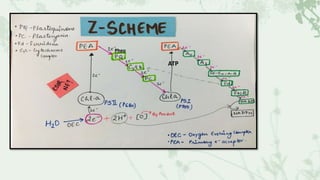
Z-SCHEME
• Light induced electron transport.
• Involves PS I and PS II
• ELECTRONS move from water through PS II to PS I and
then to NADP+
• Electron transport leads to – proton motive
force generation
- ATP synthesis
Pheo
ATP
Products
• ATP produced
• NADPH produced
ATP
ATP
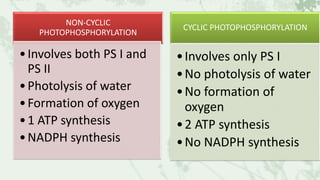
NON-CYCLIC
PHOTOPHOSPHORYLATION
•Involves both PS I and
PS II
•Photolysis of water
•Formation of oxygen
•1 ATP synthesis
•NADPH synthesis
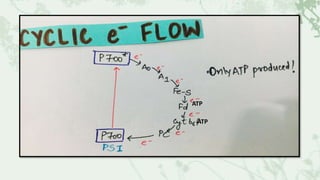
CYCLIC PHOTOPHOSPHORYLATION
•Involves only PS I
•No photolysis of water
•No formation of
oxygen
•2 ATP synthesis
•No NADPH synthesis
PHOTOSYNTHESIS (part-6)
CALVIN CYCLE
PHOTORESPIRATION
CSIR-NET QUESTION
DARK REACTION
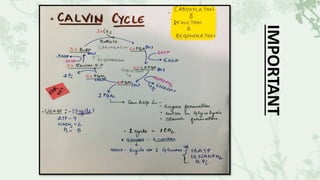
CALVIN CYCLE
• By-Melvin Calvin in 1957
• Also called C3 CYCLE – first stable product-
PGA (3C)
• Light independent reaction
• Require products of light reaction.
• REDUCTIVE-PENTOSE PHOSPHATE PATHWAY
• REQUIRES -ATP
NADPH CO2
Location – STROMA
RUBISCO
• Ribulose-1,5-bisphosphate carboxylase-oxygenase
• Can work as both oxygenase and carboxygenase
• Equal affinity for OXYGEN and CARBON DIOXIDE
• Same active site for both.
• Activity depends on concentration
CONDITIONS
• Moderate temperature
• Moderate light CSIR –NET
• High concentration of CO2
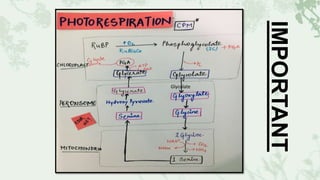
IMPORTANT
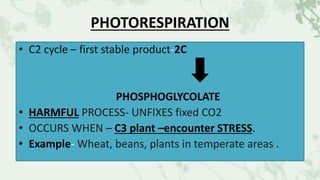
PHOTORESPIRATION
• C2 cycle – first stable product-2C
PHOSPHOGLYCOLATE
• HARMFUL PROCESS- UNFIXES fixed CO2
• OCCURS WHEN – C3 plant –encounter STRESS.
• Example- Wheat, beans, plants in temperate areas .
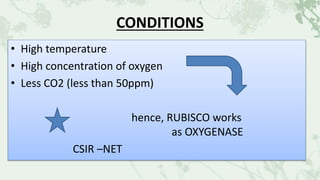
CONDITIONS
• High temperature
• High concentration of oxygen
• Less CO2 (less than 50ppm)
hence, RUBISCO works
as OXYGENASE
CSIR –NET
IMPORTANT
Glycolate
PHOTOSYNTHESIS (part-7)
C4- PATHWAY
CAM PATHWAY
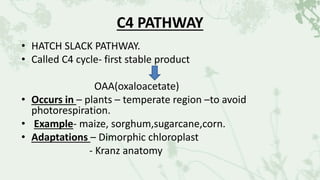
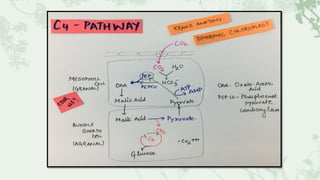
C4 PATHWAY
• HATCH SLACK PATHWAY.
• Called C4 cycle- first stable product
OAA(oxaloacetate)
• Occurs in – plants – temperate region –to avoid
photorespiration.
• Example- maize, sorghum,sugarcane,corn.
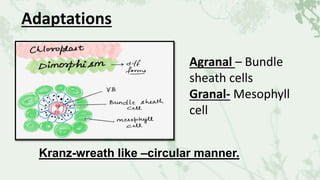
• Adaptations – Dimorphic chloroplast
- Kranz anatomy
Agranal – Bundle
sheath cells
Granal- Mesophyll
cell
Kranz-wreath like –circular manner.
Adaptations
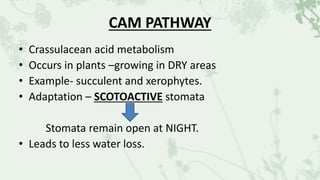
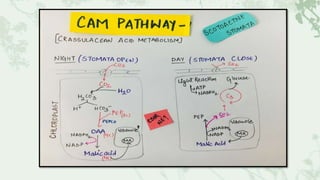
CAM PATHWAY
• Crassulacean acid metabolism
• Occurs in plants –growing in DRY areas
• Example- succulent and xerophytes.
• Adaptation – SCOTOACTIVE stomata
Stomata remain open at NIGHT.
• Leads to less water loss.
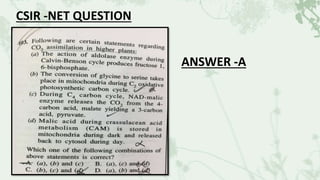
CSIR -NET QUESTION
ANSWER -A
•PHOTOSYNTHESIS
COMPLETED.
TELEGRAM CHANNEL- BOTANY INSIDER
•LIKE
•SHARE
•SUBSCRIBE

Photosynthesis