Mr. Chaitanyakumar Desitti1, Dr. Sheldon Tarre1, Dr. Uta Cheruti1, Prof. Eyal Zussman2,
Mr. Ron Avraham2 and Prof. Michal Green1
1Civil and Environmental Engineering, Technion, 2 Mechanical Engineering, Technion
Abstract
Atrazine
Atrazine cycle
Use of herbicides
Effect on frogs
Change in gender
Campaign against Atrazine
Contact Info
Chaitanyakumar Desitti
Kumar@tx.technion.ac.il
 Immobilization of microbial cells has been found
to provide for the stability of enzymatic activity,
protect the cells, sustain specific bacterial population
for extended periods, prevent biomass loss and
minimize effluent post- treatment in bioreactors.
 Pseudomonas sp. ADP , which is known as a fast
degrading atrazine bacterium, has been successfully
encapsulated in electro-spun core-shell hollow
polymeric microfibers (microtubes).
 The long term objective of this research project is
the utilization of these microtubes in a bio-reactor
for atrazine removal from polluted ground water. In
preliminary experiments, long-term atrazine
degradation was studied using P. ADP bacterium in
microtubes with no addition of external carbon
source (non-growth condition), in consecutive
batches under semi-sterile conditions.
 P.ADP is known to use atrazine only as nitrogen
source and not as a carbon source. The results
demonstrated that electrospun microtubes inoculated
with P. ADP can biodegrade atrazine for more than
two years without the addition of external carbon
source. The biodegradation of atrazine was
accompanied by a release of ammonium indicating
atrazine degradation.
 Analysis of the microbial community by
polymerase chain reaction followed by denaturing
gradient gel electrophoresis (PCR-DGGE) showed a
shift towards several other microbial species. This
shift in population can probably explain the above
results of long term atrazine degradation without
external carbon source.
SHELL
CORE
Electrospinning setup Bacteria in fibers Fibers on plastic carrier SEM of microtube Microtubes in batch
 Bioremediation is eco-friendly and cleaner
technology for micro pollutant removal in polluted
water. However, effective bioremediation requires
large concentrations of active bacteria that can be
difficult to maintain under in-situ or ex-situ conditions
and contribute to the contamination of the product
water.
 Encapsulation of bacteria is an efficient method to
maintain a specific bacterial population. Electrospun
nanofibers having high porosity, nano-scale interstitial
space, and large surface-to-volume ratio are attractive
for environmental engineering applications. The co-
spun nanotube technology has been applied for pure
enzyme encapsulation (Dror et al., 2008) and bacterial
cell encapsulation (Klein et al., 2009; Klein et al.,
2012).
 Atrazine is used as an agricultural herbicide in
many parts of the world to control a variety of weeds.
However, recent studies have shown that atrazine
causes sexual abnormalities in frogs (Hayes et al.,
2002), reduced testosterone production in rats
(Trentacoste et al., 2001) and elevated levels of
prostate cancer in workers at an atrazine
manufacturing factory (Sass et al., 2003). Small
amounts of atrazine residues are frequently detected in
surface and well water samples (Thurman et al., 1992).
 Pseudomonas sp. ADP can use atrazine only as a
nitrogen source but not as a carbon
source (Mandelbaum et al., 1995).
Introduction
Results & Discussion
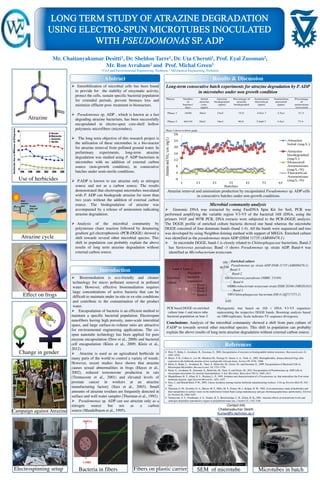
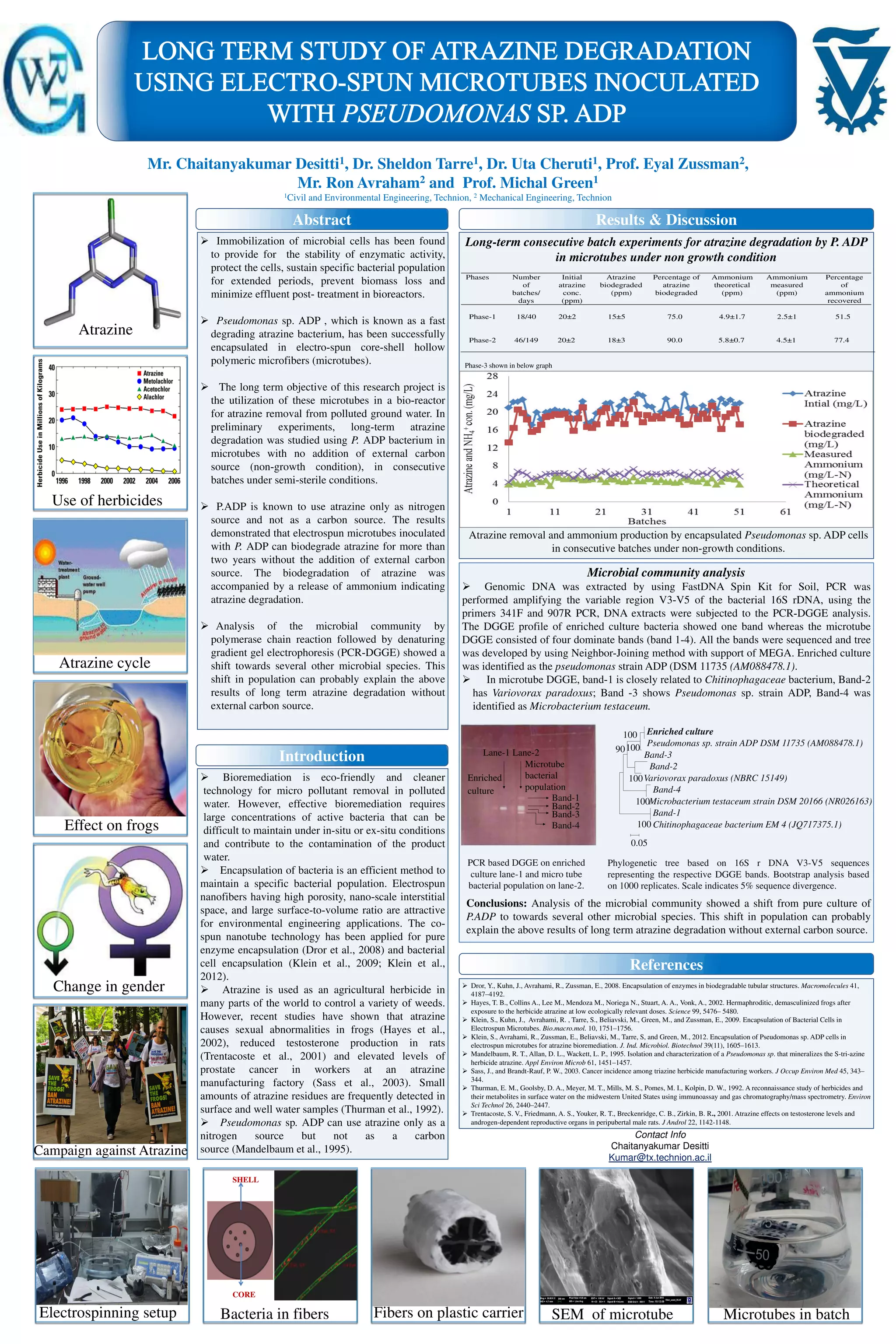
Long-term consecutive batch experiments for atrazine degradation by P. ADP
in microtubes under non growth condition
Atrazine removal and ammonium production by encapsulated Pseudomonas sp. ADP cells
in consecutive batches under non-growth conditions.
Band-4
Band-1
PCR based DGGE on enriched
culture lane-1 and micro tube
bacterial population on lane-2.
Enriched culture
Pseudomonas sp. strain ADP DSM 11735 (AM088478.1)
Band-3
Band-2
Variovorax paradoxus (NBRC 15149)
Band-4
Microbacterium testaceum strain DSM 20166 (NR026163)
Band-1
Chitinophagaceae bacterium EM 4 (JQ717375.1)100
100
100
100
100
90
0.05
Phylogenetic tree based on 16S r DNA V3-V5 sequences
representing the respective DGGE bands. Bootstrap analysis based
on 1000 replicates. Scale indicates 5% sequence divergence.
Microbial community analysis
 Genomic DNA was extracted by using FastDNA Spin Kit for Soil, PCR was
performed amplifying the variable region V3-V5 of the bacterial 16S rDNA, using the
primers 341F and 907R PCR, DNA extracts were subjected to the PCR-DGGE analysis.
The DGGE profile of enriched culture bacteria showed one band whereas the microtube
DGGE consisted of four dominate bands (band 1-4). All the bands were sequenced and tree
was developed by using Neighbor-Joining method with support of MEGA. Enriched culture
was identified as the pseudomonas strain ADP (DSM 11735 (AM088478.1).
 In microtube DGGE, band-1 is closely related to Chitinophagaceae bacterium, Band-2
has Variovorax paradoxus; Band -3 shows Pseudomonas sp. strain ADP, Band-4 was
identified as Microbacterium testaceum.
References
 Dror, Y., Kuhn, J., Avrahami, R., Zussman, E., 2008. Encapsulation of enzymes in biodegradable tubular structures. Macromolecules 41,
4187–4192.
 Hayes, T. B., Collins A., Lee M., Mendoza M., Noriega N., Stuart, A. A., Vonk, A., 2002. Hermaphroditic, demasculinized frogs after
exposure to the herbicide atrazine at low ecologically relevant doses. Science 99, 5476– 5480.
 Klein, S., Kuhn, J., Avrahami, R. , Tarre, S., Beliavski, M., Green, M., and Zussman, E., 2009. Encapsulation of Bacterial Cells in
Electrospun Microtubes. Bio.macro.mol. 10, 1751–1756.
 Klein, S., Avrahami, R., Zussman, E., Beliavski, M., Tarre, S, and Green, M., 2012. Encapsulation of Pseudomonas sp. ADP cells in
electrospun microtubes for atrazine bioremediation. J. Ind. Microbiol. Biotechnol 39(11), 1605–1613.
 Mandelbaum, R. T., Allan, D. L., Wackett, L. P., 1995. Isolation and characterization of a Pseudomonas sp. that mineralizes the S-tri-azine
herbicide atrazine. Appl Environ Microb 61, 1451–1457.
 Sass, J., and Brandt-Rauf, P. W., 2003. Cancer incidence among triazine herbicide manufacturing workers. J Occup Environ Med 45, 343–
344.
 Thurman, E. M., Goolsby, D. A., Meyer, M. T., Mills, M. S., Pomes, M. I., Kolpin, D. W., 1992. A reconnaissance study of herbicides and
their metabolites in surface water on the midwestern United States using immunoassay and gas chromatography/mass spectrometry. Environ
Sci Technol 26, 2440–2447.
 Trentacoste, S. V., Friedmann, A. S., Youker, R. T., Breckenridge, C. B., Zirkin, B. R., 2001. Atrazine effects on testosterone levels and
androgen-dependent reproductive organs in peripubertal male rats. J Androl 22, 1142-1148.
Lane-1 Lane-2
Enriched
culture
Microtube
bacterial
population
Band-2
Band-3
Conclusions: Analysis of the microbial community showed a shift from pure culture of
P.ADP to towards several other microbial species. This shift in population can probably
explain the above results of long term atrazine degradation without external carbon source.
Phase-3 shown in below graph
Phases Number
of
batches/
days
Initial
atrazine
conc.
(ppm)
Atrazine
biodegraded
(ppm)
Percentage of
atrazine
biodegraded
Ammonium
theoretical
(ppm)
Ammonium
measured
(ppm)
Percentage
of
ammonium
recovered
Phase-1 18/40 20±2 15±5 75.0 4.9±1.7 2.5±1 51.5
Phase-2 46/149 20±2 18±3 90.0 5.8±0.7 4.5±1 77.4

Poster on microtube bacterial encapsulation

  • 1.
    Mr. Chaitanyakumar Desitti1,Dr. Sheldon Tarre1, Dr. Uta Cheruti1, Prof. Eyal Zussman2, Mr. Ron Avraham2 and Prof. Michal Green1 1Civil and Environmental Engineering, Technion, 2 Mechanical Engineering, Technion Abstract Atrazine Atrazine cycle Use of herbicides Effect on frogs Change in gender Campaign against Atrazine Contact Info Chaitanyakumar Desitti Kumar@tx.technion.ac.il  Immobilization of microbial cells has been found to provide for the stability of enzymatic activity, protect the cells, sustain specific bacterial population for extended periods, prevent biomass loss and minimize effluent post- treatment in bioreactors.  Pseudomonas sp. ADP , which is known as a fast degrading atrazine bacterium, has been successfully encapsulated in electro-spun core-shell hollow polymeric microfibers (microtubes).  The long term objective of this research project is the utilization of these microtubes in a bio-reactor for atrazine removal from polluted ground water. In preliminary experiments, long-term atrazine degradation was studied using P. ADP bacterium in microtubes with no addition of external carbon source (non-growth condition), in consecutive batches under semi-sterile conditions.  P.ADP is known to use atrazine only as nitrogen source and not as a carbon source. The results demonstrated that electrospun microtubes inoculated with P. ADP can biodegrade atrazine for more than two years without the addition of external carbon source. The biodegradation of atrazine was accompanied by a release of ammonium indicating atrazine degradation.  Analysis of the microbial community by polymerase chain reaction followed by denaturing gradient gel electrophoresis (PCR-DGGE) showed a shift towards several other microbial species. This shift in population can probably explain the above results of long term atrazine degradation without external carbon source. SHELL CORE Electrospinning setup Bacteria in fibers Fibers on plastic carrier SEM of microtube Microtubes in batch  Bioremediation is eco-friendly and cleaner technology for micro pollutant removal in polluted water. However, effective bioremediation requires large concentrations of active bacteria that can be difficult to maintain under in-situ or ex-situ conditions and contribute to the contamination of the product water.  Encapsulation of bacteria is an efficient method to maintain a specific bacterial population. Electrospun nanofibers having high porosity, nano-scale interstitial space, and large surface-to-volume ratio are attractive for environmental engineering applications. The co- spun nanotube technology has been applied for pure enzyme encapsulation (Dror et al., 2008) and bacterial cell encapsulation (Klein et al., 2009; Klein et al., 2012).  Atrazine is used as an agricultural herbicide in many parts of the world to control a variety of weeds. However, recent studies have shown that atrazine causes sexual abnormalities in frogs (Hayes et al., 2002), reduced testosterone production in rats (Trentacoste et al., 2001) and elevated levels of prostate cancer in workers at an atrazine manufacturing factory (Sass et al., 2003). Small amounts of atrazine residues are frequently detected in surface and well water samples (Thurman et al., 1992).  Pseudomonas sp. ADP can use atrazine only as a nitrogen source but not as a carbon source (Mandelbaum et al., 1995). Introduction Results & Discussion Long-term consecutive batch experiments for atrazine degradation by P. ADP in microtubes under non growth condition Atrazine removal and ammonium production by encapsulated Pseudomonas sp. ADP cells in consecutive batches under non-growth conditions. Band-4 Band-1 PCR based DGGE on enriched culture lane-1 and micro tube bacterial population on lane-2. Enriched culture Pseudomonas sp. strain ADP DSM 11735 (AM088478.1) Band-3 Band-2 Variovorax paradoxus (NBRC 15149) Band-4 Microbacterium testaceum strain DSM 20166 (NR026163) Band-1 Chitinophagaceae bacterium EM 4 (JQ717375.1)100 100 100 100 100 90 0.05 Phylogenetic tree based on 16S r DNA V3-V5 sequences representing the respective DGGE bands. Bootstrap analysis based on 1000 replicates. Scale indicates 5% sequence divergence. Microbial community analysis  Genomic DNA was extracted by using FastDNA Spin Kit for Soil, PCR was performed amplifying the variable region V3-V5 of the bacterial 16S rDNA, using the primers 341F and 907R PCR, DNA extracts were subjected to the PCR-DGGE analysis. The DGGE profile of enriched culture bacteria showed one band whereas the microtube DGGE consisted of four dominate bands (band 1-4). All the bands were sequenced and tree was developed by using Neighbor-Joining method with support of MEGA. Enriched culture was identified as the pseudomonas strain ADP (DSM 11735 (AM088478.1).  In microtube DGGE, band-1 is closely related to Chitinophagaceae bacterium, Band-2 has Variovorax paradoxus; Band -3 shows Pseudomonas sp. strain ADP, Band-4 was identified as Microbacterium testaceum. References  Dror, Y., Kuhn, J., Avrahami, R., Zussman, E., 2008. Encapsulation of enzymes in biodegradable tubular structures. Macromolecules 41, 4187–4192.  Hayes, T. B., Collins A., Lee M., Mendoza M., Noriega N., Stuart, A. A., Vonk, A., 2002. Hermaphroditic, demasculinized frogs after exposure to the herbicide atrazine at low ecologically relevant doses. Science 99, 5476– 5480.  Klein, S., Kuhn, J., Avrahami, R. , Tarre, S., Beliavski, M., Green, M., and Zussman, E., 2009. Encapsulation of Bacterial Cells in Electrospun Microtubes. Bio.macro.mol. 10, 1751–1756.  Klein, S., Avrahami, R., Zussman, E., Beliavski, M., Tarre, S, and Green, M., 2012. Encapsulation of Pseudomonas sp. ADP cells in electrospun microtubes for atrazine bioremediation. J. Ind. Microbiol. Biotechnol 39(11), 1605–1613.  Mandelbaum, R. T., Allan, D. L., Wackett, L. P., 1995. Isolation and characterization of a Pseudomonas sp. that mineralizes the S-tri-azine herbicide atrazine. Appl Environ Microb 61, 1451–1457.  Sass, J., and Brandt-Rauf, P. W., 2003. Cancer incidence among triazine herbicide manufacturing workers. J Occup Environ Med 45, 343– 344.  Thurman, E. M., Goolsby, D. A., Meyer, M. T., Mills, M. S., Pomes, M. I., Kolpin, D. W., 1992. A reconnaissance study of herbicides and their metabolites in surface water on the midwestern United States using immunoassay and gas chromatography/mass spectrometry. Environ Sci Technol 26, 2440–2447.  Trentacoste, S. V., Friedmann, A. S., Youker, R. T., Breckenridge, C. B., Zirkin, B. R., 2001. Atrazine effects on testosterone levels and androgen-dependent reproductive organs in peripubertal male rats. J Androl 22, 1142-1148. Lane-1 Lane-2 Enriched culture Microtube bacterial population Band-2 Band-3 Conclusions: Analysis of the microbial community showed a shift from pure culture of P.ADP to towards several other microbial species. This shift in population can probably explain the above results of long term atrazine degradation without external carbon source. Phase-3 shown in below graph Phases Number of batches/ days Initial atrazine conc. (ppm) Atrazine biodegraded (ppm) Percentage of atrazine biodegraded Ammonium theoretical (ppm) Ammonium measured (ppm) Percentage of ammonium recovered Phase-1 18/40 20±2 15±5 75.0 4.9±1.7 2.5±1 51.5 Phase-2 46/149 20±2 18±3 90.0 5.8±0.7 4.5±1 77.4