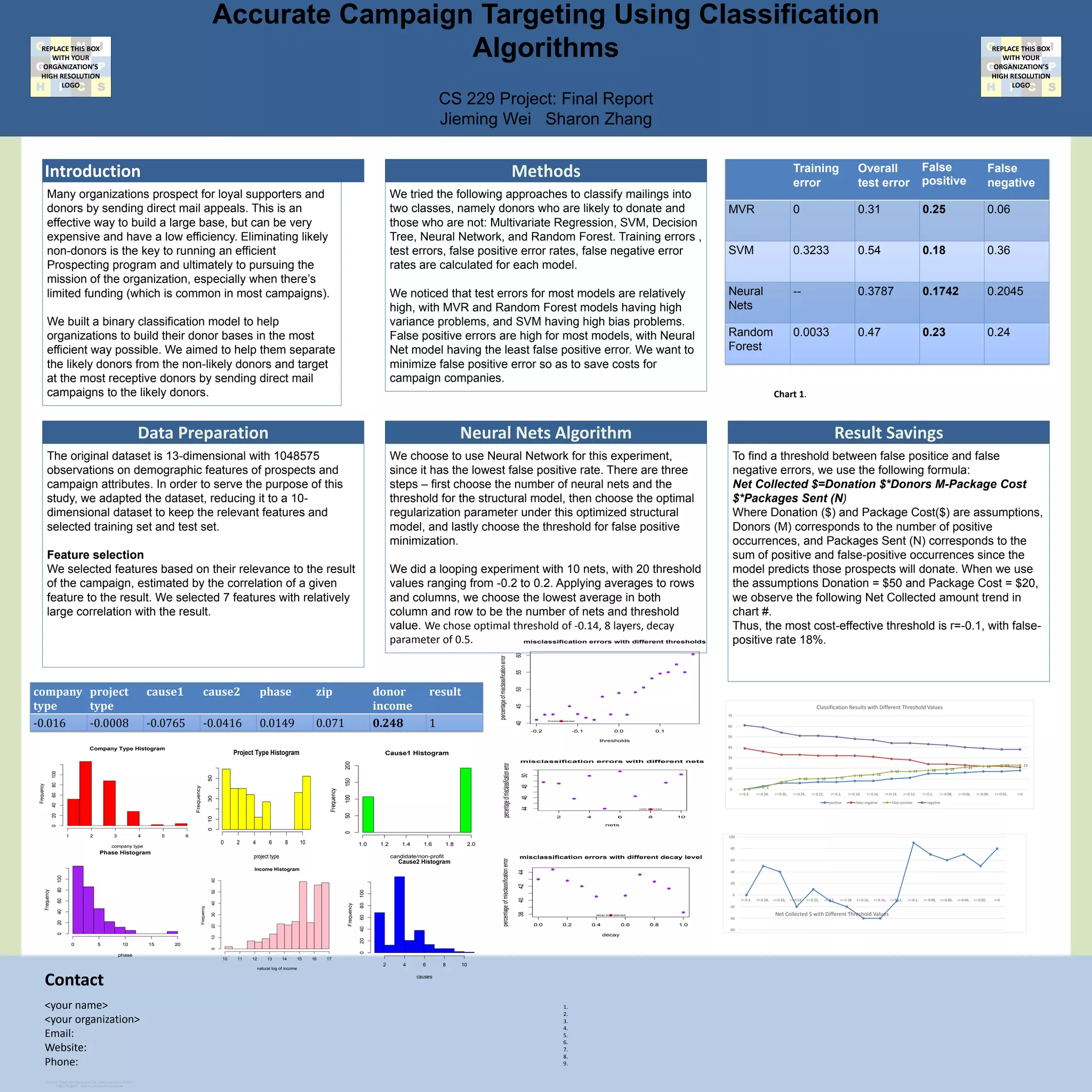
Accurate Campaign Targeting Using Classification 
Algorithms 
CS 229 Project: Final Report 
Jieming Wei Sharon Zhang 
Introduction 
Contact 
<your name> 
<your organization> 
Email: 
Website: 
Phone: 
Methods 
misclassification errors with different nets 
misclassification errors with different decay level 
1. 
2. 
3. 
4. 
5. 
6. 
7. 
8. 
9. 
Many organizations prospect for loyal supporters and 
donors by sending direct mail appeals. This is an 
effective way to build a large base, but can be very 
expensive and have a low efficiency. Eliminating likely 
non-donors is the key to running an efficient 
Prospecting program and ultimately to pursuing the 
mission of the organization, especially when there’s 
limited funding (which is common in most campaigns). 
We built a binary classification model to help 
organizations to build their donor bases in the most 
efficient way possible. We aimed to help them separate 
the likely donors from the non-likely donors and target 
at the most receptive donors by sending direct mail 
campaigns to the likely donors. 
We choose to use Neural Network for this experiment, 
since it has the lowest false positive rate. There are three 
steps – first choose the number of neural nets and the 
threshold for the structural model, then choose the optimal 
regularization parameter under this optimized structural 
model, and lastly choose the threshold for false positive 
minimization. 
We did a looping experiment with 10 nets, with 20 threshold 
values ranging from -0.2 to 0.2. Applying averages to rows 
and columns, we choose the lowest average in both 
column and row to be the number of nets and threshold 
value. We chose optimal threshold of -0.14, 8 layers, decay 
parameter of 0.5. 
Data Preparation 
We tried the following approaches to classify mailings into 
two classes, namely donors who are likely to donate and 
those who are not: Multivariate Regression, SVM, Decision 
Tree, Neural Network, and Random Forest. Training errors , 
test errors, false positive error rates, false negative error 
rates are calculated for each model. 
We noticed that test errors for most models are relatively 
high, with MVR and Random Forest models having high 
variance problems, and SVM having high bias problems. 
False positive errors are high for most models, with Neural 
Net model having the least false positive error. We want to 
minimize false positive error so as to save costs for 
campaign companies. 
To find a threshold between false positice and false 
negative errors, we use the following formula: 
Net Collected $=Donation $*Donors M-Package Cost 
$*Packages Sent (N) 
Where Donation ($) and Package Cost($) are assumptions, 
Donors (M) corresponds to the number of positive 
occurrences, and Packages Sent (N) corresponds to the 
sum of positive and false-positive occurrences since the 
model predicts those prospects will donate. When we use 
the assumptions Donation = $50 and Package Cost = $20, 
we observe the following Net Collected amount trend in 
chart #. 
Thus, the most cost-effective threshold is r=-0.1, with false-positive 
rate 18%. 
Result Savings 
The original dataset is 13-dimensional with 1048575 
observations on demographic features of prospects and 
campaign attributes. In order to serve the purpose of this 
study, we adapted the dataset, reducing it to a 10- 
dimensional dataset to keep the relevant features and 
selected training set and test set. 
Feature selection 
We selected features based on their relevance to the result 
of the campaign, estimated by the correlation of a given 
feature to the result. We selected 7 features with relatively 
large correlation with the result. 
Neural Nets Algorithm 
Chart 1. 
REPLACE THIS BOX 
WITH YOUR 
ORGANIZATION’S 
HIGH RESOLUTION 
LOGO 
REPLACE THIS BOX 
WITH YOUR 
ORGANIZATION’S 
HIGH RESOLUTION 
LOGO 
Training 
error 
Overall 
test error 
False 
positive 
False 
negative 
MVR 0 0.31 0.25 0.06 
SVM 0.3233 0.54 0.18 0.36 
Neural 
Nets 
-- 0.3787 0.1742 0.2045 
Random 
Forest 
0.0033 0.47 0.23 0.24 
company 
type 
project 
type 
cause1 cause2 phase zip donor 
income 
result 
-0.016 -0.0008 -0.0765 -0.0416 0.0149 0.071 0.248 1 
Company Type Histogram 
company type 
Frequency 
1 2 3 4 5 6 
0 20 40 60 80 100 
Cause1 Histogram 
candidate/non-profit 
Frequency 
1.0 1.2 1.4 1.6 1.8 2.0 
0 50 100 150 200 
Project Type Histogram 
project type 
Frequency 
0 2 4 6 8 10 
0 10 30 50 
Cause2 Histogram 
causes 
Frequency 
2 4 6 8 10 
0 20 40 60 80 100 
Phase Histogram 
phase 
Frequency 
0 5 10 15 20 
0 20 40 60 80 100 
Income Histogram 
natural log of income 
Frequency 
10 11 12 13 14 15 16 17 
0 10 20 30 40 50 60 
-0.2 -0.1 0.0 0.1 
40 45 50 55 60 
misclassification errors with different thresholds 
thresholds 
percentage of misclassification error 
threshold selected 
2 4 6 8 10 
44 46 48 50 
nets 
percentage of misclassification error 
nets selected 
0.0 0.2 0.4 0.6 0.8 1.0 
38 40 42 44 
decay 
percentage of misclassification error 
decay level selected 
70 
60 
50 
40 
30 
20 
10 
100 
80 
60 
40 
20 
0 
-20 
-40 
-60 
Classification Results with Different Threshold Values 
r=-0.3, r=-0.28, r=-0.26, r=-0.24, r=-0.22, r=-0.2, r=-0.18, r=-0.16, r=-0.14, r=-0.12, r=-0.1, r=-0.08, r=-0.06, r=-0.04, r=-0.02, r=0 
Net Collected $ with Different Threshold Values 
0 
2 
7 
10 10 11 
13 14 
17 17 18 19 
21 22 23 23 
0 
r=-0.3, r=-0.28, r=-0.26, r=-0.24, r=-0.22, r=-0.2, r=-0.18, r=-0.16, r=-0.14, r=-0.12, r=-0.1, r=-0.08, r=-0.06, r=-0.04, r=-0.02, r=0 
positive false-negative false-positive negative

Accurate Campaign Targeting Using Classification - Poster

  • 1.
    Accurate Campaign TargetingUsing Classification Algorithms CS 229 Project: Final Report Jieming Wei Sharon Zhang Introduction Contact <your name> <your organization> Email: Website: Phone: Methods misclassification errors with different nets misclassification errors with different decay level 1. 2. 3. 4. 5. 6. 7. 8. 9. Many organizations prospect for loyal supporters and donors by sending direct mail appeals. This is an effective way to build a large base, but can be very expensive and have a low efficiency. Eliminating likely non-donors is the key to running an efficient Prospecting program and ultimately to pursuing the mission of the organization, especially when there’s limited funding (which is common in most campaigns). We built a binary classification model to help organizations to build their donor bases in the most efficient way possible. We aimed to help them separate the likely donors from the non-likely donors and target at the most receptive donors by sending direct mail campaigns to the likely donors. We choose to use Neural Network for this experiment, since it has the lowest false positive rate. There are three steps – first choose the number of neural nets and the threshold for the structural model, then choose the optimal regularization parameter under this optimized structural model, and lastly choose the threshold for false positive minimization. We did a looping experiment with 10 nets, with 20 threshold values ranging from -0.2 to 0.2. Applying averages to rows and columns, we choose the lowest average in both column and row to be the number of nets and threshold value. We chose optimal threshold of -0.14, 8 layers, decay parameter of 0.5. Data Preparation We tried the following approaches to classify mailings into two classes, namely donors who are likely to donate and those who are not: Multivariate Regression, SVM, Decision Tree, Neural Network, and Random Forest. Training errors , test errors, false positive error rates, false negative error rates are calculated for each model. We noticed that test errors for most models are relatively high, with MVR and Random Forest models having high variance problems, and SVM having high bias problems. False positive errors are high for most models, with Neural Net model having the least false positive error. We want to minimize false positive error so as to save costs for campaign companies. To find a threshold between false positice and false negative errors, we use the following formula: Net Collected $=Donation $*Donors M-Package Cost $*Packages Sent (N) Where Donation ($) and Package Cost($) are assumptions, Donors (M) corresponds to the number of positive occurrences, and Packages Sent (N) corresponds to the sum of positive and false-positive occurrences since the model predicts those prospects will donate. When we use the assumptions Donation = $50 and Package Cost = $20, we observe the following Net Collected amount trend in chart #. Thus, the most cost-effective threshold is r=-0.1, with false-positive rate 18%. Result Savings The original dataset is 13-dimensional with 1048575 observations on demographic features of prospects and campaign attributes. In order to serve the purpose of this study, we adapted the dataset, reducing it to a 10- dimensional dataset to keep the relevant features and selected training set and test set. Feature selection We selected features based on their relevance to the result of the campaign, estimated by the correlation of a given feature to the result. We selected 7 features with relatively large correlation with the result. Neural Nets Algorithm Chart 1. REPLACE THIS BOX WITH YOUR ORGANIZATION’S HIGH RESOLUTION LOGO REPLACE THIS BOX WITH YOUR ORGANIZATION’S HIGH RESOLUTION LOGO Training error Overall test error False positive False negative MVR 0 0.31 0.25 0.06 SVM 0.3233 0.54 0.18 0.36 Neural Nets -- 0.3787 0.1742 0.2045 Random Forest 0.0033 0.47 0.23 0.24 company type project type cause1 cause2 phase zip donor income result -0.016 -0.0008 -0.0765 -0.0416 0.0149 0.071 0.248 1 Company Type Histogram company type Frequency 1 2 3 4 5 6 0 20 40 60 80 100 Cause1 Histogram candidate/non-profit Frequency 1.0 1.2 1.4 1.6 1.8 2.0 0 50 100 150 200 Project Type Histogram project type Frequency 0 2 4 6 8 10 0 10 30 50 Cause2 Histogram causes Frequency 2 4 6 8 10 0 20 40 60 80 100 Phase Histogram phase Frequency 0 5 10 15 20 0 20 40 60 80 100 Income Histogram natural log of income Frequency 10 11 12 13 14 15 16 17 0 10 20 30 40 50 60 -0.2 -0.1 0.0 0.1 40 45 50 55 60 misclassification errors with different thresholds thresholds percentage of misclassification error threshold selected 2 4 6 8 10 44 46 48 50 nets percentage of misclassification error nets selected 0.0 0.2 0.4 0.6 0.8 1.0 38 40 42 44 decay percentage of misclassification error decay level selected 70 60 50 40 30 20 10 100 80 60 40 20 0 -20 -40 -60 Classification Results with Different Threshold Values r=-0.3, r=-0.28, r=-0.26, r=-0.24, r=-0.22, r=-0.2, r=-0.18, r=-0.16, r=-0.14, r=-0.12, r=-0.1, r=-0.08, r=-0.06, r=-0.04, r=-0.02, r=0 Net Collected $ with Different Threshold Values 0 2 7 10 10 11 13 14 17 17 18 19 21 22 23 23 0 r=-0.3, r=-0.28, r=-0.26, r=-0.24, r=-0.22, r=-0.2, r=-0.18, r=-0.16, r=-0.14, r=-0.12, r=-0.1, r=-0.08, r=-0.06, r=-0.04, r=-0.02, r=0 positive false-negative false-positive negative