Chapter 9
Audit Sampling: An
Application to
Substantive Tests of
Account Balances
Copyright © 2017 McGraw-Hill Education. All rights reserved. No reproduction or distribution without the prior written consent of McGraw-Hill Education.
Substantive Tests of Details of
Account Balances
Consider the following information about the inventory
account balance of an entity:
Book value of inventory account balance 3,000,000
$
Book value of items sampled 100,000
$
Audited value of items sampled 98,000
Total amount of overstatement observed in audit sample 2,000
$
The ratio of misstatement in the sample is 2%
($2,000 ÷ $100,000)
Applying the ratio to the entire population produces a best
estimate of misstatement of inventory of $60,000.
($3,000,000 × 2%)
LO# 1
9-2
Substantive Tests of Details of
Account Balances
The results of our audit test depend upon
the tolerable misstatement associated
with the inventory account. If the tolerable
misstatement is $50,000, we cannot
conclude that the account is fairly stated
because our best estimate of the
projected misstatement is greater than
the tolerable misstatement.
LO# 1
9-3
Monetary-Unit Sampling (MUS)
MUS uses attribute-sampling theory to
express a monetary conclusion rather than a
rate of occurrence. It is commonly used by
auditors to test accounts such as accounts
receivable, loans receivable, investment
securities, and inventory.
LO# 2
9-4
Monetary-Unit Sampling (MUS)
MUS uses attribute-sampling theory (used
primarily to test controls) to estimate the
percentage of monetary units in a population
that might be misstated and then multiplies
this percentage by an estimate of how much
the dollars are misstated.
LO# 2
9-5
Steps in MUS
Steps in MUS Application
Planning
1. Determine the test objectives.
2. Define the population characteristics:
• Define the population.
• Define the sampling unit.
• Define a misstatement.
3. Determine the sample size, using the following inputs:
• Desired confidence level or risk of incorrect acceptance.
• Tolerable misstatement.
• Expected population misstatement.
• Population size.
Performance
4. Select sample items.
5. Perform the auditing procedures.
• Understand and analyze any misstatements observed.
Evaluation
6. Calculate the projected misstatement and the upper limit on misstatement.
7. Draw final conclusions.
LO# 2
9-6
Steps in MUS
Steps in MUS Application
Planning
1. Determine the test objectives.
2. Define the population characteristics.
• Define the population.
• Define the sampling unit.
• Define a misstatement.
Sampling may be used for substantive testing to:
1. Test the reasonableness of assertions about a
financial statement amount (i.e., accuracy,
existence). This is the most common use of sampling
for substantive testing.
2. Develop an estimate of some amount.
LO# 2
9-7
Steps in MUS
Steps in MUS Application
Planning
1. Determine the test objectives.
2. Define the population characteristics.
• Define the population.
• Define the sampling unit.
• Define a misstatement.
For MUS, the population is defined as the
monetary value of an account balance,
such as accounts receivable, investment
securities, or inventory.
LO# 2
9-8
Steps in MUS
Steps in MUS Application
Planning
1. Determine the test objectives.
2. Define the population characteristics.
• Define the population.
• Define the sampling unit.
• Define a misstatement.
An individual dollar represents the sampling unit.
LO# 2
9-9
Steps in MUS
Steps in MUS Application
Planning
1. Determine the test objectives.
2. Define the population characteristics.
• Define the population.
• Define the sampling unit.
• Define a misstatement.
A misstatement is defined as the difference between
monetary amounts in the entity’s records and
amounts supported by audit evidence.
LO# 2
9-10
Steps in MUS
Steps in MUS Application
3. Determine the sample size, using the following inputs:
• Desired confidence level or risk of incorrect acceptance.
• Tolerable misstatement.
• Expected population misstatement.
• Population size.
Factor
Relationship
to Sample Size
Change
in Factor
Effect on
Sample
Lower Decrease
Higher Increase
Lower Increase
Higher Decrease
Lower Decrease
Higher Increase
Lower Decrease
Higher Increase
Desired confidence level
Tolerable mistatement
Expected mistatement
Population size
Direct
Inverse
Direct
Direct
LO# 2
9-11
Steps in MUS
Steps in MUS Application
Performance
4. Select sample items.
5. Perform the auditing procedures.
Evaluation
6. Calculate the projected misstatement and the upper limit on misstatement.
7. Draw final conclusions.
The auditor selects a sample for MUS by using a
systematic selection approach called probability-
proportional-to-size selection. The sampling interval can
be determined by dividing the book value of the
population by the sample size. Each individual dollar in
the population has an equal chance of being selected
and items or “logical units” greater than the interval will
always be selected.
LO# 2
9-12
Steps in MUS
Assume an entity’s book value of accounts receivable is $2,500,000, and
the auditor determined a sample size of 93. The sampling interval will be
$26,882 ($2,500,000 ÷ 93). The random number selected is $3,977, so the
auditor would select the following items for testing:
Cumulative Sample
Account Balance Dollars Item
1001 Ace Emergency Center 2,350
$ 2,350
$
1002 Admington Hospital 15,495 17,845 3,977
$ (1)
1003 Jess Base, Inc. 945 18,790
1004 Good Hospital Corp. 21,893 40,683 30,859 (2)
1005 Jen Mara Corp. 3,968 44,651
1006 Zippy Corp. 32,549 77,200 57,741 (3)
1007 Green River Mfg. 2,246 79,446
1008 Bead Hospital Centers 11,860 91,306 84,623 (4)
• • • •
• • • •
1213 Andrew Call Medical - 2,472,032
1214 Lilly Heather, Inc. 26,945 2,498,977 2,477,121 (93)
1215 Janyne Ann Corp. 1,023 2,500,000
$
Total Accounts Receivable 2,500,000
$
3,977
$
26,882
30,859
$
LO# 2
9-13
Steps in MUS
Steps in MUS Application
Performance
4. Select sample items.
5. Perform the auditing procedures.
Evaluation
6. Calculate the projected misstatement and the upper limit on misstatement.
7. Draw final conclusions.
After the sample items have been selected,
the auditor conducts the planned audit
procedures on the logical units containing
the selected dollar sampling units.
LO# 2
9-14
Steps in MUS
Steps in MUS Application
Evaluation
6. Calculate the projected misstatement and the upper limit on misstatement.
7. Draw final conclusions.
The misstatements detected in the sample
must be projected to the population. Let’s
look at the following example:
Book value 2,500,000
$
Tolerable misstatement 125,000
$
Sample size 93
Desired confidence level 95%
Expected amount of misstatement 25,000
$
Sampling interval 26,882
$
New Example Information
LO# 2
9-15
Number of Misstatement Incremental Misstatement Incremental
Errors Factor Increase Factor Increase
0 2.3 3.0
1 3.9 1.6 4.7 1.7
2 5.3 1.4 6.2 1.5
3 6.6 1.3 7.6 1.4
4 7.9 1.3 9.0 1.4
95% Confidence Level
90% Confidence Level
Steps in MUS
Basic Precision using the Table
If no misstatements are found in the sample,
the best estimate of the population
misstatement would be zero dollars.
$26,882 × 3.0 = $80,646 upper misstatement limit
LO# 3
9-16
Steps in MUS
Misstatements Detected
In the sample of 93 items, the following misstatements
were found:
Customer Book Value Audit Value Difference
Tainting
Factor
Diff/BV
Good Hospital Corp. 21,893
$ 18,609
$ 3,284
$ 0.15
Marva Medical Supply 6,705 4,023 2,682 0.40
Learn Heart Centers 15,000 0 15,000 1.00
Axa Corp. 32,549 30,049 2,500 NA
$3,284 ÷ $21,893 = 15%
Because the Axa balance of $32,549 is greater than the
interval of $26,882, no sampling risk is added. Since all
the dollars in the large accounts are audited, there is no
sampling risk associated with large accounts.
LO# 3
9-17
Steps in MUS
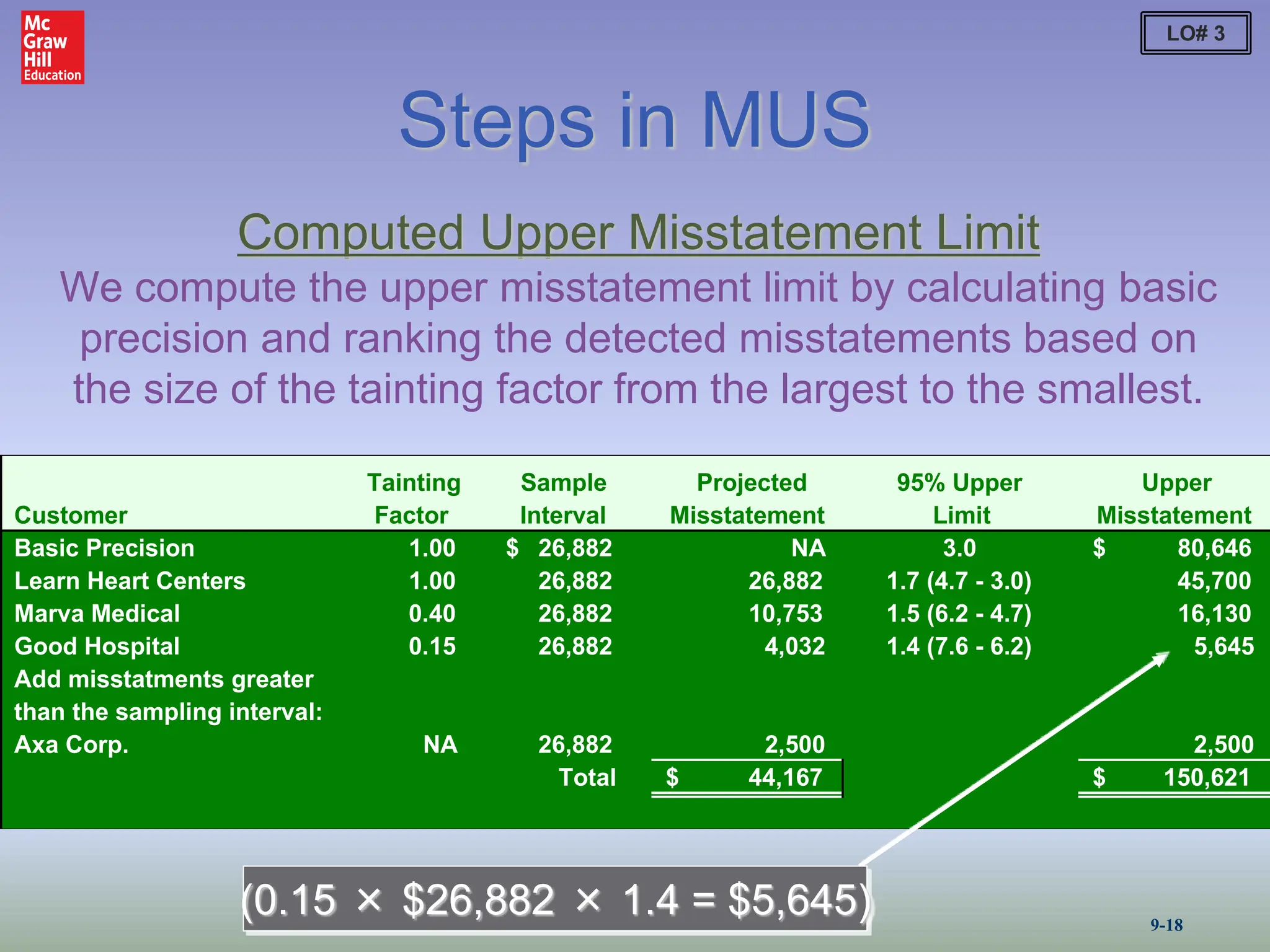
Computed Upper Misstatement Limit
We compute the upper misstatement limit by calculating basic
precision and ranking the detected misstatements based on
the size of the tainting factor from the largest to the smallest.
Customer
Tainting
Factor
Sample
Interval
Projected
Misstatement
95% Upper
Limit
Upper
Misstatement
Basic Precision 1.00 26,882
$ NA 3.0 80,646
$
Learn Heart Centers 1.00 26,882 26,882 1.7 (4.7 - 3.0) 45,700
Marva Medical 0.40 26,882 10,753 1.5 (6.2 - 4.7) 16,130
Good Hospital 0.15 26,882 4,032 1.4 (7.6 - 6.2) 5,645
Add misstatments greater
than the sampling interval:
Axa Corp. NA 26,882 2,500 2,500
Total 44,167
$ 150,621
$
(0.15 × $26,882 × 1.4 = $5,645)
LO# 3
9-18
Steps in MUS
Steps in MUS Application
Evaluation
6. Calculate the projected misstatement and the upper limit on misstatement
7. Draw final conclusions.
We compare the tolerable misstatement to the upper
misstatement limit. If the upper misstatement limit is less
than or equal to the tolerable misstatement, we conclude
that the balance is not materially misstated.
In our example, the final decision is
whether the accounts receivable balance
is materially misstated or not.
LO# 3
9-19
Steps in MUS
In our example, the upper misstatement limit of $150,621
is greater than the tolerable misstatement of $125,000, so
the auditor concludes that the accounts receivable
balance is materially misstated.
When faced with this situation, the auditor may:
1. Increase the sample size.
2. Perform other substantive procedures.
3. Request the entity adjust the accounts receivable balance.
4. If management refuses to adjust the account balance, the
auditor would consider issuing a qualified or an adverse
opinion.
LO# 3
9-20

7. Plan, perform, and evaluate samples for substantive procedures IPPTChap009.pptx

  • 1.
    Chapter 9 Audit Sampling:An Application to Substantive Tests of Account Balances Copyright © 2017 McGraw-Hill Education. All rights reserved. No reproduction or distribution without the prior written consent of McGraw-Hill Education.
  • 2.
    Substantive Tests ofDetails of Account Balances Consider the following information about the inventory account balance of an entity: Book value of inventory account balance 3,000,000 $ Book value of items sampled 100,000 $ Audited value of items sampled 98,000 Total amount of overstatement observed in audit sample 2,000 $ The ratio of misstatement in the sample is 2% ($2,000 ÷ $100,000) Applying the ratio to the entire population produces a best estimate of misstatement of inventory of $60,000. ($3,000,000 × 2%) LO# 1 9-2
  • 3.
    Substantive Tests ofDetails of Account Balances The results of our audit test depend upon the tolerable misstatement associated with the inventory account. If the tolerable misstatement is $50,000, we cannot conclude that the account is fairly stated because our best estimate of the projected misstatement is greater than the tolerable misstatement. LO# 1 9-3
  • 4.
    Monetary-Unit Sampling (MUS) MUSuses attribute-sampling theory to express a monetary conclusion rather than a rate of occurrence. It is commonly used by auditors to test accounts such as accounts receivable, loans receivable, investment securities, and inventory. LO# 2 9-4
  • 5.
    Monetary-Unit Sampling (MUS) MUSuses attribute-sampling theory (used primarily to test controls) to estimate the percentage of monetary units in a population that might be misstated and then multiplies this percentage by an estimate of how much the dollars are misstated. LO# 2 9-5
  • 6.
    Steps in MUS Stepsin MUS Application Planning 1. Determine the test objectives. 2. Define the population characteristics: • Define the population. • Define the sampling unit. • Define a misstatement. 3. Determine the sample size, using the following inputs: • Desired confidence level or risk of incorrect acceptance. • Tolerable misstatement. • Expected population misstatement. • Population size. Performance 4. Select sample items. 5. Perform the auditing procedures. • Understand and analyze any misstatements observed. Evaluation 6. Calculate the projected misstatement and the upper limit on misstatement. 7. Draw final conclusions. LO# 2 9-6
  • 7.
    Steps in MUS Stepsin MUS Application Planning 1. Determine the test objectives. 2. Define the population characteristics. • Define the population. • Define the sampling unit. • Define a misstatement. Sampling may be used for substantive testing to: 1. Test the reasonableness of assertions about a financial statement amount (i.e., accuracy, existence). This is the most common use of sampling for substantive testing. 2. Develop an estimate of some amount. LO# 2 9-7
  • 8.
    Steps in MUS Stepsin MUS Application Planning 1. Determine the test objectives. 2. Define the population characteristics. • Define the population. • Define the sampling unit. • Define a misstatement. For MUS, the population is defined as the monetary value of an account balance, such as accounts receivable, investment securities, or inventory. LO# 2 9-8
  • 9.
    Steps in MUS Stepsin MUS Application Planning 1. Determine the test objectives. 2. Define the population characteristics. • Define the population. • Define the sampling unit. • Define a misstatement. An individual dollar represents the sampling unit. LO# 2 9-9
  • 10.
    Steps in MUS Stepsin MUS Application Planning 1. Determine the test objectives. 2. Define the population characteristics. • Define the population. • Define the sampling unit. • Define a misstatement. A misstatement is defined as the difference between monetary amounts in the entity’s records and amounts supported by audit evidence. LO# 2 9-10
  • 11.
    Steps in MUS Stepsin MUS Application 3. Determine the sample size, using the following inputs: • Desired confidence level or risk of incorrect acceptance. • Tolerable misstatement. • Expected population misstatement. • Population size. Factor Relationship to Sample Size Change in Factor Effect on Sample Lower Decrease Higher Increase Lower Increase Higher Decrease Lower Decrease Higher Increase Lower Decrease Higher Increase Desired confidence level Tolerable mistatement Expected mistatement Population size Direct Inverse Direct Direct LO# 2 9-11
  • 12.
    Steps in MUS Stepsin MUS Application Performance 4. Select sample items. 5. Perform the auditing procedures. Evaluation 6. Calculate the projected misstatement and the upper limit on misstatement. 7. Draw final conclusions. The auditor selects a sample for MUS by using a systematic selection approach called probability- proportional-to-size selection. The sampling interval can be determined by dividing the book value of the population by the sample size. Each individual dollar in the population has an equal chance of being selected and items or “logical units” greater than the interval will always be selected. LO# 2 9-12
  • 13.
    Steps in MUS Assumean entity’s book value of accounts receivable is $2,500,000, and the auditor determined a sample size of 93. The sampling interval will be $26,882 ($2,500,000 ÷ 93). The random number selected is $3,977, so the auditor would select the following items for testing: Cumulative Sample Account Balance Dollars Item 1001 Ace Emergency Center 2,350 $ 2,350 $ 1002 Admington Hospital 15,495 17,845 3,977 $ (1) 1003 Jess Base, Inc. 945 18,790 1004 Good Hospital Corp. 21,893 40,683 30,859 (2) 1005 Jen Mara Corp. 3,968 44,651 1006 Zippy Corp. 32,549 77,200 57,741 (3) 1007 Green River Mfg. 2,246 79,446 1008 Bead Hospital Centers 11,860 91,306 84,623 (4) • • • • • • • • 1213 Andrew Call Medical - 2,472,032 1214 Lilly Heather, Inc. 26,945 2,498,977 2,477,121 (93) 1215 Janyne Ann Corp. 1,023 2,500,000 $ Total Accounts Receivable 2,500,000 $ 3,977 $ 26,882 30,859 $ LO# 2 9-13
  • 14.
    Steps in MUS Stepsin MUS Application Performance 4. Select sample items. 5. Perform the auditing procedures. Evaluation 6. Calculate the projected misstatement and the upper limit on misstatement. 7. Draw final conclusions. After the sample items have been selected, the auditor conducts the planned audit procedures on the logical units containing the selected dollar sampling units. LO# 2 9-14
  • 15.
    Steps in MUS Stepsin MUS Application Evaluation 6. Calculate the projected misstatement and the upper limit on misstatement. 7. Draw final conclusions. The misstatements detected in the sample must be projected to the population. Let’s look at the following example: Book value 2,500,000 $ Tolerable misstatement 125,000 $ Sample size 93 Desired confidence level 95% Expected amount of misstatement 25,000 $ Sampling interval 26,882 $ New Example Information LO# 2 9-15
  • 16.
    Number of MisstatementIncremental Misstatement Incremental Errors Factor Increase Factor Increase 0 2.3 3.0 1 3.9 1.6 4.7 1.7 2 5.3 1.4 6.2 1.5 3 6.6 1.3 7.6 1.4 4 7.9 1.3 9.0 1.4 95% Confidence Level 90% Confidence Level Steps in MUS Basic Precision using the Table If no misstatements are found in the sample, the best estimate of the population misstatement would be zero dollars. $26,882 × 3.0 = $80,646 upper misstatement limit LO# 3 9-16
  • 17.
    Steps in MUS MisstatementsDetected In the sample of 93 items, the following misstatements were found: Customer Book Value Audit Value Difference Tainting Factor Diff/BV Good Hospital Corp. 21,893 $ 18,609 $ 3,284 $ 0.15 Marva Medical Supply 6,705 4,023 2,682 0.40 Learn Heart Centers 15,000 0 15,000 1.00 Axa Corp. 32,549 30,049 2,500 NA $3,284 ÷ $21,893 = 15% Because the Axa balance of $32,549 is greater than the interval of $26,882, no sampling risk is added. Since all the dollars in the large accounts are audited, there is no sampling risk associated with large accounts. LO# 3 9-17
  • 18.
    Steps in MUS ComputedUpper Misstatement Limit We compute the upper misstatement limit by calculating basic precision and ranking the detected misstatements based on the size of the tainting factor from the largest to the smallest. Customer Tainting Factor Sample Interval Projected Misstatement 95% Upper Limit Upper Misstatement Basic Precision 1.00 26,882 $ NA 3.0 80,646 $ Learn Heart Centers 1.00 26,882 26,882 1.7 (4.7 - 3.0) 45,700 Marva Medical 0.40 26,882 10,753 1.5 (6.2 - 4.7) 16,130 Good Hospital 0.15 26,882 4,032 1.4 (7.6 - 6.2) 5,645 Add misstatments greater than the sampling interval: Axa Corp. NA 26,882 2,500 2,500 Total 44,167 $ 150,621 $ (0.15 × $26,882 × 1.4 = $5,645) LO# 3 9-18
  • 19.
    Steps in MUS Stepsin MUS Application Evaluation 6. Calculate the projected misstatement and the upper limit on misstatement 7. Draw final conclusions. We compare the tolerable misstatement to the upper misstatement limit. If the upper misstatement limit is less than or equal to the tolerable misstatement, we conclude that the balance is not materially misstated. In our example, the final decision is whether the accounts receivable balance is materially misstated or not. LO# 3 9-19
  • 20.
    Steps in MUS Inour example, the upper misstatement limit of $150,621 is greater than the tolerable misstatement of $125,000, so the auditor concludes that the accounts receivable balance is materially misstated. When faced with this situation, the auditor may: 1. Increase the sample size. 2. Perform other substantive procedures. 3. Request the entity adjust the accounts receivable balance. 4. If management refuses to adjust the account balance, the auditor would consider issuing a qualified or an adverse opinion. LO# 3 9-20

Editor's Notes

  • #2 Chapter 9: Audit Sampling: An Application to Substantive Tests of Account Balances
  • #4 The results of our audit test depend upon the tolerable misstatement associated with the inventory account. If the tolerable misstatement is $50,000, we cannot conclude that the account is fairly stated because our best estimate of the projected misstatement is greater than the tolerable misstatement.
  • #5 MUS uses attribute-sampling theory to express a monetary conclusion rather than a rate of occurrence. It is commonly used by auditors to test accounts such as accounts receivable, loans receivable, investment securities, and inventory.
  • #7 Planning: Determine the test objectives. Define the population characteristics. Determine the sample size, using the desired confidence level, the tolerable misstatement, the expected population misstatement, and population size. Performance 4. Select sample items. 5. Perform the auditing procedures. Evaluation 6. Calculate the projected misstatement and the upper limit on misstatement. 7. Draw final conclusions.
  • #8 Sampling may be used for substantive testing to: Test the reasonableness of assertions about a financial statement amount (i.e., accuracy, existence). This is the most common use of sampling for substantive testing. Develop an estimate of some amount.
  • #9 For MUS, the population is defined as the monetary value of an account balance, such as accounts receivable, investment securities, or inventory.
  • #10 An individual dollar represents the sampling unit.
  • #11 A misstatement is defined as the difference between monetary amounts in the entity’s records and amounts supported by audit evidence.
  • #12 Changes in the confidence level, expected misstatement, and population size have direct relationships with sample size. Tolerable misstatement has an inverse relationship with sample size.
  • #14 Assume an entity’s book value of accounts receivable is $2,500,000, and the auditor determined a sample size of 93. The sampling interval will be $26,882 ($2,500,000 ÷ 93). The random number selected is $3,977, so the auditor would select the following items for testing: $3,977, $30,859, $57,741, etc.
  • #15 After the sample items have been selected, the auditor conducts the planned audit procedures on the logical units containing the selected dollar sampling units.
  • #16 The misstatements detected in the sample must be projected to the population.
  • #17 Basic Precision using the Table If no misstatements are found in the sample, the best estimate of the population misstatement would be zero dollars.
  • #19 Computed Upper Misstatement Limit We compute the upper misstatement limit by calculating basic precision and ranking the detected misstatements based on the size of the tainting factor from the largest to the smallest.
  • #20 The final decision is whether the accounts receivable balance is materially misstated or not. We compare the tolerable misstatement to the upper misstatement limit. If the upper misstatement limit is less than or equal to the tolerable misstatement, we conclude that the balance is not materially misstated.
  • #21 When faced with a situation where the upper misstatement limit is greater than the tolerable misstatement, the auditor concludes that the balance is materially misstated, the auditor may: Increase the sample size. Perform other substantive procedures. Request the entity adjust the accounts receivable balance. If management refuses to adjust the account balance, the auditor would consider issuing a qualified or an adverse opinion.