
Uploaded byRMwebsite
Poster 2D Thinning
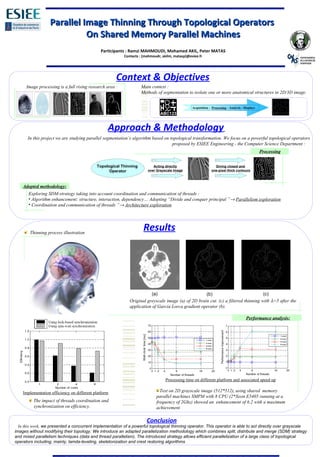
This document discusses parallelizing image thinning algorithms through topological operators on shared memory parallel machines. It presents an approach that combines split-distribute-merge strategy with mixed data and thread parallelism. The methodology was tested on 2D grayscale images using a shared memory machine with 8 CPUs. The results showed a 6.2x speedup with efficient parallel implementation.
More Related Content


Poster 2D Thinning
- 1. Parallel Image ThinningThrough Topological Operators On Shared Memory Parallel Machines Participants : Ramzi MAHMOUDI, Mohamed AKIL, Peter MATAS Contacts : {mahmoudr, akilm, matasp}@esiee.fr Context & Objectives Approach & Methodology In this project we are studying parallel segmentation’s algorithm based on topological transformation. We focus on a powerful topological operators proposed by ESIEE Engineering - the Computer Science Department : Results Conclusion (a) (c) Original greyscale image (a) of 2D brain cut. (c) a filtered thinning with =5 after the application of Garcia Lorca gradient operator (b). Exploring SDM-strategy taking into account coordination and communication of threads : Algorithm enhancement: structure, interaction, dependency… Adopting “Divide and conquer principal ” Parallelism exploration Coordination and communication of threads ” Architecture exploration Thinning process illustration Topological Thinning Operator Acting directly over Grayscale Image Giving closed and one-pixel thick contours Acquisition - Processing - Analysis - Displays In this work, we presented a concurrent implementation of a powerful topological thinning operator. This operator is able to act directly over grayscale images without modifying their topology. We introduce an adapted parallelization methodology which combines split, distribute and merge (SDM) strategy and mixed parallelism techniques (data and thread parallelism). The introduced strategy allows efficient parallelization of a large class of topological operators including, mainly, lamda-leveling, skeletonization and crest restoring algorithms Image processing is a full rising research area : Main context : Methods of segmentation to isolate one or more anatomical structures in 2D/3D image. Processing Performance analysis: The impact of threads coordination and synchronization on efficiency. Processing time on different platform and associated speed up Test on 2D grayscale image (512*512), using shared memory parallel machines SMPM with 8 CPU (2*Xeon E5405 running at a frequency of 2Ghz) showed an enhancement of 6.2 with a maximum achievement Implementation efficiency on different platform (b) Adopted methodology: