ChemAxon
Graphisoft Park, Hx Building
H-1037 Budapest, Hungary
Phone: +36 1 453 2660
Fax: +36 1 453 2659
http://www.chemaxon.com
Making The Most of
Approximate Maximum Common Substructure Search
Introduction
Maximum common substructure (MCS) is a computationally
hard problem that is of great importance in multiple aspects of
chemical informatics. Its many applications include:
● Similarity search
● Clustering
● Reaction mapping
● Molecule alignment
● Matched molecular pair (MMP) search
Péter Englert12
, Péter Kovács12
1
Department of Algorithms and Applications, Faculty of Informatics, Eötvös Loránd University
2
ChemAxon Ltd.
Aim
The aim of our research was to develop highly efficient heuristic
MCS algorithms. Our implementations are optimized for both
running time and accuracy. We also consider the chemical
relevance of the result, which includes customizable matching
rules, keeping rings together, and providing appropriate
mappings for reaction mapping and molecule alignment.
Heuristics
Apart from comparing existing algorithms and heuristics, for
example, the connectivity heuristic, which we have found very
powerful; new heuristics and methods have also been
developed.
One of the most important ones is based on ECFP hash codes.
We assign hash values to atom neighborhoods, and prefer
matching atoms which have large neighborhoods whose hash
values match.
Mapping optimization
Another improvement is that the one-to-one atom
correspondence defined by the found common substructure is
also taken into account. This is especially important in
applications like molecule alignment or reaction mapping.
Examples:
Non-preferred mapping
The developed solution handles these simple cases, as well as
many other more complex ones.Customizability
Methods have been developed to provide features like keeping
rings together, enumerating multiple common substructures, or
providing fully customizable matching options. The possible
non-local and non-transitive nature of these matching rules
require special considerations. Examples:
Conclusion
Effective heuristics have been developed to improve both the
performance and the accuracy of MCS algorithms, as well as to
provide chemically more relevant results for several
applications.
The resulting implementations are included in the 6.0 version of
ChemAxon's JChem software suite.
Representation
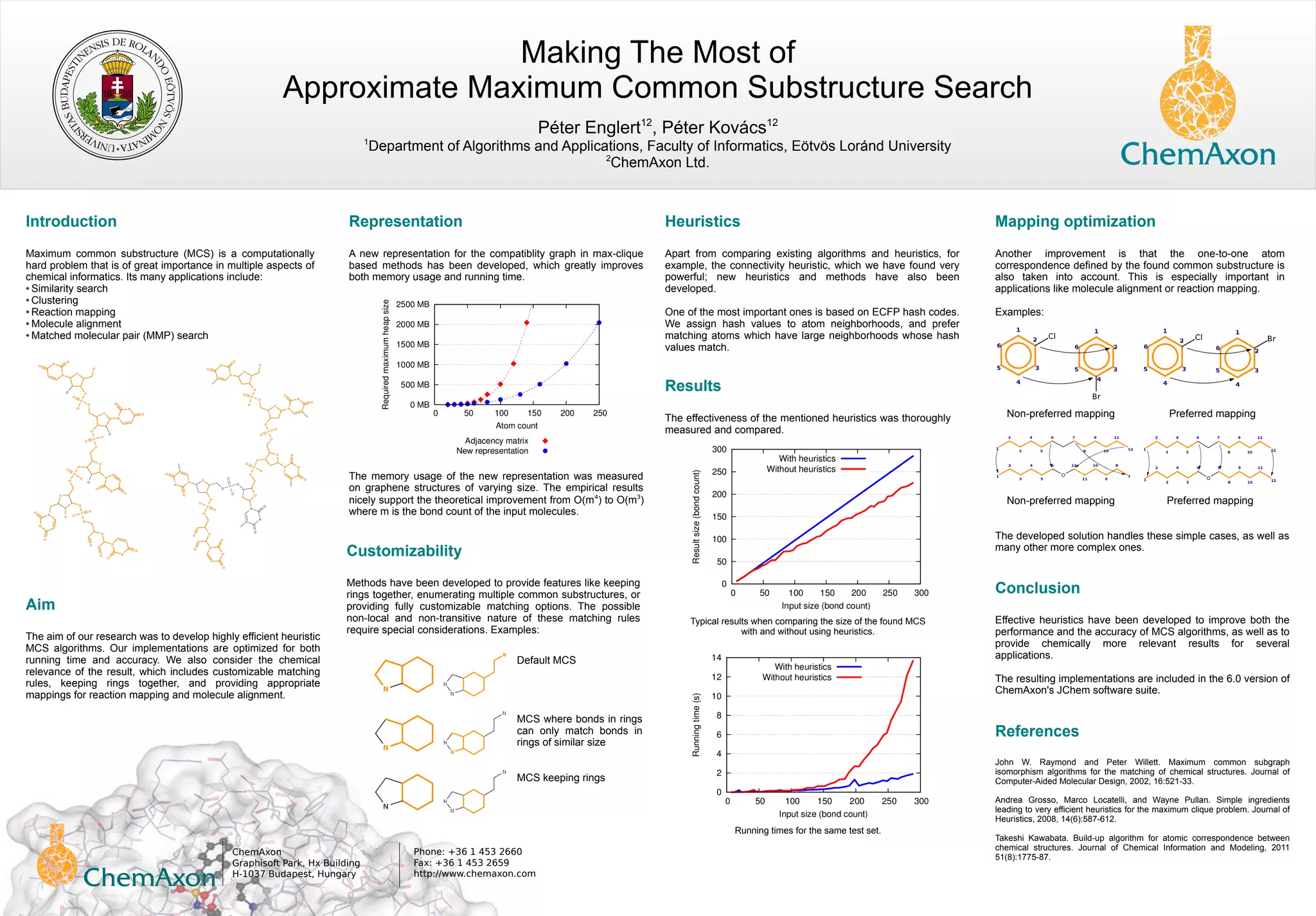
A new representation for the compatiblity graph in max-clique
based methods has been developed, which greatly improves
both memory usage and running time.
The memory usage of the new representation was measured
on graphene structures of varying size. The empirical results
nicely support the theoretical improvement from O(m4
) to O(m3
)
where m is the bond count of the input molecules.
Preferred mapping
Non-preferred mapping Preferred mapping
Default MCS
MCS keeping rings
Results
The effectiveness of the mentioned heuristics was thoroughly
measured and compared.
Typical results when comparing the size of the found MCS
with and without using heuristics.
Running times for the same test set.
MCS where bonds in rings
can only match bonds in
rings of similar size
References
John W. Raymond and Peter Willett. Maximum common subgraph
isomorphism algorithms for the matching of chemical structures. Journal of
Computer-Aided Molecular Design, 2002, 16:521-33.
Andrea Grosso, Marco Locatelli, and Wayne Pullan. Simple ingredients
leading to very efficient heuristics for the maximum clique problem. Journal of
Heuristics, 2008, 14(6):587-612.
Takeshi Kawabata. Build-up algorithm for atomic correspondence between
chemical structures. Journal of Chemical Information and Modeling, 2011
51(8):1775-87.

Making the most of maximum common substructure search

  • 1.
    ChemAxon Graphisoft Park, HxBuilding H-1037 Budapest, Hungary Phone: +36 1 453 2660 Fax: +36 1 453 2659 http://www.chemaxon.com Making The Most of Approximate Maximum Common Substructure Search Introduction Maximum common substructure (MCS) is a computationally hard problem that is of great importance in multiple aspects of chemical informatics. Its many applications include: ● Similarity search ● Clustering ● Reaction mapping ● Molecule alignment ● Matched molecular pair (MMP) search Péter Englert12 , Péter Kovács12 1 Department of Algorithms and Applications, Faculty of Informatics, Eötvös Loránd University 2 ChemAxon Ltd. Aim The aim of our research was to develop highly efficient heuristic MCS algorithms. Our implementations are optimized for both running time and accuracy. We also consider the chemical relevance of the result, which includes customizable matching rules, keeping rings together, and providing appropriate mappings for reaction mapping and molecule alignment. Heuristics Apart from comparing existing algorithms and heuristics, for example, the connectivity heuristic, which we have found very powerful; new heuristics and methods have also been developed. One of the most important ones is based on ECFP hash codes. We assign hash values to atom neighborhoods, and prefer matching atoms which have large neighborhoods whose hash values match. Mapping optimization Another improvement is that the one-to-one atom correspondence defined by the found common substructure is also taken into account. This is especially important in applications like molecule alignment or reaction mapping. Examples: Non-preferred mapping The developed solution handles these simple cases, as well as many other more complex ones.Customizability Methods have been developed to provide features like keeping rings together, enumerating multiple common substructures, or providing fully customizable matching options. The possible non-local and non-transitive nature of these matching rules require special considerations. Examples: Conclusion Effective heuristics have been developed to improve both the performance and the accuracy of MCS algorithms, as well as to provide chemically more relevant results for several applications. The resulting implementations are included in the 6.0 version of ChemAxon's JChem software suite. Representation A new representation for the compatiblity graph in max-clique based methods has been developed, which greatly improves both memory usage and running time. The memory usage of the new representation was measured on graphene structures of varying size. The empirical results nicely support the theoretical improvement from O(m4 ) to O(m3 ) where m is the bond count of the input molecules. Preferred mapping Non-preferred mapping Preferred mapping Default MCS MCS keeping rings Results The effectiveness of the mentioned heuristics was thoroughly measured and compared. Typical results when comparing the size of the found MCS with and without using heuristics. Running times for the same test set. MCS where bonds in rings can only match bonds in rings of similar size References John W. Raymond and Peter Willett. Maximum common subgraph isomorphism algorithms for the matching of chemical structures. Journal of Computer-Aided Molecular Design, 2002, 16:521-33. Andrea Grosso, Marco Locatelli, and Wayne Pullan. Simple ingredients leading to very efficient heuristics for the maximum clique problem. Journal of Heuristics, 2008, 14(6):587-612. Takeshi Kawabata. Build-up algorithm for atomic correspondence between chemical structures. Journal of Chemical Information and Modeling, 2011 51(8):1775-87.