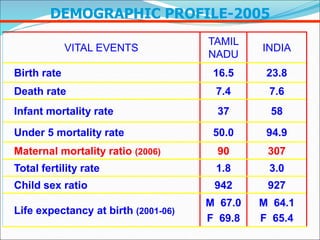
VITAL EVENTS
TAMIL
NADU
INDIA
Birth rate 16.5 23.8
Death rate 7.4 7.6
Infant mortality rate 37 58
Under 5 mortality rate 50.0 94.9
Maternal mortality ratio (2006) 90 307
Total fertility rate 1.8 3.0
Child sex ratio 942 927
Life expectancy at birth (2001-06)
M 67.0
F 69.8
M 64.1
F 65.4
DEMOGRAPHIC PROFILE-2005
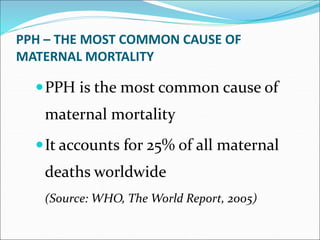
PPH – THE MOST COMMON CAUSE OF
MATERNAL MORTALITY
PPH is the most common cause of
maternal mortality
It accounts for 25% of all maternal
deaths worldwide
(Source: WHO, The World Report, 2005)
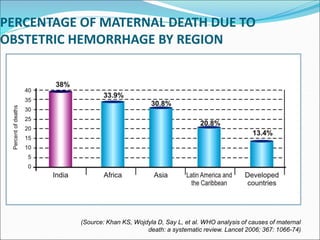
PERCENTAGE OF MATERNAL DEATH DUE TO
OBSTETRIC HEMORRHAGE BY REGION
(Source: Khan KS, Wojdyla D, Say L, et al. WHO analysis of causes of maternal

death: a systematic review. Lancet 2006; 367: 1066-74)
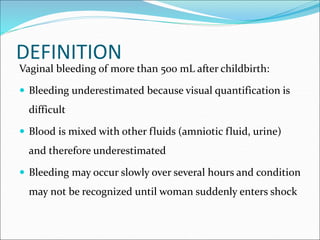
DEFINITION
Vaginal bleeding of more than 500 mL after childbirth:
 Bleeding underestimated because visual quantification is
difficult
 Blood is mixed with other fluids (amniotic fluid, urine)
and therefore underestimated
 Bleeding may occur slowly over several hours and condition
may not be recognized until woman suddenly enters shock
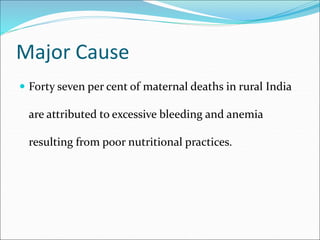
Major Cause
 Forty seven per cent of maternal deaths in rural India
are attributed to excessive bleeding and anemia
resulting from poor nutritional practices.
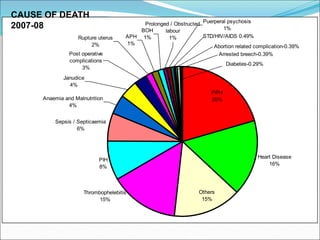
Heart Disease
16%
PIH
8%
Sepsis / Septicaemia
6%
Thrombophelebitis
15%
Others
15%
Janudice
4%
Post operative
complications
3%
Anaemia and Malnutrition
4%
Rupture uterus
2%
PPH
20%
APH
1%
BOH
1%
Prolonged / Obstructed
labour
1%
Puerperal psychosis
1%
STD/HIV/AIDS 0.49%
Abortion related complication-0.39%
Diabetes-0.29%
Arrested breech-0.39%
CAUSE OF DEATH
2007-08
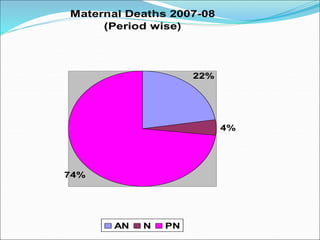
Maternal Deaths 2007-08
(Period wise)
22%
4%
74%
AN N PN
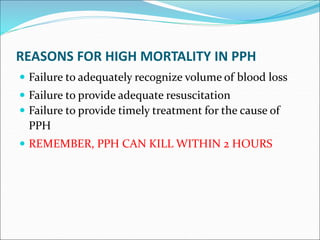
REASONS FOR HIGH MORTALITY IN PPH
 Failure to adequately recognize volume of blood loss
 Failure to provide adequate resuscitation
 Failure to provide timely treatment for the cause of
PPH
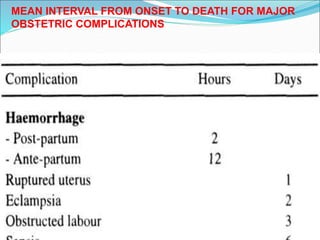
 REMEMBER, PPH CAN KILL WITHIN 2 HOURS
MEAN INTERVAL FROM ONSET TO DEATH FOR MAJOR
OBSTETRIC COMPLICATIONS
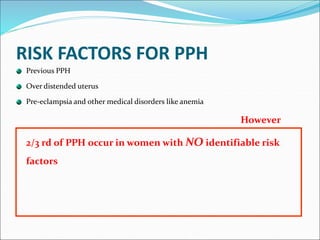
RISK FACTORS FOR PPH
Previous PPH
Over distended uterus
Pre-eclampsia and other medical disorders like anemia
However
2/3 rd of PPH occur in women with NO identifiable risk
factors
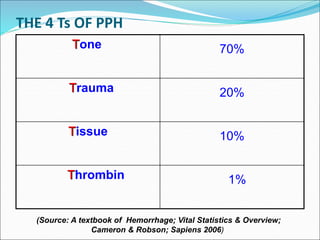
THE 4 Ts OF PPH
Tone 70%
Trauma 20%
Tissue 10%
Thrombin 1%
(Source: A textbook of Hemorrhage; Vital Statistics & Overview;
Cameron & Robson; Sapiens 2006)
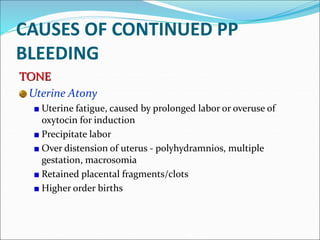
CAUSES OF CONTINUED PP
BLEEDING
TONE
Uterine Atony
Uterine fatigue, caused by prolonged labor or overuse of
oxytocin for induction
Precipitate labor
Over distension of uterus - polyhydramnios, multiple
gestation, macrosomia
Retained placental fragments/clots
Higher order births
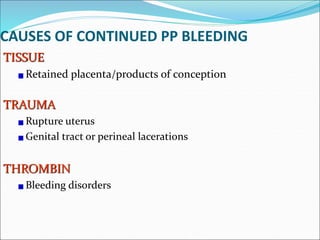
TISSUE
Retained placenta/products of conception
TRAUMA
Rupture uterus
Genital tract or perineal lacerations
THROMBIN
Bleeding disorders
CAUSES OF CONTINUED PP BLEEDING
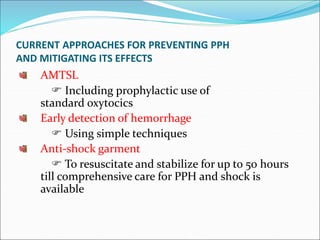
CURRENT APPROACHES FOR PREVENTING PPH
AND MITIGATING ITS EFFECTS
AMTSL
 Including prophylactic use of
standard oxytocics
Early detection of hemorrhage
 Using simple techniques
Anti-shock garment
 To resuscitate and stabilize for up to 50 hours
till comprehensive care for PPH and shock is
available
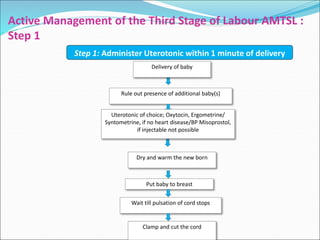
Active Management of the Third Stage of Labour AMTSL :
Step 1
Step 1: Administer Uterotonic within 1 minute of delivery
Rule out presence of additional baby(s)
Dry and warm the new born
Delivery of baby
Uterotonic of choice; Oxytocin, Ergometrine/
Syntometrine, if no heart disease/BP Misoprostol,
if injectable not possible
Put baby to breast
Wait till pulsation of cord stops
Clamp and cut the cord
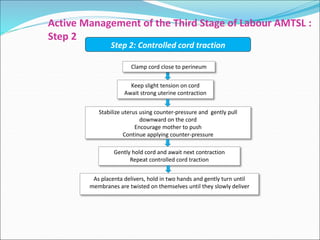
Active Management of the Third Stage of Labour AMTSL :
Step 2
Stabilize uterus using counter-pressure and gently pull
downward on the cord
Encourage mother to push
Continue applying counter-pressure
Keep slight tension on cord
Await strong uterine contraction
Clamp cord close to perineum
Step 2: Controlled cord traction
Gently hold cord and await next contraction
Repeat controlled cord traction
As placenta delivers, hold in two hands and gently turn until
membranes are twisted on themselves until they slowly deliver
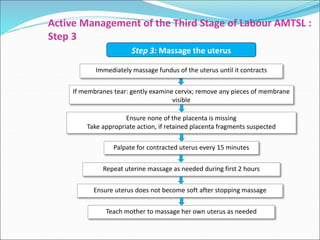
Active Management of the Third Stage of Labour AMTSL :
Step 3
Palpate for contracted uterus every 15 minutes
Repeat uterine massage as needed during first 2 hours
Ensure uterus does not become soft after stopping massage
Immediately massage fundus of the uterus until it contracts
Step 3: Massage the uterus
If membranes tear: gently examine cervix; remove any pieces of membrane
visible
Ensure none of the placenta is missing
Take appropriate action, if retained placenta fragments suspected
Teach mother to massage her own uterus as needed
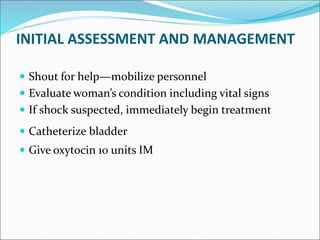
INITIAL ASSESSMENT AND MANAGEMENT
 Shout for help—mobilize personnel
 Evaluate woman’s condition including vital signs
 If shock suspected, immediately begin treatment
 Catheterize bladder
 Give oxytocin 10 units IM
INITIAL ASSESSMENT AND MANAGEMENT
 Massage uterus to expel clots and feel to see that it is
contracted—recheck intermittently
 Infuse IV fluids
 Check to see that placenta has been expelled—examine for
completeness
 Examine the cervix, vagina and perineum for tears
EARLY DETECTION OF HEMORRHAGE
 Most common method of assessing blood loss during
delivery:
 How reliable are our (gu)estimates?
Visual Estimation of Blood Loss
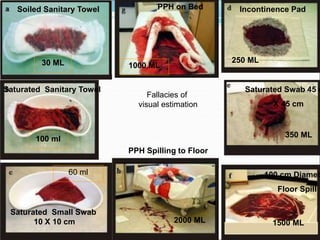
Fallacies of
visual estimation
Soiled Sanitary Towel
30 ML
Saturated Sanitary Towel
100 ml
Saturated Small Swab
10 X 10 cm
60 ml
Incontinence Pad
250 ML
Saturated Swab 45 c
X 45 cm
350 ML
100 cm Diamet
Floor Spill
1500 ML
PPH on Bed
1000 ML
PPH Spilling to Floor
2000 ML
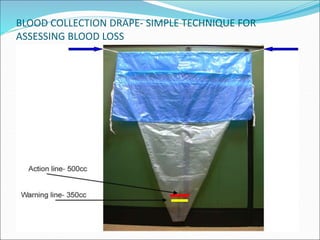
BLOOD COLLECTION DRAPE- SIMPLE TECHNIQUE FOR
ASSESSING BLOOD LOSS
Actions for PPH
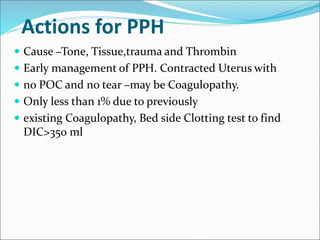
 Cause –Tone, Tissue,trauma and Thrombin
 Early management of PPH. Contracted Uterus with
 no POC and no tear –may be Coagulopathy.
 Only less than 1% due to previously
 existing Coagulopathy, Bed side Clotting test to find
DIC>350 ml
Actions for PPH
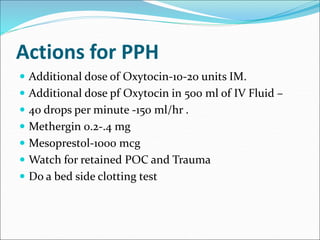
 Additional dose of Oxytocin-10-20 units IM.
 Additional dose pf Oxytocin in 500 ml of IV Fluid –
 40 drops per minute -150 ml/hr .
 Methergin 0.2-.4 mg
 Mesoprestol-1000 mcg
 Watch for retained POC and Trauma
 Do a bed side clotting test
Oxytocic Drugs: Oxytocin
 Advantages
 Causes uterus to contract
 Acts within 2 ½min. when given IM
 Generally does not cause side effects
 Disadvantages
 More expensive than ergometrine
 Not heat stable
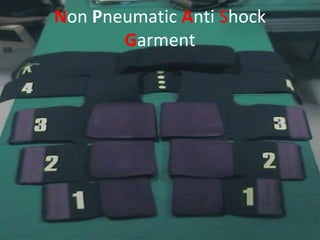
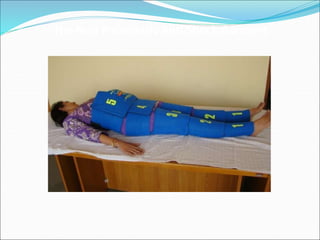
Non Pneumatic Anti Shock
Garment
The Non Pnuematic Anti Shock Garment
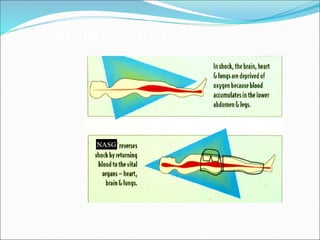
How the NASG works
REMEMBER
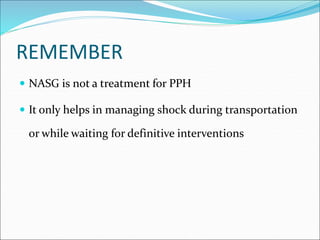
 NASG is not a treatment for PPH
 It only helps in managing shock during transportation
or while waiting for definitive interventions
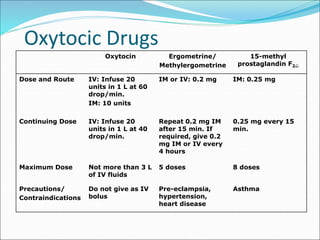
Oxytocic Drugs
Oxytocin Ergometrine/
Methylergometrine
15-methyl
prostaglandin F2
Dose and Route IV: Infuse 20
units in 1 L at 60
drop/min.
IM: 10 units
IM or IV: 0.2 mg IM: 0.25 mg
Continuing Dose IV: Infuse 20
units in 1 L at 40
drop/min.
Repeat 0.2 mg IM
after 15 min. If
required, give 0.2
mg IM or IV every
4 hours
0.25 mg every 15
min.
Maximum Dose Not more than 3 L
of IV fluids
5 doses 8 doses
Precautions/
Contraindications
Do not give as IV
bolus
Pre-eclampsia,
hypertension,
heart disease
Asthma
Oxytocic Drugs: Ergometrine
 Advantages
 Low price
 Effect lasts 2–4 hours
 Disadvantages
 Takes 6–7 minutes to become effective when given IM
 Causes tonic uterine contraction
 Increased risk of hypertension, vomiting, headache
 Contraindicated in women with hypertension or heart
disease
 Not heat stable
Oxytocic Drugs: Syntometrine
 Advantages
 Combined effect of rapid action of oxytocin and
sustained action of ergometrine
 Disadvantages
 Increased risk of hypertension, nausea and vomiting
 Not heat stable
 More expensive
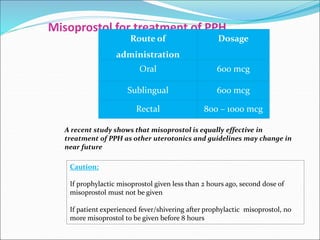
Misoprostol for treatment of PPH
Route of
administration
Dosage
Oral 600 mcg
Sublingual 600 mcg
Rectal 800 – 1000 mcg
Caution:
If prophylactic misoprostol given less than 2 hours ago, second dose of
misoprostol must not be given
If patient experienced fever/shivering after prophylactic misoprostol, no
more misoprostol to be given before 8 hours
A recent study shows that misoprostol is equally effective in
treatment of PPH as other uterotonics and guidelines may change in
near future
UNRESPONSIVE UTERINE BLEEDING
 Tamponade techniques
 gauze, balloons,
condom/glove with
infiltration of placental bed with
vasoconstrictors
 Laparotomy
 Conservative
 Vessel ligation (uterine,
ovarian , hypogastric )
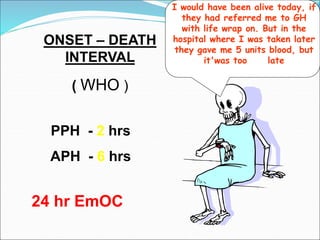
ONSET – DEATH
INTERVAL
( WHO )
PPH - 2 hrs
APH - 6 hrs
I would have been alive today, if
they had referred me to GH
with life wrap on. But in the
hospital where I was taken later
they gave me 5 units blood, but
it'was too late
24 hr EmOC
The Taj is beautiful; but we don’t need anymore Taj Mahal
Let us join hands in preventing PPH

Postpartum Haemorrhage The enemy within2.ppt

  • 3.
    VITAL EVENTS TAMIL NADU INDIA Birth rate16.5 23.8 Death rate 7.4 7.6 Infant mortality rate 37 58 Under 5 mortality rate 50.0 94.9 Maternal mortality ratio (2006) 90 307 Total fertility rate 1.8 3.0 Child sex ratio 942 927 Life expectancy at birth (2001-06) M 67.0 F 69.8 M 64.1 F 65.4 DEMOGRAPHIC PROFILE-2005
  • 4.
    PPH – THEMOST COMMON CAUSE OF MATERNAL MORTALITY PPH is the most common cause of maternal mortality It accounts for 25% of all maternal deaths worldwide (Source: WHO, The World Report, 2005)
  • 5.
    PERCENTAGE OF MATERNALDEATH DUE TO OBSTETRIC HEMORRHAGE BY REGION (Source: Khan KS, Wojdyla D, Say L, et al. WHO analysis of causes of maternal death: a systematic review. Lancet 2006; 367: 1066-74)
  • 6.
    DEFINITION Vaginal bleeding ofmore than 500 mL after childbirth:  Bleeding underestimated because visual quantification is difficult  Blood is mixed with other fluids (amniotic fluid, urine) and therefore underestimated  Bleeding may occur slowly over several hours and condition may not be recognized until woman suddenly enters shock
  • 7.
    Major Cause  Fortyseven per cent of maternal deaths in rural India are attributed to excessive bleeding and anemia resulting from poor nutritional practices.
  • 8.
    Heart Disease 16% PIH 8% Sepsis /Septicaemia 6% Thrombophelebitis 15% Others 15% Janudice 4% Post operative complications 3% Anaemia and Malnutrition 4% Rupture uterus 2% PPH 20% APH 1% BOH 1% Prolonged / Obstructed labour 1% Puerperal psychosis 1% STD/HIV/AIDS 0.49% Abortion related complication-0.39% Diabetes-0.29% Arrested breech-0.39% CAUSE OF DEATH 2007-08
  • 9.
    Maternal Deaths 2007-08 (Periodwise) 22% 4% 74% AN N PN
  • 10.
    REASONS FOR HIGHMORTALITY IN PPH  Failure to adequately recognize volume of blood loss  Failure to provide adequate resuscitation  Failure to provide timely treatment for the cause of PPH  REMEMBER, PPH CAN KILL WITHIN 2 HOURS
  • 11.
    MEAN INTERVAL FROMONSET TO DEATH FOR MAJOR OBSTETRIC COMPLICATIONS
  • 12.
    RISK FACTORS FORPPH Previous PPH Over distended uterus Pre-eclampsia and other medical disorders like anemia However 2/3 rd of PPH occur in women with NO identifiable risk factors
  • 13.
    THE 4 TsOF PPH Tone 70% Trauma 20% Tissue 10% Thrombin 1% (Source: A textbook of Hemorrhage; Vital Statistics & Overview; Cameron & Robson; Sapiens 2006)
  • 14.
    CAUSES OF CONTINUEDPP BLEEDING TONE Uterine Atony Uterine fatigue, caused by prolonged labor or overuse of oxytocin for induction Precipitate labor Over distension of uterus - polyhydramnios, multiple gestation, macrosomia Retained placental fragments/clots Higher order births
  • 15.
    TISSUE Retained placenta/products ofconception TRAUMA Rupture uterus Genital tract or perineal lacerations THROMBIN Bleeding disorders CAUSES OF CONTINUED PP BLEEDING
  • 16.
    CURRENT APPROACHES FORPREVENTING PPH AND MITIGATING ITS EFFECTS AMTSL  Including prophylactic use of standard oxytocics Early detection of hemorrhage  Using simple techniques Anti-shock garment  To resuscitate and stabilize for up to 50 hours till comprehensive care for PPH and shock is available
  • 17.
    Active Management ofthe Third Stage of Labour AMTSL : Step 1 Step 1: Administer Uterotonic within 1 minute of delivery Rule out presence of additional baby(s) Dry and warm the new born Delivery of baby Uterotonic of choice; Oxytocin, Ergometrine/ Syntometrine, if no heart disease/BP Misoprostol, if injectable not possible Put baby to breast Wait till pulsation of cord stops Clamp and cut the cord
  • 18.
    Active Management ofthe Third Stage of Labour AMTSL : Step 2 Stabilize uterus using counter-pressure and gently pull downward on the cord Encourage mother to push Continue applying counter-pressure Keep slight tension on cord Await strong uterine contraction Clamp cord close to perineum Step 2: Controlled cord traction Gently hold cord and await next contraction Repeat controlled cord traction As placenta delivers, hold in two hands and gently turn until membranes are twisted on themselves until they slowly deliver
  • 19.
    Active Management ofthe Third Stage of Labour AMTSL : Step 3 Palpate for contracted uterus every 15 minutes Repeat uterine massage as needed during first 2 hours Ensure uterus does not become soft after stopping massage Immediately massage fundus of the uterus until it contracts Step 3: Massage the uterus If membranes tear: gently examine cervix; remove any pieces of membrane visible Ensure none of the placenta is missing Take appropriate action, if retained placenta fragments suspected Teach mother to massage her own uterus as needed
  • 20.
    INITIAL ASSESSMENT ANDMANAGEMENT  Shout for help—mobilize personnel  Evaluate woman’s condition including vital signs  If shock suspected, immediately begin treatment  Catheterize bladder  Give oxytocin 10 units IM
  • 21.
    INITIAL ASSESSMENT ANDMANAGEMENT  Massage uterus to expel clots and feel to see that it is contracted—recheck intermittently  Infuse IV fluids  Check to see that placenta has been expelled—examine for completeness  Examine the cervix, vagina and perineum for tears
  • 22.
    EARLY DETECTION OFHEMORRHAGE  Most common method of assessing blood loss during delivery:  How reliable are our (gu)estimates? Visual Estimation of Blood Loss
  • 23.
    Fallacies of visual estimation SoiledSanitary Towel 30 ML Saturated Sanitary Towel 100 ml Saturated Small Swab 10 X 10 cm 60 ml Incontinence Pad 250 ML Saturated Swab 45 c X 45 cm 350 ML 100 cm Diamet Floor Spill 1500 ML PPH on Bed 1000 ML PPH Spilling to Floor 2000 ML
  • 24.
    BLOOD COLLECTION DRAPE-SIMPLE TECHNIQUE FOR ASSESSING BLOOD LOSS
  • 25.
    Actions for PPH Cause –Tone, Tissue,trauma and Thrombin  Early management of PPH. Contracted Uterus with  no POC and no tear –may be Coagulopathy.  Only less than 1% due to previously  existing Coagulopathy, Bed side Clotting test to find DIC>350 ml
  • 26.
    Actions for PPH Additional dose of Oxytocin-10-20 units IM.  Additional dose pf Oxytocin in 500 ml of IV Fluid –  40 drops per minute -150 ml/hr .  Methergin 0.2-.4 mg  Mesoprestol-1000 mcg  Watch for retained POC and Trauma  Do a bed side clotting test
  • 27.
    Oxytocic Drugs: Oxytocin Advantages  Causes uterus to contract  Acts within 2 ½min. when given IM  Generally does not cause side effects  Disadvantages  More expensive than ergometrine  Not heat stable
  • 28.
    Non Pneumatic AntiShock Garment
  • 29.
    The Non PnuematicAnti Shock Garment
  • 30.
  • 31.
    REMEMBER  NASG isnot a treatment for PPH  It only helps in managing shock during transportation or while waiting for definitive interventions
  • 32.
    Oxytocic Drugs Oxytocin Ergometrine/ Methylergometrine 15-methyl prostaglandinF2 Dose and Route IV: Infuse 20 units in 1 L at 60 drop/min. IM: 10 units IM or IV: 0.2 mg IM: 0.25 mg Continuing Dose IV: Infuse 20 units in 1 L at 40 drop/min. Repeat 0.2 mg IM after 15 min. If required, give 0.2 mg IM or IV every 4 hours 0.25 mg every 15 min. Maximum Dose Not more than 3 L of IV fluids 5 doses 8 doses Precautions/ Contraindications Do not give as IV bolus Pre-eclampsia, hypertension, heart disease Asthma
  • 33.
    Oxytocic Drugs: Ergometrine Advantages  Low price  Effect lasts 2–4 hours  Disadvantages  Takes 6–7 minutes to become effective when given IM  Causes tonic uterine contraction  Increased risk of hypertension, vomiting, headache  Contraindicated in women with hypertension or heart disease  Not heat stable
  • 34.
    Oxytocic Drugs: Syntometrine Advantages  Combined effect of rapid action of oxytocin and sustained action of ergometrine  Disadvantages  Increased risk of hypertension, nausea and vomiting  Not heat stable  More expensive
  • 35.
    Misoprostol for treatmentof PPH Route of administration Dosage Oral 600 mcg Sublingual 600 mcg Rectal 800 – 1000 mcg Caution: If prophylactic misoprostol given less than 2 hours ago, second dose of misoprostol must not be given If patient experienced fever/shivering after prophylactic misoprostol, no more misoprostol to be given before 8 hours A recent study shows that misoprostol is equally effective in treatment of PPH as other uterotonics and guidelines may change in near future
  • 36.
    UNRESPONSIVE UTERINE BLEEDING Tamponade techniques  gauze, balloons, condom/glove with infiltration of placental bed with vasoconstrictors  Laparotomy  Conservative  Vessel ligation (uterine, ovarian , hypogastric )
  • 37.
    ONSET – DEATH INTERVAL (WHO ) PPH - 2 hrs APH - 6 hrs I would have been alive today, if they had referred me to GH with life wrap on. But in the hospital where I was taken later they gave me 5 units blood, but it'was too late 24 hr EmOC
  • 38.
    The Taj isbeautiful; but we don’t need anymore Taj Mahal Let us join hands in preventing PPH