Apostrophes and
Possession
Apostrophe: Uses
1. Indicate missing letters
 Contractions: don’t
 Dialect: I saw ’em talkin’.
2. Indicate possession
 Tom's shirt (the shirt that
belongs toTom)
The
Possessive
Only used with nouns.
Primarily used with:
 People
 Animals
 Countries
Shows a relationship of
belonging between one
person/thing and another.
Tip: Telling if a Noun is Possessive
• If you can rewrite the phrase using
“of,” the noun is possessive.
• E.g.: the journey’s end  the end
of the journey
Why is indicating possession
important?
• Those things over there
are my husband’s.
• Those things over there
are my husbands’.
• Those things over there
are my husbands.
Those things over there
belong to my husband.
Those things over there
belong to several
husbands of mine.
I'm married to those
men over there.
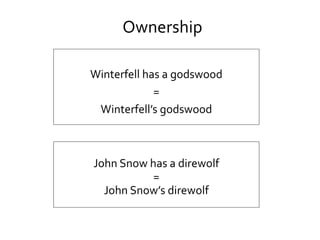
Winterfell has a godswood
=
Winterfell’s godswood
Ownership
John Snow has a direwolf
=
John Snow’s direwolf
Residence
Sansa sleeps in this room = Sansa’s room
Sam studies in this library= Sam’s library
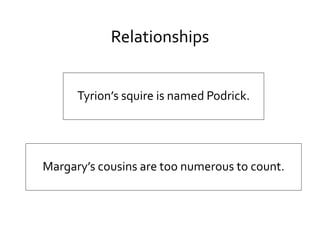
Relationships
Tyrion’s squire is named Podrick.
Margary’s cousins are too numerous to count.
Fixed Expressions
a day's work
a month's pay
today's newspaper
in a year's time
a stone's throw away
Making Nouns
Possessive
Singular Nouns
 Add an apostrophe followed by an “s”
The food belonging to one cat
=
the cat's food
Singular Nouns Ending in “s”
• Add an apostrophe followed by an “s”
• OR add an apostrophe
The pipe belonging to the rhinoceros
=
the rhinoceros’s pipe.
The pipe belonging to the rhinoceros
=
the rhinoceros’ pipe.
Plural Nouns
 Add an apostrophe
followed by an “s”:
The school the children
attend
=
The children's school.
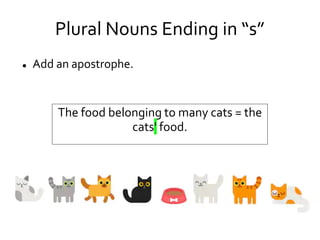
Plural Nouns Ending in “s”
 Add an apostrophe.
The food belonging to many cats = the
cats' food.
Compound Possession
 What is the difference between “Mary and Paul's
beliefs” and “Mary's and Paul's beliefs”?
 In the first example, Mary and Paul share the same
beliefs in common; in the second example, they
each have their own set of beliefs.
Apostrophes and
Possessive Pronouns
 Possessive
pronouns never
take an
apostrophe.
 My
 Yours
 Hers
 Ours
 Its
Use its to indicate possession,
NOT
it’s (it is).

Possessive

  • 1.
  • 2.
    Apostrophe: Uses 1. Indicatemissing letters  Contractions: don’t  Dialect: I saw ’em talkin’. 2. Indicate possession  Tom's shirt (the shirt that belongs toTom)
  • 3.
    The Possessive Only used withnouns. Primarily used with:  People  Animals  Countries
  • 4.
    Shows a relationshipof belonging between one person/thing and another.
  • 5.
    Tip: Telling ifa Noun is Possessive • If you can rewrite the phrase using “of,” the noun is possessive. • E.g.: the journey’s end  the end of the journey
  • 6.
    Why is indicatingpossession important? • Those things over there are my husband’s. • Those things over there are my husbands’. • Those things over there are my husbands. Those things over there belong to my husband. Those things over there belong to several husbands of mine. I'm married to those men over there.
  • 7.
    Winterfell has agodswood = Winterfell’s godswood Ownership John Snow has a direwolf = John Snow’s direwolf
  • 8.
    Residence Sansa sleeps inthis room = Sansa’s room Sam studies in this library= Sam’s library
  • 9.
    Relationships Tyrion’s squire isnamed Podrick. Margary’s cousins are too numerous to count.
  • 10.
    Fixed Expressions a day'swork a month's pay today's newspaper in a year's time a stone's throw away
  • 11.
  • 12.
    Singular Nouns  Addan apostrophe followed by an “s” The food belonging to one cat = the cat's food
  • 13.
    Singular Nouns Endingin “s” • Add an apostrophe followed by an “s” • OR add an apostrophe The pipe belonging to the rhinoceros = the rhinoceros’s pipe. The pipe belonging to the rhinoceros = the rhinoceros’ pipe.
  • 14.
    Plural Nouns  Addan apostrophe followed by an “s”: The school the children attend = The children's school.
  • 15.
    Plural Nouns Endingin “s”  Add an apostrophe. The food belonging to many cats = the cats' food.
  • 16.
    Compound Possession  Whatis the difference between “Mary and Paul's beliefs” and “Mary's and Paul's beliefs”?  In the first example, Mary and Paul share the same beliefs in common; in the second example, they each have their own set of beliefs.
  • 17.
    Apostrophes and Possessive Pronouns Possessive pronouns never take an apostrophe.  My  Yours  Hers  Ours  Its
  • 18.
    Use its toindicate possession, NOT it’s (it is).