Making Subjects and Verbs Agree
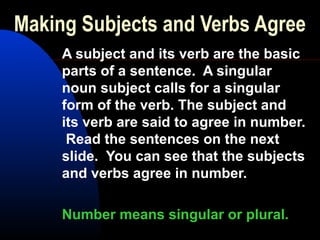
A subject and its verb are the basic
parts of a sentence. A singular
noun subject calls for a singular
form of the verb. The subject and
its verb are said to agree in number.
Read the sentences on the next
slide. You can see that the subjects
and verbs agree in number.
Number means singular or plural.
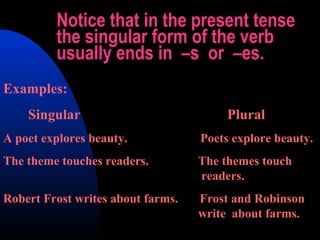
Notice that in the present tense
the singular form of the verb
usually ends in –s or –es.
Examples:
Singular Plural
A poet explores beauty. Poets explore beauty.
The theme touches readers. The themes touch
readers.
Robert Frost writes about farms. Frost and Robinson
write about farms.
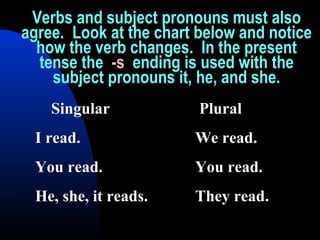
Verbs and subject pronouns must also
agree. Look at the chart below and notice
how the verb changes. In the present
tense the -s ending is used with the
subject pronouns it, he, and she.
Singular Plural
I read. We read.
You read. You read.
He, she, it reads. They read.
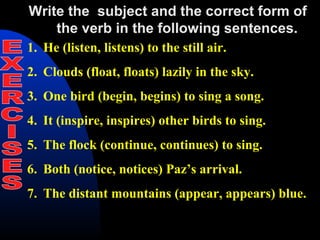
Write the subject and the correct form of
the verb in the following sentences.
1. He (listen, listens) to the still air.
2. Clouds (float, floats) lazily in the sky.
3. One bird (begin, begins) to sing a song.
4. It (inspire, inspires) other birds to sing.
5. The flock (continue, continues) to sing.
6. Both (notice, notices) Paz’s arrival.
7. The distant mountains (appear, appears) blue.
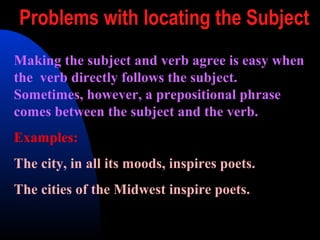
Problems with locating the Subject
Making the subject and verb agree is easy when
the verb directly follows the subject.
Sometimes, however, a prepositional phrase
comes between the subject and the verb.
Examples:
The city, in all its moods, inspires poets.
The cities of the Midwest inspire poets.
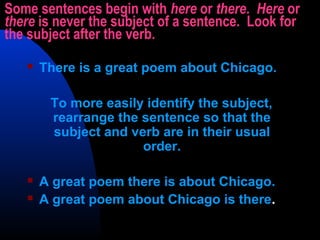
Some sentences begin with here or there. Here or
there is never the subject of a sentence. Look for
the subject after the verb.
 There is a great poem about Chicago.
To more easily identify the subject,
rearrange the sentence so that the
subject and verb are in their usual
order.
 A great poem there is about Chicago.
 A great poem about Chicago is there.
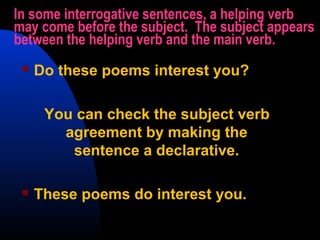
In some interrogative sentences, a helping verb
may come before the subject. The subject appears
between the helping verb and the main verb.
 Do these poems interest you?
You can check the subject verb
agreement by making the
sentence a declarative.
 These poems do interest you.
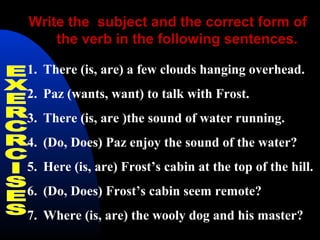
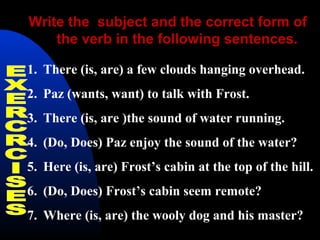
Write the subject and the correct form of
the verb in the following sentences.
1. There (is, are) a few clouds hanging overhead.
2. Paz (wants, want) to talk with Frost.
3. There (is, are )the sound of water running.
4. (Do, Does) Paz enjoy the sound of the water?
5. Here (is, are) Frost’s cabin at the top of the hill.
6. (Do, Does) Frost’s cabin seem remote?
7. Where (is, are) the wooly dog and his master?
Write the subject and the correct form of
the verb in the following sentences.
1. There (is, are) a few clouds hanging overhead.
2. Paz (wants, want) to talk with Frost.
3. There (is, are )the sound of water running.
4. (Do, Does) Paz enjoy the sound of the water?
5. Here (is, are) Frost’s cabin at the top of the hill.
6. (Do, Does) Frost’s cabin seem remote?
7. Where (is, are) the wooly dog and his master?

Subject verb agreement

  • 2.
    Making Subjects andVerbs Agree A subject and its verb are the basic parts of a sentence. A singular noun subject calls for a singular form of the verb. The subject and its verb are said to agree in number. Read the sentences on the next slide. You can see that the subjects and verbs agree in number. Number means singular or plural.
  • 3.
    Notice that inthe present tense the singular form of the verb usually ends in –s or –es. Examples: Singular Plural A poet explores beauty. Poets explore beauty. The theme touches readers. The themes touch readers. Robert Frost writes about farms. Frost and Robinson write about farms.
  • 4.
    Verbs and subjectpronouns must also agree. Look at the chart below and notice how the verb changes. In the present tense the -s ending is used with the subject pronouns it, he, and she. Singular Plural I read. We read. You read. You read. He, she, it reads. They read.
  • 5.
    Write the subjectand the correct form of the verb in the following sentences. 1. He (listen, listens) to the still air. 2. Clouds (float, floats) lazily in the sky. 3. One bird (begin, begins) to sing a song. 4. It (inspire, inspires) other birds to sing. 5. The flock (continue, continues) to sing. 6. Both (notice, notices) Paz’s arrival. 7. The distant mountains (appear, appears) blue.
  • 6.
    Problems with locatingthe Subject Making the subject and verb agree is easy when the verb directly follows the subject. Sometimes, however, a prepositional phrase comes between the subject and the verb. Examples: The city, in all its moods, inspires poets. The cities of the Midwest inspire poets.
  • 7.
    Some sentences beginwith here or there. Here or there is never the subject of a sentence. Look for the subject after the verb.  There is a great poem about Chicago. To more easily identify the subject, rearrange the sentence so that the subject and verb are in their usual order.  A great poem there is about Chicago.  A great poem about Chicago is there.
  • 8.
    In some interrogativesentences, a helping verb may come before the subject. The subject appears between the helping verb and the main verb.  Do these poems interest you? You can check the subject verb agreement by making the sentence a declarative.  These poems do interest you.
  • 9.
    Write the subjectand the correct form of the verb in the following sentences. 1. There (is, are) a few clouds hanging overhead. 2. Paz (wants, want) to talk with Frost. 3. There (is, are )the sound of water running. 4. (Do, Does) Paz enjoy the sound of the water? 5. Here (is, are) Frost’s cabin at the top of the hill. 6. (Do, Does) Frost’s cabin seem remote? 7. Where (is, are) the wooly dog and his master?
  • 10.
    Write the subjectand the correct form of the verb in the following sentences. 1. There (is, are) a few clouds hanging overhead. 2. Paz (wants, want) to talk with Frost. 3. There (is, are )the sound of water running. 4. (Do, Does) Paz enjoy the sound of the water? 5. Here (is, are) Frost’s cabin at the top of the hill. 6. (Do, Does) Frost’s cabin seem remote? 7. Where (is, are) the wooly dog and his master?

Editor's Notes

  • #3 Writer’s Choice p. 444
  • #4 Writer’s Choice text p. 444
  • #5 Writer’s Choice Text p. 500
  • #6 Writer’s Choice Text WB Lesson 50
  • #7 Writer’s Choice Text p. 502
  • #8 Writer’s Choice Text p. 502
  • #9 Writer’s Choice Text p. 502
  • #10 Writer’s Choice Text WB Lesson 51