Positioning is defined as planning the
person in a proper body alignment for the
purpose of preventive, promotive, curative
and rehabilitative aspects of health or
placing the patient in good body alignment
as needed therapeutically.
1. To promote comfort to the patient
2. To relieve pressure on various body parts
3. To stimulate circulation
4. To carry out nursing intervention
5. To perform surgical and medical
interventions
6. To prevent complications caused by
immobility
1. Maintain good body mechanics
2. Wash hands before and after procedure
3. Ensure patient’s comfort
4. Obtain assistance as required
5. Ensure that mattress is firm and level of
bed is at working height
6. Follow safety measures to prevent
accidents
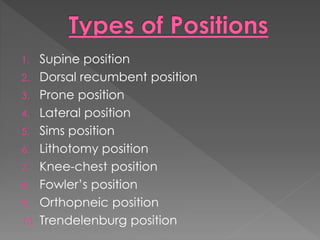
1. Supine position
2. Dorsal recumbent position
3. Prone position
4. Lateral position
5. Sims position
6. Lithotomy position
7. Knee-chest position
8. Fowler’s position
9. Orthopneic position
10. Trendelenburg position
The patient lies on his back with his legs
extended.
Indication
i. Usual position
ii. Physical examination
iii. Examination of the chest and abdomen
a) Place the patient on back with one pillow under
the head, arms and hands at the sides, legs
straight and extended.
b) Place trochanter rolls/ sand bags parallel to
thighs.
c) Place small pillow/ roll under the ankle to
elevate heels.
d) Place footboard under bottom of feet.
e) If the patient is a paralyzed, place hand rolls in
hand.
FOOT BOARD
Patient lies on back, knees fully flexed, thighs
flexed and externally rotated feet flat on the
bed.
Indication
It is used for catheterization, vaginal douche,
vulval, vaginal and genital examination
a) Place the patient on back in bed with pillow
under the head for patient.
b) Knees should be fully flexed, thighs flexed
and externally rotated and feet flat on the
bed.
Position in which the patient lies on the
abdomen with the head turned to one side
with one small pillow under the ankle.
Indications
a) Post operatively
b) Patient with pressure sores, burns, injuries
and operations on the back.
c) Renal biopsy.
d) To Examine the back
a) Explain the procedure
b) Provide privacy
c) Place the patient flat on abdomen with one
pillow under the head
d) Turn patients head to one side and align the
patient in good position
e) Place both arms at the side of the head and
support arm in flexed position at level of
shoulder.
f) Place small pillow under abdomen below
diaphragm.
g) Support lower legs with pillows to elevate
toes.
 The client lies on the side with weight on hip
and shoulder.
 The upper leg is flexed more than the lower
leg.
 The upper knee and hip should be at the same
level.
i. Patients who requires periodic position
changes
ii. In immediate post-operative patients
iii. Used for rectal examination.
iv. Inserting suppositories.
v. For taking rectal temperature.
vi. Giving back care
vii. For giving enema and colonic irrigation.
a) Explain the procedure
b) Provide privacy
c) Lower the head of bed as low as patient can
tolerate.
d) Position the patient to side of bed
e) Turn the patient to one side.
f) Position both arms in flexed position. Upper
most arms are supported by pillow on level
with shoulder.
g) Place pillow under back
h) Place pillow under semi flexed upper leg at
hip, from groin to foot.
 In this position the client lies on either the right
or left side.
 The lower arm behind the body and upper arm
is bent at the shoulder and elbow.
 The knees are both bent, with the upper most
leg more acutely bent.
 These positions similar to the lateral position
except that the patient’s weight is on the
anterior aspect of the patient’s shoulder girdle
and hip.
i. Vaginal and rectal examination
ii. Administration of enema and
suppository
iii. Position for sigmoidoscopy and
protoscopy
SIGMOIDOSCOPY
PROTOSCOPY
a) Explain the procedure to the patient
b) Provide privacy
c) Place the patient on the side
d) Place small pillow under head and neck
e) Place pillow under flexed upper arm,
supporting arm level with shoulder.
f) Place pillow under flexed upper leg, supporting
leg level with hip.
g) Place sand bags parallel to planter surface of
dependant foot.
 The client lies supine with hips flexed. The
legs are separated and thighs are flexed.
 The patient’s buttocks are kept at the edge of
the table and legs are supported by stirrups.
i. For delivery of baby
ii. For rectal examination & surgeries
iii. For vaginal examination & hysterectomy
a) Explain the procedure to the patient
b) Provide privacy
c) Position the patient to lie on his back with
one pillow under the head and neck
d) Place both legs flexed at hip and knee, at
90 degree with legs.
e) Buttocks are kept on the edge of the table
and the legs are supported on stirrups
 The patient rests on the knees and the
chest.
 The body is at 90˚ angle to the hips with
back straight, the arm above the head, and
the head turned to one side.
 The abdomen remains unsupported.
 Used for vaginal and rectal examination
 Used in first aid treatment in cord prolapse
or retroverted uterus
1. Explain the procedure to the patient
2. Make the patient rest on the knees and
chest
3. The head is turned to one side with the
cheek on a pillow.
4. The arm should be extended on the bed
and flexed at the elbows to support the
patient partially.
 It is a sitting position in which the head is
elevated at 45˚ to 60˚, and the client knees
are slightly elevated, avoiding pressure on the
popliteal vessels.
 Backrest and two pillows are used for the
back and head. Pillows can be used to
maintain natural alignment of the hands wrist
and forearms.
i. To relieve dyspnea
ii. To improve circulation
iii. To relax the muscles of the abdomen, back
and thighs.
iv. To relieve abdominal distention.
a) Explain the procedure
b) Elevate the head of the bed
c) Rest the head against mattress or small pillow.
d) Use pillow to support arm.
e) Place a small pillow at lower back.
f) Place foot board at bottom of patient’s feet.
g) Place the patient in sitting position with arms
at sides and knees raised with pillow.
 High fowler’s position with over bed table to be
placed across the front of the patient.
 Patient to rest both hands on over bed table/on
pillow placed on it and leans forward.
 Leaning forward facilitates respiration by
allowing maximum chest expansion by
reducing pressure of abdominal organs on
diaphragm.
1. Patients with severe dyspnea
2. Cardiac patients
3. Position for thoracentesis.
1. Explain the procedure to patient
2. Place the patient in high fowlers position
3. Ask patient to rest both hands on over bed
table/on pillow placed on it and leans
forward.
 In this the patient lies on the back with the
head low.
 The foot of the bed is elevated at 45˚ angle.
Entire frame of bed is tilted with head of
bed down.
 Used in emergency situations like
shock, hemorrhage and hypotension
 Postural drainage
 Patients with deep vein thrombosis
1. Explain the procedure to patient
2. Place the patient in supine position
3. Lower the head end of the bed or if it is not
adjustable type, use bed block at foot end
and tilt entire frame of bed down. OR
elevate the foot end at 45˚angle.
4. The patient is carefully supported to
prevent from slipping.
positioning-converted.pdf

positioning-converted.pdf

  • 2.
    Positioning is definedas planning the person in a proper body alignment for the purpose of preventive, promotive, curative and rehabilitative aspects of health or placing the patient in good body alignment as needed therapeutically.
  • 3.
    1. To promotecomfort to the patient 2. To relieve pressure on various body parts 3. To stimulate circulation 4. To carry out nursing intervention 5. To perform surgical and medical interventions 6. To prevent complications caused by immobility
  • 4.
    1. Maintain goodbody mechanics 2. Wash hands before and after procedure 3. Ensure patient’s comfort 4. Obtain assistance as required 5. Ensure that mattress is firm and level of bed is at working height 6. Follow safety measures to prevent accidents
  • 5.
    1. Supine position 2.Dorsal recumbent position 3. Prone position 4. Lateral position 5. Sims position 6. Lithotomy position 7. Knee-chest position 8. Fowler’s position 9. Orthopneic position 10. Trendelenburg position
  • 7.
    The patient lieson his back with his legs extended. Indication i. Usual position ii. Physical examination iii. Examination of the chest and abdomen
  • 8.
    a) Place thepatient on back with one pillow under the head, arms and hands at the sides, legs straight and extended. b) Place trochanter rolls/ sand bags parallel to thighs. c) Place small pillow/ roll under the ankle to elevate heels. d) Place footboard under bottom of feet. e) If the patient is a paralyzed, place hand rolls in hand.
  • 9.
  • 11.
    Patient lies onback, knees fully flexed, thighs flexed and externally rotated feet flat on the bed. Indication It is used for catheterization, vaginal douche, vulval, vaginal and genital examination
  • 12.
    a) Place thepatient on back in bed with pillow under the head for patient. b) Knees should be fully flexed, thighs flexed and externally rotated and feet flat on the bed.
  • 14.
    Position in whichthe patient lies on the abdomen with the head turned to one side with one small pillow under the ankle. Indications a) Post operatively b) Patient with pressure sores, burns, injuries and operations on the back. c) Renal biopsy. d) To Examine the back
  • 15.
    a) Explain theprocedure b) Provide privacy c) Place the patient flat on abdomen with one pillow under the head d) Turn patients head to one side and align the patient in good position e) Place both arms at the side of the head and support arm in flexed position at level of shoulder.
  • 16.
    f) Place smallpillow under abdomen below diaphragm. g) Support lower legs with pillows to elevate toes.
  • 18.
     The clientlies on the side with weight on hip and shoulder.  The upper leg is flexed more than the lower leg.  The upper knee and hip should be at the same level.
  • 19.
    i. Patients whorequires periodic position changes ii. In immediate post-operative patients iii. Used for rectal examination. iv. Inserting suppositories. v. For taking rectal temperature. vi. Giving back care vii. For giving enema and colonic irrigation.
  • 20.
    a) Explain theprocedure b) Provide privacy c) Lower the head of bed as low as patient can tolerate. d) Position the patient to side of bed e) Turn the patient to one side. f) Position both arms in flexed position. Upper most arms are supported by pillow on level with shoulder.
  • 21.
    g) Place pillowunder back h) Place pillow under semi flexed upper leg at hip, from groin to foot.
  • 23.
     In thisposition the client lies on either the right or left side.  The lower arm behind the body and upper arm is bent at the shoulder and elbow.  The knees are both bent, with the upper most leg more acutely bent.  These positions similar to the lateral position except that the patient’s weight is on the anterior aspect of the patient’s shoulder girdle and hip.
  • 24.
    i. Vaginal andrectal examination ii. Administration of enema and suppository iii. Position for sigmoidoscopy and protoscopy
  • 25.
  • 26.
    a) Explain theprocedure to the patient b) Provide privacy c) Place the patient on the side d) Place small pillow under head and neck e) Place pillow under flexed upper arm, supporting arm level with shoulder. f) Place pillow under flexed upper leg, supporting leg level with hip. g) Place sand bags parallel to planter surface of dependant foot.
  • 28.
     The clientlies supine with hips flexed. The legs are separated and thighs are flexed.  The patient’s buttocks are kept at the edge of the table and legs are supported by stirrups.
  • 29.
    i. For deliveryof baby ii. For rectal examination & surgeries iii. For vaginal examination & hysterectomy
  • 30.
    a) Explain theprocedure to the patient b) Provide privacy c) Position the patient to lie on his back with one pillow under the head and neck d) Place both legs flexed at hip and knee, at 90 degree with legs. e) Buttocks are kept on the edge of the table and the legs are supported on stirrups
  • 32.
     The patientrests on the knees and the chest.  The body is at 90˚ angle to the hips with back straight, the arm above the head, and the head turned to one side.  The abdomen remains unsupported.
  • 33.
     Used forvaginal and rectal examination  Used in first aid treatment in cord prolapse or retroverted uterus
  • 34.
    1. Explain theprocedure to the patient 2. Make the patient rest on the knees and chest 3. The head is turned to one side with the cheek on a pillow. 4. The arm should be extended on the bed and flexed at the elbows to support the patient partially.
  • 36.
     It isa sitting position in which the head is elevated at 45˚ to 60˚, and the client knees are slightly elevated, avoiding pressure on the popliteal vessels.  Backrest and two pillows are used for the back and head. Pillows can be used to maintain natural alignment of the hands wrist and forearms.
  • 38.
    i. To relievedyspnea ii. To improve circulation iii. To relax the muscles of the abdomen, back and thighs. iv. To relieve abdominal distention.
  • 39.
    a) Explain theprocedure b) Elevate the head of the bed c) Rest the head against mattress or small pillow. d) Use pillow to support arm. e) Place a small pillow at lower back. f) Place foot board at bottom of patient’s feet. g) Place the patient in sitting position with arms at sides and knees raised with pillow.
  • 41.
     High fowler’sposition with over bed table to be placed across the front of the patient.  Patient to rest both hands on over bed table/on pillow placed on it and leans forward.  Leaning forward facilitates respiration by allowing maximum chest expansion by reducing pressure of abdominal organs on diaphragm.
  • 42.
    1. Patients withsevere dyspnea 2. Cardiac patients 3. Position for thoracentesis.
  • 43.
    1. Explain theprocedure to patient 2. Place the patient in high fowlers position 3. Ask patient to rest both hands on over bed table/on pillow placed on it and leans forward.
  • 45.
     In thisthe patient lies on the back with the head low.  The foot of the bed is elevated at 45˚ angle. Entire frame of bed is tilted with head of bed down.
  • 46.
     Used inemergency situations like shock, hemorrhage and hypotension  Postural drainage  Patients with deep vein thrombosis
  • 47.
    1. Explain theprocedure to patient 2. Place the patient in supine position 3. Lower the head end of the bed or if it is not adjustable type, use bed block at foot end and tilt entire frame of bed down. OR elevate the foot end at 45˚angle. 4. The patient is carefully supported to prevent from slipping.