Positioning of Client
Prepared by: Geeta Rai, Lecturer
Definition
Positioning defined as placing the person in such
a way to perform therapeutic interventions
and to promote the health of an individual.
Contd…
Positioning defined as placing the person in a
proper body alignment for the purpose of
preventive, promotive, curative, and
rehabilitative aspects of health.
Contd…
Patient positioning involves properly maintaining
a patient’s neutral body alignment by preventing
hyperextension and extreme lateral rotation to
prevent complications of immobility and injury.
Positioning patients is an essential aspect of
nursing practice and a responsibility of the
registered nurse.
Purpose
● To provide comfort to the patient
● To relieve pressure on various parts
● To improve circulation
● To prevent formation of deformity
● To carry out investigations
Contd…
● To perform surgical and medical investigations
● To prevent pressure sores
● To provide proper body alignment
● To conduct delivery/labor
● To carry out nursing interventions
Principles of positioning
● Systemic and orderly way of doing
● Cooperation between two
● Follow safety measure to prevent accidents
● Active participation
● Using a right technique at right time
Factors involved in positioning
● Need of an individual
● Self care ability
● Extend of disability
● Nature of disease condition
● Level of consciousness
● Protocol of the hospital
Types of position
● Supine position
● Dorsal position (Lying on back)
● Dorsal recumbent position
● Lithotomy position
● Lateral position
Contd…
● Prone position
● Slim’s position
● Knee-chest position
● Trendelenburg’s position
● Fowler’s position / Semi fowler’s position
SUPINE POSITION
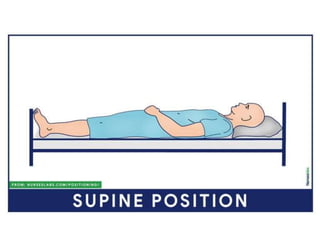
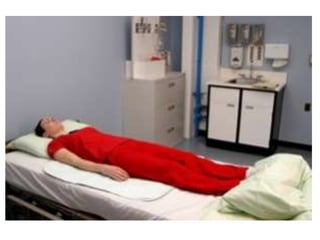
Supine position, the patient lies on his back with
his head and shoulders are slightly elevated. One
pillow is given under the head. His legs should be
slightly flexed. A small pillow is placed under his
knees.
Indication
● The usual position used by the patient
● Used for examination of the chest and
abdomen
Procedure
● Place the patient on back with one pillow
under the head, arms and hands at the sides,
knees flexed and separated.
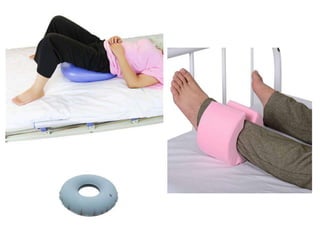
● Place the air ring under the hips and cotton
rings or foam pads under the heels to reduce
the pressure.
Contd…
● Align the patient’s body in good position.
● Support the body parts in good alignment for
comfort when the patient is paralyzed.
Contraindication
● Elderly patients
● Patients with operation on abdomen, breast
and thorax
● Prone to hypostatic pneumonia
● Patients with long standing illnesses and
neurological conditions
LATERAL POSITION
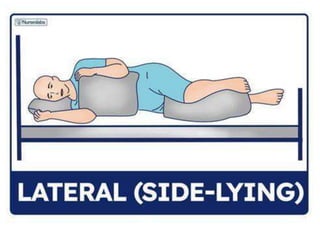
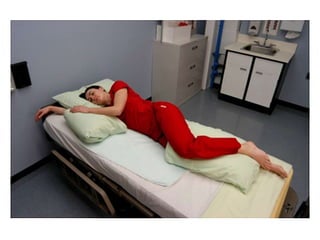
Patient lies on left side with legs flexed at thighs.
The upper leg is flexed more than the lower. A
pillow is kept in front of the abdomen and at the
back and one under the upper leg.
Indication
● Lateral position is used for giving back care
enemas and colonic irrigation
● Used for examination of perineum or rectum
inserting suppositories
● For taking rectal temperature
● For change of position
● Later position is a relaxing position
● Giving back care
Procedure
Explain the procedure to the patient
● Provide privacy.
● For left lateral position, place the patient on
left side with buttocks to the edge of bed,
both thighs flexed and left arm underneath.
Contd…
● For right lateral position, place the patient on
right side with buttocks to the edge of bed,
both thighs flexed and right arm underneath.
● Place air ring under the hips to reduce
pressure on trochanters and at the hip joints,
the cotton rings or foam pads under the
ankles of lower legs to reduce the pressure
on ankles.
Contd…
● Align the patient in good position and make
sure the patient is not lying on his arm.
● Support the body parts in good alignment for
comfort.
Left lateral position: with one pillow under the
head, patient is placed to lie on the left side.
Contd…
Use of left lateral positions:
● For giving edema
● For inserting suppositories
● To take rectal examination
● To take rectal temperature
Contraindication
● After hip surgery
● After orthopedic surgery
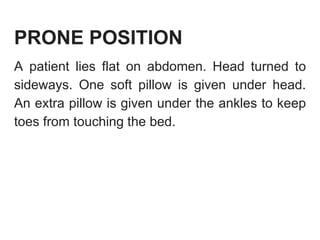
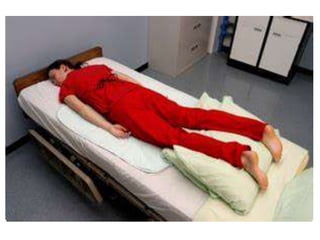
PRONE POSITION
A patient lies flat on abdomen. Head turned to
sideways. One soft pillow is given under head.
An extra pillow is given under the ankles to keep
toes from touching the bed.
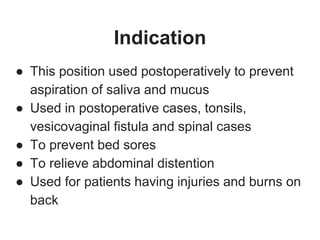
Indication
● This position used postoperatively to prevent
aspiration of saliva and mucus
● Used in postoperative cases, tonsils,
vesicovaginal fistula and spinal cases
● To prevent bed sores
● To relieve abdominal distention
● Used for patients having injuries and burns on
back
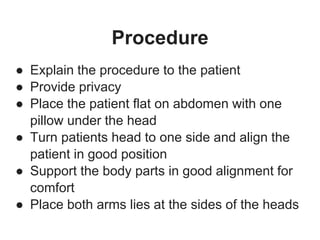
Procedure
● Explain the procedure to the patient
● Provide privacy
● Place the patient flat on abdomen with one
pillow under the head
● Turn patients head to one side and align the
patient in good position
● Support the body parts in good alignment for
comfort
● Place both arms lies at the sides of the heads
Contraindication
This position is not well tolerated by the elderly or
patient with cardiovascular or respiratory
problems
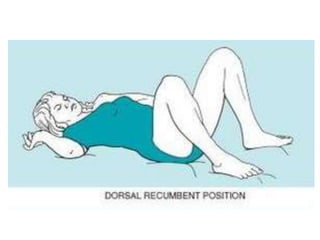
DORSAL RECUMBENT
POSITION
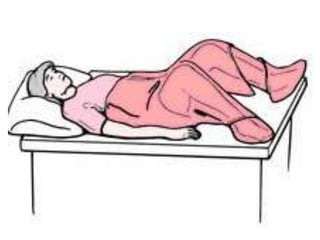
Patient lies on back, knees fully flexed, thighs
flexed and externally rotated feet flat on the bed.
Indication
● It is used for catheterization, vaginal douche,
vulval, vaginal and rectal examination
● It is also used for vaginal operations and
insertion of tampons
● Patients who are convalescent period
Contd…
● Patients with gastric conditions
● Patients with chest conditions
● Patients with abdominal or pelvic operations
unless erect sitting position is indicated
Procedure
● Place the patient on back in bed with two or
more pillows under the head and one pillow
under the knees or maintain his position by
elevating the top of bed on blocks.
Contd…
● Place the air ring under the hips and cotton
rings or foam pads under the heels to reduce
the pressure.
● Align the patient’s body in good position.
● Support the body parts in good alignment for
comfort when the patient is paralyzed.
FOWLER’S POSITION
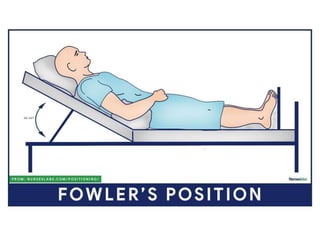
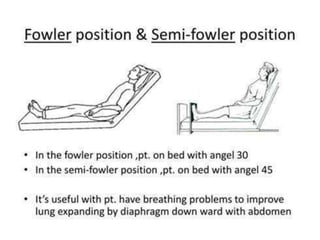
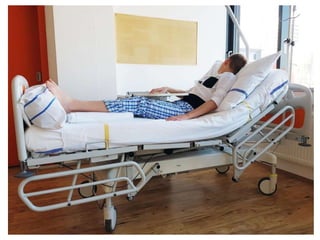
Fowler’s position is a sitting position in which the
head is elevated, at least, a 45 degree angle.
Back rest and two pillows are used for the back
and head. Fowler’s position the main weight
bearing areas of the patient are the heels,
sacrum and the posterior aspects of the ileum.
SEMI-FOWLER’S POSITION
The semi-fowler’s position is the position of a
patient who is lying in bed in a supine position
with the head of the bed at approximately 30 to
45 degrees.
Indications
● To relieve dyspnea
● To improve circulation
● To prevent thrombosis
● Postoperatively to assist drainage from
abdominal or pelvic cavity
Contd…
● To relax the muscles of the abdomen, back
and thighs
● To relieve tension on the abdominal sutures
● To promote comfort
● To localize infection, e.g. priorities
● To relieve edema of the chest and abdomen
Procedure
● Explain the procedure of the patient
● Arrange the articles needed at the bedside
● Provide privacy
● Place the patient in sitting position with arms
at the sides and knees raised with pillow
Contd…
● Maintain this position; elevate the head of bed
to an angle from 45-60 degree (semi-fowler) or
60-90 degree (high-fowler)
● Elevate the knee rest to an angle of 15 degree
or place a small pillow under the knees
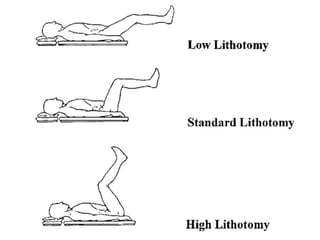
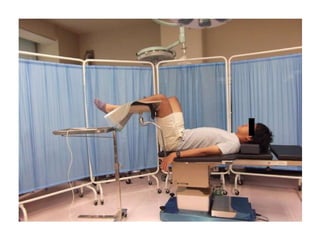
LITHOTOMY POSITION
The patient lies on her back. The legs are
separated and thighs are flexed on the abdomen
and the legs are on the thighs. The patient’s
buttocks are kept the edge of the table and legs
are supported by stirrups.
Indication
● This position is given during gynecological
examinations, treatments, and operations on
genitourinary system
● For delivery of baby
● For rectal examinations and operations
Procedure
● Explain the procedure to the patient
● Provide privacy
● Position the patient to lie on his back with
one pillow under the head
● Keep the legs well separated and the thighs
are well flexed on the abdomen and the legs
on the thighs
● Buttocks are kept on the edge of the table
and the legs are supported on stirrups
Contraindication
Contraindications of this position are, patients
with arthritis or joint deformity may be unable
assume this position
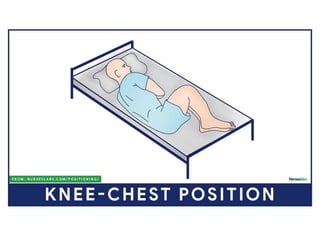
KNEE CHEST POSITION
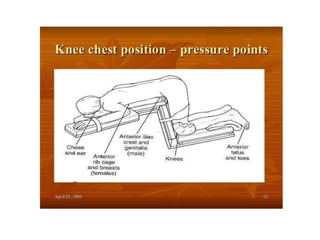
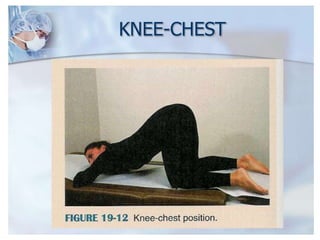
Patient rests on the knees and the chest. The
head is turned to one side with one check on a
pillow. A pillow is placed under the chest. The
weight is on the chest and knees.
ASSISTING THE PATIENT IN KNEE-CHEST
POSITION
A prone position in which the individual rests on
the knees and upper part of the chest, assumed
for gynecologic or rectal examination. It is also
called genupectoral position.
Indication
● This position is used for sigmoidoscopy
● Used for vaginal and rectal examination
● Used in first aid treatment in cord prolapse or
retroverted uterus
● As exercise for postpartum and gynecology
patients
Procedure
● Explain the procedure to the patient
● Collect the needed articles at the bedside
● Provide privacy
● Make the patient rests on the knees and chest
● The head is turned to one side with the cheek
on a pillow
Contd…
● The arms should be extended on the bed and
flexed at the elbows to support the patient
partially
● The weight should rest on the chest and knees
which are flexed so that the thighs are at right
angles to the legs
Contraindication
Patients with cardiovascular and respiratory
problems cannot assume this position
CARDIAC POSITION
The client is propped-up in a sitting position by
means of back rest and pillows. Place an over
bed table in front with a pillow on it. The client
has an air cushion to sit and a small pillow under
the knees.
TRENDELENBURG’S
POSITION
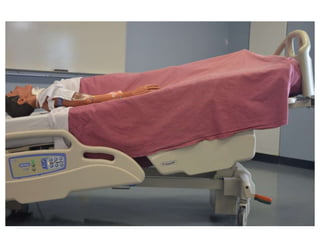
The patient lies on his back. The patient’s head is
low. The foot of the bed is elevated at 45 degree
angle. The body is on an inclined place and the
legs hang downward over the end of the table.
Indication
● Used in emergency situations like shock and
hemorrhage
● This position is used for vaginal surgeries
● Used to displace intestines from pelvic cavity
into upper abdomen
● Used during operations on the pelvic organs
● To arrest bleeding from lower limb
Procedure
● Explain the procedure to the patient
● Arrange the article need at the bedside
● Provide privacy (if needed)
● Place the patient lied on his back
● Elevate the foot end at 45 degree angle
Contd…
● The body is on an inclined place with hips
higher than the bed
● The knees are flexed
● The patient is carefully supported to prevent
slipping
● Draping done depends upon the kind of
operation to be performed
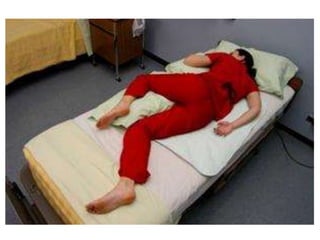
SIM’S POSITION
Sim’s position is similar to the lateral position
except that the patient’s weight is on the anterior
aspects of shoulder girdle and hip. The patient’s
lower arm is behind him and the upper arm is
flexed at the shoulder and elbow.
Indication
● This position is used for unconscious patient
● It is used for rectal examinations
● Used for vaginal examinations
● Used for relaxation in antenatal exercises
Procedure
● Explain the procedure to the patient
● Collect articles need at the bed side
● Provide privacy
● Place the patient on the side
● One pillow is placed under the head with the
left check resting on it
Contd…
● The left arm is drawn behind the body and the
right arm may be in any position comfortable
for the patient
● The right thigh is flexed against the abdomen
● The left leg is extended well
● Cover the patient with top sheet neatly
Contraindication
Patients with deformities of the hip or knee may
be unable to assume this position
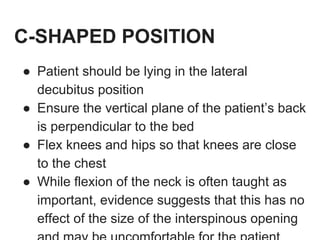
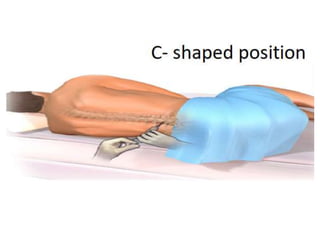
C-SHAPED POSITION
● Patient should be lying in the lateral
decubitus position
● Ensure the vertical plane of the patient’s back
is perpendicular to the bed
● Flex knees and hips so that knees are close
to the chest
● While flexion of the neck is often taught as
important, evidence suggests that this has no
effect of the size of the interspinous opening
TYPES OF PATIENTS NEED
SPECIAL CARE
● Unconscious patient
● Infant and children
● Hemiplegic and paraplegic position
● Immediate postoperative patients
● Orthopedic patients
● Cardiac patients
GENERAL INSTRUCTIONS
● Maintain good body alignment of the patient at
all times.
● Support body parts in good alignment by using
supportive devices to promote comfort and
prevent undue muscle strain.
Contd…
❖ Avoid prolonged flexion of any one body
segment by changing the position at least
every two hours.
❖ Reduce the pressure caused by body weight
of his or her body or object by changing the
position and using protective devices.
PRELIMINARY ASSESSMENT
● Check the patient’s general condition
● Check the physician’s order for any limited
movements
● Assess the self-care ability of an individual
● Arrange the comfort devices near the bedside
Contd…
● Identify the deformed extremity
● Support the immobilize area during positioning
● Identify the rationale before positioning
EQUIPMENT
● Extra man power if needed
● Extra pillows
● Sheets and sheet rolls
● Comfort devices such as back rest, cardiac
table, sand bag, etc
Procedure
● Explain the procedure to the patient
● Provide privacy
● Arrange the articles and manpower (if needed)
● Untie the bed sheets
● Turn/lift/ambulate gently
● Place and support with extra pillows under
pressure points
Contd…
● Special care taken at pressure areas
● Cover the patient with top sheet
● Hand wash
● Record the time, position and condition of the
skin
Contd…
● Positioning a patient in bed is important for
maintaining alignment and for preventing bed
sores (pressure ulcers), foot drop, and
contractures.
Proper positioning is also vital for providing
comfort for patients who are bedridden or
have decreased mobility related to a medical
condition or treatment.
Contd…
When positioning a patient in bed, supportive
devices such as pillows, rolls, and blankets,
along with repositioning, can aid in providing
comfort and safety.
Contd…
Good body alignment can be achieved in any of
the bed rest positions. The following points
should be checked.
● Head should be in midline with the trunk
● Back should be straight, with normal body
curves (cervical, thoracic, and lumbar)
maintained
Contd…
● Ribs should be elevated to prevent
constriction of the chest
● Arms and legs should be in a position of
function (the position for maximum
usefulness of the joints, feet and hands)
Contd…
Position of function of leg and feet. This position
favors standing upright and walking. In general, if
the toes point to the ceiling when in a back-lying
position and point to the floor when in a front-
lying position, the feet, legs, and hips are in good
alignment.
Contd…
Position of function of arms and hands. This
position favors raising arms and grasping things
with the fingers. The hand should not droop at
the wrist, be clenched in a fist, or be flat. The
position of function for the hand is dorsiflexion (at
a slight upward angle) at the wrist, with the
fingers and thumb in position to write with a
pencil.
END
REFERENCE
https://nurseinfo.in/patient-positioning