DIFFERENT
POSITION IN
NURSING CARE
PUBLISHED BY
JASMINE.J
POSITION
DEFINITION : Positioning is defined as planning the person in a proper body alignment for
the purpose of preventive, promotive, curative and rehabilitative aspects of health or placing
the patient in good body alignment as needed therapeutically.
PURPOSES „
 To promote comfort to the patient
 To relieve pressure on various parts
 To stimulate circulation
 To provide proper body alignment
 To carry out nursing intervention
 To perform surgical and medical interventions
 To prevent complications caused by immobility
 To promote normal physiological functions
PRINCIPLES
 Maintain good body mechanics
 Wash hands before and after procedure
 Ensure patient’s comfort
 Obtain assistance as required
 Ensure that mattress is firm and level of bed is at working hide
 Follow safety measures to prevent accidents
 Follow the systematic and orderly way of doing
 Use right technique at right time
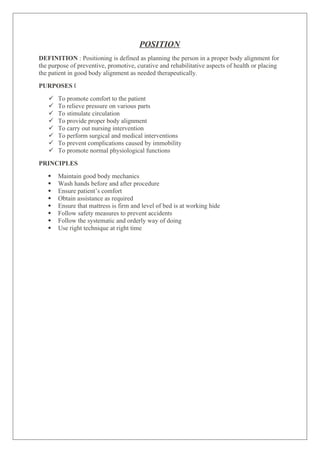
1.SUPINE POSITION
The patient lies on his back with his head and shoulders are slightly elevated
Indication:
 Usual position
 Examination of the chest and abdomen
PROCEDURE :
 Place the patient on back with one pillow under the head, arms and hands at the sides,
knees flexed and separated.
 Place the air ring under the hips and cotton or foam pads under the heels to reduce the
pressure.
 Place footboard under bottom of feet.
 If the patient is a paralyzed, place hand role in hand.
 Align the patient’s body in good position
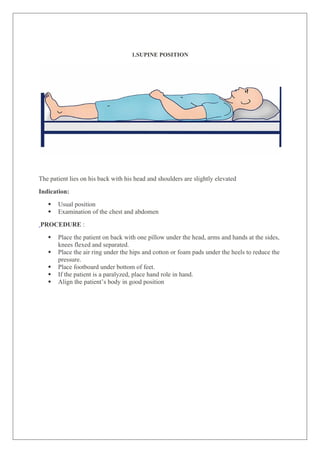
2. PRONE POSITION
Position in which the patient lies on the abdomen with the head turned to one side with one
small pillow under the ankle and abdomen.
Indications
 Post operatively
 Patient with pressure sores, burns, injuries and operations on the back.
 To relieve abdomen distension
 Renal biopsy.
 Examine the back
 For patients after 24 hours of amputation of lower limbs
PROCEDURE:
 Explain the procedure
 Provide privacy
 Place the patient flat on abdomen with one pillow under the head
 Turn patients head to one side and align the patient in good position
 Place both arms at the side of the head and support arm in flexed position at level of
shoulder.
 Support lower legs with pillows to elevate toes.
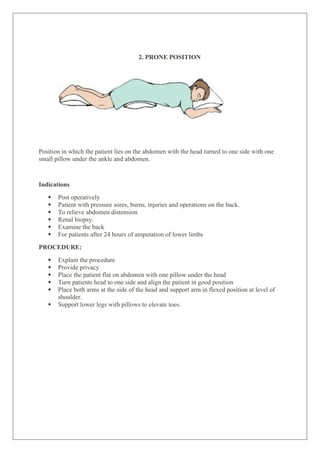
3. LATERAL POSITION
The client lies on the side with weight on hip and shoulder or the patient lies on his side with
both arms forward and his knees and hips flexed.
The upper leg is flexed more than the lower leg.
The upper knee and hip should be at the same level.
A pillow is given under the head, back and front to support the arms and abdomen.
A small pillow is given in between the knees.
INDICATIONS :
 Patients who requires periodic position changes
 In immediate post-operative patients
 Used for examination of perineum
 Inserting suppositories.
 For taking rectal temperature.
 Giving back care
 For giving enema and colonic irrigation.

PROCEDURE :
 Explain the procedure
 Provide privacy
 Lower the head of bed as low as patient can tolerate.
 position the patient to side of bed
 Turn the patient to one side
 Place the air ring under the hips to reduce pressure in trochanters and at the hip joints
 Position both arms in flexed position.
 Upper most arms are supported by pillow on level with shoulder.
 Place pillow under back
 Place pillow under semi flexed upper leg at hip, from groin to foot.
 Place sand bag parallel to plantar surface of dependent foot.
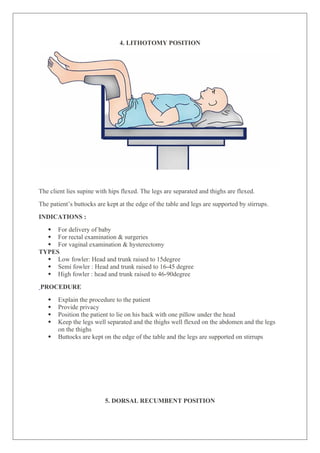
4. LITHOTOMY POSITION
The client lies supine with hips flexed. The legs are separated and thighs are flexed.
The patient’s buttocks are kept at the edge of the table and legs are supported by stirrups.
INDICATIONS :
 For delivery of baby
 For rectal examination & surgeries
 For vaginal examination & hysterectomy
TYPES
 Low fowler: Head and trunk raised to 15degree
 Semi fowler : Head and trunk raised to 16-45 degree
 High fowler : head and trunk raised to 46-90degree
PROCEDURE
 Explain the procedure to the patient
 Provide privacy
 Position the patient to lie on his back with one pillow under the head
 Keep the legs well separated and the thighs well flexed on the abdomen and the legs
on the thighs
 Buttocks are kept on the edge of the table and the legs are supported on stirrups
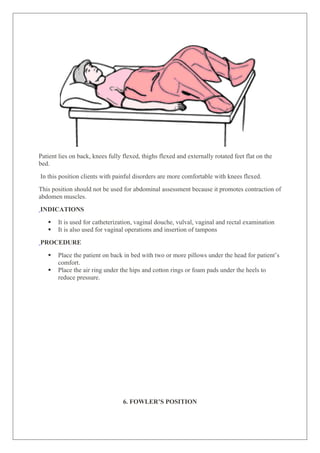
5. DORSAL RECUMBENT POSITION
Patient lies on back, knees fully flexed, thighs flexed and externally rotated feet flat on the
bed.
In this position clients with painful disorders are more comfortable with knees flexed.
This position should not be used for abdominal assessment because it promotes contraction of
abdomen muscles.
INDICATIONS
 It is used for catheterization, vaginal douche, vulval, vaginal and rectal examination
 It is also used for vaginal operations and insertion of tampons
PROCEDURE
 Place the patient on back in bed with two or more pillows under the head for patient’s
comfort.
 Place the air ring under the hips and cotton rings or foam pads under the heels to
reduce pressure.
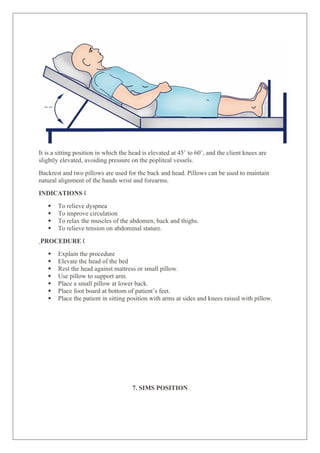
6. FOWLER’S POSITION
It is a sitting position in which the head is elevated at 45˚ to 60˚, and the client knees are
slightly elevated, avoiding pressure on the popliteal vessels.
Backrest and two pillows are used for the back and head. Pillows can be used to maintain
natural alignment of the hands wrist and forearms.
INDICATIONS „
 To relieve dyspnea
 To improve circulation
 To relax the muscles of the abdomen, back and thighs.
 To relieve tension on abdominal stature.
PROCEDURE „
 Explain the procedure
 Elevate the head of the bed
 Rest the head against mattress or small pillow.
 Use pillow to support arm.
 Place a small pillow at lower back.
 Place foot board at bottom of patient’s feet.
 Place the patient in sitting position with arms at sides and knees raised with pillow.
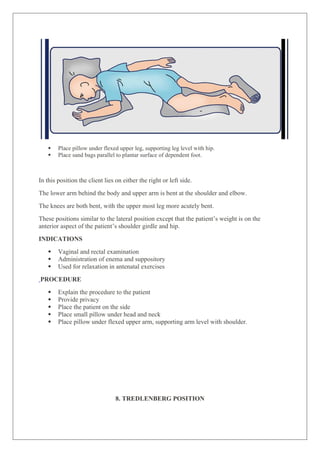
7. SIMS POSITION
 Place pillow under flexed upper leg, supporting leg level with hip.
 Place sand bags parallel to plantar surface of dependent foot.
In this position the client lies on either the right or left side.
The lower arm behind the body and upper arm is bent at the shoulder and elbow.
The knees are both bent, with the upper most leg more acutely bent.
These positions similar to the lateral position except that the patient’s weight is on the
anterior aspect of the patient’s shoulder girdle and hip.
INDICATIONS
 Vaginal and rectal examination
 Administration of enema and suppository
 Used for relaxation in antenatal exercises
PROCEDURE
 Explain the procedure to the patient
 Provide privacy
 Place the patient on the side
 Place small pillow under head and neck
 Place pillow under flexed upper arm, supporting arm level with shoulder.
8. TREDLENBERG POSITION
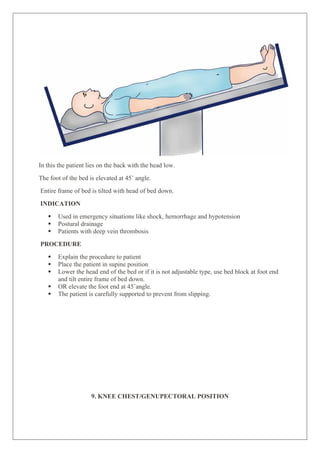
In this the patient lies on the back with the head low.
The foot of the bed is elevated at 45˚ angle.
Entire frame of bed is tilted with head of bed down.
INDICATION
 Used in emergency situations like shock, hemorrhage and hypotension
 Postural drainage
 Patients with deep vein thrombosis
PROCEDURE
 Explain the procedure to patient
 Place the patient in supine position
 Lower the head end of the bed or if it is not adjustable type, use bed block at foot end
and tilt entire frame of bed down.
 OR elevate the foot end at 45˚angle.
 The patient is carefully supported to prevent from slipping.
9. KNEE CHEST/GENUPECTORAL POSITION
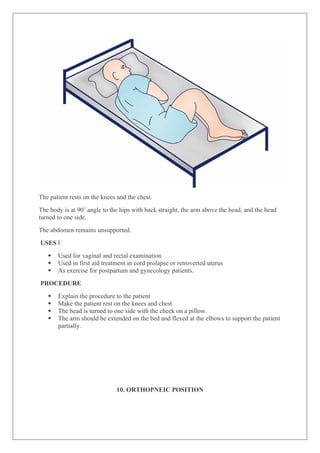
The patient rests on the knees and the chest.
The body is at 90˚ angle to the hips with back straight, the arm above the head, and the head
turned to one side.
The abdomen remains unsupported.
USES „
 Used for vaginal and rectal examination
 Used in first aid treatment in cord prolapse or retroverted uterus
 As exercise for postpartum and gynecology patients.
PROCEDURE
 Explain the procedure to the patient
 Make the patient rest on the knees and chest
 The head is turned to one side with the cheek on a pillow.
 The arm should be extended on the bed and flexed at the elbows to support the patient
partially.
10. ORTHOPNEIC POSITION
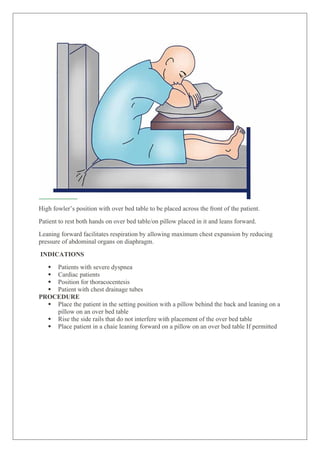
High fowler’s position with over bed table to be placed across the front of the patient.
Patient to rest both hands on over bed table/on pillow placed in it and leans forward.
Leaning forward facilitates respiration by allowing maximum chest expansion by reducing
pressure of abdominal organs on diaphragm.
INDICATIONS
 Patients with severe dyspnea
 Cardiac patients
 Position for thoracocentesis
 Patient with chest drainage tubes
PROCEDURE
 Place the patient in the setting position with a pillow behind the back and leaning on a
pillow on an over bed table
 Rise the side rails that do not interfere with placement of the over bed table
 Place patient in a chaie leaning forward on a pillow on an over bed table If permitted
DIFFERENT POSITION IN NURSING CARE .docx

DIFFERENT POSITION IN NURSING CARE .docx

  • 1.
  • 2.
    POSITION DEFINITION : Positioningis defined as planning the person in a proper body alignment for the purpose of preventive, promotive, curative and rehabilitative aspects of health or placing the patient in good body alignment as needed therapeutically. PURPOSES „  To promote comfort to the patient  To relieve pressure on various parts  To stimulate circulation  To provide proper body alignment  To carry out nursing intervention  To perform surgical and medical interventions  To prevent complications caused by immobility  To promote normal physiological functions PRINCIPLES  Maintain good body mechanics  Wash hands before and after procedure  Ensure patient’s comfort  Obtain assistance as required  Ensure that mattress is firm and level of bed is at working hide  Follow safety measures to prevent accidents  Follow the systematic and orderly way of doing  Use right technique at right time
  • 3.
    1.SUPINE POSITION The patientlies on his back with his head and shoulders are slightly elevated Indication:  Usual position  Examination of the chest and abdomen PROCEDURE :  Place the patient on back with one pillow under the head, arms and hands at the sides, knees flexed and separated.  Place the air ring under the hips and cotton or foam pads under the heels to reduce the pressure.  Place footboard under bottom of feet.  If the patient is a paralyzed, place hand role in hand.  Align the patient’s body in good position
  • 4.
    2. PRONE POSITION Positionin which the patient lies on the abdomen with the head turned to one side with one small pillow under the ankle and abdomen. Indications  Post operatively  Patient with pressure sores, burns, injuries and operations on the back.  To relieve abdomen distension  Renal biopsy.  Examine the back  For patients after 24 hours of amputation of lower limbs PROCEDURE:  Explain the procedure  Provide privacy  Place the patient flat on abdomen with one pillow under the head  Turn patients head to one side and align the patient in good position  Place both arms at the side of the head and support arm in flexed position at level of shoulder.  Support lower legs with pillows to elevate toes.
  • 5.
    3. LATERAL POSITION Theclient lies on the side with weight on hip and shoulder or the patient lies on his side with both arms forward and his knees and hips flexed. The upper leg is flexed more than the lower leg. The upper knee and hip should be at the same level. A pillow is given under the head, back and front to support the arms and abdomen. A small pillow is given in between the knees. INDICATIONS :  Patients who requires periodic position changes  In immediate post-operative patients  Used for examination of perineum  Inserting suppositories.  For taking rectal temperature.  Giving back care  For giving enema and colonic irrigation.  PROCEDURE :  Explain the procedure  Provide privacy  Lower the head of bed as low as patient can tolerate.  position the patient to side of bed  Turn the patient to one side  Place the air ring under the hips to reduce pressure in trochanters and at the hip joints  Position both arms in flexed position.  Upper most arms are supported by pillow on level with shoulder.  Place pillow under back  Place pillow under semi flexed upper leg at hip, from groin to foot.  Place sand bag parallel to plantar surface of dependent foot.
  • 6.
    4. LITHOTOMY POSITION Theclient lies supine with hips flexed. The legs are separated and thighs are flexed. The patient’s buttocks are kept at the edge of the table and legs are supported by stirrups. INDICATIONS :  For delivery of baby  For rectal examination & surgeries  For vaginal examination & hysterectomy TYPES  Low fowler: Head and trunk raised to 15degree  Semi fowler : Head and trunk raised to 16-45 degree  High fowler : head and trunk raised to 46-90degree PROCEDURE  Explain the procedure to the patient  Provide privacy  Position the patient to lie on his back with one pillow under the head  Keep the legs well separated and the thighs well flexed on the abdomen and the legs on the thighs  Buttocks are kept on the edge of the table and the legs are supported on stirrups 5. DORSAL RECUMBENT POSITION
  • 7.
    Patient lies onback, knees fully flexed, thighs flexed and externally rotated feet flat on the bed. In this position clients with painful disorders are more comfortable with knees flexed. This position should not be used for abdominal assessment because it promotes contraction of abdomen muscles. INDICATIONS  It is used for catheterization, vaginal douche, vulval, vaginal and rectal examination  It is also used for vaginal operations and insertion of tampons PROCEDURE  Place the patient on back in bed with two or more pillows under the head for patient’s comfort.  Place the air ring under the hips and cotton rings or foam pads under the heels to reduce pressure. 6. FOWLER’S POSITION
  • 8.
    It is asitting position in which the head is elevated at 45˚ to 60˚, and the client knees are slightly elevated, avoiding pressure on the popliteal vessels. Backrest and two pillows are used for the back and head. Pillows can be used to maintain natural alignment of the hands wrist and forearms. INDICATIONS „  To relieve dyspnea  To improve circulation  To relax the muscles of the abdomen, back and thighs.  To relieve tension on abdominal stature. PROCEDURE „  Explain the procedure  Elevate the head of the bed  Rest the head against mattress or small pillow.  Use pillow to support arm.  Place a small pillow at lower back.  Place foot board at bottom of patient’s feet.  Place the patient in sitting position with arms at sides and knees raised with pillow. 7. SIMS POSITION
  • 9.
     Place pillowunder flexed upper leg, supporting leg level with hip.  Place sand bags parallel to plantar surface of dependent foot. In this position the client lies on either the right or left side. The lower arm behind the body and upper arm is bent at the shoulder and elbow. The knees are both bent, with the upper most leg more acutely bent. These positions similar to the lateral position except that the patient’s weight is on the anterior aspect of the patient’s shoulder girdle and hip. INDICATIONS  Vaginal and rectal examination  Administration of enema and suppository  Used for relaxation in antenatal exercises PROCEDURE  Explain the procedure to the patient  Provide privacy  Place the patient on the side  Place small pillow under head and neck  Place pillow under flexed upper arm, supporting arm level with shoulder. 8. TREDLENBERG POSITION
  • 10.
    In this thepatient lies on the back with the head low. The foot of the bed is elevated at 45˚ angle. Entire frame of bed is tilted with head of bed down. INDICATION  Used in emergency situations like shock, hemorrhage and hypotension  Postural drainage  Patients with deep vein thrombosis PROCEDURE  Explain the procedure to patient  Place the patient in supine position  Lower the head end of the bed or if it is not adjustable type, use bed block at foot end and tilt entire frame of bed down.  OR elevate the foot end at 45˚angle.  The patient is carefully supported to prevent from slipping. 9. KNEE CHEST/GENUPECTORAL POSITION
  • 11.
    The patient restson the knees and the chest. The body is at 90˚ angle to the hips with back straight, the arm above the head, and the head turned to one side. The abdomen remains unsupported. USES „  Used for vaginal and rectal examination  Used in first aid treatment in cord prolapse or retroverted uterus  As exercise for postpartum and gynecology patients. PROCEDURE  Explain the procedure to the patient  Make the patient rest on the knees and chest  The head is turned to one side with the cheek on a pillow.  The arm should be extended on the bed and flexed at the elbows to support the patient partially. 10. ORTHOPNEIC POSITION
  • 12.
    High fowler’s positionwith over bed table to be placed across the front of the patient. Patient to rest both hands on over bed table/on pillow placed in it and leans forward. Leaning forward facilitates respiration by allowing maximum chest expansion by reducing pressure of abdominal organs on diaphragm. INDICATIONS  Patients with severe dyspnea  Cardiac patients  Position for thoracocentesis  Patient with chest drainage tubes PROCEDURE  Place the patient in the setting position with a pillow behind the back and leaning on a pillow on an over bed table  Rise the side rails that do not interfere with placement of the over bed table  Place patient in a chaie leaning forward on a pillow on an over bed table If permitted