Positioning…
By –
Shakti Singh (M.Sc. Nursing)
Sr. Nursing Educator
SMVDNSH JK
Mob. 97827-55166
Positioning…
Patient Position Should
Be Changed Every 2nd Hourly
Left Lateral
Supine
Left Lateral
12
Right Lateral
Supine
Right Lateral
10
08
06
04
02
Definition…
 Positioning defined as placing the person in such a way to perform therapeutic
intervention to promote the health of an individual.
 Placing the person in a proper body alignment for the purpose of preventive,
promotvie, curative and rehabilitative aspect of health.
Purpose…
 To provide comfort to the patient
 To relieve pressure on various aspects
 To improve circulation
 To prevent formation of deformity
 To carry out investigations
 To perform surgical and medical investigations
 To prevent pressure sores
 To provide proper body alignment
 To conduct delivery / labor
 To carryout nursing interventions
Principles…
 Maintain good body mechanics
 Obtain assistance as required
 Ensure the mattress is firm and level of bed is at working height
 Ensure that sheets are clean and dry
 Avoid placing a body part directly over another to prevent pressure
 Plan a regular position changes schedule for the patient for 24 hours
 Ensure patient comfort
 Wash hands before and after procedure
General instructions…
 Maintain good body alignment of the patient at all the times
 Support body parts in good alignment by using supportive devices
 Avoid prolonged flexion of any one body segment by changing the position at
least every two hours
 Reduce the pressure by body weight
Preliminary assessment…
 Check
 Patients general conditions
 Physician order
 Assess self care ability
 Arrange the comfort devices near the bed side
 Identify the deformed extremity (support the immobilize area during positioning)
 Identify the rationale before positioning
Equipment…
 Extra man power if needed
 Extra pillows
 Mattresses
 Adjustable bed
 Bed side rails
 Trapeze bar
 Sheets and sheets rolls
 Comfort devices such as back rest, foot rest, bed cradle, cardiac table, sand bags,
hand rolls etc.
Procedure…
 Explain the procedure to the patients
 Provide privacy
 Arrange the articles and manpower
 Unite the bed sheet
 Turn/lift/ambulate gently
 Place and support with extra pillows under pressure points
 Special care taken at pressure areas
 Cover the patient with top sheet
 Hand washing
 Record the time, position and condition of the skin
Types of positions…
 Fowler’s position
 High Fowler’s position
 Supine position
 Prone position
 Lithotomy position
 Sim’s position
 Lateral position
 Trendelenburg position
 Reverse Trendelenburg position
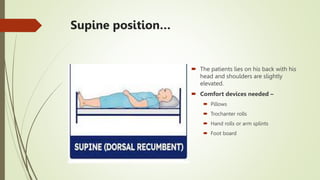
Supine position…
 The patients lies on his back with his
head and shoulders are slightly
elevated.
 Comfort devices needed –
 Pillows
 Trochanter rolls
 Hand rolls or arm splints
 Foot board
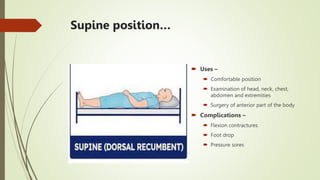
Supine position…
 Uses –
 Comfortable position
 Examination of head, neck, chest,
abdomen and extremities
 Surgery of anterior part of the body
 Complications –
 Flexion contractures
 Foot drop
 Pressure sores
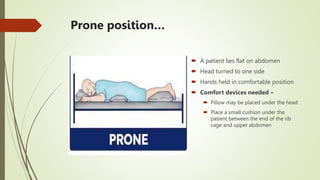
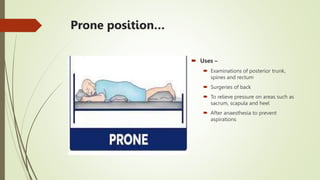
Prone position…
 A patient lies flat on abdomen
 Head turned to one side
 Hands held in comfortable position
 Comfort devices needed –
 Pillow may be placed under the head
 Place a small cushion under the
patient between the end of the rib
cage and upper abdomen
Prone position…
 Uses –
 Examinations of posterior trunk,
spines and rectum
 Surgeries of back
 To relieve pressure on areas such as
sacrum, scapula and heel
 After anaesthesia to prevent
aspirations
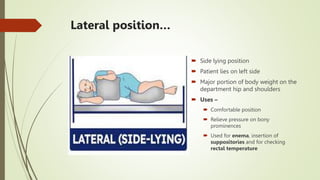
Lateral position…
 Side lying position
 Patient lies on left side
 Major portion of body weight on the
department hip and shoulders
 Uses –
 Comfortable position
 Relieve pressure on bony
prominences
 Used for enema, insertion of
suppositories and for checking
rectal temperature
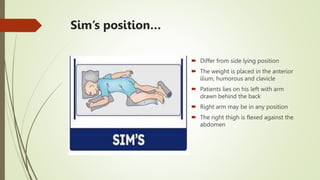
Sim’s position…
 Differ from side lying position
 The weight is placed in the anterior
ilium, humorous and clavicle
 Patients lies on his left with arm
drawn behind the back
 Right arm may be in any position
 The right thigh is flexed against the
abdomen
Sim’s position…
 Comfort devices –
 Pillow under the head with left check
resting on it
 Place pillow under the upper flexed
leg from the groin to the foot
 Uses –
 Vaginal and rectal examination
 To relieve pressure in the buttocks,
scapula and heels
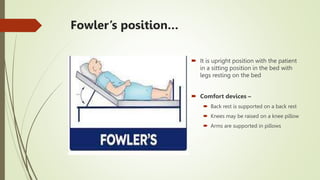
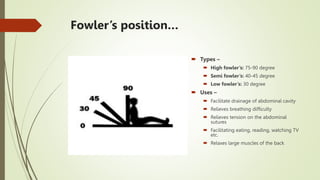
Fowler’s position…
 It is upright position with the patient
in a sitting position in the bed with
legs resting on the bed
 Comfort devices –
 Back rest is supported on a back rest
 Knees may be raised on a knee pillow
 Arms are supported in pillows
Fowler’s position…
 Types –
 High fowler’s: 75-90 degree
 Semi fowler’s: 40-45 degree
 Low fowler’s: 30 degree
 Uses –
 Facilitate drainage of abdominal cavity
 Relieves breathing difficulty
 Relieves tension on the abdominal
sutures
 Facilitating eating, reading, watching TV
etc.
 Relaxes large muscles of the back
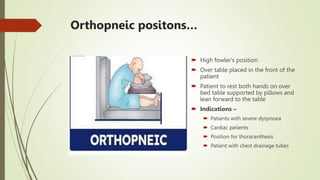
Orthopneic positons…
 High fowler's position
 Over table placed in the front of the
patient
 Patient to rest both hands on over
bed table supported by pillows and
lean forward to the table
 Indications –
 Patients with severe dyspnoea
 Cardiac patients
 Position for thoracenthesis
 Patient with chest drainage tubes
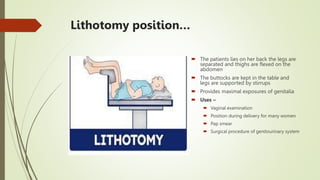
 The patients lies on her back the legs are
separated and thighs are flexed on the
abdomen
 The buttocks are kept in the table and
legs are supported by stirrups
 Provides maximal exposures of genitalia
 Uses –
 Vaginal examination
 Position during delivery for many women
 Pap smear
 Surgical procedure of genitourinary system
Lithotomy position…
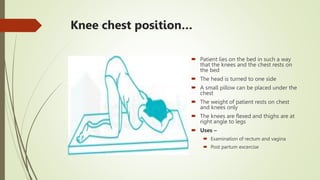
Knee chest position…
 Patient lies on the bed in such a way
that the knees and the chest rests on
the bed
 The head is turned to one side
 A small pillow can be placed under the
chest
 The weight of patient rests on chest
and knees only
 The knees are flexed and thighs are at
right angle to legs
 Uses –
 Examination of rectum and vagina
 Post partum excercise
Trendelenburg's position…
 Head of the bed is lowered and the
foot raised in a straight incline
 Patient lies on his back
 Beds are available with electric control
system
 Revers Trendelenburg's position:
Head end of the bed is raised
 Uses –
 Promote venous circulation and venous
rectum with poor peripheral perfusion
 Postural drainage
 In OT examination and surgery in the
pelvic organs
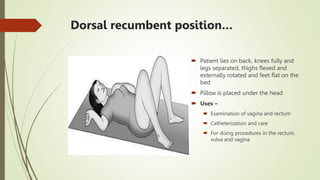
Dorsal recumbent position…
 Patient lies on back, knees fully and
legs separated, thighs flexed and
externally rotated and feet flat on the
bed
 Pillow is placed under the head
 Uses –
 Examination of vagina and rectum
 Catheterization and care
 For doing procedures in the rectum,
vulva and vagina
Always welcome yours
suggestions…
Regards!!!
Team Education
SMVDNSH JK
+91-97827-55166
educationdailyreports@g
mail.com