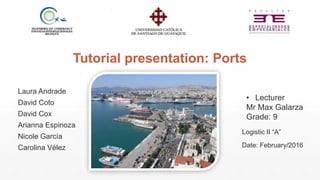
Tutorial presentation: Ports
Laura Andrade
David Coto
David Cox
Arianna Espinoza
Nicole García
Carolina Vélez
Logistic II “A”
Date: February/2016
• Lecturer
Mr Max Galarza
Grade: 9
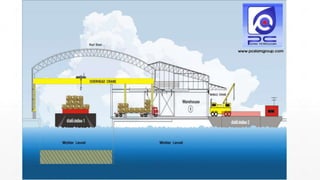
Ports as place
A port (or seaport) is a place at which the transfer of cargo and
passengers to and from waterways and shores occurs.
The transfers are made to and from vessels.
Port is a place equipped to facilitate the necessary relation
between ships and the land.
Talley, Port Economics.
“Maritime Policy & Management.”
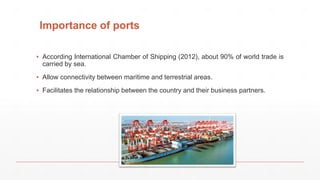
Importance of ports
▪ According International Chamber of Shipping (2012), about 90% of world trade is
carried by sea.
▪ Allow connectivity between maritime and terrestrial areas.
▪ Facilitates the relationship between the country and their business partners.
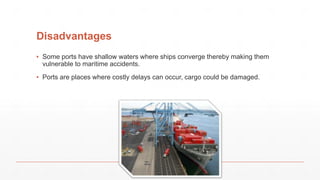
Disadvantages
▪ Some ports have shallow waters where ships converge thereby making them
vulnerable to maritime accidents.
▪ Ports are places where costly delays can occur, cargo could be damaged.
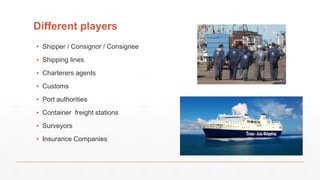
Different players
▪ Shipper / Consignor / Consignee
▪ Shipping lines
▪ Charterers agents
▪ Customs
▪ Port authorities
▪ Container freight stations
▪ Surveyors
▪ Insurance Companies
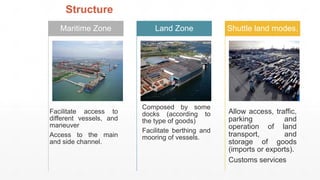
Structure
Facilitate access to
different vessels, and
maneuver
Access to the main
and side channel.
Maritime Zone
Composed by some
docks (according to
the type of goods)
Facilitate berthing and
mooring of vessels.
Land Zone
Allow access, traffic,
parking and
operation of land
transport, and
storage of goods
(imports or exports).
Customs services
Shuttle land modes.
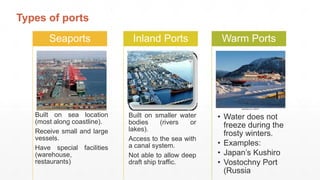
Types of ports
Built on sea location
(most along coastline).
Receive small and large
vessels.
Have special facilities
(warehouse,
restaurants)
Seaports
Built on smaller water
bodies (rivers or
lakes).
Access to the sea with
a canal system.
Not able to allow deep
draft ship traffic.
Inland Ports
• Water does not
freeze during the
frosty winters.
• Examples:
• Japan’s Kushiro
• Vostochny Port
(Russia
Warm Ports
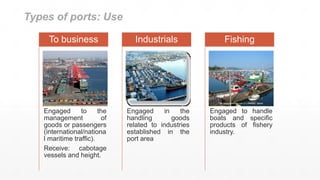
Types of ports: Use
Engaged to the
management of
goods or passengers
(international/nationa
l maritime traffic).
Receive: cabotage
vessels and height.
To business
Engaged in the
handling goods
related to industries
established in the
port area
Industrials
Engaged to handle
boats and specific
products of fishery
industry.
Fishing
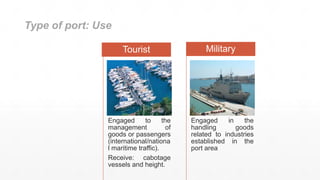
Type of port: Use
Engaged to the
management of
goods or passengers
(international/nationa
l maritime traffic).
Receive: cabotage
vessels and height.
Tourist
Engaged in the
handling goods
related to industries
established in the
port area
Military
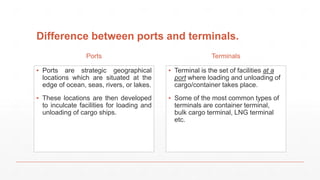
Ports
▪ Ports are strategic geographical
locations which are situated at the
edge of ocean, seas, rivers, or lakes.
▪ These locations are then developed
to inculcate facilities for loading and
unloading of cargo ships.
Terminals
▪ Terminal is the set of facilities at a
port where loading and unloading of
cargo/container takes place.
▪ Some of the most common types of
terminals are container terminal,
bulk cargo terminal, LNG terminal
etc.
Difference between ports and terminals.
Ports
Supply
chain
&
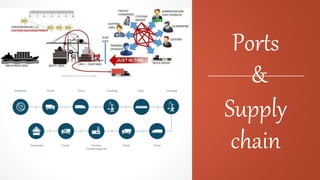
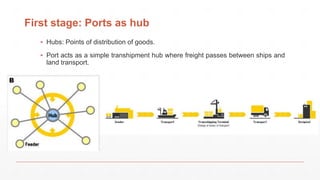
First stage: Ports as hub
▪ Hubs: Points of distribution of goods.
▪ Port acts as a simple transhipment hub where freight passes between ships and
land transport.
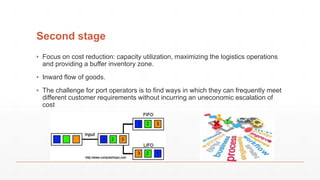
Second stage
▪ Focus on cost reduction: capacity utilization, maximizing the logistics operations
and providing a buffer inventory zone.
▪ Inward flow of goods.
▪ The challenge for port operators is to find ways in which they can frequently meet
different customer requirements without incurring an uneconomic escalation of
cost
Third stage: Broader logistics zone
▪ The port transport system streamlines the port logistics activities from shippers to
consignees and vice-versa.
▪ Integrated intermodal transport systems: the ocean voyage, the transit through
the port, and hinterland transport.
▪ Adoption of the Just-InTime (JIT) concept is a measure for internal integration
towards a lean and agile port environment.
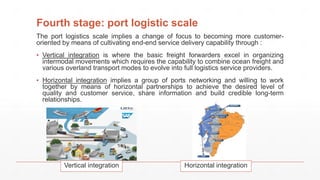
Fourth stage: port logistic scale
The port logistics scale implies a change of focus to becoming more customer-
oriented by means of cultivating end-end service delivery capability through :
▪ Vertical integration is where the basic freight forwarders excel in organizing
intermodal movements which requires the capability to combine ocean freight and
various overland transport modes to evolve into full logistics service providers.
▪ Horizontal integration implies a group of ports networking and willing to work
together by means of horizontal partnerships to achieve the desired level of
quality and customer service, share information and build credible long-term
relationships.
Vertical integration Horizontal integration
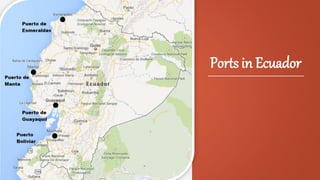
Ports in Ecuador
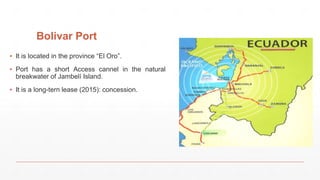
Bolivar Port
▪ It is located in the province “El Oro”.
▪ Port has a short Access cannel in the natural
breakwater of Jambelí Island.
▪ It is a long-tern lease (2015): concession.
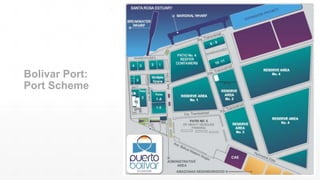
Bolivar Port:
Port Scheme
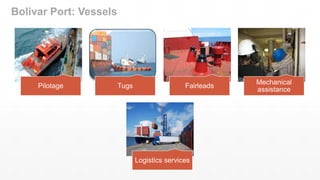
Bolivar Port: Vessels
Pilotage Tugs Fairleads
Mechanical
assistance
Logistics services
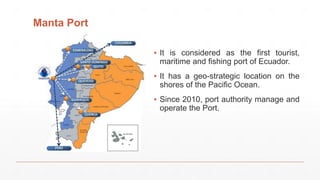
Manta Port
▪ It is considered as the first tourist,
maritime and fishing port of Ecuador.
▪ It has a geo-strategic location on the
shores of the Pacific Ocean.
▪ Since 2010, port authority manage and
operate the Port.
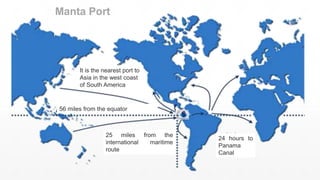
It is the nearest port to
Asia in the west coast
of South America
56 miles from the equator
25 miles from the
international maritime
route
24 hours to
Panama
Canal
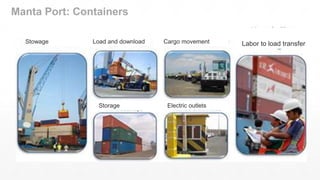
Manta Port
Stowage Load and download Cargo movement Labor to load transfer
Storage Electric outlets
Manta Port: Containers
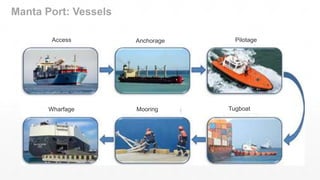
Manta Port: Vessels
Access Anchorage Pilotage
TugboatMooringWharfage
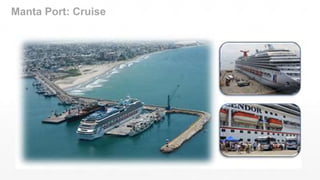
Manta Port: Cruise
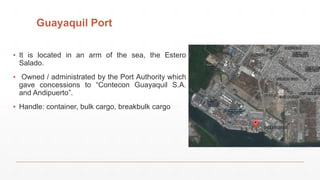
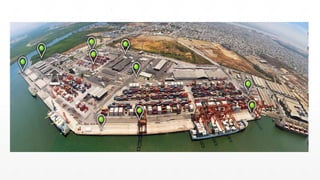
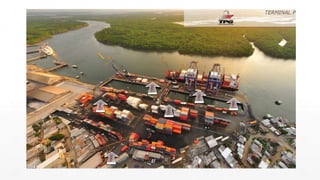
Guayaquil Port
▪ It is located in an arm of the sea, the Estero
Salado.
▪ Owned / administrated by the Port Authority which
gave concessions to “Contecon Guayaquil S.A.
and Andipuerto”.
▪ Handle: container, bulk cargo, breakbulk cargo
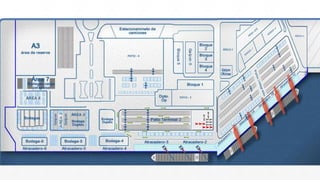
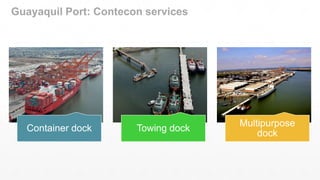
Guayaquil Port: Contecon services
Container dock Towing dock
Multipurpose
dock
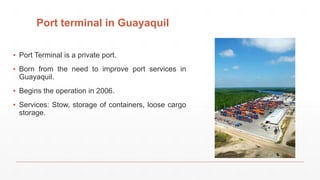
Port terminal in Guayaquil
▪ Port Terminal is a private port.
▪ Born from the need to improve port services in
Guayaquil.
▪ Begins the operation in 2006.
▪ Services: Stow, storage of containers, loose cargo
storage.
Port concessions
▪ Delegation to private initiative
▪ Granting the right to a private company to occupy and exploit
▪ Port, land or aquatic areas
▪ More than 5 years
▪ Rehabilitate, improve and / or expand
▪ Provide services
CILTEC. (2012). Puertos marítimos | Trade and Logistics Innovaction Center. Retrieved January 16, 2016,
from http://www.ciltec.com.mx/es/infraestructura-logistica/puertos-maritimos
DGPM. (n.d.). Definición y clasificación de puertos. Retrieved from
http://www.puertoensenada.com.mx/upl/sec/Capitulo_02_Definicion_y_Clasificacion.pdf
Fundación Valencia. Valencia Port. Retrieved from https://www.youtube.com/watch?v=9DO-0Lpd8CA
Puerto de Manta. Instalacaciones del Puerto Retrieved from http://www.puertodemanta.gob.ec/quienes-
somos/instalaciones
Radhika. The new role of seaports as integral parts of global supply chains. Retrieved from
http://zenithresearch.org.in/images/stories/pdf/2012/April/EIJMMS/11_EIJMMS_VOL2_ISSUE4.pdf
Robinson, R. (2010). Maritime policy & Management. Retrieved from
http://dx.doi.org/10.1080/03088830210132623
Rúa, C. (2006). Los puertos en el transporte marítimo. Retrieved from
https://upcommons.upc.edu/bitstream/handle/2117/289/8.%20Rua.pdf?sequence=1
Talley, W. (2009). Port Economics. Retrieved from http://www.univpgri-palembang.ac.id/perpus-
fkip/Perpustakaan/Geography/Geografi%20manusia/Ekonomi%20Pelabuhan.pdf
Sources

Ports Tutory

  • 1.
    Tutorial presentation: Ports LauraAndrade David Coto David Cox Arianna Espinoza Nicole García Carolina Vélez Logistic II “A” Date: February/2016 • Lecturer Mr Max Galarza Grade: 9
  • 2.
    Ports as place Aport (or seaport) is a place at which the transfer of cargo and passengers to and from waterways and shores occurs. The transfers are made to and from vessels. Port is a place equipped to facilitate the necessary relation between ships and the land. Talley, Port Economics. “Maritime Policy & Management.”
  • 3.
    Importance of ports ▪According International Chamber of Shipping (2012), about 90% of world trade is carried by sea. ▪ Allow connectivity between maritime and terrestrial areas. ▪ Facilitates the relationship between the country and their business partners.
  • 4.
    Disadvantages ▪ Some portshave shallow waters where ships converge thereby making them vulnerable to maritime accidents. ▪ Ports are places where costly delays can occur, cargo could be damaged.
  • 5.
    Different players ▪ Shipper/ Consignor / Consignee ▪ Shipping lines ▪ Charterers agents ▪ Customs ▪ Port authorities ▪ Container freight stations ▪ Surveyors ▪ Insurance Companies
  • 6.
    Structure Facilitate access to differentvessels, and maneuver Access to the main and side channel. Maritime Zone Composed by some docks (according to the type of goods) Facilitate berthing and mooring of vessels. Land Zone Allow access, traffic, parking and operation of land transport, and storage of goods (imports or exports). Customs services Shuttle land modes.
  • 8.
    Types of ports Builton sea location (most along coastline). Receive small and large vessels. Have special facilities (warehouse, restaurants) Seaports Built on smaller water bodies (rivers or lakes). Access to the sea with a canal system. Not able to allow deep draft ship traffic. Inland Ports • Water does not freeze during the frosty winters. • Examples: • Japan’s Kushiro • Vostochny Port (Russia Warm Ports
  • 9.
    Types of ports:Use Engaged to the management of goods or passengers (international/nationa l maritime traffic). Receive: cabotage vessels and height. To business Engaged in the handling goods related to industries established in the port area Industrials Engaged to handle boats and specific products of fishery industry. Fishing
  • 10.
    Type of port:Use Engaged to the management of goods or passengers (international/nationa l maritime traffic). Receive: cabotage vessels and height. Tourist Engaged in the handling goods related to industries established in the port area Military
  • 11.
    Ports ▪ Ports arestrategic geographical locations which are situated at the edge of ocean, seas, rivers, or lakes. ▪ These locations are then developed to inculcate facilities for loading and unloading of cargo ships. Terminals ▪ Terminal is the set of facilities at a port where loading and unloading of cargo/container takes place. ▪ Some of the most common types of terminals are container terminal, bulk cargo terminal, LNG terminal etc. Difference between ports and terminals.
  • 12.
  • 13.
    First stage: Portsas hub ▪ Hubs: Points of distribution of goods. ▪ Port acts as a simple transhipment hub where freight passes between ships and land transport.
  • 14.
    Second stage ▪ Focuson cost reduction: capacity utilization, maximizing the logistics operations and providing a buffer inventory zone. ▪ Inward flow of goods. ▪ The challenge for port operators is to find ways in which they can frequently meet different customer requirements without incurring an uneconomic escalation of cost
  • 15.
    Third stage: Broaderlogistics zone ▪ The port transport system streamlines the port logistics activities from shippers to consignees and vice-versa. ▪ Integrated intermodal transport systems: the ocean voyage, the transit through the port, and hinterland transport. ▪ Adoption of the Just-InTime (JIT) concept is a measure for internal integration towards a lean and agile port environment.
  • 16.
    Fourth stage: portlogistic scale The port logistics scale implies a change of focus to becoming more customer- oriented by means of cultivating end-end service delivery capability through : ▪ Vertical integration is where the basic freight forwarders excel in organizing intermodal movements which requires the capability to combine ocean freight and various overland transport modes to evolve into full logistics service providers. ▪ Horizontal integration implies a group of ports networking and willing to work together by means of horizontal partnerships to achieve the desired level of quality and customer service, share information and build credible long-term relationships. Vertical integration Horizontal integration
  • 17.
  • 18.
    Bolivar Port ▪ Itis located in the province “El Oro”. ▪ Port has a short Access cannel in the natural breakwater of Jambelí Island. ▪ It is a long-tern lease (2015): concession.
  • 19.
  • 20.
    Bolivar Port: Vessels PilotageTugs Fairleads Mechanical assistance Logistics services
  • 21.
    Manta Port ▪ Itis considered as the first tourist, maritime and fishing port of Ecuador. ▪ It has a geo-strategic location on the shores of the Pacific Ocean. ▪ Since 2010, port authority manage and operate the Port.
  • 22.
    It is thenearest port to Asia in the west coast of South America 56 miles from the equator 25 miles from the international maritime route 24 hours to Panama Canal Manta Port
  • 23.
    Stowage Load anddownload Cargo movement Labor to load transfer Storage Electric outlets Manta Port: Containers
  • 24.
    Manta Port: Vessels AccessAnchorage Pilotage TugboatMooringWharfage
  • 25.
  • 26.
    Guayaquil Port ▪ Itis located in an arm of the sea, the Estero Salado. ▪ Owned / administrated by the Port Authority which gave concessions to “Contecon Guayaquil S.A. and Andipuerto”. ▪ Handle: container, bulk cargo, breakbulk cargo
  • 29.
    Guayaquil Port: Conteconservices Container dock Towing dock Multipurpose dock
  • 30.
    Port terminal inGuayaquil ▪ Port Terminal is a private port. ▪ Born from the need to improve port services in Guayaquil. ▪ Begins the operation in 2006. ▪ Services: Stow, storage of containers, loose cargo storage.
  • 32.
    Port concessions ▪ Delegationto private initiative ▪ Granting the right to a private company to occupy and exploit ▪ Port, land or aquatic areas ▪ More than 5 years ▪ Rehabilitate, improve and / or expand ▪ Provide services
  • 34.
    CILTEC. (2012). Puertosmarítimos | Trade and Logistics Innovaction Center. Retrieved January 16, 2016, from http://www.ciltec.com.mx/es/infraestructura-logistica/puertos-maritimos DGPM. (n.d.). Definición y clasificación de puertos. Retrieved from http://www.puertoensenada.com.mx/upl/sec/Capitulo_02_Definicion_y_Clasificacion.pdf Fundación Valencia. Valencia Port. Retrieved from https://www.youtube.com/watch?v=9DO-0Lpd8CA Puerto de Manta. Instalacaciones del Puerto Retrieved from http://www.puertodemanta.gob.ec/quienes- somos/instalaciones Radhika. The new role of seaports as integral parts of global supply chains. Retrieved from http://zenithresearch.org.in/images/stories/pdf/2012/April/EIJMMS/11_EIJMMS_VOL2_ISSUE4.pdf Robinson, R. (2010). Maritime policy & Management. Retrieved from http://dx.doi.org/10.1080/03088830210132623 Rúa, C. (2006). Los puertos en el transporte marítimo. Retrieved from https://upcommons.upc.edu/bitstream/handle/2117/289/8.%20Rua.pdf?sequence=1 Talley, W. (2009). Port Economics. Retrieved from http://www.univpgri-palembang.ac.id/perpus- fkip/Perpustakaan/Geography/Geografi%20manusia/Ekonomi%20Pelabuhan.pdf Sources