
Janella Mae C. Torres 
IV - Newton 
DEVELOPMENT OF 
TRANSPORTATION IN 
THE WORLD
What is Transportation? 
 is the transfer of an item from one 
place to another (any types of matter 
or energy) 
 is the act of moving something from 
one place to another
Importance of 
Transportation 
 it facilitates trade, exchange and travel 
 it prevents regions to be largely isolated with 
each other 
 it allows people to move to new areas 
 it allows people to get to their destination
Elements 
 There are five (5) elements needed for 
transportation 
1. INFRASTRUCTURE or ACCOMODATION 
(including terminals or ports) 
2. VEHICLE (body or technology) 
3. ENERGY (fuel or pulse) 
4. OPERATOR 
5. SUPPORT SERVICES (which allow the 
transportation to occur safely)
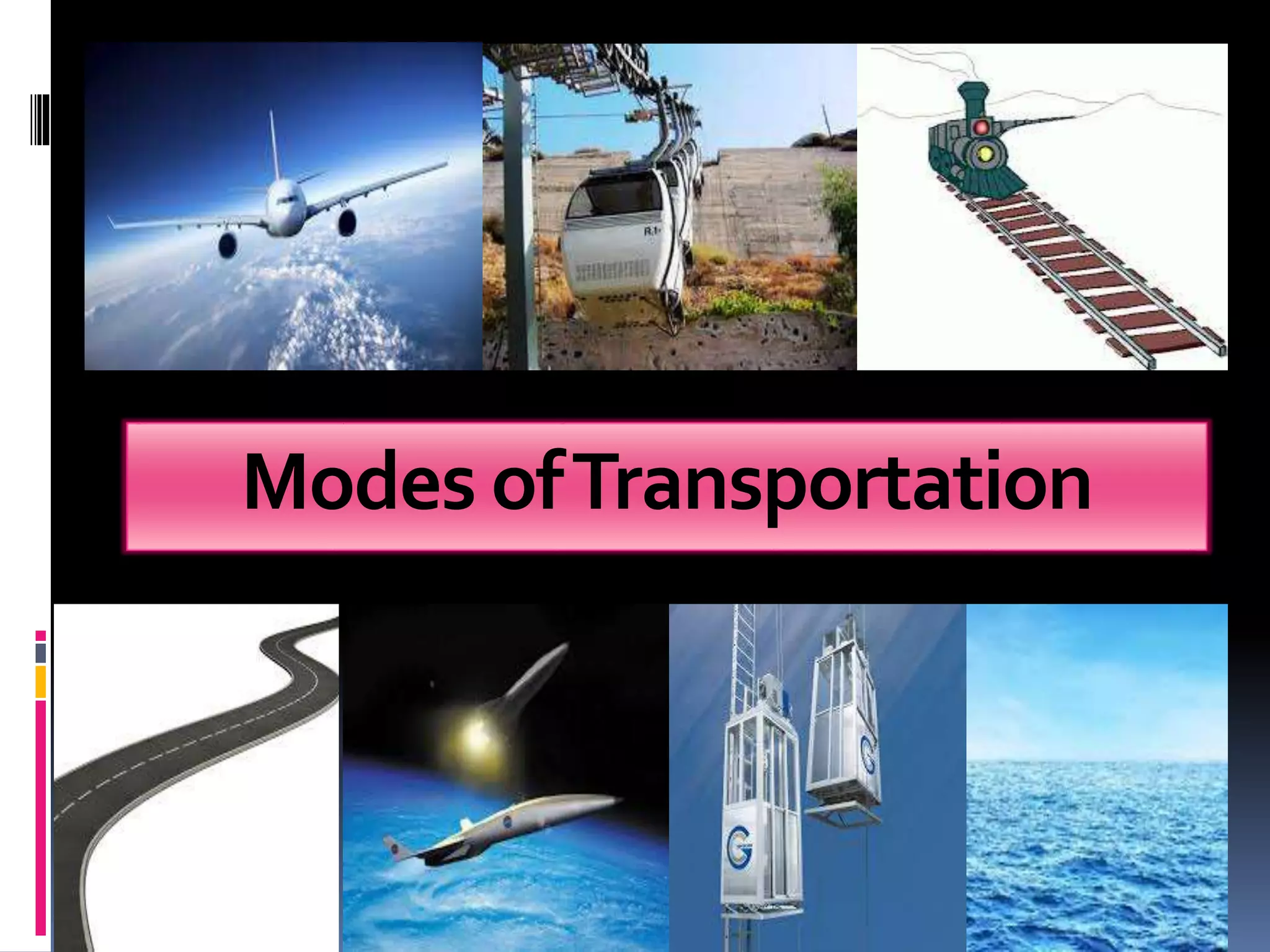
Modes of Transportation
Timeline of Transportation
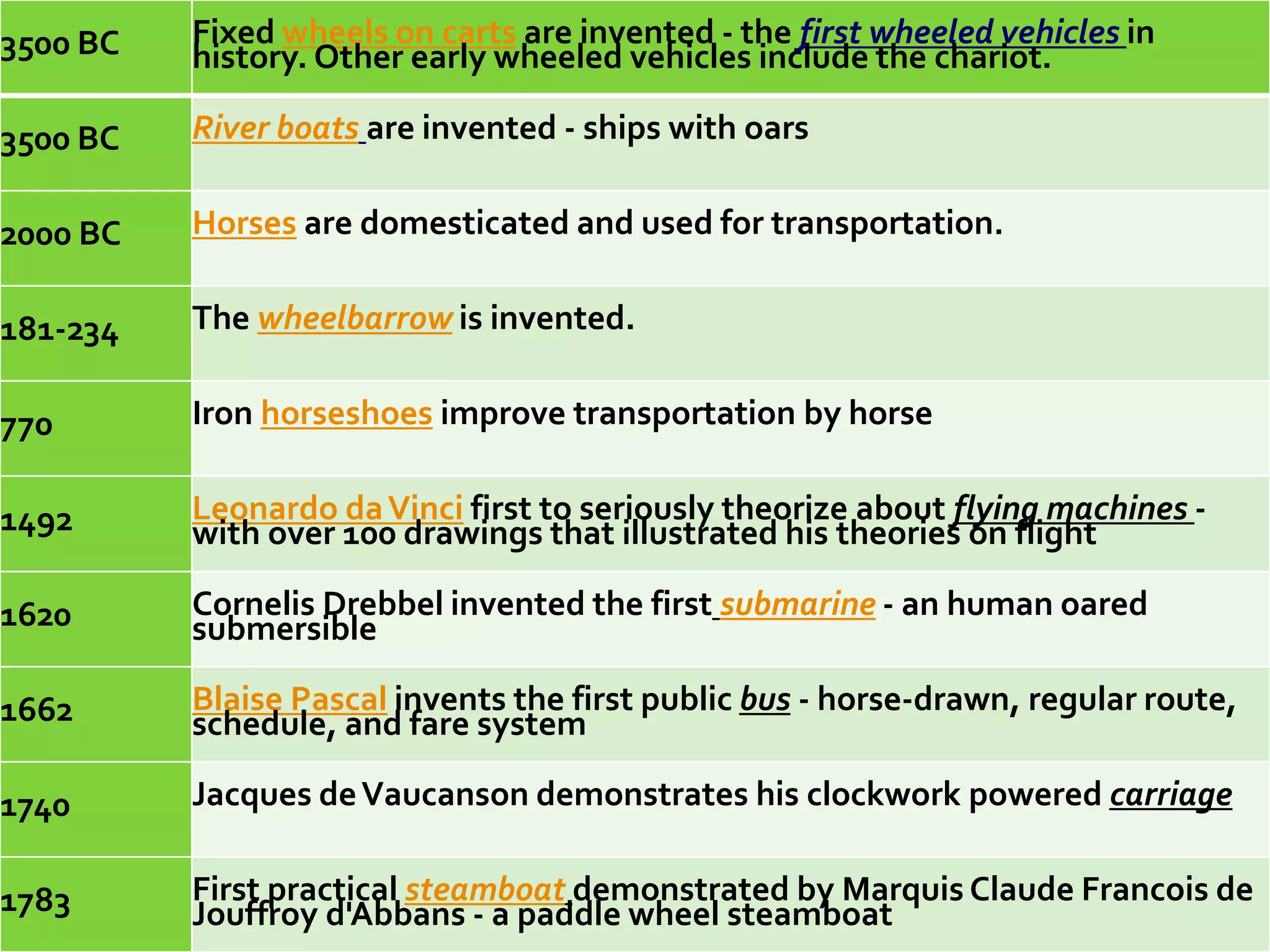
3500 BC Fixed wheels on carts are invented - the first wheeled vehicles in 
history. Other early wheeled vehicles include the chariot. 
3500 BC River boats are invented - ships with oars 
2000 BC Horses are domesticated and used for transportation. 
181-234 The wheelbarrow is invented. 
770 Iron horseshoes improve transportation by horse 
1492 Leonardo da Vinci first to seriously theorize about flying machines - 
with over 100 drawings that illustrated his theories on flight 
1620 Cornelis Drebbel invented the first submarine - an human oared 
submersible 
1662 Blaise Pascal invents the first public bus - horse-drawn, regular route, 
schedule, and fare system 
1740 Jacques de Vaucanson demonstrates his clockwork powered carriage 
1783 First practical steamboat demonstrated by Marquis Claude Francois de 
Jouffroy d'Abbans - a paddle wheel steamboat
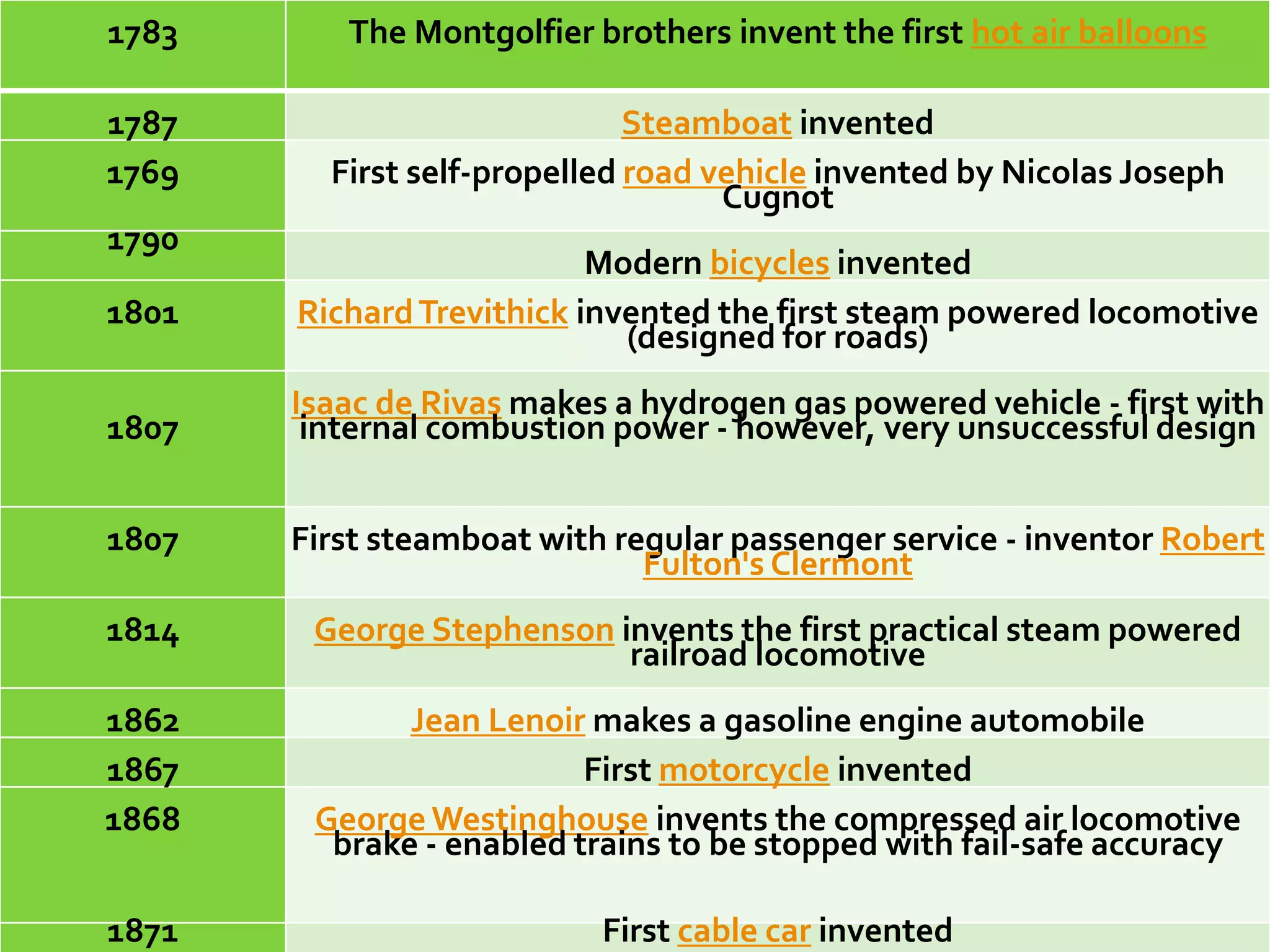
1783 The Montgolfier brothers invent the first hot air balloons 
1787 Steamboat invented 
1769 First self-propelled road vehicle invented by Nicolas Joseph 
Cugnot 
1790 
Modern bicycles invented 
1801 Richard Trevithick invented the first steam powered locomotive 
(designed for roads) 
1807 
Isaac de Rivas makes a hydrogen gas powered vehicle - first with 
internal combustion power - however, very unsuccessful design 
1807 First steamboat with regular passenger service - inventor Robert 
Fulton's Clermont 
1814 George Stephenson invents the first practical steam powered 
railroad locomotive 
1862 Jean Lenoir makes a gasoline engine automobile 
1867 First motorcycle invented 
1868 George Westinghouse invents the compressed air locomotive 
brake - enabled trains to be stopped with fail-safe accuracy 
1871 First cable car invented
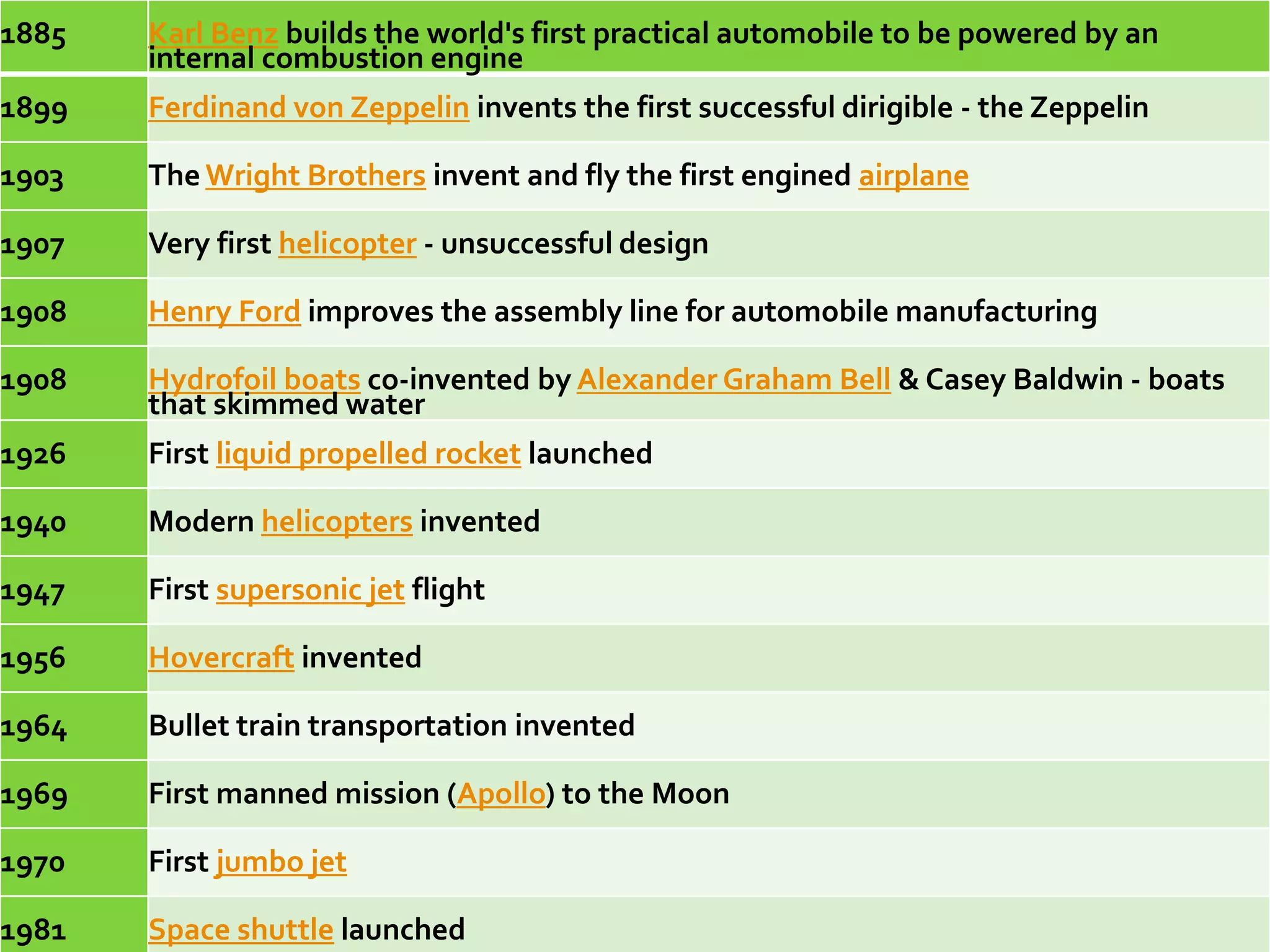
1885 Karl Benz builds the world's first practical automobile to be powered by an 
internal combustion engine 
1899 Ferdinand von Zeppelin invents the first successful dirigible - the Zeppelin 
1903 TheWright Brothers invent and fly the first engined airplane 
1907 Very first helicopter - unsuccessful design 
1908 Henry Ford improves the assembly line for automobile manufacturing 
1908 Hydrofoil boats co-invented byAlexander Graham Bell & Casey Baldwin - boats 
that skimmed water 
1926 First liquid propelled rocket launched 
1940 Modern helicopters invented 
1947 First supersonic jet flight 
1956 Hovercraft invented 
1964 Bullet train transportation invented 
1969 First manned mission (Apollo) to the Moon 
1970 First jumbo jet 
1981 Space shuttle launched
Thank you 
for listening  
- JMCT
Sources 
 http://inventors.about.com/library/inventors/bl_hi 
story_of_transportation.htm 
 http://www.ask.com/world-view/importance-transportation- 
899f57cba0b1de67 
 http://www.artinaid.com/2013/04/what-is-transportation/ 
 http://cincymap.org/blog/what-is-transportation/ 
 Google images

Development of Transportation in the World

  • 1.
    Janella Mae C.Torres IV - Newton DEVELOPMENT OF TRANSPORTATION IN THE WORLD
  • 2.
    What is Transportation?  is the transfer of an item from one place to another (any types of matter or energy)  is the act of moving something from one place to another
  • 3.
    Importance of Transportation  it facilitates trade, exchange and travel  it prevents regions to be largely isolated with each other  it allows people to move to new areas  it allows people to get to their destination
  • 4.
    Elements  Thereare five (5) elements needed for transportation 1. INFRASTRUCTURE or ACCOMODATION (including terminals or ports) 2. VEHICLE (body or technology) 3. ENERGY (fuel or pulse) 4. OPERATOR 5. SUPPORT SERVICES (which allow the transportation to occur safely)
  • 5.
  • 6.
  • 7.
    3500 BC Fixedwheels on carts are invented - the first wheeled vehicles in history. Other early wheeled vehicles include the chariot. 3500 BC River boats are invented - ships with oars 2000 BC Horses are domesticated and used for transportation. 181-234 The wheelbarrow is invented. 770 Iron horseshoes improve transportation by horse 1492 Leonardo da Vinci first to seriously theorize about flying machines - with over 100 drawings that illustrated his theories on flight 1620 Cornelis Drebbel invented the first submarine - an human oared submersible 1662 Blaise Pascal invents the first public bus - horse-drawn, regular route, schedule, and fare system 1740 Jacques de Vaucanson demonstrates his clockwork powered carriage 1783 First practical steamboat demonstrated by Marquis Claude Francois de Jouffroy d'Abbans - a paddle wheel steamboat
  • 8.
    1783 The Montgolfierbrothers invent the first hot air balloons 1787 Steamboat invented 1769 First self-propelled road vehicle invented by Nicolas Joseph Cugnot 1790 Modern bicycles invented 1801 Richard Trevithick invented the first steam powered locomotive (designed for roads) 1807 Isaac de Rivas makes a hydrogen gas powered vehicle - first with internal combustion power - however, very unsuccessful design 1807 First steamboat with regular passenger service - inventor Robert Fulton's Clermont 1814 George Stephenson invents the first practical steam powered railroad locomotive 1862 Jean Lenoir makes a gasoline engine automobile 1867 First motorcycle invented 1868 George Westinghouse invents the compressed air locomotive brake - enabled trains to be stopped with fail-safe accuracy 1871 First cable car invented
  • 9.
    1885 Karl Benzbuilds the world's first practical automobile to be powered by an internal combustion engine 1899 Ferdinand von Zeppelin invents the first successful dirigible - the Zeppelin 1903 TheWright Brothers invent and fly the first engined airplane 1907 Very first helicopter - unsuccessful design 1908 Henry Ford improves the assembly line for automobile manufacturing 1908 Hydrofoil boats co-invented byAlexander Graham Bell & Casey Baldwin - boats that skimmed water 1926 First liquid propelled rocket launched 1940 Modern helicopters invented 1947 First supersonic jet flight 1956 Hovercraft invented 1964 Bullet train transportation invented 1969 First manned mission (Apollo) to the Moon 1970 First jumbo jet 1981 Space shuttle launched
  • 10.
    Thank you forlistening  - JMCT
  • 11.
    Sources  http://inventors.about.com/library/inventors/bl_hi story_of_transportation.htm  http://www.ask.com/world-view/importance-transportation- 899f57cba0b1de67  http://www.artinaid.com/2013/04/what-is-transportation/  http://cincymap.org/blog/what-is-transportation/  Google images