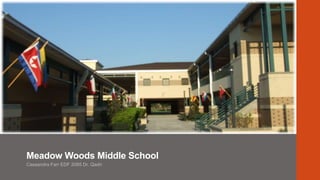
Meadow Woods Middle School
Cassandra Farr EDF 2085 Dr. Qadri
Culture/Faith
During my observations I was able to
tour the Arabic facilities, eat a
traditional Arabic dinner and
participate in a Q&A session at the
Center for Peace in Orlando.
Overall, this was an enlightening
experience and I hope they continue
it. During the event they gave out free
Qurans (paperback) and various
DVDs about the Muslim faith.
Exceptional
Education
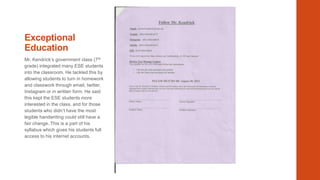
Mr. Kendrick’s government class (7 th
grade) integrated many ESE students
into the classroom. He tackled this by
allowing students to turn in homework
and classwork through email, twitter,
Instagram or in written form. He said
this kept the ESE students more
interested in the class, and for those
students who didn’t have the most
legible handwriting could still have a
fair change. This is a part of his
syllabus which gives his students full
access to his internet accounts.
ESOL
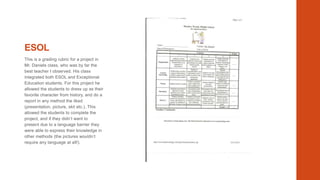
This is a grading rubric for a project in
Mr. Daniels class, who was by far the
best teacher I observed. His class
integrated both ESOL and Exceptional
Education students. For this project he
allowed the students to dress up as their
favorite character from history, and do a
report in any method the liked
(presentation, picture, skit etc.). This
allowed the students to complete the
project, and if they didn’t want to
present due to a language barrier they
were able to express their knowledge in
other methods (the pictures wouldn’t
require any language at all!).
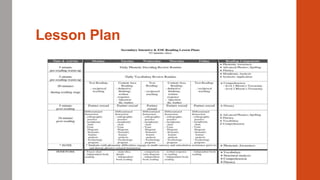
Lesson Plan
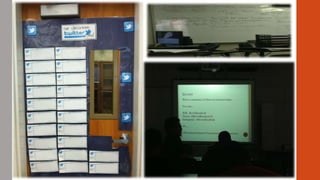
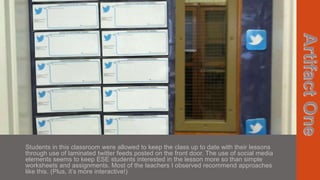
Students in this classroom were allowed to keep the class up to date with their lessons
through use of laminated twitter feeds posted on the front door. The use of social media
elements seems to keep ESE students interested in the lesson more so than simple
worksheets and assignments. Most of the teachers I observed recommend approaches
like this. (Plus, it’s more interactive!)
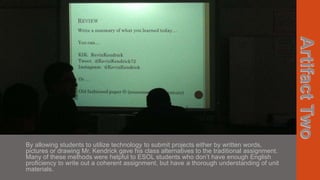
By allowing students to utilize technology to submit projects either by written words,
pictures or drawing Mr. Kendrick gave his class alternatives to the traditional assignment.
Many of these methods were helpful to ESOL students who don’t have enough English
proficiency to write out a coherent assignment, but have a thorough understanding of unit
materials.
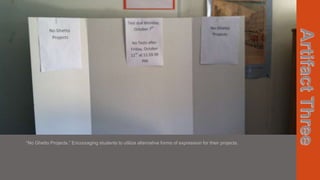
“No Ghetto Projects.” Encouraging students to utilize alternative forms of expression for their projects.
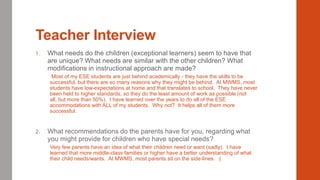
Teacher Interview
1.

What needs do the children (exceptional learners) seem to have that
are unique? What needs are similar with the other children? What
modifications in instructional approach are made?
Most of my ESE students are just behind academically - they have the skills to be
successful, but there are so many reasons why they might be behind. At MWMS, most
students have low-expectations at home and that translates to school. They have never
been held to higher standards, so they do the least amount of work as possible (not
all, but more than 50%). I have learned over the years to do all of the ESE
accommodations with ALL of my students. Why not? It helps all of them more
successful.

2.

What recommendations do the parents have for you, regarding what
you might provide for children who have special needs?
Very few parents have an idea of what their children need or want (sadly). I have
learned that more middle-class families or higher have a better understanding of what
their child needs/wants. At MWMS, most parents sit on the side-lines. :(
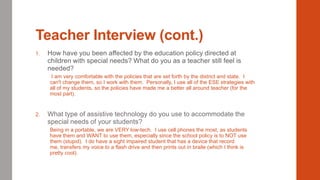
Teacher Interview (cont.)
1.

How have you been affected by the education policy directed at
children with special needs? What do you as a teacher still feel is
needed?
I am very comfortable with the policies that are set forth by the district and state. I
can't change them, so I work with them. Personally, I use all of the ESE strategies with
all of my students, so the policies have made me a better all around teacher (for the
most part).

2.

What type of assistive technology do you use to accommodate the
special needs of your students?
Being in a portable, we are VERY low-tech. I use cell phones the most, as students
have them and WANT to use them, especially since the school policy is to NOT use
them (stupid). I do have a sight impaired student that has a device that record
me, transfers my voice to a flash drive and then prints out in braile (which I think is
pretty cool).
Portfolio powerpoint

Portfolio powerpoint

  • 1.
    Meadow Woods MiddleSchool Cassandra Farr EDF 2085 Dr. Qadri
  • 3.
    Culture/Faith During my observationsI was able to tour the Arabic facilities, eat a traditional Arabic dinner and participate in a Q&A session at the Center for Peace in Orlando. Overall, this was an enlightening experience and I hope they continue it. During the event they gave out free Qurans (paperback) and various DVDs about the Muslim faith.
  • 4.
    Exceptional Education Mr. Kendrick’s governmentclass (7 th grade) integrated many ESE students into the classroom. He tackled this by allowing students to turn in homework and classwork through email, twitter, Instagram or in written form. He said this kept the ESE students more interested in the class, and for those students who didn’t have the most legible handwriting could still have a fair change. This is a part of his syllabus which gives his students full access to his internet accounts.
  • 5.
    ESOL This is agrading rubric for a project in Mr. Daniels class, who was by far the best teacher I observed. His class integrated both ESOL and Exceptional Education students. For this project he allowed the students to dress up as their favorite character from history, and do a report in any method the liked (presentation, picture, skit etc.). This allowed the students to complete the project, and if they didn’t want to present due to a language barrier they were able to express their knowledge in other methods (the pictures wouldn’t require any language at all!).
  • 6.
  • 7.
    Students in thisclassroom were allowed to keep the class up to date with their lessons through use of laminated twitter feeds posted on the front door. The use of social media elements seems to keep ESE students interested in the lesson more so than simple worksheets and assignments. Most of the teachers I observed recommend approaches like this. (Plus, it’s more interactive!)
  • 8.
    By allowing studentsto utilize technology to submit projects either by written words, pictures or drawing Mr. Kendrick gave his class alternatives to the traditional assignment. Many of these methods were helpful to ESOL students who don’t have enough English proficiency to write out a coherent assignment, but have a thorough understanding of unit materials.
  • 9.
    “No Ghetto Projects.”Encouraging students to utilize alternative forms of expression for their projects.
  • 10.
    Teacher Interview 1. What needsdo the children (exceptional learners) seem to have that are unique? What needs are similar with the other children? What modifications in instructional approach are made? Most of my ESE students are just behind academically - they have the skills to be successful, but there are so many reasons why they might be behind. At MWMS, most students have low-expectations at home and that translates to school. They have never been held to higher standards, so they do the least amount of work as possible (not all, but more than 50%). I have learned over the years to do all of the ESE accommodations with ALL of my students. Why not? It helps all of them more successful. 2. What recommendations do the parents have for you, regarding what you might provide for children who have special needs? Very few parents have an idea of what their children need or want (sadly). I have learned that more middle-class families or higher have a better understanding of what their child needs/wants. At MWMS, most parents sit on the side-lines. :(
  • 11.
    Teacher Interview (cont.) 1. Howhave you been affected by the education policy directed at children with special needs? What do you as a teacher still feel is needed? I am very comfortable with the policies that are set forth by the district and state. I can't change them, so I work with them. Personally, I use all of the ESE strategies with all of my students, so the policies have made me a better all around teacher (for the most part). 2. What type of assistive technology do you use to accommodate the special needs of your students? Being in a portable, we are VERY low-tech. I use cell phones the most, as students have them and WANT to use them, especially since the school policy is to NOT use them (stupid). I do have a sight impaired student that has a device that record me, transfers my voice to a flash drive and then prints out in braile (which I think is pretty cool).