Field Observations
Cristal D. Abraham
Intro to Diversity for Educators
EDF 2085-16458
Dr. Yasmin Qadri
Artifact #1
Cultural
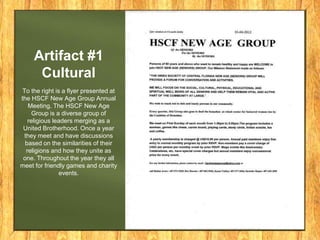
To the right is a flyer presented at
the HSCF New Age Group Annual
Meeting. The HSCF New Age
Group is a diverse group of
religious leaders merging as a
United Brotherhood. Once a year
they meet and have discussions
based on the similarities of their
religions and how they unite as
one. Throughout the year they all
meet for friendly games and charity
events.
Artifact #2
ESOL
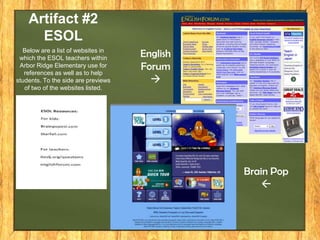
Below are a list of websites in
which the ESOL teachers within
Arbor Ridge Elementary use for
references as well as to help
students. To the side are previews
of two of the websites listed.

English
Forum


Brain Pop

Artifact #3
ESE
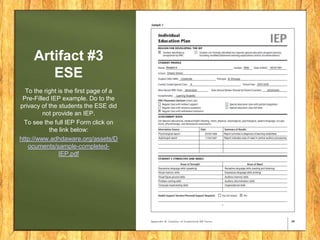
To the right is the first page of a
Pre-Filled IEP example. Do to the
privacy of the students the ESE did
not provide an IEP.
To see the full IEP Form click on
the link below:
http://www.adhdaware.org/assets/D
ocuments/sample-completedIEP.pdf
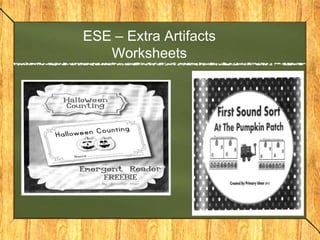
ESE – Extra Artifacts
Worksheets
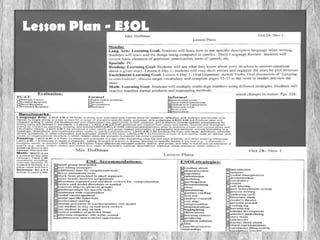
Lesson Plan - ESOL
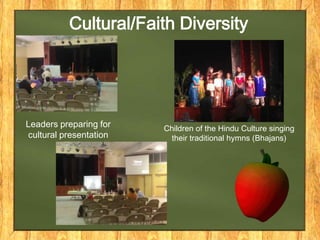
Cultural/Faith Diversity

Leaders preparing for
cultural presentation

Children of the Hindu Culture singing
their traditional hymns (Bhajans)
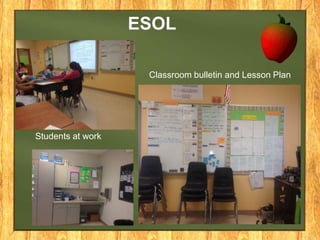
ESOL
Classroom bulletin and Lesson Plan

Students at work
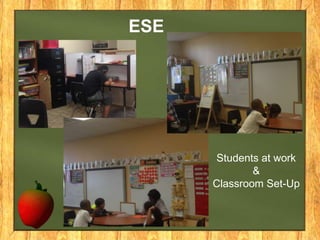
ESE

Students at work
&
Classroom Set-Up
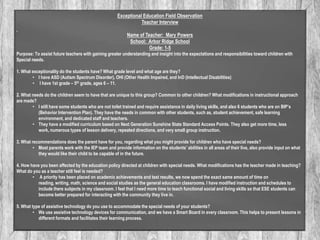
Exceptional Education Field Observation
Teacher Interview
Name of Teacher: Mary Powers
School: Arbor Ridge School
Grade: 1-5
Purpose: To assist future teachers with gaining greater understanding and insight into the expectations and responsibilities toward children with
Special needs.
1. What exceptionality do the students have? What grade level and what age are they?
• I have ASD (Autism Spectrum Disorder), OHI (Other Health Impaired, and InD (Intellectual Disabilities)
• I have 1st grade – 5th grade, ages 6 – 11.
2. What needs do the children seem to have that are unique to this group? Common to other children? What modifications in instructional approach
are made?
• I still have some students who are not toilet trained and require assistance in daily living skills, and also 6 students who are on BIP’s
(Behavior Intervention Plan). They have the needs in common with other students, such as, student achievement, safe learning
environment, and dedicated staff and teachers.
• They have a modified curriculum based on Next Generation Sunshine State Standard Access Points. They also get more time, less
work, numerous types of lesson delivery, repeated directions, and very small group instruction.
3. What recommendations does the parent have for you, regarding what you might provide for children who have special needs?
• Most parents work with the IEP team and provide information on the students’ abilities in all areas of their live, also provide input on what
they would like their child to be capable of in the future.
4. How have you been affected by the education policy directed at children with special needs. What modifications has the teacher made in teaching?
What do you as a teacher still feel is needed?
• A priority has been placed on academic achievements and test results, we now spend the exact same amount of time on
reading, writing, math, science and social studies as the general education classrooms. I have modified instruction and schedules to
include there subjects in my classroom. I feel that I need more time to teach functional social and living skills so that ESE students can
become better prepared for interacting with the community they live in.
5. What type of assistive technology do you use to accommodate the special needs of your students?
• We use assistive technology devices for communication, and we have a Smart Board in every classroom. This helps to present lessons in
different formats and facilitates their learning process.
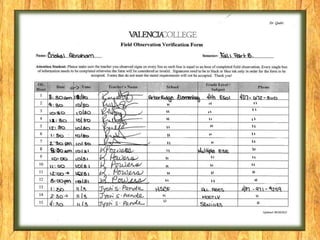
Field observations

Field observations

  • 1.
    Field Observations Cristal D.Abraham Intro to Diversity for Educators EDF 2085-16458 Dr. Yasmin Qadri
  • 2.
    Artifact #1 Cultural To theright is a flyer presented at the HSCF New Age Group Annual Meeting. The HSCF New Age Group is a diverse group of religious leaders merging as a United Brotherhood. Once a year they meet and have discussions based on the similarities of their religions and how they unite as one. Throughout the year they all meet for friendly games and charity events.
  • 3.
    Artifact #2 ESOL Below area list of websites in which the ESOL teachers within Arbor Ridge Elementary use for references as well as to help students. To the side are previews of two of the websites listed. English Forum  Brain Pop 
  • 4.
    Artifact #3 ESE To theright is the first page of a Pre-Filled IEP example. Do to the privacy of the students the ESE did not provide an IEP. To see the full IEP Form click on the link below: http://www.adhdaware.org/assets/D ocuments/sample-completedIEP.pdf
  • 5.
    ESE – ExtraArtifacts Worksheets
  • 6.
  • 7.
    Cultural/Faith Diversity Leaders preparingfor cultural presentation Children of the Hindu Culture singing their traditional hymns (Bhajans)
  • 8.
    ESOL Classroom bulletin andLesson Plan Students at work
  • 9.
  • 10.
    Exceptional Education FieldObservation Teacher Interview Name of Teacher: Mary Powers School: Arbor Ridge School Grade: 1-5 Purpose: To assist future teachers with gaining greater understanding and insight into the expectations and responsibilities toward children with Special needs. 1. What exceptionality do the students have? What grade level and what age are they? • I have ASD (Autism Spectrum Disorder), OHI (Other Health Impaired, and InD (Intellectual Disabilities) • I have 1st grade – 5th grade, ages 6 – 11. 2. What needs do the children seem to have that are unique to this group? Common to other children? What modifications in instructional approach are made? • I still have some students who are not toilet trained and require assistance in daily living skills, and also 6 students who are on BIP’s (Behavior Intervention Plan). They have the needs in common with other students, such as, student achievement, safe learning environment, and dedicated staff and teachers. • They have a modified curriculum based on Next Generation Sunshine State Standard Access Points. They also get more time, less work, numerous types of lesson delivery, repeated directions, and very small group instruction. 3. What recommendations does the parent have for you, regarding what you might provide for children who have special needs? • Most parents work with the IEP team and provide information on the students’ abilities in all areas of their live, also provide input on what they would like their child to be capable of in the future. 4. How have you been affected by the education policy directed at children with special needs. What modifications has the teacher made in teaching? What do you as a teacher still feel is needed? • A priority has been placed on academic achievements and test results, we now spend the exact same amount of time on reading, writing, math, science and social studies as the general education classrooms. I have modified instruction and schedules to include there subjects in my classroom. I feel that I need more time to teach functional social and living skills so that ESE students can become better prepared for interacting with the community they live in. 5. What type of assistive technology do you use to accommodate the special needs of your students? • We use assistive technology devices for communication, and we have a Smart Board in every classroom. This helps to present lessons in different formats and facilitates their learning process.