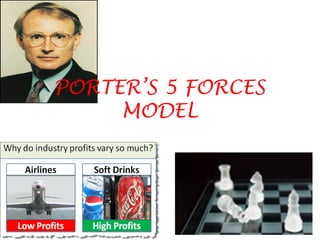
PORTER’S 5 FORCES
     MODEL


                    1
2
3
RETAILING INDUSTRY


                     4
THREAT OF NEW ENTRANTS                                   THREAT OF SUBSTITUTES

• Independent retailers decreased.                      • Deal with various products.

• Chain stores                                          • Chances of shifting is high.

• Centralized buying competitive advantage


               POWER OF SUPPLIERS                                       POWER OF BUYERS

• Historically, exploit the relationship.               • Lower bargaining power

• Less power                                            • High quality products – retailers’ honest


                       RIVARLY AMONG EXISTING FIRMS WITHIN AN INDUSTRY

• Cut throat Competition

• Reduce – frequent fliers, memberships, loyalty cards, etc..


                                                                                                      5
TELECOMMUNICATION
     INDUSTRY


                    6
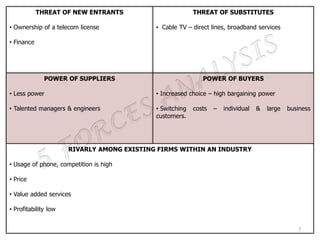
THREAT OF NEW ENTRANTS                        THREAT OF SUBSTITUTES

• Ownership of a telecom license            • Cable TV – direct lines, broadband services

• Finance


              POWER OF SUPPLIERS                             POWER OF BUYERS

• Less power                                • Increased choice – high bargaining power

• Talented managers & engineers             • Switching   costs   –   individual   &   large   business
                                            customers.


                      RIVARLY AMONG EXISTING FIRMS WITHIN AN INDUSTRY

• Usage of phone, competition is high

• Price

• Value added services

• Profitability low


                                                                                                  7
Airline Industry


                   8
THREAT OF NEW ENTRANTS                         THREAT OF SUBSTITUTES

• Saturated Market                          • Time, Money

• Brand Name & Recognition                  • Personal References & convenience


             POWER OF SUPPLIERS                                POWER OF BUYERS

• Dominated – Boeing & Airbus               • Low bargaining

• Not much of difference.                   • Consider Service of airline too.


                      RIVARLY AMONG EXISTING FIRMS WITHIN AN INDUSTRY

• High competition

• Cut throat competition

• Low Profitability


                                                                                  9
Pharma Industry


                  10
THREAT OF NEW ENTRANTS                                           THREATS OF SUBSTITUTES
• Very low barriers to entry                                 • No substitutes for the medicines

• Government policies supportive                             • Biotechnology is a threat to synthetic pharma products

• Entry price regulation exists

• Economies of scale exist

• Proprietary technology

• Product existence


                 POWER OF SUPPLIERS                                              POWER OF BUYERS
• Volume benefits occur                                      • End consumers do not have bargaining power

• Inputs standard, available locally                         • Brand identity exists but is in the hands of Influencer (Doctors)

• Numerous suppliers-switching cost low                      • Price Sensitivity is less

• Suppliers can go for forward integration                   • Highly fragmented market, so buyer concentration v/s industry
                                                             is low
• Raw material cost constitute more than 50% of the total
expenses
                                       RIVARLY AMONG EXISTING FIRMS WITHIN AN INDUSTRY
• Industry Competition

• Highly competitive.

• Top five players have mere 18% market share

• 18% market share

• Lower fixed cost and high working capital                                                                               11
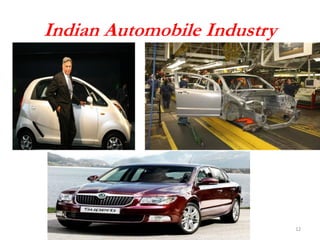
Indian Automobile Industry


                             12
THREAT OF NEW ENTRANTS                                          THREAT OF SUBSTITUTES

• Substantial entry                                          • Fairly mild

• New company requires high capital.                         • Other forms of transportation available

• Achieving minimum efficient scale is prohibitive

• Enter through strategic partnership, buying, merging

• Domestic market works well locally than globally


                  POWER OF SUPPLIERS                                                 POWER OF BUYERS

• the power axis is tipped in industry                       • The power axis is tipped in the consumers’ favor

• Powerful buyers dictate their terms to supplier            • Low switching costs from among competing brands.


                                RIVARLY AMONG EXISTING FIRMS WITHIN AN INDUSTRY

• Intense due to the entry of foreign companies

• Rivalry - high with any product being matched in a few months by the competitors

• Technical capabilities

• Collaboration with international players

                                                                                                                  13
THANK YOU


            14

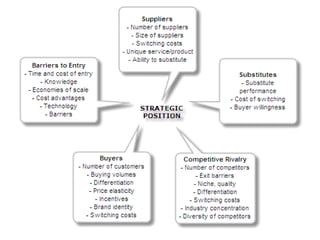
Porter's 5 forces model

  • 1.
  • 2.
  • 3.
  • 4.
  • 5.
    THREAT OF NEWENTRANTS THREAT OF SUBSTITUTES • Independent retailers decreased. • Deal with various products. • Chain stores • Chances of shifting is high. • Centralized buying competitive advantage POWER OF SUPPLIERS POWER OF BUYERS • Historically, exploit the relationship. • Lower bargaining power • Less power • High quality products – retailers’ honest RIVARLY AMONG EXISTING FIRMS WITHIN AN INDUSTRY • Cut throat Competition • Reduce – frequent fliers, memberships, loyalty cards, etc.. 5
  • 6.
  • 7.
    THREAT OF NEWENTRANTS THREAT OF SUBSTITUTES • Ownership of a telecom license • Cable TV – direct lines, broadband services • Finance POWER OF SUPPLIERS POWER OF BUYERS • Less power • Increased choice – high bargaining power • Talented managers & engineers • Switching costs – individual & large business customers. RIVARLY AMONG EXISTING FIRMS WITHIN AN INDUSTRY • Usage of phone, competition is high • Price • Value added services • Profitability low 7
  • 8.
  • 9.
    THREAT OF NEWENTRANTS THREAT OF SUBSTITUTES • Saturated Market • Time, Money • Brand Name & Recognition • Personal References & convenience POWER OF SUPPLIERS POWER OF BUYERS • Dominated – Boeing & Airbus • Low bargaining • Not much of difference. • Consider Service of airline too. RIVARLY AMONG EXISTING FIRMS WITHIN AN INDUSTRY • High competition • Cut throat competition • Low Profitability 9
  • 10.
  • 11.
    THREAT OF NEWENTRANTS THREATS OF SUBSTITUTES • Very low barriers to entry • No substitutes for the medicines • Government policies supportive • Biotechnology is a threat to synthetic pharma products • Entry price regulation exists • Economies of scale exist • Proprietary technology • Product existence POWER OF SUPPLIERS POWER OF BUYERS • Volume benefits occur • End consumers do not have bargaining power • Inputs standard, available locally • Brand identity exists but is in the hands of Influencer (Doctors) • Numerous suppliers-switching cost low • Price Sensitivity is less • Suppliers can go for forward integration • Highly fragmented market, so buyer concentration v/s industry is low • Raw material cost constitute more than 50% of the total expenses RIVARLY AMONG EXISTING FIRMS WITHIN AN INDUSTRY • Industry Competition • Highly competitive. • Top five players have mere 18% market share • 18% market share • Lower fixed cost and high working capital 11
  • 12.
  • 13.
    THREAT OF NEWENTRANTS THREAT OF SUBSTITUTES • Substantial entry • Fairly mild • New company requires high capital. • Other forms of transportation available • Achieving minimum efficient scale is prohibitive • Enter through strategic partnership, buying, merging • Domestic market works well locally than globally POWER OF SUPPLIERS POWER OF BUYERS • the power axis is tipped in industry • The power axis is tipped in the consumers’ favor • Powerful buyers dictate their terms to supplier • Low switching costs from among competing brands. RIVARLY AMONG EXISTING FIRMS WITHIN AN INDUSTRY • Intense due to the entry of foreign companies • Rivalry - high with any product being matched in a few months by the competitors • Technical capabilities • Collaboration with international players 13
  • 14.