Dr Saeed Al-Shomimi KFHU Khobar
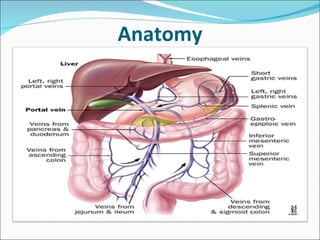
Anatomy 6 – 8 cm  Splenic + s. mesenteric  (behind neck of the pancreas ) i. mesenteric , Lt gastric
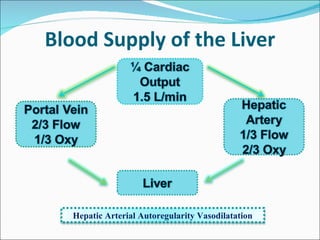
Blood Supply of the Liver Hepatic Arterial Autoregularity Vasodilatation
Pathophysiology Pressure = Flow X Resistance Portal pressure : 3 – 6 mm Hg Normal elevation: Eating Exercise Valsalva
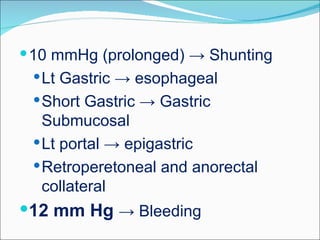
10 mmHg (prolonged) -> Shunting Lt Gastric -> esophageal Short Gastric -> Gastric Submucosal Lt portal -> epigastric Retroperetoneal and anorectal collateral 12 mm Hg  -> Bleeding
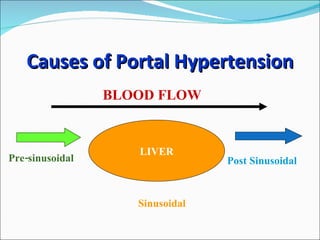
Causes of Portal Hypertension Pre-sinusoidal Sinusoidal Post Sinusoidal BLOOD FLOW LIVER
Pre-sinusoidal Extra-hepatic: Portal vein thrombosis Splenic vein Thrombosis Intra-hepatic: Congenital hepatic fibrosis Primary biliary cirrhosis Sarcidosis Schistosomaisis
Sinusoidal Steatohepatits Wilson disease
Post Sinusoidal Extra-hepatic: Budd Chiari syndrome R heart Failure Intra-hepatic: Heamochromatosis Alcoholic cirrhosis Post-hepatitic cirrhosis
Variceal Bleeding Mortality associated with 1 st  episode: Cirrhotic patient  :  40% - 70% Non cirrhotic : 5% - 10% If bleeding resolved spontaneously 30% re-bleed , 6 weeks 70% re-bleed , 1 year (30% of the initial bleeding episodes are fatal)
Acute Variceal Bleeding
Initial evaluation & stabilization Assessment of intravascular volume status Fluid resuscitation Endotracheal intubation prior to endoscopy for:  Uncontrolled bleeding Altered mental status, severe agitation Respiratory distress or depression
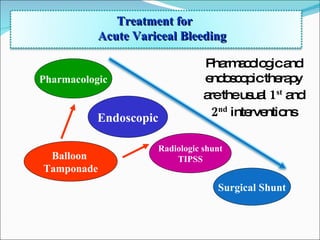
Pharmacologic Radiologic shunt TIPSS Surgical Shunt Balloon  Tamponade Pharmacologic and endoscopic therapy are the usual  1 st  and  2 nd  interventions Endoscopic Treatment for  Acute Variceal Bleeding
Pharmacologic Therapy Octreotide Synthetic analogue of somatostatin Decreases portal pressure and azygos blood flow Stops variceal bleed in 80% of the cases Efficacy is similar to endoscopic sclerotherapy and better than vasopressin
5-day course reduces bleeding after endoscopic therapy  Can cause mild hyperglycemia and abdominal cramping 250 µg Iv Bolus – followed by infusion 25 – 50 µg/h (2-4 days)
Vasopressin Reduces portal pressure but causes myocardial and mesenteric ischemia (more side effects) 20 u IV bolus (over 20 min) – infusion 0.2 – 0.4 u/min Control approximately 50% of acute episodes
Terlipressin Efficacy similar to endoscopic sclerotherapy and as effective as balloon tamponade when used with nitroglycerin Not approved for use in U.S.
Endoscopic Therapy Sclerosant injection Band ligation Became a standard form of therapy in acute variceal bleeding Initial control of hge in 70 – 95%  Re-bleeding 20 – 50%
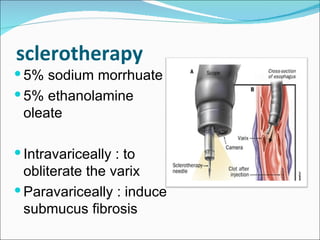
sclerotherapy 5% sodium morrhuate 5% ethanolamine oleate Intravariceally : to obliterate the varix Paravariceally : induce submucus fibrosis
3 prospective randomized controlled trials studies comparing sclerotherapy and balloon temponade: Sclerotherapy achieved better initial hge control Fewer episodes of rebleeding Improved long-term survival (furthermore, routine use of balloon temponade after sclerotherapy confer no additional benefit)
Complications: Pulmonary complications Transient chest pain Esophageal stricture Portal vein thrombosis Esophageal perforation Bacteremia
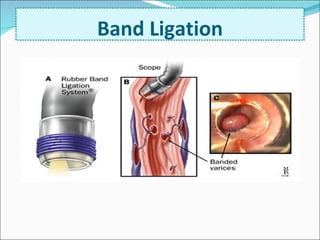
Alternative to sclerotherapy Fewer rebleeding episodes Fewer endoscopic interventions Lower procedure related mortality and over all mortality Band Ligation
Pharmacologic versus Endoscopic Therapy 2 meta-analysis compared medical pharmacotherapy with emergency sclerotherapy as 1 st  line treatment for acute bleeding: No significant difference regarding initial hge control or mortality Administration of somatostatin  before  and  after  sclerotherapy : Improve treatment efficacy Reduce blood transfusion
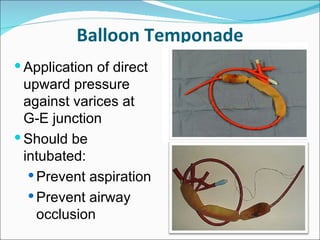
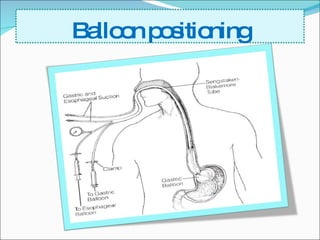
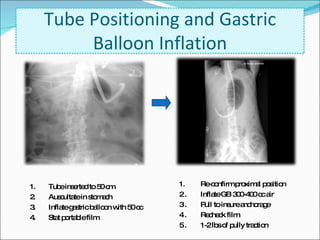
Balloon Temponade Application of direct upward pressure against varices at G-E junction Should be intubated: Prevent aspiration Prevent airway occlusion
Balloon positioning
1. Tube inserted to 50 cm 2. Auscultate in stomach  3. Inflate gastric balloon with 50 cc 4. Stat portable film Re-confirm proximal position Inflate GB 300-400 cc air Pull to insure anchorage Recheck film  1-2 lbs of pully traction Tube Positioning and Gastric Balloon Inflation
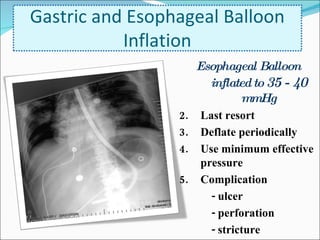
Esophageal Balloon inflated to  35 - 40  mmHg Last resort Deflate periodically Use minimum effective pressure Complication - ulcer - perforation - stricture Gastric and Esophageal Balloon Inflation
Direct temponade therapy is 90% effective in controlling the bleeding 50%  rebleeding after removal Serious potential complications (mortality 20%) Bridge therapy
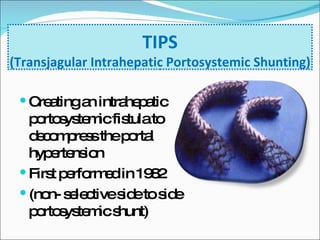
TIPS (Transjagular Intrahepatic Portosystemic Shunting) Creating an intrahepatic portosystemic fistula to decompress the portal hypertension First performed in 1982 (non- selective side to side portosystemic shunt)
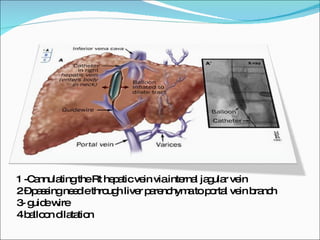
1 -Cannulating the Rt hepatic vein via internal jagular vein 2 – passing needle through liver parenchyma to portal vein branch 3- guide wire 4 balloon dilatation
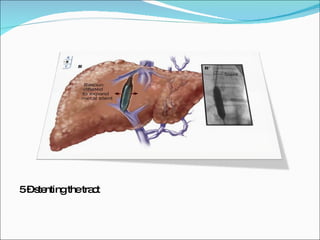
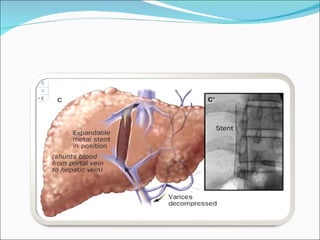
5 – stenting the tract
 
Meta-analysis comparing TIPS with endoscopy in acute hge: Significant improvement in controlling the hge Coast : ↑rate of hepatic encephalopathy
Contraindications: R side heart failure Polycystic liver Portal vein thrombosis
Complications: Intraperitoneal bleeding due to perforation of the hepatic capsule, hepatic, or portal veins TIPS embolization Acute right heart failure due to increased venous return to right heart
Late: recurrent bleeding due to TIPS stenosis or thrombosis Infection hepatic encephalopathy.
Surgical Therapy Operative intervention is reserved for cases  refractory  to other modalities
Esophageal transection EEA stapler Operative mortality 75% Complications 25%: Perforation Stricture Esophagitis ->  not useful in acute state
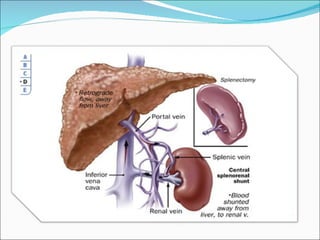
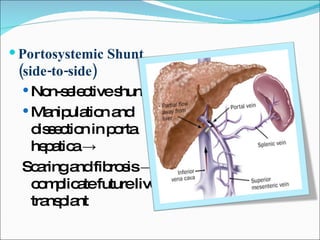
Portosystemic Shunt (side-to-side) Non-selective shunt Manipulation and dissection in porta hepatica -> Scaring and fibrosis -> complicate future liver transplant
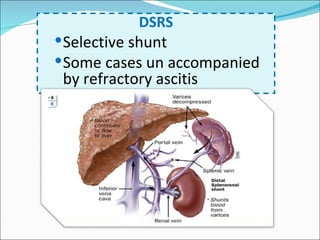
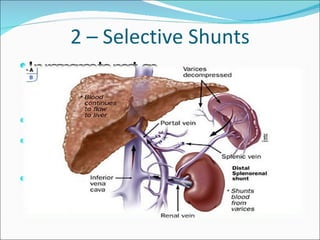
DSRS Selective shunt Some cases un accompanied by refractory ascitis
Prevention of Recurrent Variceal Bleeding
Pharmacotherapy: Rebleeding without treatment  70%  in 1 year Non-selective B blockers (propranalol) ↓ portal pressure Effect is variable and unpredictable Less benefit with decompesated liver
Endoscopic therapy: Advocated as a means for complete eradication of esophageal varices Once eliminated routine endoscopy 6-12 months Fewer rebleeding episodes than medical treatment 50 % rebleding in 1 year 30% need conversion Reserved for complaint patients
TIPS: Bridge therapy -> liver transplant Advantiges over surgery: No risk of general anesthesia No post-operative complications Limitations Stenosis (50% in 1 st  year) Encephalopathy (1/3)
Surgical Therapy: Most effective method in controlling portal hypertension and recurrent bleeding 1 Portosystemic shunt procedures 2 Esophagogastric devascularization 3 Orthotopic liver transplantation
Portosystemic Shunt Decompressing the hypertensive portal Venus system into the low pressure systemic venous circulation Toxins -> systemic circulation -> encephalopathy
To minimize these effects shunting operations have evolved: Non-selective Selective partial
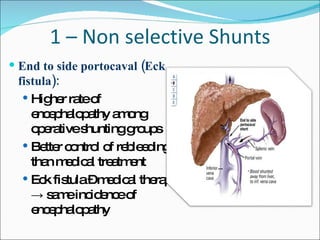
1 – Non selective Shunts End to side portocaval (Eck fistula): Higher rate of encephalopathy among operative shunting groups Better control of rebleeding than medical treatment Eck fistula – medical therapy -> same incidence of encephalopathy
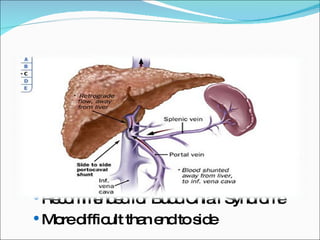
Side to Side portocaval shunt: Maintain the anatomic continuity of the portal vein Encephalopathy rate : no difference Decompress the sinusoidal pressure -> better ascitis control Recommended for Budd Chiari Syndrome More difficult than end to side
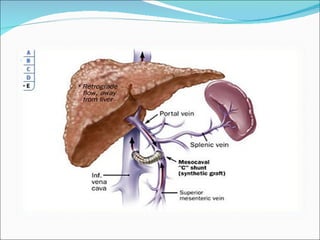
Interposition Mesocaval Shunt: Prosthetic – autogennous vien Avoid hilar dissection (future transplant) Shunt ligation in refractory post-op encephalopathy Drawback -> thrombosis (35%)
Proximal Spleno-Renal Shunt: Splenectomy + anastomosing proximal Splenic vein to Lt Renal vein Divert all portal flow into renal vein -> non selective Shunt occlusion 18%
2 – Selective Shunts In response to post-op complications of non-selective procedures 1967 DSRS Distal Splenic vein to Lt renal Vein Selectively decompress the esophagogastric veins
Contraindications: Refractory ascitis Splenic vein thrombosis Previously underwent splenectomy Splenic vein diameter < 7 mm
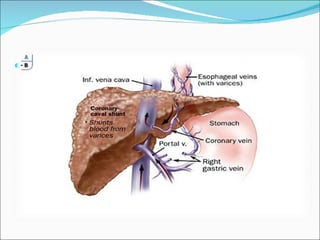
Coronary – Caval Shunt: Described in Japan in 1984 Interposition graft between L Gastric and inferior vena cava Little experience with this procedure
3 – Partial Shunts Small diameter interposition grafts Maintaining a degree of hepatopedal portal flow to the liver
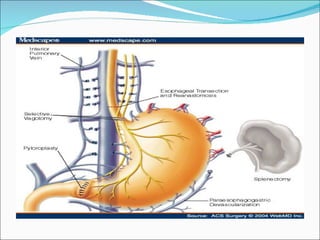
Esophagogastric Devascularization The most effective non-shunt operation for preventing variceal bleeding: Devascularization + transection + splenectomy Sugiura procedure
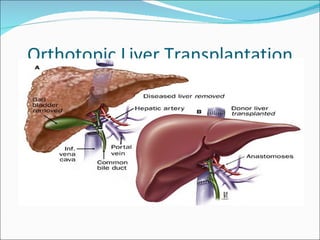
Orthotopic Liver Transplantation The most definitive form of therapy for complications of portal hypertension Selective patients: Coast Unavailability  Immunosuppresion
Child A – mild B -> non-transplant surgery Child C – advanced B -> transplant
Prophylaxis
Likehood of variceal bleeding : Alcoholic cirrhosis Active alcohol consumption Sever hepatic dysfunction Endoscopy: Variceal wall thinning Variceal tortuosity Superimposition of varices on other Gastric varicose
Non selective B blockers Prophylactic shunts showed no benefit , ↑morbidity
Portal hypertension in north Indian children Arora NK, Lodha R, Gulati S, Gupta AK, Mathur P, Joshi MS, Arora N,  Mitra DK Department of Paediatrics All India Institute of Medical Sciences New Delhi.
cross-sectional observational study Tertiary care centre in northern India January, 1990 to December, 1994 Children below the age of 14 years with suspected portal hypertension  To determine the etiology and clinical profile of portal hypertension
115   patients with portal hypertension 76.5%  had extrahepatic portal hypertension (EHPH) 23.5%  had intrahepatic causes of portal hypertension
Results: Children with  EHPH  had a significantly  earlier  onset of symptoms as compared to those with intrahepatic portal hypertension (p = 0.002) And  bled  significantly more frequently (p = 0.00).
History suggestive of potential etiological factors could be elicited in only  7%  of EHPH patients . The commonest site of block in splenoportal axis was at the formation of the portal vein .
An  inverse  relation of bleeding rates with duration of illness was seen in EHPH
Conclusion: Understanding the natural history of EHPH and portal hypertension due to other etiologies may have significant implications in choosing the appropriate intervention and predicting the outcome .
References ACS Surgery : Principles and Practice 2004 Web,MD Schwartz Principles of Surgery 7 th  Edition Indian J Pediatr.  1998 Jul-Aug;65(4):585-91. Johns Hopkins Gastroenterology & Hepatology Resource Center  http://hopkins-gi.nts.jhu.edu
Thank You

Portal Hypertension

  • 1.
  • 2.
    Anatomy 6 –8 cm Splenic + s. mesenteric (behind neck of the pancreas ) i. mesenteric , Lt gastric
  • 3.
    Blood Supply ofthe Liver Hepatic Arterial Autoregularity Vasodilatation
  • 4.
    Pathophysiology Pressure =Flow X Resistance Portal pressure : 3 – 6 mm Hg Normal elevation: Eating Exercise Valsalva
  • 5.
    10 mmHg (prolonged)-> Shunting Lt Gastric -> esophageal Short Gastric -> Gastric Submucosal Lt portal -> epigastric Retroperetoneal and anorectal collateral 12 mm Hg -> Bleeding
  • 6.
    Causes of PortalHypertension Pre-sinusoidal Sinusoidal Post Sinusoidal BLOOD FLOW LIVER
  • 7.
    Pre-sinusoidal Extra-hepatic: Portalvein thrombosis Splenic vein Thrombosis Intra-hepatic: Congenital hepatic fibrosis Primary biliary cirrhosis Sarcidosis Schistosomaisis
  • 8.
  • 9.
    Post Sinusoidal Extra-hepatic:Budd Chiari syndrome R heart Failure Intra-hepatic: Heamochromatosis Alcoholic cirrhosis Post-hepatitic cirrhosis
  • 10.
    Variceal Bleeding Mortalityassociated with 1 st episode: Cirrhotic patient : 40% - 70% Non cirrhotic : 5% - 10% If bleeding resolved spontaneously 30% re-bleed , 6 weeks 70% re-bleed , 1 year (30% of the initial bleeding episodes are fatal)
  • 11.
  • 12.
    Initial evaluation &stabilization Assessment of intravascular volume status Fluid resuscitation Endotracheal intubation prior to endoscopy for: Uncontrolled bleeding Altered mental status, severe agitation Respiratory distress or depression
  • 13.
    Pharmacologic Radiologic shuntTIPSS Surgical Shunt Balloon Tamponade Pharmacologic and endoscopic therapy are the usual 1 st and 2 nd interventions Endoscopic Treatment for Acute Variceal Bleeding
  • 14.
    Pharmacologic Therapy OctreotideSynthetic analogue of somatostatin Decreases portal pressure and azygos blood flow Stops variceal bleed in 80% of the cases Efficacy is similar to endoscopic sclerotherapy and better than vasopressin
  • 15.
    5-day course reducesbleeding after endoscopic therapy Can cause mild hyperglycemia and abdominal cramping 250 µg Iv Bolus – followed by infusion 25 – 50 µg/h (2-4 days)
  • 16.
    Vasopressin Reduces portalpressure but causes myocardial and mesenteric ischemia (more side effects) 20 u IV bolus (over 20 min) – infusion 0.2 – 0.4 u/min Control approximately 50% of acute episodes
  • 17.
    Terlipressin Efficacy similarto endoscopic sclerotherapy and as effective as balloon tamponade when used with nitroglycerin Not approved for use in U.S.
  • 18.
    Endoscopic Therapy Sclerosantinjection Band ligation Became a standard form of therapy in acute variceal bleeding Initial control of hge in 70 – 95% Re-bleeding 20 – 50%
  • 19.
    sclerotherapy 5% sodiummorrhuate 5% ethanolamine oleate Intravariceally : to obliterate the varix Paravariceally : induce submucus fibrosis
  • 20.
    3 prospective randomizedcontrolled trials studies comparing sclerotherapy and balloon temponade: Sclerotherapy achieved better initial hge control Fewer episodes of rebleeding Improved long-term survival (furthermore, routine use of balloon temponade after sclerotherapy confer no additional benefit)
  • 21.
    Complications: Pulmonary complicationsTransient chest pain Esophageal stricture Portal vein thrombosis Esophageal perforation Bacteremia
  • 22.
    Alternative to sclerotherapyFewer rebleeding episodes Fewer endoscopic interventions Lower procedure related mortality and over all mortality Band Ligation
  • 23.
    Pharmacologic versus EndoscopicTherapy 2 meta-analysis compared medical pharmacotherapy with emergency sclerotherapy as 1 st line treatment for acute bleeding: No significant difference regarding initial hge control or mortality Administration of somatostatin before and after sclerotherapy : Improve treatment efficacy Reduce blood transfusion
  • 24.
    Balloon Temponade Applicationof direct upward pressure against varices at G-E junction Should be intubated: Prevent aspiration Prevent airway occlusion
  • 25.
  • 26.
    1. Tube insertedto 50 cm 2. Auscultate in stomach 3. Inflate gastric balloon with 50 cc 4. Stat portable film Re-confirm proximal position Inflate GB 300-400 cc air Pull to insure anchorage Recheck film 1-2 lbs of pully traction Tube Positioning and Gastric Balloon Inflation
  • 27.
    Esophageal Balloon inflatedto 35 - 40 mmHg Last resort Deflate periodically Use minimum effective pressure Complication - ulcer - perforation - stricture Gastric and Esophageal Balloon Inflation
  • 28.
    Direct temponade therapyis 90% effective in controlling the bleeding 50% rebleeding after removal Serious potential complications (mortality 20%) Bridge therapy
  • 29.
    TIPS (Transjagular IntrahepaticPortosystemic Shunting) Creating an intrahepatic portosystemic fistula to decompress the portal hypertension First performed in 1982 (non- selective side to side portosystemic shunt)
  • 30.
    1 -Cannulating theRt hepatic vein via internal jagular vein 2 – passing needle through liver parenchyma to portal vein branch 3- guide wire 4 balloon dilatation
  • 31.
    5 – stentingthe tract
  • 32.
  • 33.
    Meta-analysis comparing TIPSwith endoscopy in acute hge: Significant improvement in controlling the hge Coast : ↑rate of hepatic encephalopathy
  • 34.
    Contraindications: R sideheart failure Polycystic liver Portal vein thrombosis
  • 35.
    Complications: Intraperitoneal bleedingdue to perforation of the hepatic capsule, hepatic, or portal veins TIPS embolization Acute right heart failure due to increased venous return to right heart
  • 36.
    Late: recurrent bleedingdue to TIPS stenosis or thrombosis Infection hepatic encephalopathy.
  • 37.
    Surgical Therapy Operativeintervention is reserved for cases refractory to other modalities
  • 38.
    Esophageal transection EEAstapler Operative mortality 75% Complications 25%: Perforation Stricture Esophagitis -> not useful in acute state
  • 39.
    Portosystemic Shunt (side-to-side)Non-selective shunt Manipulation and dissection in porta hepatica -> Scaring and fibrosis -> complicate future liver transplant
  • 40.
    DSRS Selective shuntSome cases un accompanied by refractory ascitis
  • 41.
    Prevention of RecurrentVariceal Bleeding
  • 42.
    Pharmacotherapy: Rebleeding withouttreatment 70% in 1 year Non-selective B blockers (propranalol) ↓ portal pressure Effect is variable and unpredictable Less benefit with decompesated liver
  • 43.
    Endoscopic therapy: Advocatedas a means for complete eradication of esophageal varices Once eliminated routine endoscopy 6-12 months Fewer rebleeding episodes than medical treatment 50 % rebleding in 1 year 30% need conversion Reserved for complaint patients
  • 44.
    TIPS: Bridge therapy-> liver transplant Advantiges over surgery: No risk of general anesthesia No post-operative complications Limitations Stenosis (50% in 1 st year) Encephalopathy (1/3)
  • 45.
    Surgical Therapy: Mosteffective method in controlling portal hypertension and recurrent bleeding 1 Portosystemic shunt procedures 2 Esophagogastric devascularization 3 Orthotopic liver transplantation
  • 46.
    Portosystemic Shunt Decompressingthe hypertensive portal Venus system into the low pressure systemic venous circulation Toxins -> systemic circulation -> encephalopathy
  • 47.
    To minimize theseeffects shunting operations have evolved: Non-selective Selective partial
  • 48.
    1 – Nonselective Shunts End to side portocaval (Eck fistula): Higher rate of encephalopathy among operative shunting groups Better control of rebleeding than medical treatment Eck fistula – medical therapy -> same incidence of encephalopathy
  • 49.
    Side to Sideportocaval shunt: Maintain the anatomic continuity of the portal vein Encephalopathy rate : no difference Decompress the sinusoidal pressure -> better ascitis control Recommended for Budd Chiari Syndrome More difficult than end to side
  • 50.
    Interposition Mesocaval Shunt:Prosthetic – autogennous vien Avoid hilar dissection (future transplant) Shunt ligation in refractory post-op encephalopathy Drawback -> thrombosis (35%)
  • 51.
    Proximal Spleno-Renal Shunt:Splenectomy + anastomosing proximal Splenic vein to Lt Renal vein Divert all portal flow into renal vein -> non selective Shunt occlusion 18%
  • 52.
    2 – SelectiveShunts In response to post-op complications of non-selective procedures 1967 DSRS Distal Splenic vein to Lt renal Vein Selectively decompress the esophagogastric veins
  • 53.
    Contraindications: Refractory ascitisSplenic vein thrombosis Previously underwent splenectomy Splenic vein diameter < 7 mm
  • 54.
    Coronary – CavalShunt: Described in Japan in 1984 Interposition graft between L Gastric and inferior vena cava Little experience with this procedure
  • 55.
    3 – PartialShunts Small diameter interposition grafts Maintaining a degree of hepatopedal portal flow to the liver
  • 56.
    Esophagogastric Devascularization Themost effective non-shunt operation for preventing variceal bleeding: Devascularization + transection + splenectomy Sugiura procedure
  • 57.
    Orthotopic Liver TransplantationThe most definitive form of therapy for complications of portal hypertension Selective patients: Coast Unavailability Immunosuppresion
  • 58.
    Child A –mild B -> non-transplant surgery Child C – advanced B -> transplant
  • 59.
  • 60.
    Likehood of varicealbleeding : Alcoholic cirrhosis Active alcohol consumption Sever hepatic dysfunction Endoscopy: Variceal wall thinning Variceal tortuosity Superimposition of varices on other Gastric varicose
  • 61.
    Non selective Bblockers Prophylactic shunts showed no benefit , ↑morbidity
  • 62.
    Portal hypertension innorth Indian children Arora NK, Lodha R, Gulati S, Gupta AK, Mathur P, Joshi MS, Arora N, Mitra DK Department of Paediatrics All India Institute of Medical Sciences New Delhi.
  • 63.
    cross-sectional observational studyTertiary care centre in northern India January, 1990 to December, 1994 Children below the age of 14 years with suspected portal hypertension To determine the etiology and clinical profile of portal hypertension
  • 64.
    115 patients with portal hypertension 76.5% had extrahepatic portal hypertension (EHPH) 23.5% had intrahepatic causes of portal hypertension
  • 65.
    Results: Children with EHPH had a significantly earlier onset of symptoms as compared to those with intrahepatic portal hypertension (p = 0.002) And bled significantly more frequently (p = 0.00).
  • 66.
    History suggestive ofpotential etiological factors could be elicited in only 7% of EHPH patients . The commonest site of block in splenoportal axis was at the formation of the portal vein .
  • 67.
    An inverse relation of bleeding rates with duration of illness was seen in EHPH
  • 68.
    Conclusion: Understanding thenatural history of EHPH and portal hypertension due to other etiologies may have significant implications in choosing the appropriate intervention and predicting the outcome .
  • 69.
    References ACS Surgery: Principles and Practice 2004 Web,MD Schwartz Principles of Surgery 7 th Edition Indian J Pediatr. 1998 Jul-Aug;65(4):585-91. Johns Hopkins Gastroenterology & Hepatology Resource Center http://hopkins-gi.nts.jhu.edu
  • 70.