SASIKUMAR NATARAJAN - EDUCATIONALIST & HOSPITALITY TRAINER
1
➢ PORK is the culinary name for the meat of a domestic pig. It
is commonly consumed meat world-wide except few gulf
countries.
➢ pork is eaten both freshly cooked and preserved. Curing
extends the shelf life of the pork product. Ham, smoked
pork, gammon, bacon and sausage are examples of
preserved pork.
➢ Charcuterie is the branch of cooking devoted to prepared
meat product , many from pork.
➢ Pork is not only the most popular meat in the western
world and in Central Europe, it is also very popular in the
Eastern and non-Muslim parts of india, Southeastern Asia (
Indochina, Philippines, Singapore, East Timor ) and in
malaysia.
➢ It is highly prized in asian cuisines for its content and
pleasant texture.
SASIKUMAR NATARAJAN - EDUCATIONALIST & HOSPITALITY TRAINER
2
HISTORY
➢Pigs were domesticated in Mesopotamia around
13000 BC.
➢Charcuterie is the branch of cooking devoted to
prepared meat product such as bacon, ham,
sausage, terrines, galantines, pates, and confit,
primarily from pig.
➢Originally intended as a way to preserve meats
before the advent of refrigeration, these
preparation are prepared today for the flavours
that are derived from the preservation processes.
➢The only “raw” meat the charcutiers were
allowed to sell was unrendered lard.
➢The charcutier prepared numerous items
,including pates, rillettes, sausages, bacon,
trotters, and head cheese.
Pig being prepared
in France during the mid-
19th century.SASIKUMAR NATARAJAN - EDUCATIONALIST & HOSPITALITY TRAINER
Consumption of pork
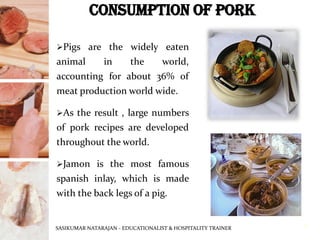
➢Pigs are the widely eaten
animal in the world,
accounting for about 36% of
meat production world wide.
➢As the result , large numbers
of pork recipes are developed
throughout the world.
➢Jamon is the most famous
spanish inlay, which is made
with the back legs of a pig.
SASIKUMAR NATARAJAN - EDUCATIONALIST & HOSPITALITY TRAINER
4
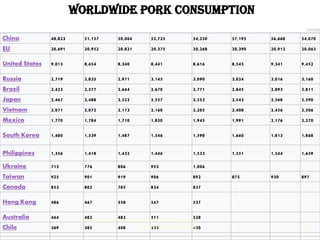
Country 2009 2010 2011 2012 2013 2014 2015 2016
China 48,823 51,157 50,004 52,725 54,250 57,195 56,668 54,070
EU 20,691 20,952 20,821 20,375 20,268 20,390 20,913 20,062
United States 9,013 8,654 8,340 8,441 8,616 8,545 9,341 9,452
Russia 2,719 2,835 2,971 3,145 3,090 3,024 3,016 3,160
Brazil 2,423 2,577 2,644 2,670 2,771 2,845 2,893 2,811
Japan 2,467 2,488 2,522 2,557 2,553 2,543 2,568 2,590
Vietnam 2,071 2,072 2,113 2,160 2,205 2,408 2,456 2,506
Mexico 1,770 1,784 1,710 1,850 1,945 1,991 2,176 2,270
South Korea 1,480 1,539 1,487 1,546 1,598 1,660 1,813 1,868
Philippines 1,356 1,418 1,432 1,446 1,533 1,551 1,544 1,659
Ukraine 713 776 806 953 1,006
Taiwan 925 901 919 906 892 875 930 897
Canada 853 802 785 834 837
Hong Kong 486 467 558 547 537
Australia 464 482 482 511 528
Chile 369 385 408 430 430
Others 3,615 3,756 3,932 4,022 4,183 6,869 6,587 6,656
Total 100,238 103,045 101,934 105,118 107,242 109,896 109,095 108,001
Worldwide pork consumption
SASIKUMAR NATARAJAN - EDUCATIONALIST &
HOSPITALITY TRAINER 5
PORK CONSUMPTION IN ASIA
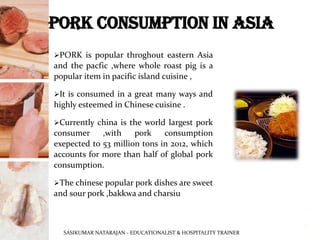
➢PORK is popular throghout eastern Asia
and the pacfic ,where whole roast pig is a
popular item in pacific island cuisine ,
➢It is consumed in a great many ways and
highly esteemed in Chinese cuisine .
➢Currently china is the world largest pork
consumer ,with pork consumption
exepected to 53 million tons in 2012, which
accounts for more than half of global pork
consumption.
➢The chinese popular pork dishes are sweet
and sour pork ,bakkwa and charsiu
SASIKUMAR NATARAJAN - EDUCATIONALIST & HOSPITALITY TRAINER
6
PORK
PRODUCTS
FRESH MEATS:
Pork may be cooked from fresh meat
or curved over time .
Cured meat products include ham
and bacon.
The carcass may be used in many
different ways for fresh meats cuts,
with the popularity of certain cuts
varying world wide
Most of the pig can be used to
produce fresh meats and in the case
of a suclkling pig, the whole body of a
youmg pig ranging in age from two to
six weeks is roasted.
SASIKUMAR NATARAJAN - EDUCATIONALIST & HOSPITALITY TRAINER
7
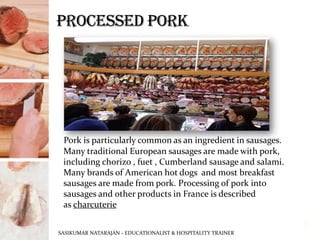
Pork is particularly common as an ingredient in sausages.
Many traditional European sausages are made with pork,
including chorizo , fuet , Cumberland sausage and salami.
Many brands of American hot dogs and most breakfast
sausages are made from pork. Processing of pork into
sausages and other products in France is described
as charcuterie
SASIKUMAR NATARAJAN - EDUCATIONALIST & HOSPITALITY TRAINER
8
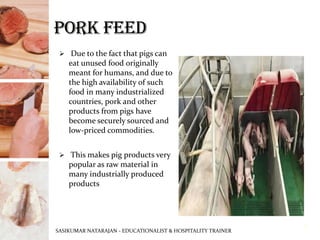
➢ Due to the fact that pigs can
eat unused food originally
meant for humans, and due to
the high availability of such
food in many industrialized
countries, pork and other
products from pigs have
become securely sourced and
low-priced commodities.
➢ This makes pig products very
popular as raw material in
many industrially produced
products
SASIKUMAR NATARAJAN - EDUCATIONALIST & HOSPITALITY TRAINER
9
SASIKUMAR NATARAJAN - EDUCATIONALIST & HOSPITALITY TRAINER
10
Cuts of pork
➢ HEAD
➢ BLADE SHOULDER
➢ SHOILDER ARM PICNIC
➢ LOIN
➢ FAT BACK
➢ SPARERIBS
➢ BELLY OR SIDE
➢ LEGS OR HAM
➢ HAM HOCK , TROTTERS ,
CHITTERLING , TAIL.
SASIKUMAR NATARAJAN - EDUCATIONALIST & HOSPITALITY TRAINER
11
➢ The head of the pig can be used
to make brawn, stocks, and
soups. After boiling, the ears can
be fried or baked and eaten
separately.
➢ The cheeks can be cured and
smoked to make jowls, known
as carrillada or carrileja in
Spanish-speaking countries.
➢ The face of Iberian pigs is
known as pestorejo or careta, and
it includes the ears and snout
(morro).
➢ The lower parts of the head are
the neck (papada) and
the amygdalae (castañetas).
➢ The tongue, which weighs
around 250 grams, is also eaten
SASIKUMAR NATARAJAN - EDUCATIONALIST & HOSPITALITY TRAINER
12
➢ Above the front limbs and behind the
head is the shoulder blade.[2]
➢ It can be boned out and rolled up as a
roasting joint, or cured as "collar
bacon". Also known as spare rib roast
and joint, it is not to be confused with
the rack of spare ribs from the front
belly. Pork butt, despite its name, is
from the upper part of the shoulder.
➢ The Boston butt, or Boston-style
shoulder cut, comes from this area and
may contain the shoulder blade.
➢ Mexican carnitas and
Iberian aguja are also sourced from
this part.
.
SASIKUMAR NATARAJAN - EDUCATIONALIST & HOSPITALITY TRAINER 13
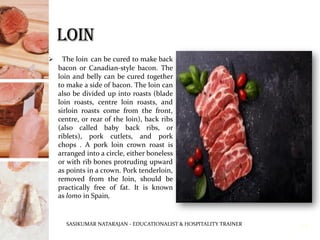
➢ The loin can be cured to make back
bacon or Canadian-style bacon. The
loin and belly can be cured together
to make a side of bacon. The loin can
also be divided up into roasts (blade
loin roasts, centre loin roasts, and
sirloin roasts come from the front,
centre, or rear of the loin), back ribs
(also called baby back ribs, or
riblets), pork cutlets, and pork
chops . A pork loin crown roast is
arranged into a circle, either boneless
or with rib bones protruding upward
as points in a crown. Pork tenderloin,
removed from the loin, should be
practically free of fat. It is known
as lomo in Spain,
SASIKUMAR NATARAJAN - EDUCATIONALIST & HOSPITALITY TRAINER 14
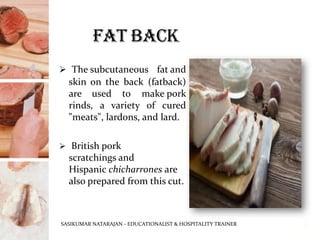
➢ The subcutaneous fat and
skin on the back (fatback)
are used to make pork
rinds, a variety of cured
"meats", lardons, and lard.
➢ British pork
scratchings and
Hispanic chicharrones are
also prepared from this cut.
SASIKUMAR NATARAJAN - EDUCATIONALIST & HOSPITALITY TRAINER 15
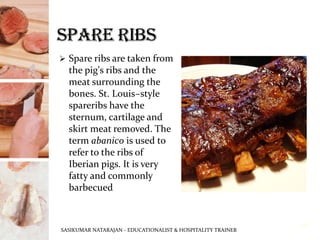
➢ Spare ribs are taken from
the pig's ribs and the
meat surrounding the
bones. St. Louis–style
spareribs have the
sternum, cartilage and
skirt meat removed. The
term abanico is used to
refer to the ribs of
Iberian pigs. It is very
fatty and commonly
barbecued
SASIKUMAR NATARAJAN - EDUCATIONALIST & HOSPITALITY TRAINER
16
➢ The belly, although a
fattier meat, can be
used for steaks or diced
as stir-fry meat. Pork
belly may be rolled for
roasting or cut
for streaky bacon. It is
the source of
Italian pancetta and
Spanish panceta.[
SASIKUMAR NATARAJAN - EDUCATIONALIST & HOSPITALITY TRAINER
17
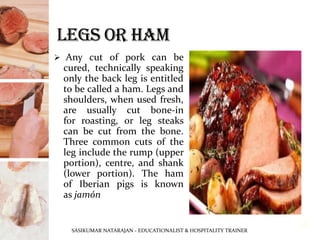
➢ Any cut of pork can be
cured, technically speaking
only the back leg is entitled
to be called a ham. Legs and
shoulders, when used fresh,
are usually cut bone-in
for roasting, or leg steaks
can be cut from the bone.
Three common cuts of the
leg include the rump (upper
portion), centre, and shank
(lower portion). The ham
of Iberian pigs is known
as jamón
SASIKUMAR NATARAJAN - EDUCATIONALIST & HOSPITALITY TRAINER
18
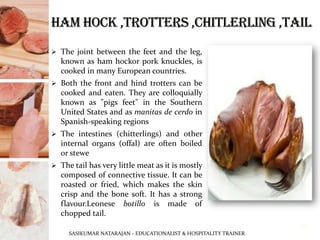
➢ The joint between the feet and the leg,
known as ham hockor pork knuckles, is
cooked in many European countries.
➢ Both the front and hind trotters can be
cooked and eaten. They are colloquially
known as "pigs feet" in the Southern
United States and as manitas de cerdo in
Spanish-speaking regions
➢ The intestines (chitterlings) and other
internal organs (offal) are often boiled
or stewe
➢ The tail has very little meat as it is mostly
composed of connective tissue. It can be
roasted or fried, which makes the skin
crisp and the bone soft. It has a strong
flavour.Leonese botillo is made of
chopped tail.
SASIKUMAR NATARAJAN - EDUCATIONALIST & HOSPITALITY TRAINER
19
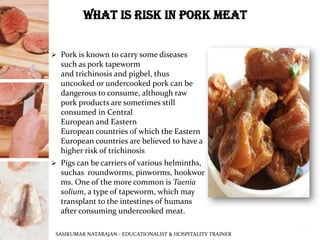
➢ Pork is known to carry some diseases
such as pork tapeworm
and trichinosis and pigbel, thus
uncooked or undercooked pork can be
dangerous to consume, although raw
pork products are sometimes still
consumed in Central
European and Eastern
European countries of which the Eastern
European countries are believed to have a
higher risk of trichinosis
➢ Pigs can be carriers of various helminths,
suchas roundworms, pinworms, hookwor
ms. One of the more common is Taenia
solium, a type of tapeworm, which may
transplant to the intestines of humans
after consuming undercooked meat.
SASIKUMAR NATARAJAN - EDUCATIONALIST & HOSPITALITY TRAINER
20
WHAT IS RISK IN PORK MEAT
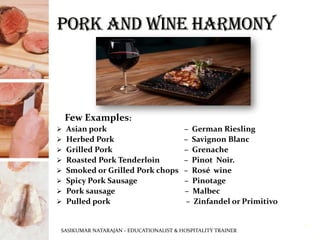
Few Examples:
➢ Asian pork – German Riesling
➢ Herbed Pork – Savignon Blanc
➢ Grilled Pork – Grenache
➢ Roasted Pork Tenderloin – Pinot Noir.
➢ Smoked or Grilled Pork chops – Rosé wine
➢ Spicy Pork Sausage – Pinotage
➢ Pork sausage – Malbec
➢ Pulled pork – Zinfandel or Primitivo
SASIKUMAR NATARAJAN - EDUCATIONALIST & HOSPITALITY TRAINER
21
➢ The meat should be stored in the coldest section of the
refrigerator. Roasts, chops and steaks can be refrigerated at
40°F or less for approximately three to four days and will
remain safe to eat while retaining the quality of the meat.
Ground pork and fresh sausage should be refrigerated for
no more than two days
SASIKUMAR NATARAJAN - EDUCATIONALIST & HOSPITALITY TRAINER 22
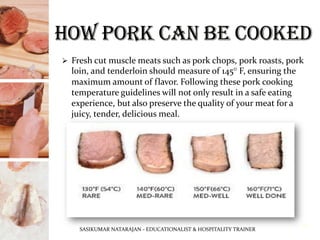
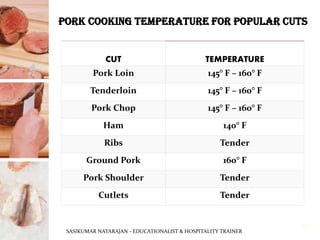
➢ Fresh cut muscle meats such as pork chops, pork roasts, pork
loin, and tenderloin should measure of 145° F, ensuring the
maximum amount of flavor. Following these pork cooking
temperature guidelines will not only result in a safe eating
experience, but also preserve the quality of your meat for a
juicy, tender, delicious meal.
SASIKUMAR NATARAJAN - EDUCATIONALIST & HOSPITALITY TRAINER
23
CUT TEMPERATURE
Pork Loin 145° F – 160° F
Tenderloin 145° F – 160° F
Pork Chop 145° F – 160° F
Ham 140° F
Ribs Tender
Ground Pork 160° F
Pork Shoulder Tender
Cutlets Tender
Pork Cooking Temperature For Popular Cuts
SASIKUMAR NATARAJAN - EDUCATIONALIST & HOSPITALITY TRAINER
24
Red-colored charsiu is one
of the popular ways to
prepare pork in Southern
China.
Sweet and sour pork,
a Chinese dish that is popular
in Europe and Americas
SASIKUMAR NATARAJAN - EDUCATIONALIST & HOSPITALITY TRAINER
25
Khao mu krop mu daeng,
Thai crispy and red pork
Bak kut the , the pork
ribs and offal soup,
of Malaysia and Singapore
SASIKUMAR NATARAJAN - EDUCATIONALIST & HOSPITALITY TRAINER 26
Gallery of dishes
Pork kielbasa, Polish sausage
Filet de Porc à la Bordelaise,
a French-style pork tenderloin.
SASIKUMAR NATARAJAN - EDUCATIONALIST & HOSPITALITY TRAINER
27
Gallery of dishes
• Online Text book
• Research Article of Mr.Yeswanth (SIHM)
• E-source
SASIKUMAR NATARAJAN - EDUCATIONALIST & HOSPITALITY TRAINER
28
cONTRIBUTOR
THANK YOU
SASIKUMAR NATARAJAN - EDUCATIONALIST & HOSPITALITY TRAINER
29

Pork

  • 1.
    SASIKUMAR NATARAJAN -EDUCATIONALIST & HOSPITALITY TRAINER 1
  • 2.
    ➢ PORK isthe culinary name for the meat of a domestic pig. It is commonly consumed meat world-wide except few gulf countries. ➢ pork is eaten both freshly cooked and preserved. Curing extends the shelf life of the pork product. Ham, smoked pork, gammon, bacon and sausage are examples of preserved pork. ➢ Charcuterie is the branch of cooking devoted to prepared meat product , many from pork. ➢ Pork is not only the most popular meat in the western world and in Central Europe, it is also very popular in the Eastern and non-Muslim parts of india, Southeastern Asia ( Indochina, Philippines, Singapore, East Timor ) and in malaysia. ➢ It is highly prized in asian cuisines for its content and pleasant texture. SASIKUMAR NATARAJAN - EDUCATIONALIST & HOSPITALITY TRAINER 2
  • 3.
    HISTORY ➢Pigs were domesticatedin Mesopotamia around 13000 BC. ➢Charcuterie is the branch of cooking devoted to prepared meat product such as bacon, ham, sausage, terrines, galantines, pates, and confit, primarily from pig. ➢Originally intended as a way to preserve meats before the advent of refrigeration, these preparation are prepared today for the flavours that are derived from the preservation processes. ➢The only “raw” meat the charcutiers were allowed to sell was unrendered lard. ➢The charcutier prepared numerous items ,including pates, rillettes, sausages, bacon, trotters, and head cheese. Pig being prepared in France during the mid- 19th century.SASIKUMAR NATARAJAN - EDUCATIONALIST & HOSPITALITY TRAINER
  • 4.
    Consumption of pork ➢Pigsare the widely eaten animal in the world, accounting for about 36% of meat production world wide. ➢As the result , large numbers of pork recipes are developed throughout the world. ➢Jamon is the most famous spanish inlay, which is made with the back legs of a pig. SASIKUMAR NATARAJAN - EDUCATIONALIST & HOSPITALITY TRAINER 4
  • 5.
    Country 2009 20102011 2012 2013 2014 2015 2016 China 48,823 51,157 50,004 52,725 54,250 57,195 56,668 54,070 EU 20,691 20,952 20,821 20,375 20,268 20,390 20,913 20,062 United States 9,013 8,654 8,340 8,441 8,616 8,545 9,341 9,452 Russia 2,719 2,835 2,971 3,145 3,090 3,024 3,016 3,160 Brazil 2,423 2,577 2,644 2,670 2,771 2,845 2,893 2,811 Japan 2,467 2,488 2,522 2,557 2,553 2,543 2,568 2,590 Vietnam 2,071 2,072 2,113 2,160 2,205 2,408 2,456 2,506 Mexico 1,770 1,784 1,710 1,850 1,945 1,991 2,176 2,270 South Korea 1,480 1,539 1,487 1,546 1,598 1,660 1,813 1,868 Philippines 1,356 1,418 1,432 1,446 1,533 1,551 1,544 1,659 Ukraine 713 776 806 953 1,006 Taiwan 925 901 919 906 892 875 930 897 Canada 853 802 785 834 837 Hong Kong 486 467 558 547 537 Australia 464 482 482 511 528 Chile 369 385 408 430 430 Others 3,615 3,756 3,932 4,022 4,183 6,869 6,587 6,656 Total 100,238 103,045 101,934 105,118 107,242 109,896 109,095 108,001 Worldwide pork consumption SASIKUMAR NATARAJAN - EDUCATIONALIST & HOSPITALITY TRAINER 5
  • 6.
    PORK CONSUMPTION INASIA ➢PORK is popular throghout eastern Asia and the pacfic ,where whole roast pig is a popular item in pacific island cuisine , ➢It is consumed in a great many ways and highly esteemed in Chinese cuisine . ➢Currently china is the world largest pork consumer ,with pork consumption exepected to 53 million tons in 2012, which accounts for more than half of global pork consumption. ➢The chinese popular pork dishes are sweet and sour pork ,bakkwa and charsiu SASIKUMAR NATARAJAN - EDUCATIONALIST & HOSPITALITY TRAINER 6
  • 7.
    PORK PRODUCTS FRESH MEATS: Pork maybe cooked from fresh meat or curved over time . Cured meat products include ham and bacon. The carcass may be used in many different ways for fresh meats cuts, with the popularity of certain cuts varying world wide Most of the pig can be used to produce fresh meats and in the case of a suclkling pig, the whole body of a youmg pig ranging in age from two to six weeks is roasted. SASIKUMAR NATARAJAN - EDUCATIONALIST & HOSPITALITY TRAINER 7
  • 8.
    Pork is particularlycommon as an ingredient in sausages. Many traditional European sausages are made with pork, including chorizo , fuet , Cumberland sausage and salami. Many brands of American hot dogs and most breakfast sausages are made from pork. Processing of pork into sausages and other products in France is described as charcuterie SASIKUMAR NATARAJAN - EDUCATIONALIST & HOSPITALITY TRAINER 8
  • 9.
    ➢ Due tothe fact that pigs can eat unused food originally meant for humans, and due to the high availability of such food in many industrialized countries, pork and other products from pigs have become securely sourced and low-priced commodities. ➢ This makes pig products very popular as raw material in many industrially produced products SASIKUMAR NATARAJAN - EDUCATIONALIST & HOSPITALITY TRAINER 9
  • 10.
    SASIKUMAR NATARAJAN -EDUCATIONALIST & HOSPITALITY TRAINER 10 Cuts of pork
  • 11.
    ➢ HEAD ➢ BLADESHOULDER ➢ SHOILDER ARM PICNIC ➢ LOIN ➢ FAT BACK ➢ SPARERIBS ➢ BELLY OR SIDE ➢ LEGS OR HAM ➢ HAM HOCK , TROTTERS , CHITTERLING , TAIL. SASIKUMAR NATARAJAN - EDUCATIONALIST & HOSPITALITY TRAINER 11
  • 12.
    ➢ The headof the pig can be used to make brawn, stocks, and soups. After boiling, the ears can be fried or baked and eaten separately. ➢ The cheeks can be cured and smoked to make jowls, known as carrillada or carrileja in Spanish-speaking countries. ➢ The face of Iberian pigs is known as pestorejo or careta, and it includes the ears and snout (morro). ➢ The lower parts of the head are the neck (papada) and the amygdalae (castañetas). ➢ The tongue, which weighs around 250 grams, is also eaten SASIKUMAR NATARAJAN - EDUCATIONALIST & HOSPITALITY TRAINER 12
  • 13.
    ➢ Above thefront limbs and behind the head is the shoulder blade.[2] ➢ It can be boned out and rolled up as a roasting joint, or cured as "collar bacon". Also known as spare rib roast and joint, it is not to be confused with the rack of spare ribs from the front belly. Pork butt, despite its name, is from the upper part of the shoulder. ➢ The Boston butt, or Boston-style shoulder cut, comes from this area and may contain the shoulder blade. ➢ Mexican carnitas and Iberian aguja are also sourced from this part. . SASIKUMAR NATARAJAN - EDUCATIONALIST & HOSPITALITY TRAINER 13
  • 14.
    ➢ The loincan be cured to make back bacon or Canadian-style bacon. The loin and belly can be cured together to make a side of bacon. The loin can also be divided up into roasts (blade loin roasts, centre loin roasts, and sirloin roasts come from the front, centre, or rear of the loin), back ribs (also called baby back ribs, or riblets), pork cutlets, and pork chops . A pork loin crown roast is arranged into a circle, either boneless or with rib bones protruding upward as points in a crown. Pork tenderloin, removed from the loin, should be practically free of fat. It is known as lomo in Spain, SASIKUMAR NATARAJAN - EDUCATIONALIST & HOSPITALITY TRAINER 14
  • 15.
    ➢ The subcutaneousfat and skin on the back (fatback) are used to make pork rinds, a variety of cured "meats", lardons, and lard. ➢ British pork scratchings and Hispanic chicharrones are also prepared from this cut. SASIKUMAR NATARAJAN - EDUCATIONALIST & HOSPITALITY TRAINER 15
  • 16.
    ➢ Spare ribsare taken from the pig's ribs and the meat surrounding the bones. St. Louis–style spareribs have the sternum, cartilage and skirt meat removed. The term abanico is used to refer to the ribs of Iberian pigs. It is very fatty and commonly barbecued SASIKUMAR NATARAJAN - EDUCATIONALIST & HOSPITALITY TRAINER 16
  • 17.
    ➢ The belly,although a fattier meat, can be used for steaks or diced as stir-fry meat. Pork belly may be rolled for roasting or cut for streaky bacon. It is the source of Italian pancetta and Spanish panceta.[ SASIKUMAR NATARAJAN - EDUCATIONALIST & HOSPITALITY TRAINER 17
  • 18.
    ➢ Any cutof pork can be cured, technically speaking only the back leg is entitled to be called a ham. Legs and shoulders, when used fresh, are usually cut bone-in for roasting, or leg steaks can be cut from the bone. Three common cuts of the leg include the rump (upper portion), centre, and shank (lower portion). The ham of Iberian pigs is known as jamón SASIKUMAR NATARAJAN - EDUCATIONALIST & HOSPITALITY TRAINER 18
  • 19.
    ➢ The jointbetween the feet and the leg, known as ham hockor pork knuckles, is cooked in many European countries. ➢ Both the front and hind trotters can be cooked and eaten. They are colloquially known as "pigs feet" in the Southern United States and as manitas de cerdo in Spanish-speaking regions ➢ The intestines (chitterlings) and other internal organs (offal) are often boiled or stewe ➢ The tail has very little meat as it is mostly composed of connective tissue. It can be roasted or fried, which makes the skin crisp and the bone soft. It has a strong flavour.Leonese botillo is made of chopped tail. SASIKUMAR NATARAJAN - EDUCATIONALIST & HOSPITALITY TRAINER 19
  • 20.
    ➢ Pork isknown to carry some diseases such as pork tapeworm and trichinosis and pigbel, thus uncooked or undercooked pork can be dangerous to consume, although raw pork products are sometimes still consumed in Central European and Eastern European countries of which the Eastern European countries are believed to have a higher risk of trichinosis ➢ Pigs can be carriers of various helminths, suchas roundworms, pinworms, hookwor ms. One of the more common is Taenia solium, a type of tapeworm, which may transplant to the intestines of humans after consuming undercooked meat. SASIKUMAR NATARAJAN - EDUCATIONALIST & HOSPITALITY TRAINER 20 WHAT IS RISK IN PORK MEAT
  • 21.
    Few Examples: ➢ Asianpork – German Riesling ➢ Herbed Pork – Savignon Blanc ➢ Grilled Pork – Grenache ➢ Roasted Pork Tenderloin – Pinot Noir. ➢ Smoked or Grilled Pork chops – Rosé wine ➢ Spicy Pork Sausage – Pinotage ➢ Pork sausage – Malbec ➢ Pulled pork – Zinfandel or Primitivo SASIKUMAR NATARAJAN - EDUCATIONALIST & HOSPITALITY TRAINER 21
  • 22.
    ➢ The meatshould be stored in the coldest section of the refrigerator. Roasts, chops and steaks can be refrigerated at 40°F or less for approximately three to four days and will remain safe to eat while retaining the quality of the meat. Ground pork and fresh sausage should be refrigerated for no more than two days SASIKUMAR NATARAJAN - EDUCATIONALIST & HOSPITALITY TRAINER 22
  • 23.
    ➢ Fresh cutmuscle meats such as pork chops, pork roasts, pork loin, and tenderloin should measure of 145° F, ensuring the maximum amount of flavor. Following these pork cooking temperature guidelines will not only result in a safe eating experience, but also preserve the quality of your meat for a juicy, tender, delicious meal. SASIKUMAR NATARAJAN - EDUCATIONALIST & HOSPITALITY TRAINER 23
  • 24.
    CUT TEMPERATURE Pork Loin145° F – 160° F Tenderloin 145° F – 160° F Pork Chop 145° F – 160° F Ham 140° F Ribs Tender Ground Pork 160° F Pork Shoulder Tender Cutlets Tender Pork Cooking Temperature For Popular Cuts SASIKUMAR NATARAJAN - EDUCATIONALIST & HOSPITALITY TRAINER 24
  • 25.
    Red-colored charsiu isone of the popular ways to prepare pork in Southern China. Sweet and sour pork, a Chinese dish that is popular in Europe and Americas SASIKUMAR NATARAJAN - EDUCATIONALIST & HOSPITALITY TRAINER 25
  • 26.
    Khao mu kropmu daeng, Thai crispy and red pork Bak kut the , the pork ribs and offal soup, of Malaysia and Singapore SASIKUMAR NATARAJAN - EDUCATIONALIST & HOSPITALITY TRAINER 26 Gallery of dishes
  • 27.
    Pork kielbasa, Polishsausage Filet de Porc à la Bordelaise, a French-style pork tenderloin. SASIKUMAR NATARAJAN - EDUCATIONALIST & HOSPITALITY TRAINER 27 Gallery of dishes
  • 28.
    • Online Textbook • Research Article of Mr.Yeswanth (SIHM) • E-source SASIKUMAR NATARAJAN - EDUCATIONALIST & HOSPITALITY TRAINER 28 cONTRIBUTOR
  • 29.
    THANK YOU SASIKUMAR NATARAJAN- EDUCATIONALIST & HOSPITALITY TRAINER 29