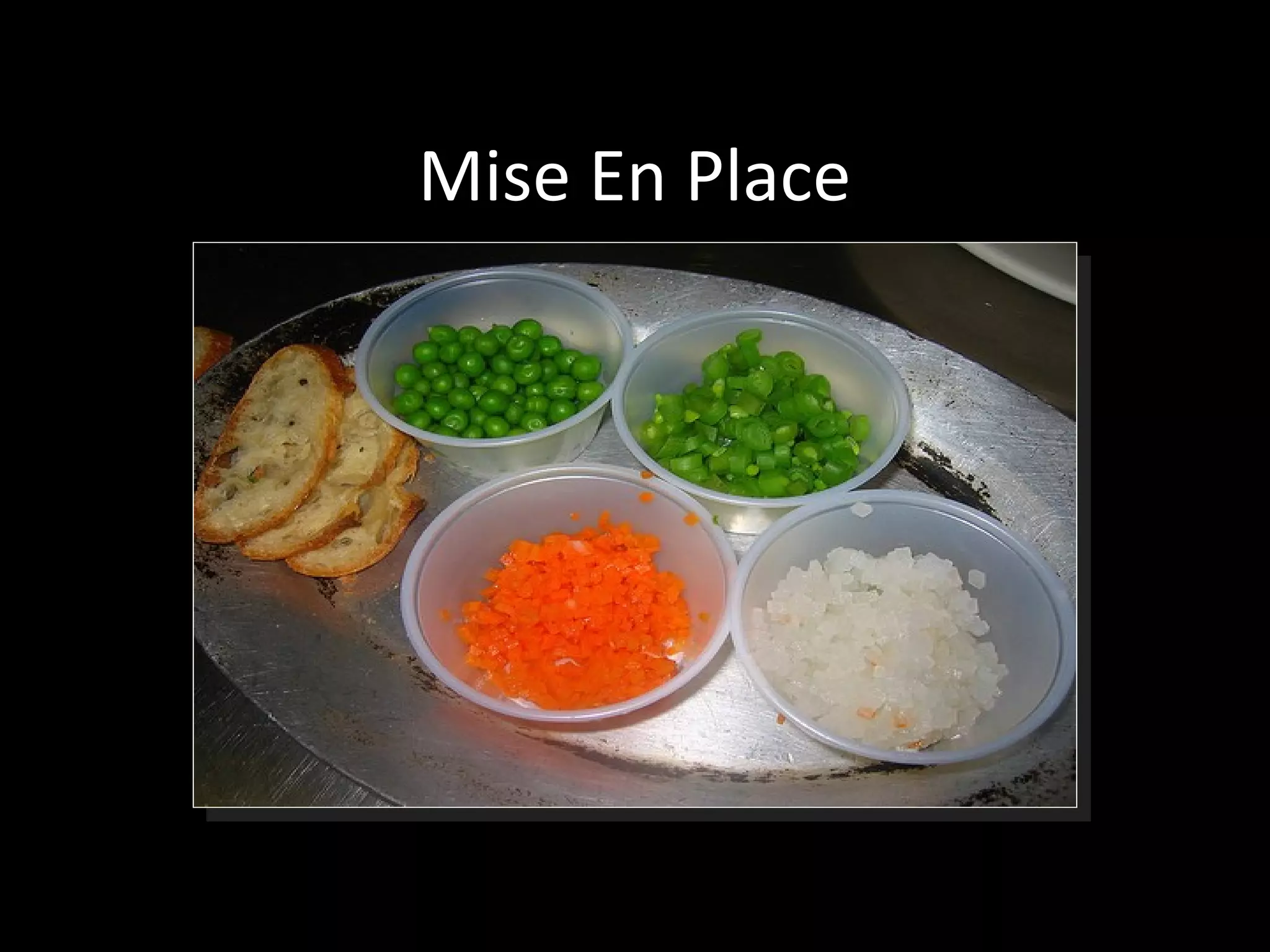
Mise En Place
• [ meez-on-plass] , literally "put in place" is
a French meaning“ everything in place", as in
set up.
• It is used in professional kitchens to refer to
the ingredients, such as cuts of meat, relishes,
sauces, par-cooked items, spices, freshly
chopped vegetables, and other components
that a cook requires for the menu items that
they expect to prepare during their shift.
Set up your work area safely and completely
before you start to work
Gather items necessary to keep your work
area safe and clean
Gather the appropriate portioning and
storage Keep foods at the best possible
temperature for prep work materials
Planning and Organizing Production
1) Assemble your tools
2) Assemble your ingredients
3) Wash, trim, cut, prepare, and measure raw
materials
4) Prepare your equipment
5) Pre heat the oven, line baking sheets, etc.
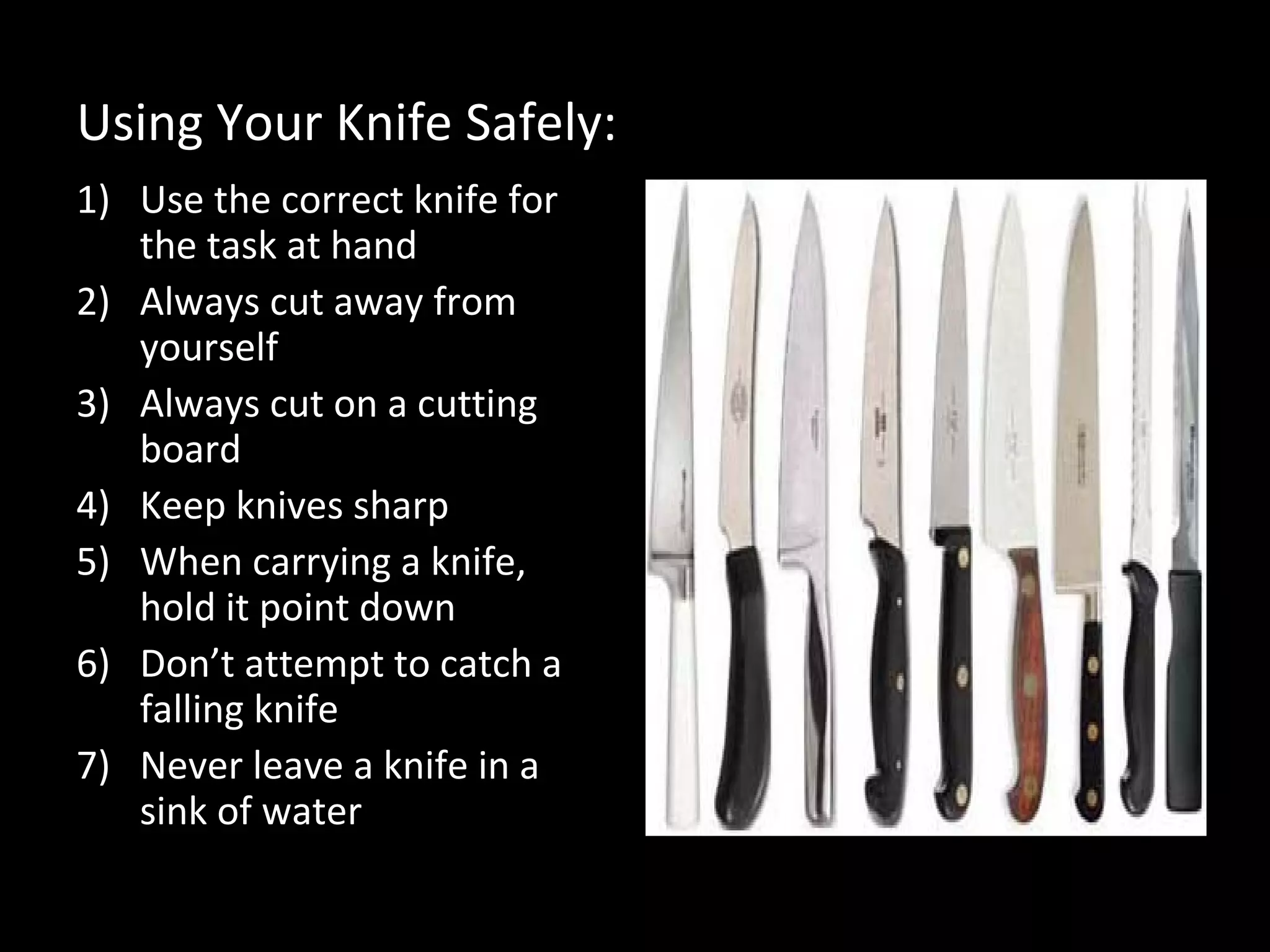
Using Your Knife Safely:
1) Use the correct knife for
the task at hand
2) Always cut away from
yourself
3) Always cut on a cutting
board
4) Keep knives sharp
5) When carrying a knife,
hold it point down
6) Don’t attempt to catch a
falling knife
7) Never leave a knife in a
sink of water
Handling the Knife
• The Grip – gives you maximum control over
the knife. The proper grip increases your
cutting accuracy and speed, it prevents
slipping , lessens the chance of accident.
• The Guiding Hand –
1) Hold the item being cut firmly
2) Guide the knife
4 Basic Grips
• Grip the handle with all
four fingers and hold
the
• thumb gently but firmly
against the blade’s
spine
4 Basic Grips
• Grip the handle with all
four fingers and hold
the
• thumb gently but firmly
against the side of the
blade
4 Basic Grips
• Grip the handle with
three fingers, rest the
index finger
• flat against the blade on
one side, and hold the
thumb
• on the opposite side to
give additional stability
4 Basic Grips
• Grip the handle
overhand, with the
knife held
• vertically – this grip is
used with a boning
knife for
• meat fabrication tasks
THE GUIDING HAND
• The fingertips are
tucked under slightly
and hold the object,
with the thumb held
back from the
fingertips. The knife
blade then rests against
the knuckles,
preventing the fingers
• from being cut.
• When you peel or trim
foods, cut them into
tournées, or flute them, you
may find yourself holding
the food in the air, above
the cutting surface. In that
case, the guiding hand
holds and turns the food
against the blade to make
the work more efficient
• cutting techniques, such
as butterflying meats or
slicing a bagel in half,
call forthe guiding hand
to be placed on top of
the food to keep it from
slipping, while the cut
• is made into the food
parallel or at an angle
to the work surface
BASIC KNIFE CUTS
Trimming, Paring, Peeling
• Trimming - removing root and stem ends from
fruits, herbs, and vegetables.
• Peeling - to strip off an outer layer using hand
or peeler
• Paring - cutting away an edge or surface using
a knife
DICE
• LARGE DICE - measuring
¾ inch × ¾ inch × ¾ inch
• MEDIUM DICE –
½ inch x ½ inch x ½ inch
• SMALL DICE –
• ¼ inch x ¼ inch x ¼ inch
BATONNET
• Pronunciation: bah-
tow-NAY
• measures ½ inch × ½
inch × 2½-3 inches.
Brunoise
• ( BROON-wahz)
• measures 1/8 inch × 1/8
inch × 1/8 inch.
Allumette
• (al-yoo-MET)
•   measuring
• ¼ inch × ¼ inch × 2½
inches.
• Also Known 
As: Matchstick cut
Julienne
• (joo-lee-ENN)
• measuring 1/8 inch ×
1/8 inch × 2½ inches.
FINE JULIENNE
1/16 inch × 1/16 inch × 2
inches.
Brunoise
• (pronounced BROON-
wahz)
• 1/8 inch × 1/8 inch ×
1/8 inch.
• FINE BRUNOISE
• 1/16 inch × 1/16 inch ×
1/16 inch.
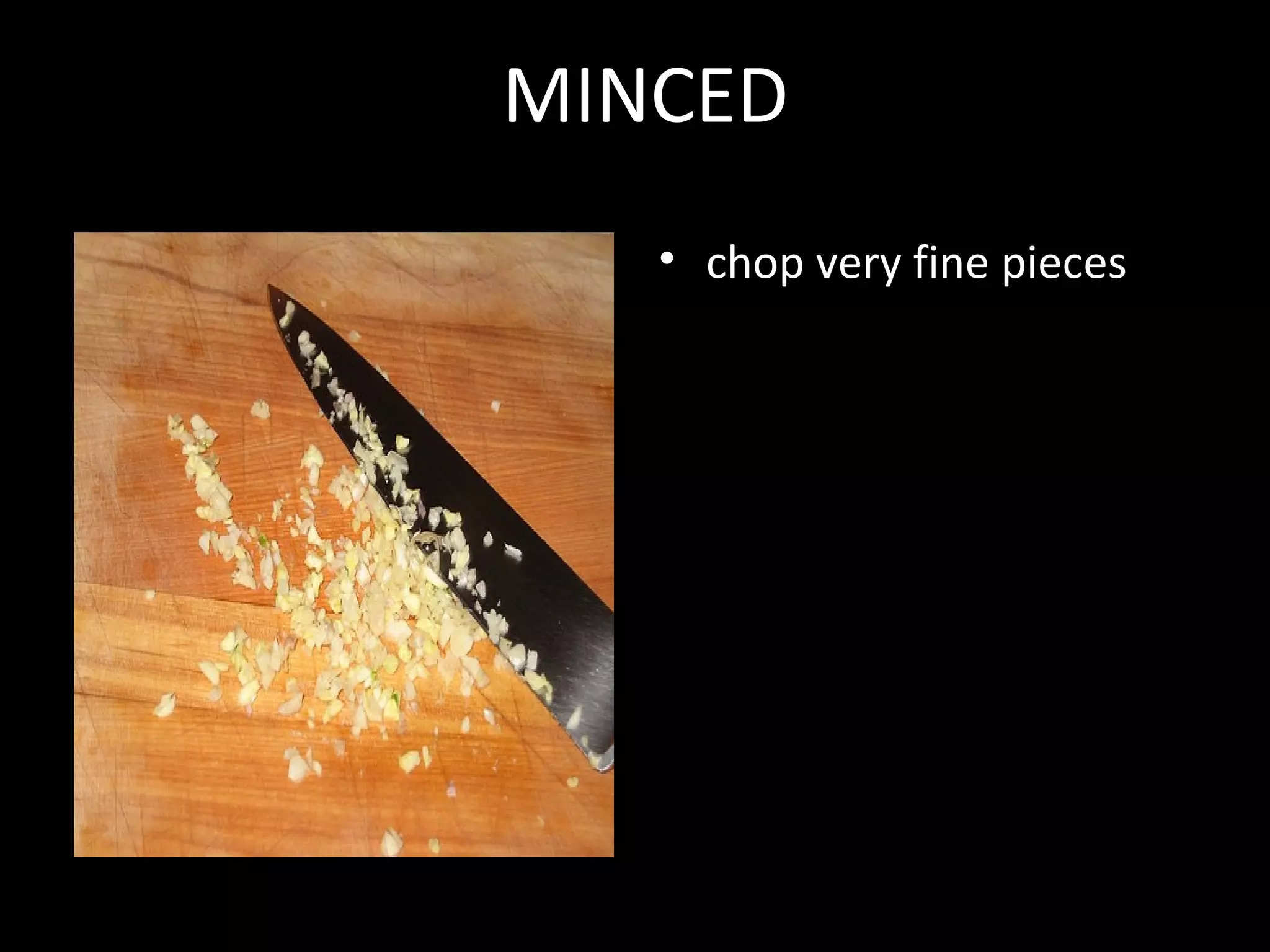
MINCED
• chop very fine pieces
Rondelle
• slant and thin
• Cut to desired
thickness, 1/8 to
1/2 inch
• (4 to 12
millimeters)
Chop
Irregular shaped pieces
Jardinere
• A long thin baton, about
2cm long and
approximately 3mm
wide and 3mm thick.
They can be slightly
larger depending on
their use.
Macedoine
• This is a diced cube,
0.5cm (5mm)
square, which is larger
than the brunoise
cut. Typical vegetables
used are carrot,
onion, turnip, beans
and celery.
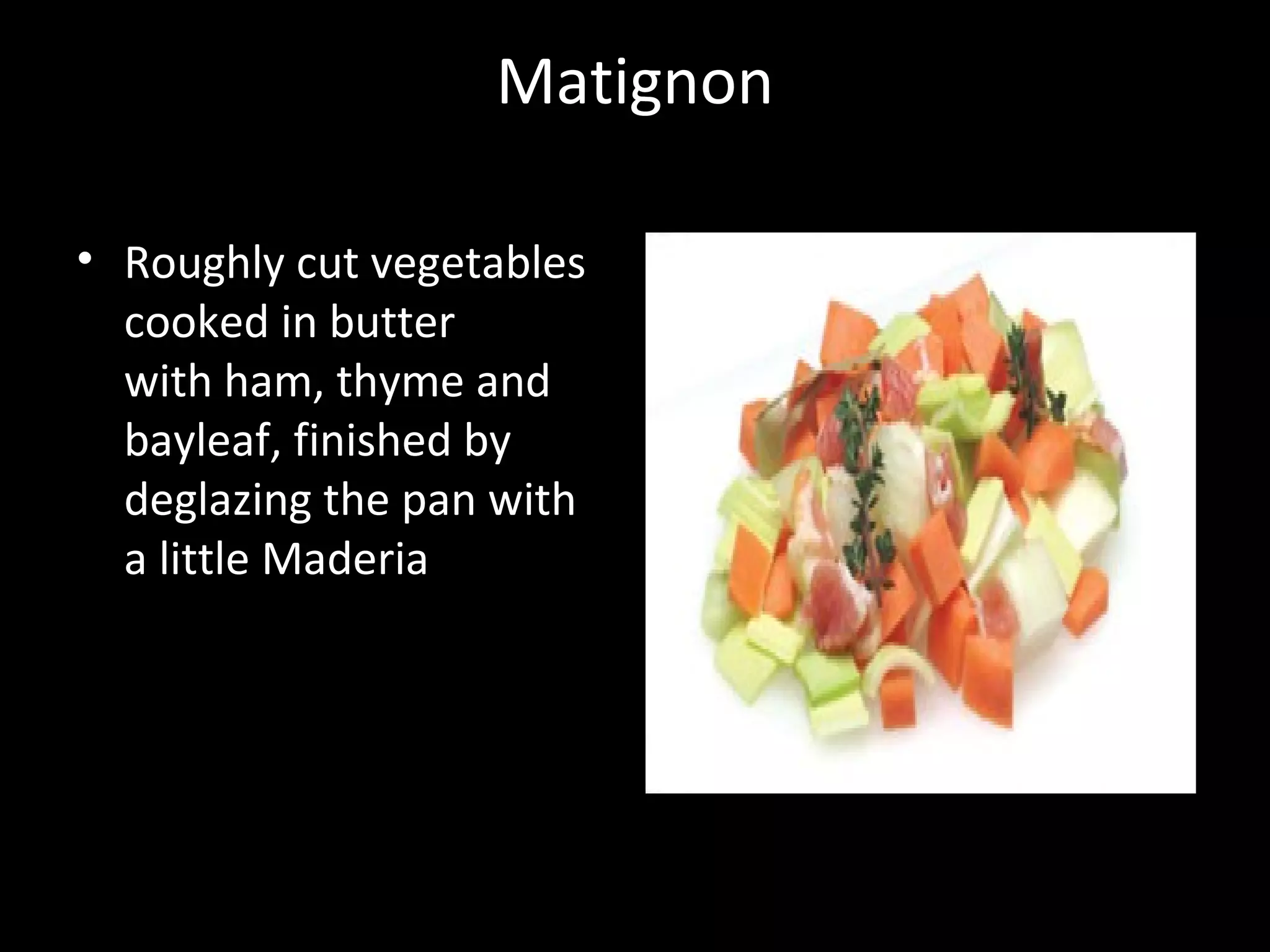
Matignon
• Roughly cut vegetables
cooked in butter
with ham, thyme and
bayleaf, finished by
deglazing the pan with
a little Maderia
Paysanne
• 1/2 x 1/2 x 1/8 inch
• (12 x 12 x 4 millimeters)
FERMIÈRE
• Cut to desired
thickness, 1/8 to 1/2
inch (4 to 12
millimeters)
LOZENGE
• Diamond shape, 1/2 x
1/2 x 1/8 inch
• (12 x 12 x 4 millimeters)
TOURNÉ
• Approximately 2 inches
(50 millimeters) long
• with seven faces

Mise en place

  • 1.
  • 2.
    • [ meez-on-plass], literally "put in place" is a French meaning“ everything in place", as in set up. • It is used in professional kitchens to refer to the ingredients, such as cuts of meat, relishes, sauces, par-cooked items, spices, freshly chopped vegetables, and other components that a cook requires for the menu items that they expect to prepare during their shift.
  • 3.
    Set up yourwork area safely and completely before you start to work Gather items necessary to keep your work area safe and clean Gather the appropriate portioning and storage Keep foods at the best possible temperature for prep work materials
  • 4.
    Planning and OrganizingProduction 1) Assemble your tools 2) Assemble your ingredients 3) Wash, trim, cut, prepare, and measure raw materials 4) Prepare your equipment 5) Pre heat the oven, line baking sheets, etc.
  • 5.
    Using Your KnifeSafely: 1) Use the correct knife for the task at hand 2) Always cut away from yourself 3) Always cut on a cutting board 4) Keep knives sharp 5) When carrying a knife, hold it point down 6) Don’t attempt to catch a falling knife 7) Never leave a knife in a sink of water
  • 6.
    Handling the Knife •The Grip – gives you maximum control over the knife. The proper grip increases your cutting accuracy and speed, it prevents slipping , lessens the chance of accident. • The Guiding Hand – 1) Hold the item being cut firmly 2) Guide the knife
  • 7.
    4 Basic Grips •Grip the handle with all four fingers and hold the • thumb gently but firmly against the blade’s spine
  • 8.
    4 Basic Grips •Grip the handle with all four fingers and hold the • thumb gently but firmly against the side of the blade
  • 9.
    4 Basic Grips •Grip the handle with three fingers, rest the index finger • flat against the blade on one side, and hold the thumb • on the opposite side to give additional stability
  • 10.
    4 Basic Grips •Grip the handle overhand, with the knife held • vertically – this grip is used with a boning knife for • meat fabrication tasks
  • 11.
  • 12.
    • The fingertipsare tucked under slightly and hold the object, with the thumb held back from the fingertips. The knife blade then rests against the knuckles, preventing the fingers • from being cut.
  • 13.
    • When youpeel or trim foods, cut them into tournées, or flute them, you may find yourself holding the food in the air, above the cutting surface. In that case, the guiding hand holds and turns the food against the blade to make the work more efficient
  • 14.
    • cutting techniques,such as butterflying meats or slicing a bagel in half, call forthe guiding hand to be placed on top of the food to keep it from slipping, while the cut • is made into the food parallel or at an angle to the work surface
  • 15.
  • 16.
    Trimming, Paring, Peeling •Trimming - removing root and stem ends from fruits, herbs, and vegetables. • Peeling - to strip off an outer layer using hand or peeler • Paring - cutting away an edge or surface using a knife
  • 17.
    DICE • LARGE DICE- measuring ¾ inch × ¾ inch × ¾ inch • MEDIUM DICE – ½ inch x ½ inch x ½ inch • SMALL DICE – • ¼ inch x ¼ inch x ¼ inch
  • 18.
    BATONNET • Pronunciation: bah- tow-NAY • measures½ inch × ½ inch × 2½-3 inches.
  • 19.
    Brunoise • ( BROON-wahz) •measures 1/8 inch × 1/8 inch × 1/8 inch.
  • 20.
    Allumette • (al-yoo-MET) •  measuring • ¼ inch × ¼ inch × 2½ inches. • Also Known  As: Matchstick cut
  • 21.
    Julienne • (joo-lee-ENN) • measuring1/8 inch × 1/8 inch × 2½ inches. FINE JULIENNE 1/16 inch × 1/16 inch × 2 inches.
  • 22.
    Brunoise • (pronounced BROON- wahz) •1/8 inch × 1/8 inch × 1/8 inch. • FINE BRUNOISE • 1/16 inch × 1/16 inch × 1/16 inch.
  • 23.
  • 24.
    Rondelle • slant andthin • Cut to desired thickness, 1/8 to 1/2 inch • (4 to 12 millimeters)
  • 25.
  • 26.
    Jardinere • A longthin baton, about 2cm long and approximately 3mm wide and 3mm thick. They can be slightly larger depending on their use.
  • 27.
    Macedoine • This isa diced cube, 0.5cm (5mm) square, which is larger than the brunoise cut. Typical vegetables used are carrot, onion, turnip, beans and celery.
  • 28.
    Matignon • Roughly cutvegetables cooked in butter with ham, thyme and bayleaf, finished by deglazing the pan with a little Maderia
  • 29.
    Paysanne • 1/2 x1/2 x 1/8 inch • (12 x 12 x 4 millimeters)
  • 30.
    FERMIÈRE • Cut todesired thickness, 1/8 to 1/2 inch (4 to 12 millimeters)
  • 31.
    LOZENGE • Diamond shape,1/2 x 1/2 x 1/8 inch • (12 x 12 x 4 millimeters)
  • 32.
    TOURNÉ • Approximately 2inches (50 millimeters) long • with seven faces