PREPARING AND
COOKING MEAT
REPORTER: KIAH LUZON
THE
DIFFERENT
CUTS OF
MEAT
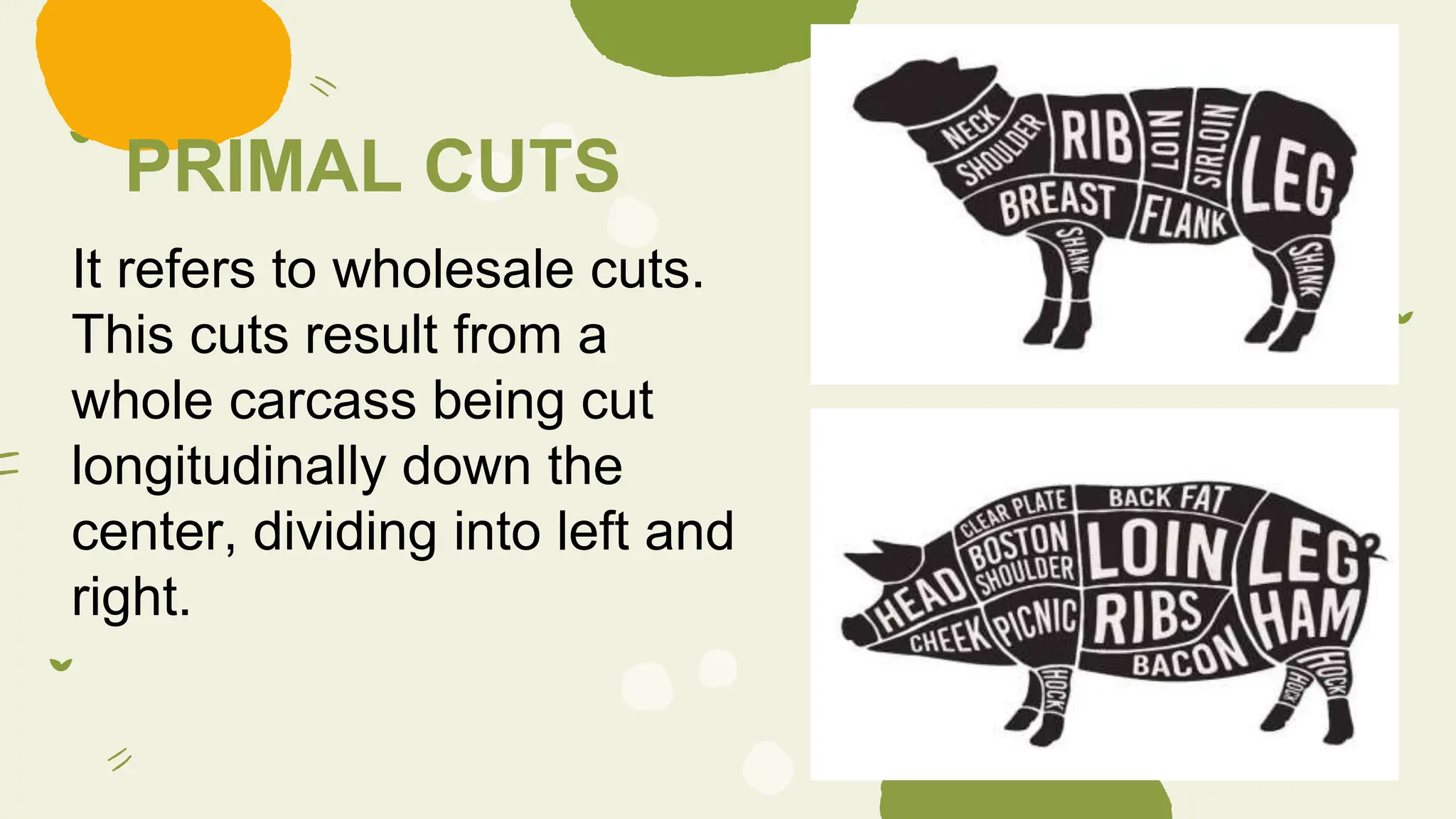
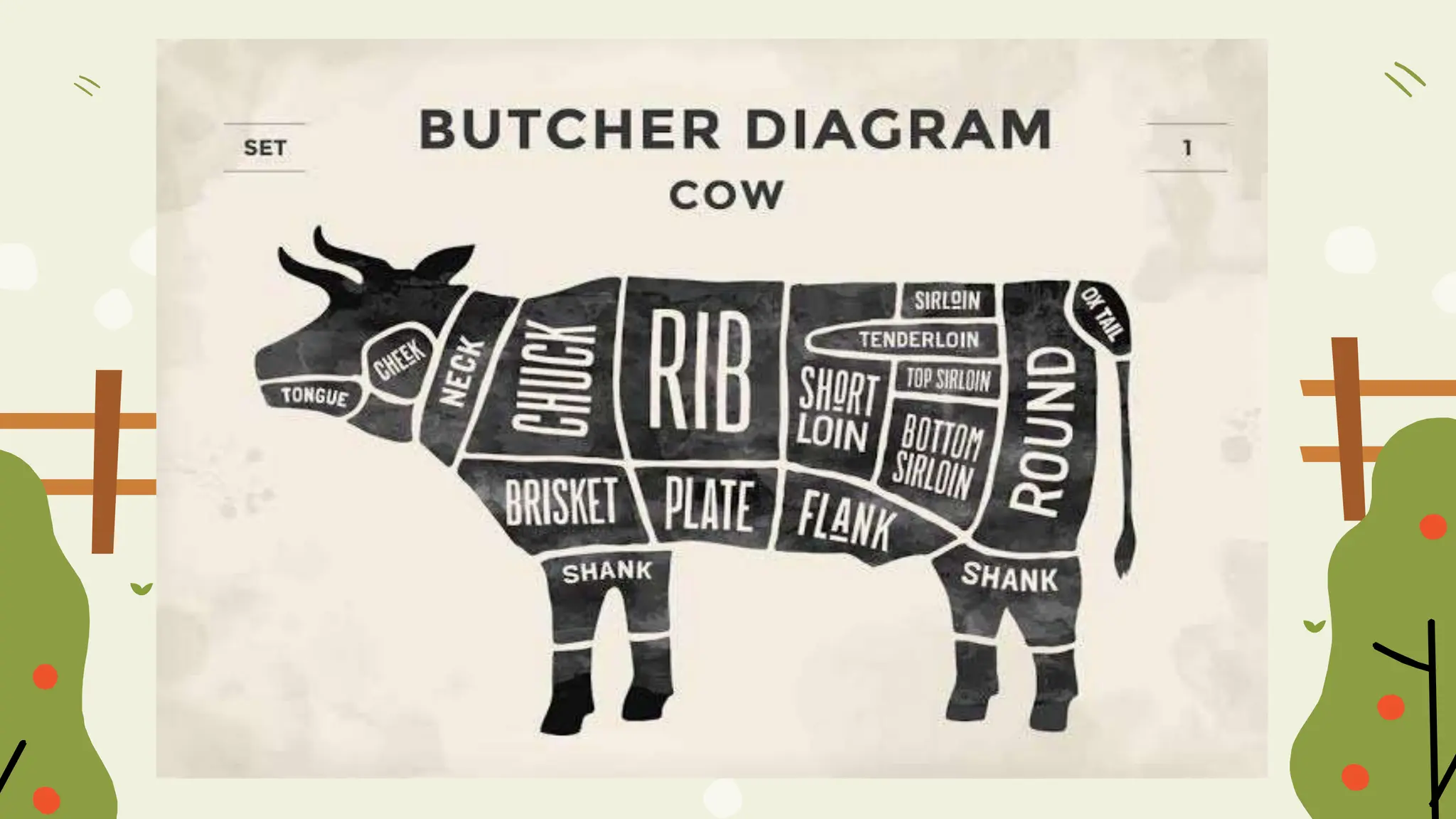
PRIMAL CUTS
It refers to wholesale cuts.
This cuts result from a
whole carcass being cut
longitudinally down the
center, dividing into left and
right.
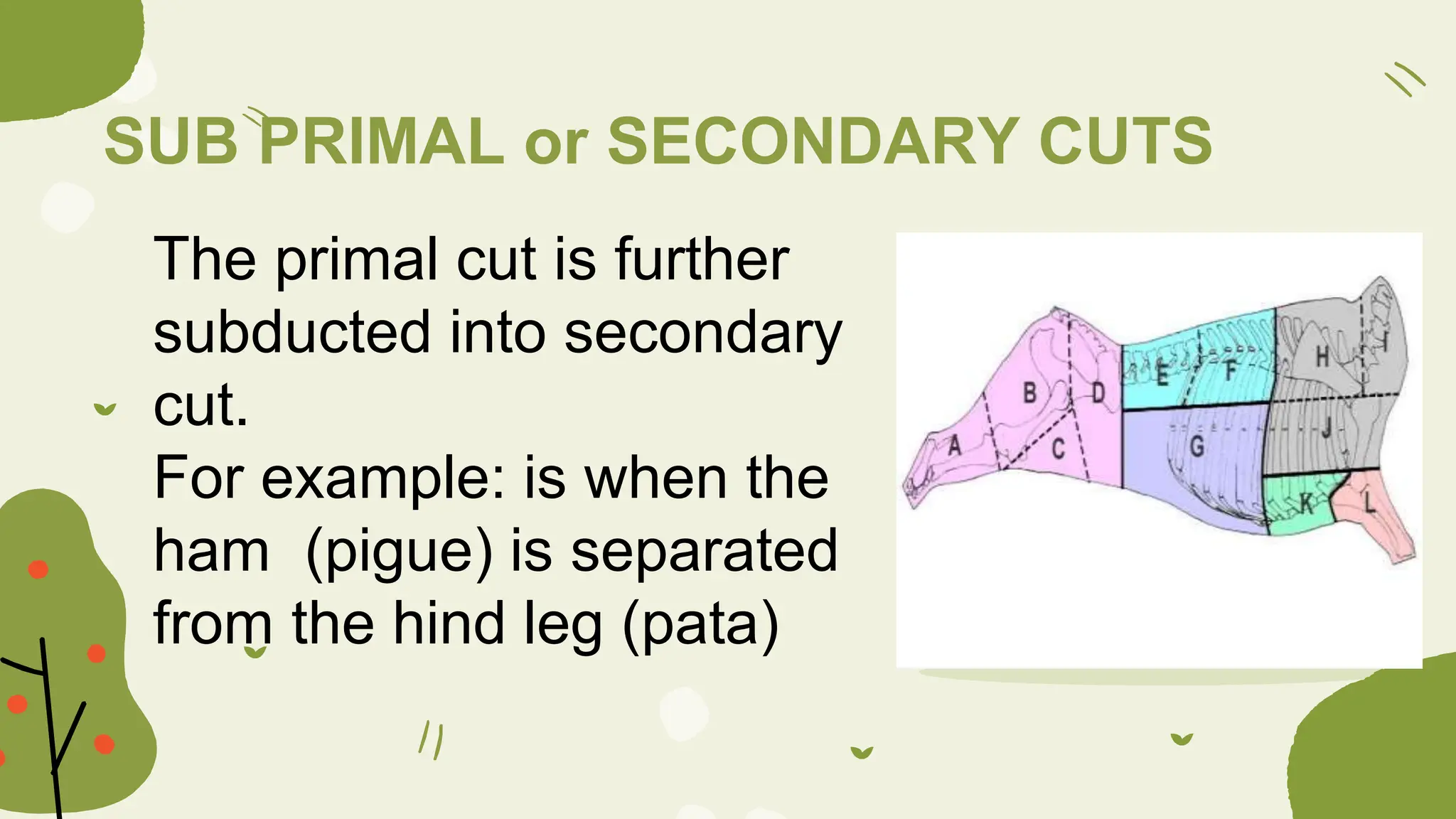
The primal cut is further
subducted into secondary
cut.
For example: is when the
ham (pigue) is separated
from the hind leg (pata)
SUB PRIMAL or SECONDARY CUTS
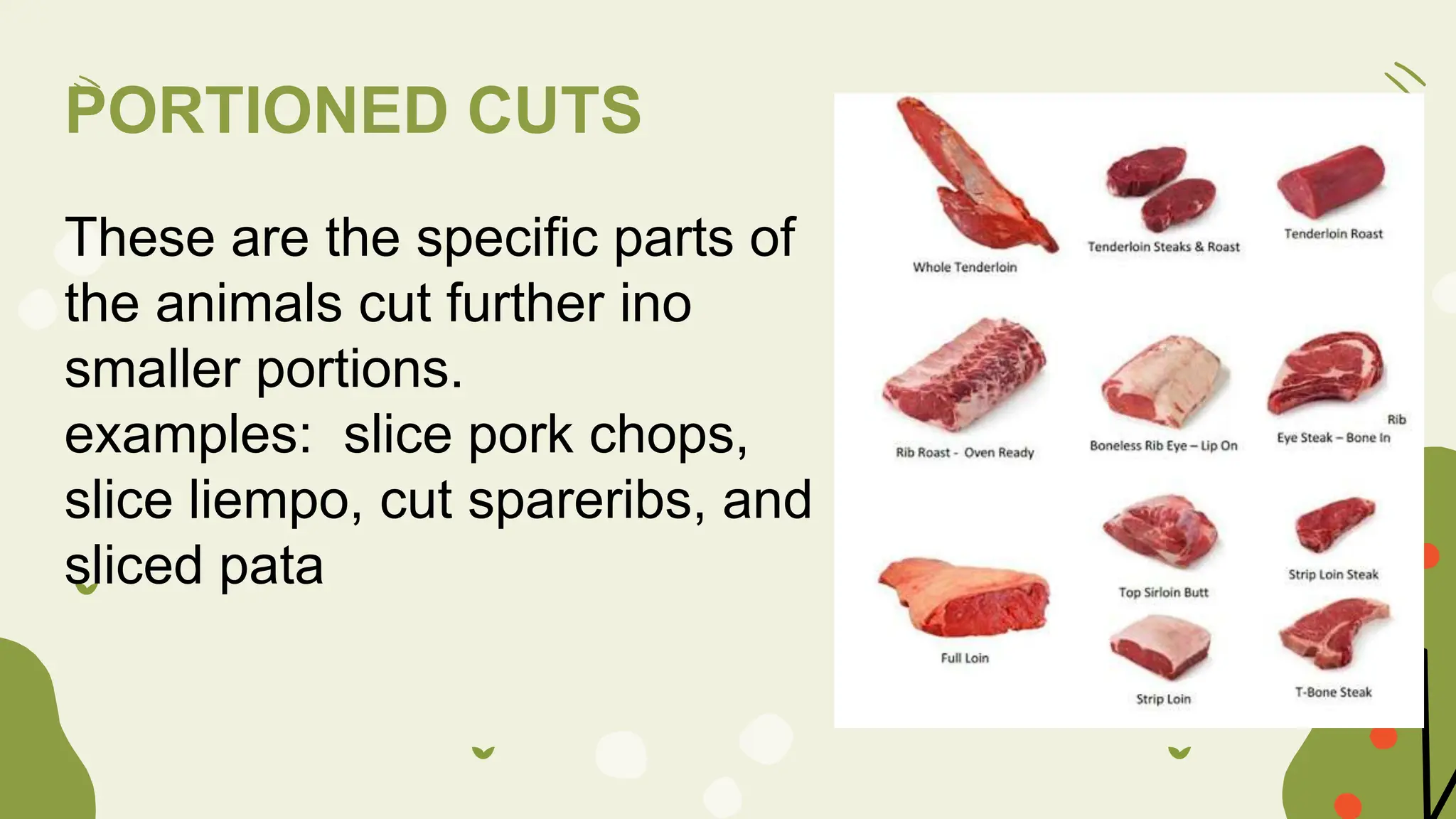
PORTIONED CUTS
These are the specific parts of
the animals cut further ino
smaller portions.
examples: slice pork chops,
slice liempo, cut spareribs, and
sliced pata
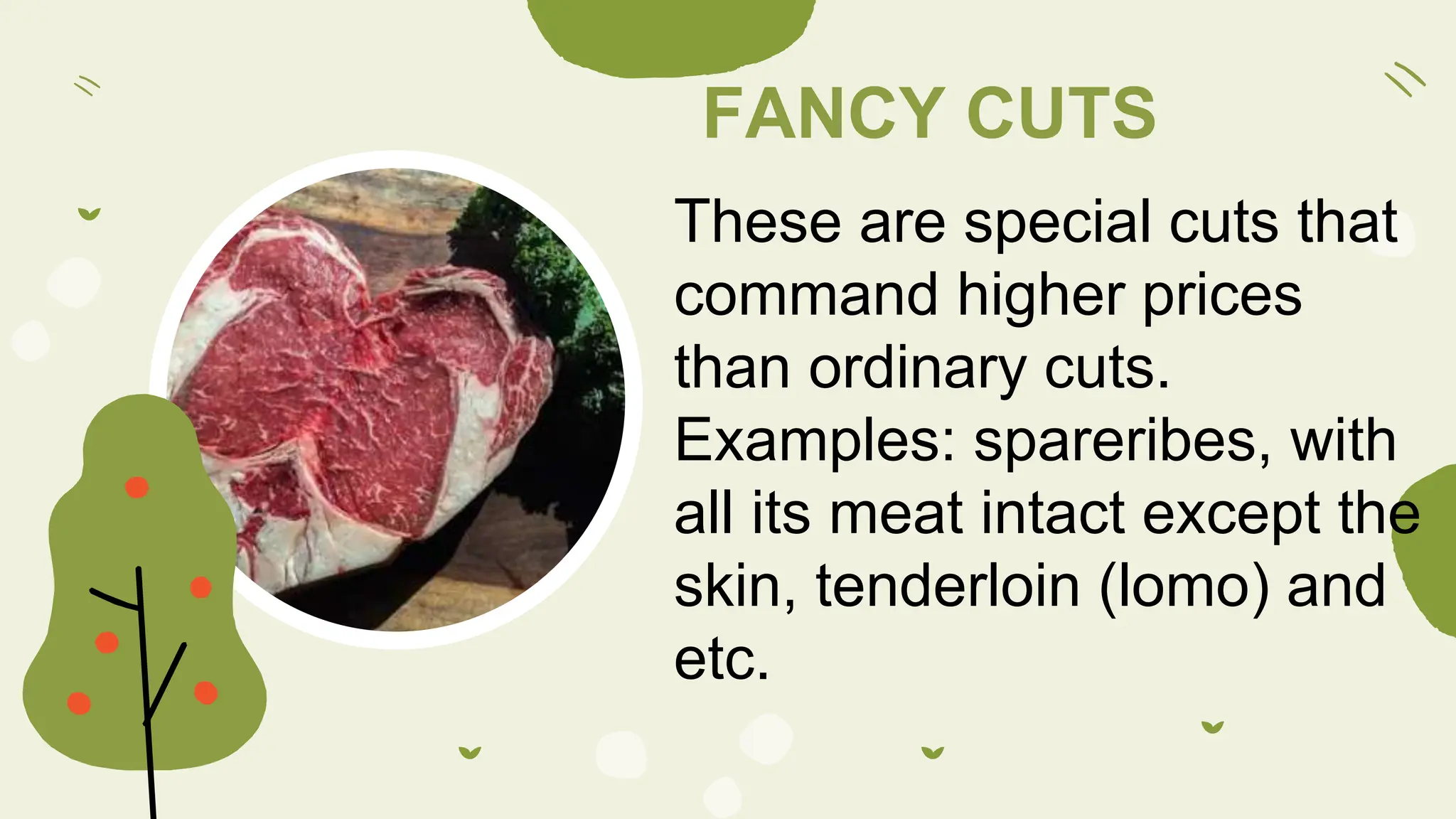
FANCY CUTS
These are special cuts that
command higher prices
than ordinary cuts.
Examples: spareribes, with
all its meat intact except the
skin, tenderloin (lomo) and
etc.
PREPARING AND PORTIONING
MEAT CUTS
1. KNIVES
● French knife– this is a wide curving and pointed blade that is usually 12’’long. use
for slicing, chopping, and mincing.
● Roast beef slicer– a long 14’’ blade that slices completely along with the roast.
● Chef’s slicer– this is 12’’ long with a pointed blade dissect around bones or slice
cooked meats.
● Butcher’s knife– a heavy blade pointed knife used in sectioning raw meat or
chopping through small bones or cartillage.
● Fruitor salad knife– this is a short 6’’ knife in various shapes used for the
preparation of fruits and vegetables
● Pairing knife– this is a veryshort knife blade for pairing fruits and vegetables.
● Cleaner– a heavy square-nose knife used to chop through bones and cartillagge.
FRENCH KNIFE ROAST BEEF
SLICER
CHEF’S SLICER
BUTCHER’S
KNIFE
FRUIT or SALAD
KNIFE
PARING
KNIFE
POTS AND PANS
1. Stockpots– these are large, round, high walled pots with
loop handles for boiling and simmering.
2. Saucepots– are large, round pots f medium depth with loop
handles for top of stove cooking where stirring or whipping
is required.
3. Braziers– these are large , heavy, shallow-walled pots with
loop handles for searing, braising, and stewing.
4. Saucepans–are large, round, shallow, heavy, straightwalled
pans with long handles
5. Sautoirs– are small, round, shallow pans with sloping sides
for quick frying for small amounts of fats.
6. Skillets– these are heavy on pans for frying or pan-broiling
STOCKPOTS SAUCEPO
TS
BRAZIERS
SAUCEPANS SAUTOIRS SKILLET
S
7. Frying pans– these are pans or light frying that are
commonly use in our kitchen
8. Double boilers– these come into two sections, with
water meant o go at the bottom section and food in the
upper covered section.
9. Roasting pan– these are large, rectangular, medium-
walled pans that come with or without cover
10. Bake pans– a large rectangular, and shallow pans
11. Sheet pans– these are rectangular and shallow
pans
FRYING
PANS
DOUBLE
BOILERS
ROASTING PANS
BAKE
PANS
SHEET
PANS
STRAINERS AND SIEVES
● Strainers– these are
perforated metal bowls
that use for draining and
straining
● Colanders– perforated
metal bowls with feet and
loop handles for draing
salad ingredients after
washing
● Sieves– these are round
metal frames with mesh
bottoms of various gauges
for sifting dry ingredients
suuch as flour
● Scoops and Dippers–
these are use for measuring
and shaping contents
● Ladles– these are metal
cups of known capacity on
long handles use for stirring
or mixing
Meat
Thermometers
these measure the interior
temperature of the meat being
cooked
Different meat
cuts
Meat cuts that are available in open
markets and supermarkets are the
wholesale cuts and retail cuts
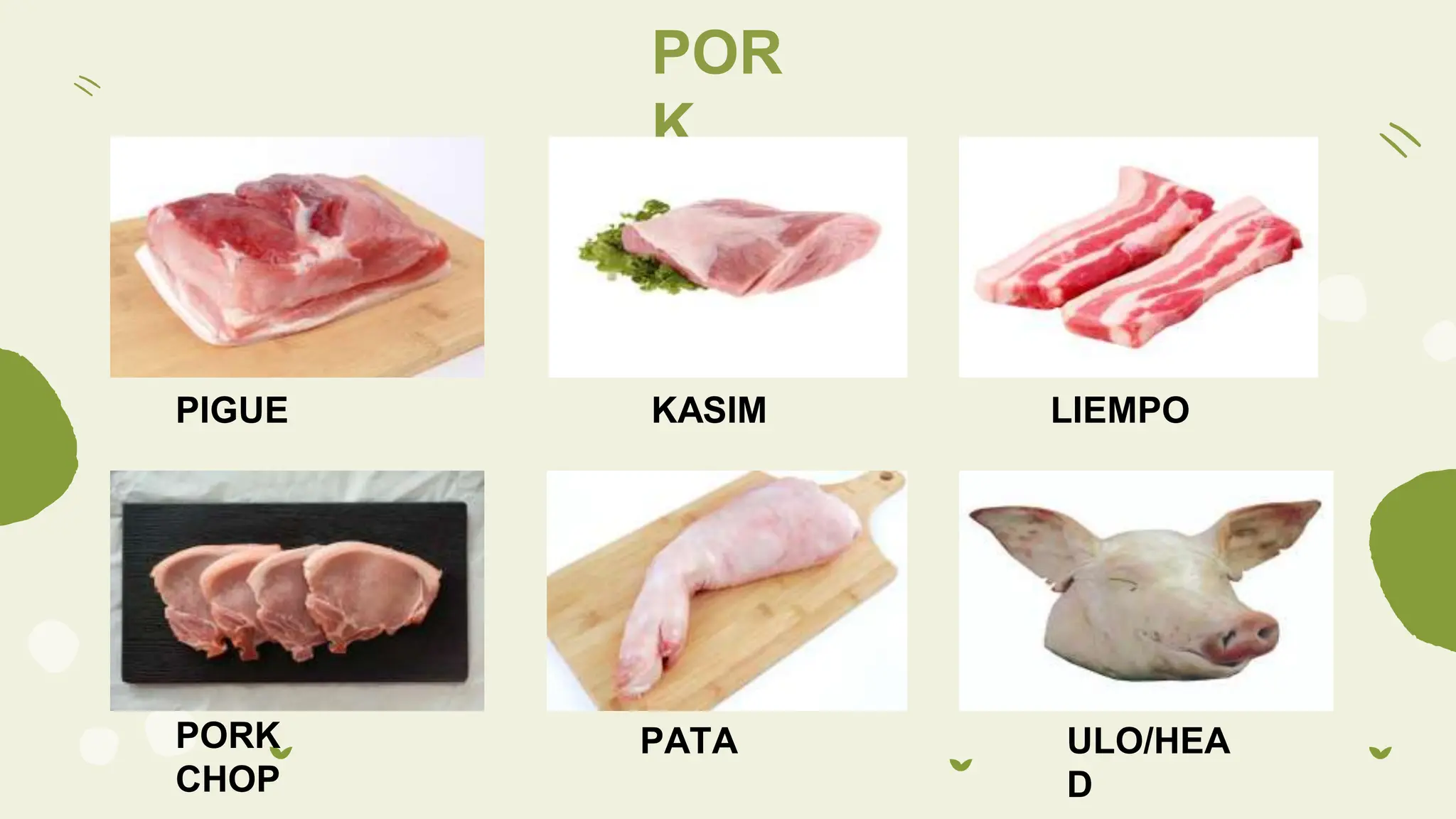
POR
K
PIGUE KASIM LIEMPO
PORK
CHOP
PATA ULO/HEA
D
LOMO SPARERIB
S
TONGU
E
HEART KIDNEY
S
LIVE
R
INTESTINES PORK
BLOOD
PANYO-
PANYO
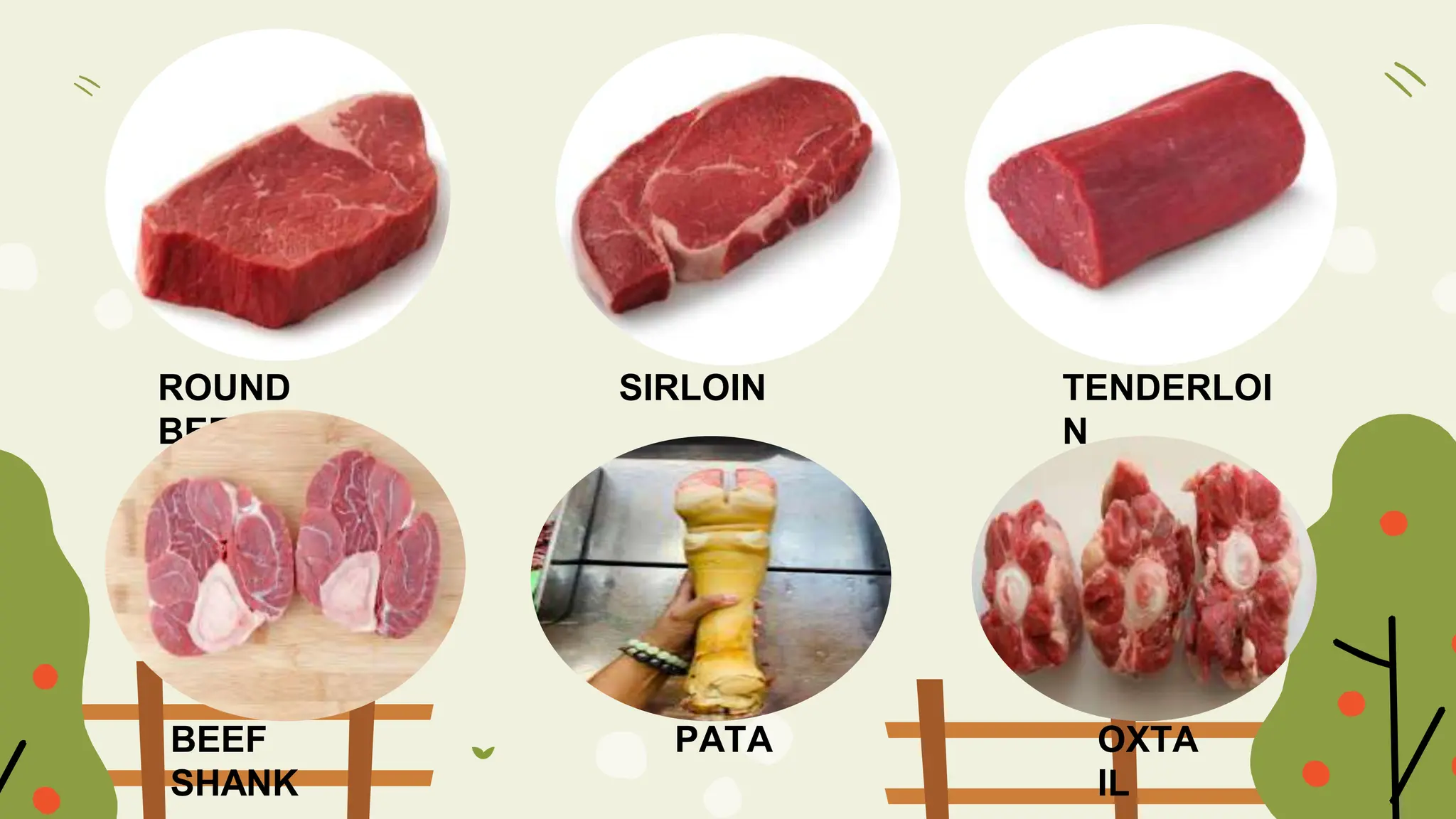
ROUND
BEEF
SIRLOIN TENDERLOI
N
BEEF
SHANK
PATA OXTA
IL
OX
BRAIN
TONGUE INTESTIN
E
HEAR
T
SPLEE
N
BEEF
BLOOD
A Picture is
Worth a
Thousand
Words

different cuts of meat

  • 1.
  • 2.
  • 3.
    PRIMAL CUTS It refersto wholesale cuts. This cuts result from a whole carcass being cut longitudinally down the center, dividing into left and right.
  • 4.
    The primal cutis further subducted into secondary cut. For example: is when the ham (pigue) is separated from the hind leg (pata) SUB PRIMAL or SECONDARY CUTS
  • 5.
    PORTIONED CUTS These arethe specific parts of the animals cut further ino smaller portions. examples: slice pork chops, slice liempo, cut spareribs, and sliced pata
  • 6.
    FANCY CUTS These arespecial cuts that command higher prices than ordinary cuts. Examples: spareribes, with all its meat intact except the skin, tenderloin (lomo) and etc.
  • 7.
    PREPARING AND PORTIONING MEATCUTS 1. KNIVES ● French knife– this is a wide curving and pointed blade that is usually 12’’long. use for slicing, chopping, and mincing. ● Roast beef slicer– a long 14’’ blade that slices completely along with the roast. ● Chef’s slicer– this is 12’’ long with a pointed blade dissect around bones or slice cooked meats. ● Butcher’s knife– a heavy blade pointed knife used in sectioning raw meat or chopping through small bones or cartillage. ● Fruitor salad knife– this is a short 6’’ knife in various shapes used for the preparation of fruits and vegetables ● Pairing knife– this is a veryshort knife blade for pairing fruits and vegetables. ● Cleaner– a heavy square-nose knife used to chop through bones and cartillagge.
  • 8.
    FRENCH KNIFE ROASTBEEF SLICER CHEF’S SLICER BUTCHER’S KNIFE FRUIT or SALAD KNIFE PARING KNIFE
  • 10.
    POTS AND PANS 1.Stockpots– these are large, round, high walled pots with loop handles for boiling and simmering. 2. Saucepots– are large, round pots f medium depth with loop handles for top of stove cooking where stirring or whipping is required. 3. Braziers– these are large , heavy, shallow-walled pots with loop handles for searing, braising, and stewing. 4. Saucepans–are large, round, shallow, heavy, straightwalled pans with long handles 5. Sautoirs– are small, round, shallow pans with sloping sides for quick frying for small amounts of fats. 6. Skillets– these are heavy on pans for frying or pan-broiling
  • 11.
  • 12.
    7. Frying pans–these are pans or light frying that are commonly use in our kitchen 8. Double boilers– these come into two sections, with water meant o go at the bottom section and food in the upper covered section. 9. Roasting pan– these are large, rectangular, medium- walled pans that come with or without cover 10. Bake pans– a large rectangular, and shallow pans 11. Sheet pans– these are rectangular and shallow pans
  • 13.
  • 14.
    STRAINERS AND SIEVES ●Strainers– these are perforated metal bowls that use for draining and straining ● Colanders– perforated metal bowls with feet and loop handles for draing salad ingredients after washing
  • 15.
    ● Sieves– theseare round metal frames with mesh bottoms of various gauges for sifting dry ingredients suuch as flour ● Scoops and Dippers– these are use for measuring and shaping contents ● Ladles– these are metal cups of known capacity on long handles use for stirring or mixing
  • 16.
    Meat Thermometers these measure theinterior temperature of the meat being cooked
  • 17.
    Different meat cuts Meat cutsthat are available in open markets and supermarkets are the wholesale cuts and retail cuts
  • 19.
  • 20.
  • 21.
  • 23.
  • 24.
  • 25.
    A Picture is Wortha Thousand Words