Community Health Needs Assessments
and Implementation Plan:
      p
Our Approach


 December 2011
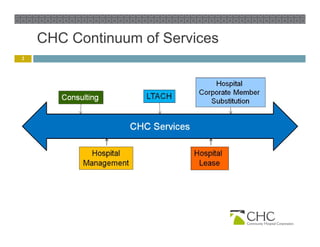
CHC Continuum of Services
2
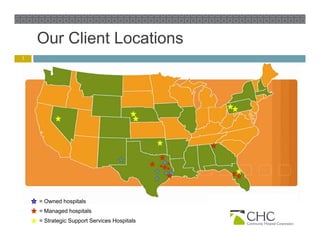
Our Client Locations
3


    = Owned hospitals
    = Managed hospitals
    = Strategic Support Services Hospitals
Community Health Needs Assessment
    Our E
    O Experience
           i
4


       We have conducted community health needs
        assessments and implementation plans for our
        Texas hospital clients for several years
         Not-for-profit hospital requirement
         Texas charity care & community benefit statute

       IRS proposed regulations are very similar to
        Texas requirements
Community Health Needs Assessment
    Background
    B k      d
5


       Patient Protection & Affordable Care Act
        specifies four new requirements for not-for-profit
        hospitals
           Conduct Community Health Needs Assessments
            (CHNA) once every three years
       Specific regulations h
        S    ifi      l i    have not b
                                      been fi li d b
                                           finalized by
        the Treasury Department
       IRS recently released Notice 2011-52
                   tl   l    d N ti 2011 52
           Describes specific provisions related to CHNA
            requirements that the IRS anticipates will be in the
            regulations
Community Health Needs Assessment
    Background
    B k      d
6


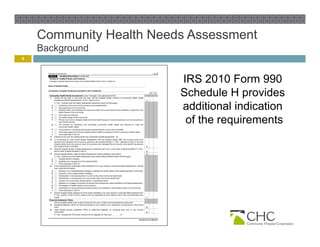
                         IRS 2010 Form 990
                         Schedule H provides
                         additional indication
                          of the requirements
Community Health Needs Assessment
Our P
O Process

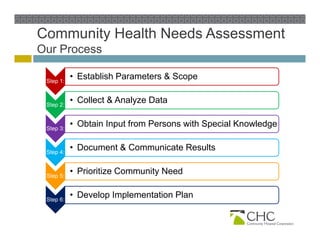
 Step 1:
           • Establish Parameters & Scope


 Step 2:
           • Collect & Analyze Data


 Step 3:
           • Obtain Input from Persons with Special Knowledge


 Step 4:
           • Document & Communicate Results


 Step 5:
           • Prioritize Community Need


 Step 6:
           • Develop Implementation Plan
The Process                                                   Step 1:
    Establish Parameters & Scope
8


       Define and map service area of the community
        served
         Geographic location ( y, county, metro area)
              g p              (city,    y,            )
         For some hospitals, could be a specific target
          population or function served
         Our recommendation - Service area based on…
             Hospitals’ patient origin
             Available data sources
             Realistic capabilities of serving community needs

       Confirm methods of data collection and gathering
                                               g       g
        input from community
The Process                                      Step 2:
    Collect & Analyze Data
9


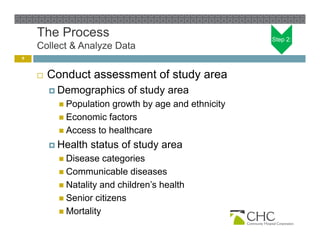
       Conduct assessment of study area
         Demographics     of study area
           Population
              p        g
                       growth by age and ethnicity
                               y g               y
           Economic factors
           Access to healthcare

         Health   status of study area
           Disease   categories
           Communicable diseases
           Natality and children’s health
           Senior citizens
           Mortality
The Process                                            Step 3:
     Obtain Input – Specific Persons
10


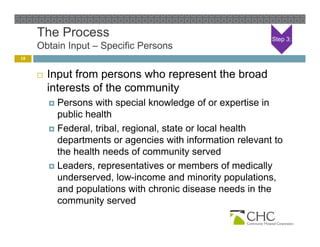
        Input from persons who represent the broad
         interests of the community
          Persons with special knowledge of or expertise in
           public health
          Federal, tribal, regional, state or local health
           departments or agencies with information relevant to
           the health needs of community served
          Leaders, representatives or members of medically
                   , p                                      y
           underserved, low-income and minority populations,
           and populations with chronic disease needs in the
           community served
The Process                                                           Step 3:
     Obtain Input – Others (optional)
11


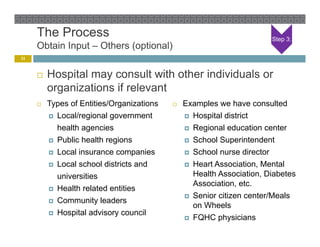
        Hospital may consult with other individuals or
         organizations if relevant
        Types of Entities/Organizations      Examples we have consulted
            Local/regional government            Hospital district
             health agencies                      Regional education center
            Public health regions                School Superintendent
            Local insurance companies            School nurse director
            Local school districts and           Heart Association, Mental
             universities                          Health Association, Diabetes
                                                   Association, etc.
            Health related entities
                                                  Senior citizen center/Meals
            Community leaders
                                                   on Wheels
            Hospital advisory council
                                                  FQHC physicians
The Process                                               Step 4:
     Document & Communicate Results
12


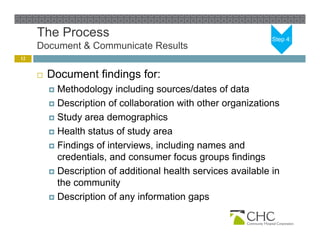
        Document findings for:
          Methodology including sources/dates of data
          Description of collaboration with other organizations
                 p                                   g
          Study area demographics

          Health status of study area

          Findings of interviews, including names and
           credentials, and consumer focus groups findings
          Description of additional health services available in
           the community
          Description of any information g p
                 p           y             gaps
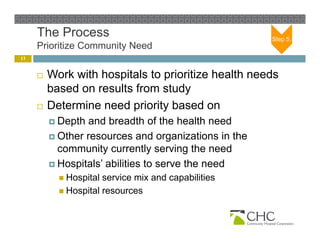
The Process                                      Step 5:
     Prioritize Community Need
13


        Work with hospitals to prioritize health needs
         based on results from study
        Determine need priority based on
          Depth  and breadth of the health need
          Other resources and organizations in the
           community currently serving the need
          Hospitals’ abilities to serve the need
            Hospital service mix and capabilities
            Hospital resources
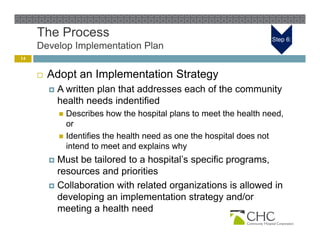
The Process                                                    Step 6:
     Develop Implementation Plan
14


        Adopt an Implementation Strategy
            A written plan that addresses each of the community
             health needs indentified
              Describes how the hospital plans to meet the health need,
               or
              Identifies the health need as one the hospital does not
                                                        p
               intend to meet and explains why
          Must be tailored to a hospital’s specific programs,
           resources and priorities
          Collaboration with related organizations is allowed in
           developing an implementation strategy and/or
                 p g         p                   gy
           meeting a health need
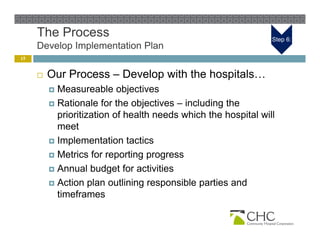
The Process                                                Step 6:
     Develop Implementation Plan
15


        Our Process – Develop with the hospitals…
          Measureable objectives
          Rationale for the objectives – including the
                                 j                g
           prioritization of health needs which the hospital will
           meet
          Implementation tactics

          Metrics for reporting progress

          Annual budget for activities

          Action plan outlining responsible parties and
           timeframes
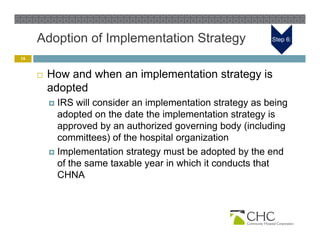
Adoption of Implementation Strategy                    Step 6:


16


        How and when an implementation strategy is
         adopted
          IRS will consider an implementation strategy as being
           adopted on the date the implementation strategy is
           approved by an authorized governing body (including
           committees) of the hospital organization
          Implementation strategy must be adopted by the end
           of the same taxable year in which it conducts that
           CHNA
Making CHNA Widely Available
          g           y
17


        Posting the written report of the CHNA on the
         hospital facility’s website
        Posting o website o a o e e y, as long as
           os g on ebs e of another entity,         o g
         there is either a link to the hospital’s CHNA or
         the hospital facility provides the website address
         where the document can be accessed
        The CHNA must remain available until such time
         that a subsequent CHNA is made available
The Team
18


        Cindy B. Matthews, Executive Vice President
                B Matthews
        Mike E. Bowers, Senior Vice President
        Lisette N. Hudson, Marketing Manager
                 N Hudson
        Laura Schieber, Marketing Consultant
        Others at CHC as needed
         Oth      t           d d
For More Information
19


           David Domingue, Director of Sales

            Community Hospital Consulting
           5801 Tennyson Parkway, Suite 550
                   Plano, TX 75074
                    972.943.6400

            www.communityhospitalcorp.com
                        y   p       p
         ddomingue@communityhospitalcorp.com

Community Health Needs Assessment Process

  • 1.
    Community Health NeedsAssessments and Implementation Plan: p Our Approach December 2011
  • 2.
    CHC Continuum ofServices 2
  • 3.
    Our Client Locations 3 = Owned hospitals = Managed hospitals = Strategic Support Services Hospitals
  • 4.
    Community Health NeedsAssessment Our E O Experience i 4  We have conducted community health needs assessments and implementation plans for our Texas hospital clients for several years  Not-for-profit hospital requirement  Texas charity care & community benefit statute  IRS proposed regulations are very similar to Texas requirements
  • 5.
    Community Health NeedsAssessment Background B k d 5  Patient Protection & Affordable Care Act specifies four new requirements for not-for-profit hospitals  Conduct Community Health Needs Assessments (CHNA) once every three years  Specific regulations h S ifi l i have not b been fi li d b finalized by the Treasury Department  IRS recently released Notice 2011-52 tl l d N ti 2011 52  Describes specific provisions related to CHNA requirements that the IRS anticipates will be in the regulations
  • 6.
    Community Health NeedsAssessment Background B k d 6 IRS 2010 Form 990 Schedule H provides additional indication of the requirements
  • 7.
    Community Health NeedsAssessment Our P O Process Step 1: • Establish Parameters & Scope Step 2: • Collect & Analyze Data Step 3: • Obtain Input from Persons with Special Knowledge Step 4: • Document & Communicate Results Step 5: • Prioritize Community Need Step 6: • Develop Implementation Plan
  • 8.
    The Process Step 1: Establish Parameters & Scope 8  Define and map service area of the community served  Geographic location ( y, county, metro area) g p (city, y, )  For some hospitals, could be a specific target population or function served  Our recommendation - Service area based on…  Hospitals’ patient origin  Available data sources  Realistic capabilities of serving community needs  Confirm methods of data collection and gathering g g input from community
  • 9.
    The Process Step 2: Collect & Analyze Data 9  Conduct assessment of study area  Demographics of study area  Population p g growth by age and ethnicity y g y  Economic factors  Access to healthcare  Health status of study area  Disease categories  Communicable diseases  Natality and children’s health  Senior citizens  Mortality
  • 10.
    The Process Step 3: Obtain Input – Specific Persons 10  Input from persons who represent the broad interests of the community  Persons with special knowledge of or expertise in public health  Federal, tribal, regional, state or local health departments or agencies with information relevant to the health needs of community served  Leaders, representatives or members of medically , p y underserved, low-income and minority populations, and populations with chronic disease needs in the community served
  • 11.
    The Process Step 3: Obtain Input – Others (optional) 11  Hospital may consult with other individuals or organizations if relevant  Types of Entities/Organizations  Examples we have consulted  Local/regional government  Hospital district health agencies  Regional education center  Public health regions  School Superintendent  Local insurance companies  School nurse director  Local school districts and  Heart Association, Mental universities Health Association, Diabetes Association, etc.  Health related entities  Senior citizen center/Meals  Community leaders on Wheels  Hospital advisory council  FQHC physicians
  • 12.
    The Process Step 4: Document & Communicate Results 12  Document findings for:  Methodology including sources/dates of data  Description of collaboration with other organizations p g  Study area demographics  Health status of study area  Findings of interviews, including names and credentials, and consumer focus groups findings  Description of additional health services available in the community  Description of any information g p p y gaps
  • 13.
    The Process Step 5: Prioritize Community Need 13  Work with hospitals to prioritize health needs based on results from study  Determine need priority based on  Depth and breadth of the health need  Other resources and organizations in the community currently serving the need  Hospitals’ abilities to serve the need  Hospital service mix and capabilities  Hospital resources
  • 14.
    The Process Step 6: Develop Implementation Plan 14  Adopt an Implementation Strategy  A written plan that addresses each of the community health needs indentified  Describes how the hospital plans to meet the health need, or  Identifies the health need as one the hospital does not p intend to meet and explains why  Must be tailored to a hospital’s specific programs, resources and priorities  Collaboration with related organizations is allowed in developing an implementation strategy and/or p g p gy meeting a health need
  • 15.
    The Process Step 6: Develop Implementation Plan 15  Our Process – Develop with the hospitals…  Measureable objectives  Rationale for the objectives – including the j g prioritization of health needs which the hospital will meet  Implementation tactics  Metrics for reporting progress  Annual budget for activities  Action plan outlining responsible parties and timeframes
  • 16.
    Adoption of ImplementationStrategy Step 6: 16  How and when an implementation strategy is adopted  IRS will consider an implementation strategy as being adopted on the date the implementation strategy is approved by an authorized governing body (including committees) of the hospital organization  Implementation strategy must be adopted by the end of the same taxable year in which it conducts that CHNA
  • 17.
    Making CHNA WidelyAvailable g y 17  Posting the written report of the CHNA on the hospital facility’s website  Posting o website o a o e e y, as long as os g on ebs e of another entity, o g there is either a link to the hospital’s CHNA or the hospital facility provides the website address where the document can be accessed  The CHNA must remain available until such time that a subsequent CHNA is made available
  • 18.
    The Team 18  Cindy B. Matthews, Executive Vice President B Matthews  Mike E. Bowers, Senior Vice President  Lisette N. Hudson, Marketing Manager N Hudson  Laura Schieber, Marketing Consultant  Others at CHC as needed Oth t d d
  • 19.
    For More Information 19 David Domingue, Director of Sales Community Hospital Consulting 5801 Tennyson Parkway, Suite 550 Plano, TX 75074 972.943.6400 www.communityhospitalcorp.com y p p ddomingue@communityhospitalcorp.com