Population
Ecology
Population Dynamics
• Population:
•All the individuals of a species that live
together in an area
• Demography:
•The statistical study of populations,
allows predictions to be made about
how a population will change
Population Dynamics
• Three Key Features of Populations
• Size
• Density
• Dispersion
Three Key Features of Populations
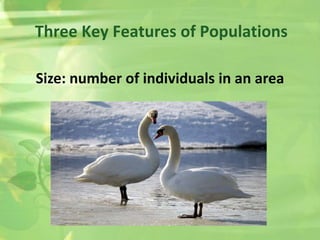
Size: number of individuals in an area
Three Key Features of Populations
• Growth Rate:
• Birth Rate (natality) - Death Rate (mortality)
• How many individuals are born vs. how many
die
• Birth rate (b) − death rate (d) = rate of natural
increase (r)
Density: measurement of population per unit
area or unit volume
Pop. Density = # of individuals ÷ unit of space
Three Key Features of Populations
1. Immigration: movement of individuals into a population
2. Emigration: movement of individuals out of a population
3. Density-dependent factors: Biotic factors in the
environment that have an increasing effect as population
size increases (disease, competition, parasites)
4. Density-independent factors: Abiotic factors in the
environment that affect populations regardless of their
density (temperature, weather)
How Do You Affect Density?
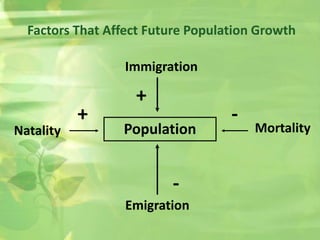
Immigration
Emigration
Natality Mortality
Population
+
+
-
-
Factors That Affect Future Population Growth
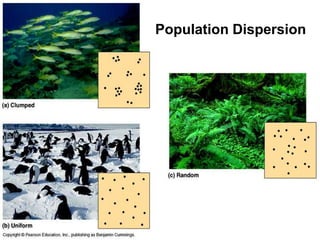
Population Dispersion
• Dispersion: describes the spacing of
organisms relative to each other
• Clumped
• Uniform
• Random
Three Key Features of Populations
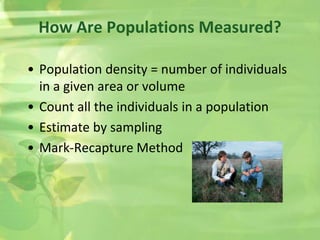
• Population density = number of individuals
in a given area or volume
• Count all the individuals in a population
• Estimate by sampling
• Mark-Recapture Method
How Are Populations Measured?
• Idealized models describe two kinds of
population growth:
1. Exponential Growth
2. Logistic Growth
How Do Populations Grow?
Carrying Capacity
• Carrying Capacity (k):
• The maximum population size that can be
supported by the available resources
• There can only be as many organisms as the
environmental resources can support
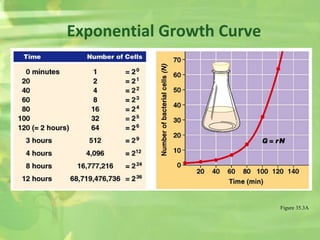
Figure 35.3A
Exponential Growth Curve
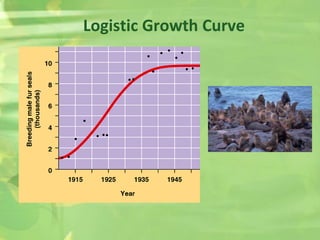
Logistic Growth Curve
• Declining birth rate or increasing death rate
are caused by several factors including:
• Limited food supply
• The buildup of toxic wastes
• Increased disease
• Predation
Factors Limiting Growth Rate
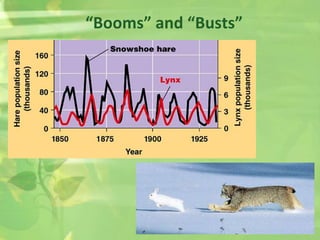
“Booms” and “Busts”
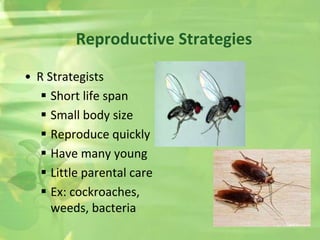
• R Strategists
 Short life span
 Small body size
 Reproduce quickly
 Have many young
 Little parental care
 Ex: cockroaches,
weeds, bacteria
Reproductive Strategies
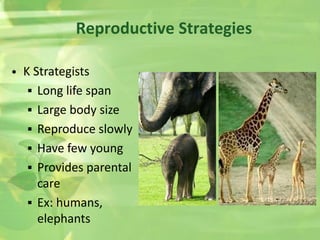
• K Strategists
 Long life span
 Large body size
 Reproduce slowly
 Have few young
 Provides parental
care
 Ex: humans,
elephants
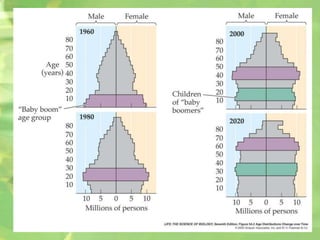
Age Distribution
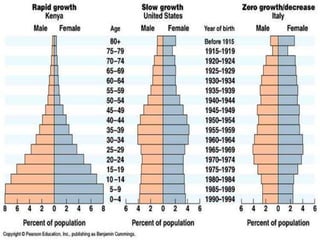
• Distribution of males and females in each age
group of a population
• Used to predict future population growth
Human Population Growth
• J curve growth
• Grows at a rate of about 80 million yearly
• r =1.3%
• Why doesn’t environmental resistance take effect?
• Altering their environment
• Technological advances
•The cultural revolution
•The agricultural revolution
•The industrial-medical revolution
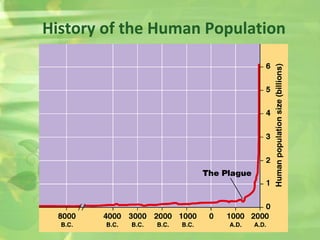
• Doubled three times in the last three centuries
• About 6.1 billion and may reach 9.3 billion by
the year 2050
• Improved health and technology have lowered
death rates
The Human Population
History of the Human Population

1589271686-14-population-ecology.ppt

  • 1.
  • 2.
    Population Dynamics • Population: •Allthe individuals of a species that live together in an area • Demography: •The statistical study of populations, allows predictions to be made about how a population will change
  • 3.
    Population Dynamics • ThreeKey Features of Populations • Size • Density • Dispersion
  • 4.
    Three Key Featuresof Populations Size: number of individuals in an area
  • 5.
    Three Key Featuresof Populations • Growth Rate: • Birth Rate (natality) - Death Rate (mortality) • How many individuals are born vs. how many die • Birth rate (b) − death rate (d) = rate of natural increase (r)
  • 7.
    Density: measurement ofpopulation per unit area or unit volume Pop. Density = # of individuals ÷ unit of space Three Key Features of Populations
  • 8.
    1. Immigration: movementof individuals into a population 2. Emigration: movement of individuals out of a population 3. Density-dependent factors: Biotic factors in the environment that have an increasing effect as population size increases (disease, competition, parasites) 4. Density-independent factors: Abiotic factors in the environment that affect populations regardless of their density (temperature, weather) How Do You Affect Density?
  • 9.
  • 10.
  • 11.
    • Dispersion: describesthe spacing of organisms relative to each other • Clumped • Uniform • Random Three Key Features of Populations
  • 12.
    • Population density= number of individuals in a given area or volume • Count all the individuals in a population • Estimate by sampling • Mark-Recapture Method How Are Populations Measured?
  • 13.
    • Idealized modelsdescribe two kinds of population growth: 1. Exponential Growth 2. Logistic Growth How Do Populations Grow?
  • 14.
    Carrying Capacity • CarryingCapacity (k): • The maximum population size that can be supported by the available resources • There can only be as many organisms as the environmental resources can support
  • 15.
  • 16.
  • 17.
    • Declining birthrate or increasing death rate are caused by several factors including: • Limited food supply • The buildup of toxic wastes • Increased disease • Predation Factors Limiting Growth Rate
  • 18.
  • 19.
    • R Strategists Short life span  Small body size  Reproduce quickly  Have many young  Little parental care  Ex: cockroaches, weeds, bacteria Reproductive Strategies
  • 20.
    Reproductive Strategies • KStrategists  Long life span  Large body size  Reproduce slowly  Have few young  Provides parental care  Ex: humans, elephants
  • 21.
    Age Distribution • Distributionof males and females in each age group of a population • Used to predict future population growth
  • 23.
    Human Population Growth •J curve growth • Grows at a rate of about 80 million yearly • r =1.3% • Why doesn’t environmental resistance take effect? • Altering their environment • Technological advances •The cultural revolution •The agricultural revolution •The industrial-medical revolution
  • 24.
    • Doubled threetimes in the last three centuries • About 6.1 billion and may reach 9.3 billion by the year 2050 • Improved health and technology have lowered death rates The Human Population
  • 25.
    History of theHuman Population