Dynamic networks of interactive learning and agricultural research for development:  three critical roles for agricultural advisory services By: Arno Maatman, Director ICRA
Co-Authors Mariana Wongtschowski, KIT Willem Heemskerk, KIT Nour Sellamna, ICRA Kristin Davis, GFRAS Silim Nahdy, AFAAS Dan Kisauzi, AFAAS Ochola Washington, RUFORUM
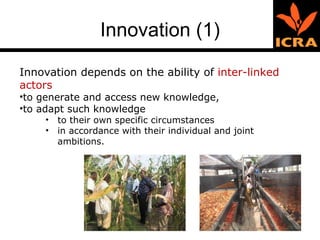
Innovation (1) Innovation depends on the ability of  inter-linked actors   to generate and access new knowledge,  to adapt such knowledge  to their own specific circumstances  in accordance with their individual and joint ambitions.
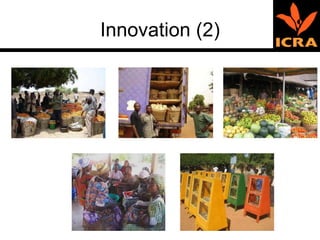
Innovation (2)
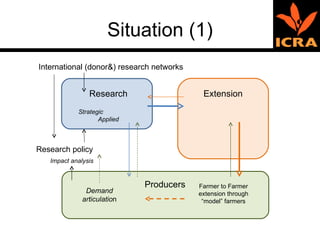
Situation (1) Strategic  Applied Research Extension Producers Research policy Demand articulatio n Farmer to Farmer extension through “model” farmers International (donor&) research networks Impact analysis
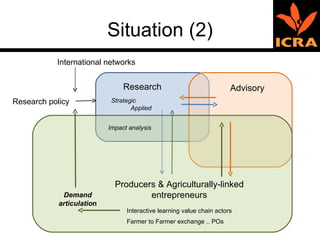
Situation (2) Strategic  Applied Research Advisory Producers & Agriculturally-linked entrepreneurs Research policy Demand articulatio n Farmer to Farmer exchange .. POs International networks Interactive learning value chain actors Impact analysis
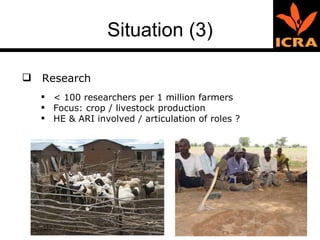
Situation (3) Research < 100 researchers per 1 million farmers Focus: crop / livestock production HE & ARI involved / articulation of roles ?
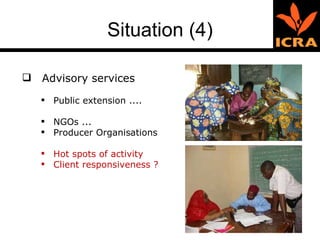
Situation (4) Advisory services Public extension .... NGOs ...  Producer Organisations  Hot spots of activity  Client responsiveness ?
Making a difference (1) IAR4D integrates the  perspectives, knowledge and actions  of different stakeholders around a  common theme IAR4D integrates the  learning  by stakeholders from  working together IAR4D   integrates analysis, action and change across the  different (social, economic, environmental) “dimensions” of development  IAR4D   integrates analysis, action and change at  different levels of spatial, economic and social organisation  From: Hawkins  et al.  (FARA, white paper on IAR4D)
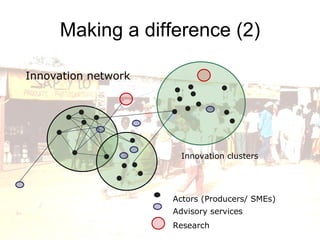
Making a difference (2) Research Actors (Producers/ SMEs) Advisory services Innovation clusters Innovation network
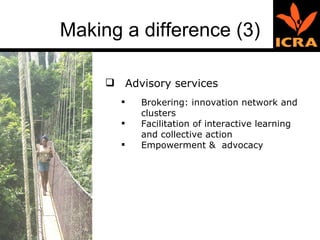
Making a difference (3) Advisory services Brokering: innovation network and clusters Facilitation of interactive learning and collective action Empowerment &  advocacy
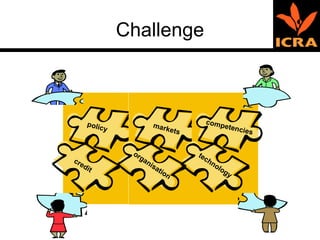
Challenge
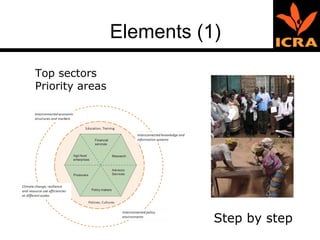
Elements (1) Step by step Top sectors Priority areas
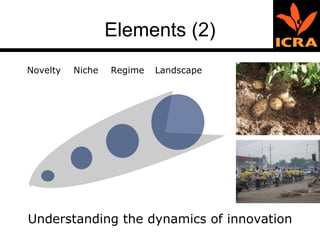
Elements (2) Understanding the dynamics of innovation Novelty  Niche  Regime Landscape
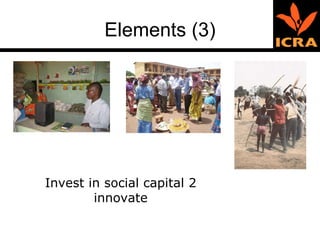
Elements (3) Invest in social capital 2 innovate
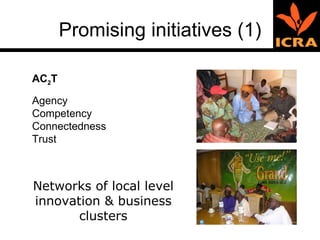
Promising initiatives (1) Networks of local level innovation & business clusters AC 2 T Agency Competency Connectedness Trust
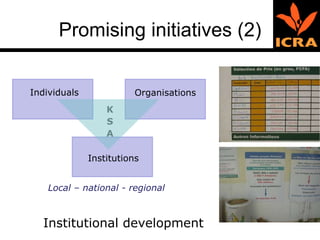
Promising initiatives (2) Institutional development Individuals Organisations Institutions K S A Local – national - regional
Thank you

Dynamic Networks of Interactive Learning and Agricultural Research for Development: Three Critical Roles for Agricultural Advisory Services

  • 1.
    Dynamic networks ofinteractive learning and agricultural research for development: three critical roles for agricultural advisory services By: Arno Maatman, Director ICRA
  • 2.
    Co-Authors Mariana Wongtschowski,KIT Willem Heemskerk, KIT Nour Sellamna, ICRA Kristin Davis, GFRAS Silim Nahdy, AFAAS Dan Kisauzi, AFAAS Ochola Washington, RUFORUM
  • 3.
    Innovation (1) Innovationdepends on the ability of inter-linked actors to generate and access new knowledge, to adapt such knowledge to their own specific circumstances in accordance with their individual and joint ambitions.
  • 4.
  • 5.
    Situation (1) Strategic Applied Research Extension Producers Research policy Demand articulatio n Farmer to Farmer extension through “model” farmers International (donor&) research networks Impact analysis
  • 6.
    Situation (2) Strategic Applied Research Advisory Producers & Agriculturally-linked entrepreneurs Research policy Demand articulatio n Farmer to Farmer exchange .. POs International networks Interactive learning value chain actors Impact analysis
  • 7.
    Situation (3) Research< 100 researchers per 1 million farmers Focus: crop / livestock production HE & ARI involved / articulation of roles ?
  • 8.
    Situation (4) Advisoryservices Public extension .... NGOs ... Producer Organisations Hot spots of activity Client responsiveness ?
  • 9.
    Making a difference(1) IAR4D integrates the perspectives, knowledge and actions of different stakeholders around a common theme IAR4D integrates the learning by stakeholders from working together IAR4D integrates analysis, action and change across the different (social, economic, environmental) “dimensions” of development IAR4D integrates analysis, action and change at different levels of spatial, economic and social organisation From: Hawkins et al. (FARA, white paper on IAR4D)
  • 10.
    Making a difference(2) Research Actors (Producers/ SMEs) Advisory services Innovation clusters Innovation network
  • 11.
    Making a difference(3) Advisory services Brokering: innovation network and clusters Facilitation of interactive learning and collective action Empowerment & advocacy
  • 12.
  • 13.
    Elements (1) Stepby step Top sectors Priority areas
  • 14.
    Elements (2) Understandingthe dynamics of innovation Novelty Niche Regime Landscape
  • 15.
    Elements (3) Investin social capital 2 innovate
  • 16.
    Promising initiatives (1)Networks of local level innovation & business clusters AC 2 T Agency Competency Connectedness Trust
  • 17.
    Promising initiatives (2)Institutional development Individuals Organisations Institutions K S A Local – national - regional
  • 18.

Editor's Notes

  • #2 This paper has much to do with me: I started as R … food sec. policies / risk mgt in agric. Sector  agribusiness devt. We look here at innovation and R – and in particular applied research – to support innovation.
  • #4 Interaction, negotiation and learning are key factors in innovation.
  • #5 Innovation = complex &amp; continuous process; tomato producers – competing Gh/ BF; several innovation challenges: seed supply; fertilization to reduce water content; organizational issues – to coordinate supply; to negotiate with the market queens; market analysis &amp; competitive intelligence; new channel options – processing/ drying  local markets
  • #6 25 years ago – I was based in BF .. Among other things as advisor to the national research org INERA  innovation then was perceived relatively easy [by me at least]  the most significant flows of info / knowledge/ ideas  R to Ext  producers
  • #7 Today .. Much more complex picture (and this is even a rude simplification): overlaps / private sector = producers + entrepreneurs
  • #8 Research .. Despite trends / reversals in trends etc .. Low researcher – farmer ratio; … (we have discussed this extensively); in addition agric research is not the unique domain of the NARI/ SROs and CG centers  arrival of universities / university outreach / action-research programs.
  • #9 Public extension went down in the 80s / 90s; NGOs filled in some of the gaps; POs are increasingly important. Nonetheless: …
  • #10 ICRA has been involved in training/ coaching of professionals in ARD also called IAR4D for over two decades; IAR4D is championed by FARA as well  together with FARA we have produced a white paper describing, among other things several examples / cases of R4D .. Not all perfect, but at least with a clear intention to make a difference. The difference is in 4 principles:
  • #11 AR4D involves the strategic positioning of R in innovation networks (formal/ informal) …
  • #12 Researchers cannot do everything alone: in our paper we argue that in order to make AR4D work – AAS play crucial complementary roles.
  • #13 The challenge is big .. For innovation to be nurtured and to go to scale – several elements of a complex puzzle have to be put together.
  • #14 However .. [picture is not readable on purpose] … while it is important to have an idea of the puzzle .. Innovation systems are best built step by step.
  • #15 Public private roles will / may change over time
  • #16 Important: innovation relies on social capital .. Pro-poor innovation  requires reducing the barriers to entry for interactive learning ! Public funding remains critical ..
  • #17 There is a lot happening …
  • #18 The argument is that R should aim to become an even more relevant/ strategic partner of producers/ entrepreneurs etc. in learning networks … [There still is room for improvement here  Sissokho ; why looking at donors; instead focus on the “client” …]