Polysemy
Report by:
Eric Dave
Buduhan
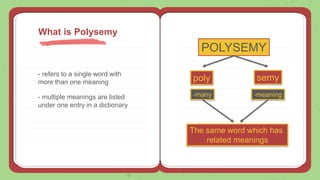
- refers to a single word with
more than one meaning
- multiple meanings are listed
under one entry in a dictionary
What is Polysemy
POLYSEMY
poly semy
-many -meaning
The same word which has
related meanings
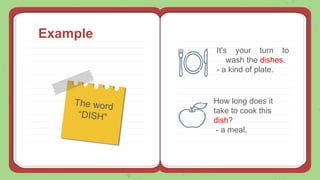
Example
It's your turn to
wash the dishes.
- a kind of plate.
How long does it
take to cook this
dish?
- a meal.
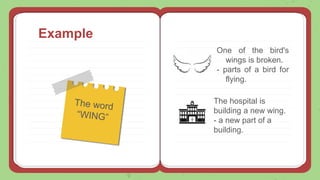
Example
One of the bird's
wings is broken.
- parts of a bird for
flying.
The hospital is
building a new wing.
- a new part of a
building.
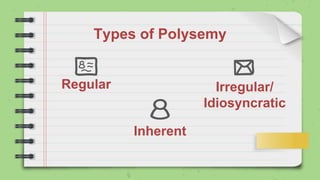
Inherent
Regular Irregular/
Idiosyncratic
Types of Polysemy
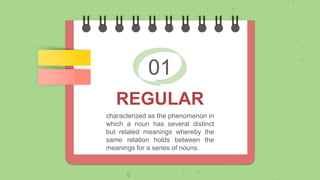
01
REGULAR
characterized as the phenomenon in
which a noun has several distinct
but related meanings whereby the
same relation holds between the
meanings for a series of nouns.
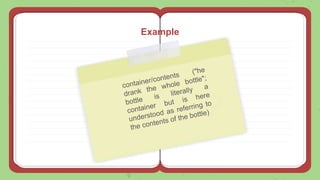
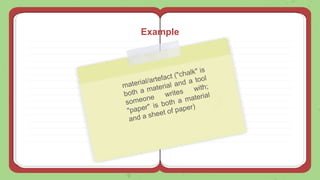
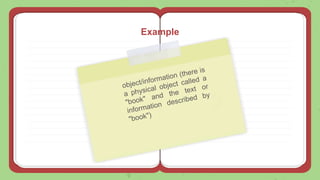
Example
Example
Example
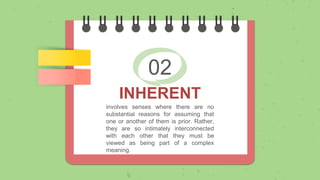
02
INHERENT
involves senses where there are no
substantial reasons for assuming that
one or another of them is prior. Rather,
they are so intimately interconnected
with each other that they must be
viewed as being part of a complex
meaning.
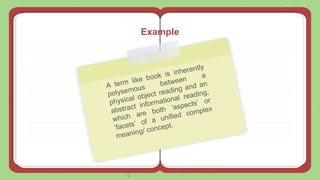
Example
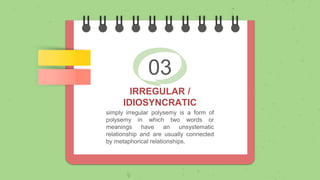
03
IRREGULAR /
IDIOSYNCRATIC
simply irregular polysemy is a form of
polysemy in which two words or
meanings have an unsystematic
relationship and are usually connected
by metaphorical relationships.
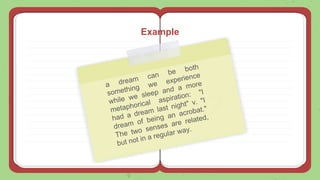
Example
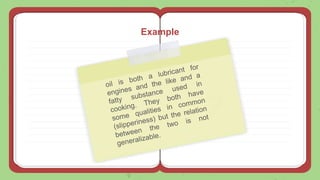
Example
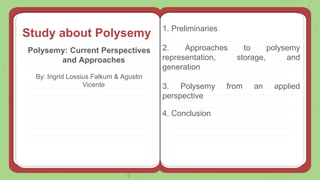
Study about Polysemy 1. Preliminaries
2. Approaches to polysemy
representation, storage, and
generation
3. Polysemy from an applied
perspective
4. Conclusion
Polysemy: Current Perspectives
and Approaches
By: Ingrid Lossius Falkum & Agustin
Vicente
01
Preliminaries
What is Polysemy?
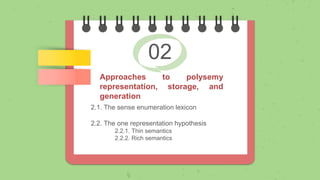
02
Approaches to polysemy
representation, storage, and
generation
2.1. The sense enumeration lexicon
2.2. The one representation hypothesis
2.2.1. Thin semantics
2.2.2. Rich semantics
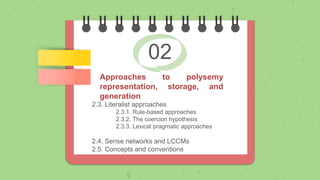
02
Approaches to polysemy
representation, storage, and
generation
2.3. Literalist approaches
2.3.1. Rule-based approaches
2.3.2. The coercion hypothesis
2.3.3. Lexical pragmatic approaches
2.4. Sense networks and LCCMs
2.5. Concepts and conventions
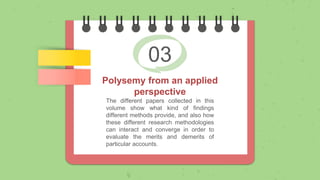
03
Polysemy from an applied
perspective
The different papers collected in this
volume show what kind of findings
different methods provide, and also how
these different research methodologies
can interact and converge in order to
evaluate the merits and demerits of
particular accounts.
04
Conclusion
Two main concerns in the contemporary
discussion have been identified: the
question of how the different senses of a
polysemous expression are represented
and stored, and the question of how
new senses arise and eventually
establish as senses of a polysemous
term.
References
Apresjan, J. D. (1974). Regular polysemy.
Falkum, I. L., & Vicente, A. (2015).
Polysemy: Current perspectives and
approaches.
Gries, S. T. (2019). Polysemy. Cognitive
Linguistics—Key Topics, 23-43.
Ravin, Y., & Leacock, C. (2000).
Polysemy: an overview. Polysemy:
Theoretical and computational
approaches, 1-29.
Vicente, A., & Falkum, I. L. (2017).
Polysemy. In Oxford research
encyclopedia of linguistics.
THANK YOU
FOR
LISTENING!
THAT
WOULD BE
ALL.

Polysemy examples and its types simple report .pptx

  • 1.
  • 2.
    - refers toa single word with more than one meaning - multiple meanings are listed under one entry in a dictionary What is Polysemy POLYSEMY poly semy -many -meaning The same word which has related meanings
  • 3.
    Example It's your turnto wash the dishes. - a kind of plate. How long does it take to cook this dish? - a meal.
  • 4.
    Example One of thebird's wings is broken. - parts of a bird for flying. The hospital is building a new wing. - a new part of a building.
  • 5.
  • 6.
    01 REGULAR characterized as thephenomenon in which a noun has several distinct but related meanings whereby the same relation holds between the meanings for a series of nouns.
  • 7.
  • 8.
  • 9.
  • 10.
    02 INHERENT involves senses wherethere are no substantial reasons for assuming that one or another of them is prior. Rather, they are so intimately interconnected with each other that they must be viewed as being part of a complex meaning.
  • 11.
  • 12.
    03 IRREGULAR / IDIOSYNCRATIC simply irregularpolysemy is a form of polysemy in which two words or meanings have an unsystematic relationship and are usually connected by metaphorical relationships.
  • 13.
  • 14.
  • 15.
    Study about Polysemy1. Preliminaries 2. Approaches to polysemy representation, storage, and generation 3. Polysemy from an applied perspective 4. Conclusion Polysemy: Current Perspectives and Approaches By: Ingrid Lossius Falkum & Agustin Vicente
  • 16.
  • 17.
    02 Approaches to polysemy representation,storage, and generation 2.1. The sense enumeration lexicon 2.2. The one representation hypothesis 2.2.1. Thin semantics 2.2.2. Rich semantics
  • 18.
    02 Approaches to polysemy representation,storage, and generation 2.3. Literalist approaches 2.3.1. Rule-based approaches 2.3.2. The coercion hypothesis 2.3.3. Lexical pragmatic approaches 2.4. Sense networks and LCCMs 2.5. Concepts and conventions
  • 19.
    03 Polysemy from anapplied perspective The different papers collected in this volume show what kind of findings different methods provide, and also how these different research methodologies can interact and converge in order to evaluate the merits and demerits of particular accounts.
  • 20.
    04 Conclusion Two main concernsin the contemporary discussion have been identified: the question of how the different senses of a polysemous expression are represented and stored, and the question of how new senses arise and eventually establish as senses of a polysemous term.
  • 21.
    References Apresjan, J. D.(1974). Regular polysemy. Falkum, I. L., & Vicente, A. (2015). Polysemy: Current perspectives and approaches. Gries, S. T. (2019). Polysemy. Cognitive Linguistics—Key Topics, 23-43. Ravin, Y., & Leacock, C. (2000). Polysemy: an overview. Polysemy: Theoretical and computational approaches, 1-29. Vicente, A., & Falkum, I. L. (2017). Polysemy. In Oxford research encyclopedia of linguistics.
  • 22.