Literature Review
Bioactive Materials
by Wanpeng Cao & Larry L. Hench
                         Sept 20th 2012


By      : Leon Valentino
Advisor : Prof. Shao-Ju Shih
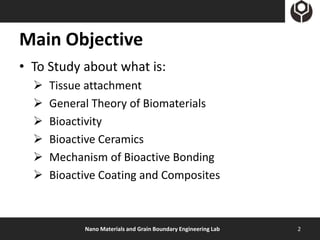
Main Objective
• To Study about what is:
     Tissue attachment
     General Theory of Biomaterials
     Bioactivity
     Bioactive Ceramics
     Mechanism of Bioactive Bonding
     Bioactive Coating and Composites


            Nano Materials and Grain Boundary Engineering Lab   2
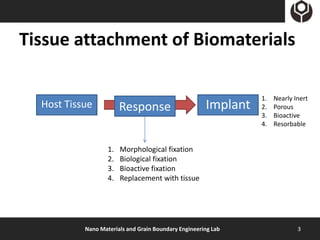
Tissue attachment of Biomaterials

                                                                1.   Nearly Inert
  Host Tissue           Response                      Implant   2.   Porous
                                                                3.   Bioactive
                                                                4.   Resorbable


                   1.   Morphological fixation
                   2.   Biological fixation
                   3.   Bioactive fixation
                   4.   Replacement with tissue


           Nano Materials and Grain Boundary Engineering Lab                 3
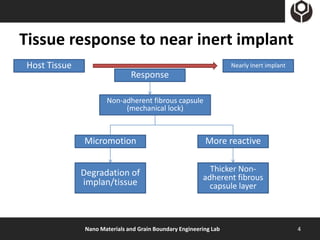
Tissue response to near inert implant
Host Tissue                                                       Nearly Inert implant
                              Response

                     Non-adherent fibrous capsule
                          (mechanical lock)


              Micromotion                                More reactive


              Degradation of                              Thicker Non-
                                                        adherent fibrous
              implan/tissue                               capsule layer


              Nano Materials and Grain Boundary Engineering Lab                          4
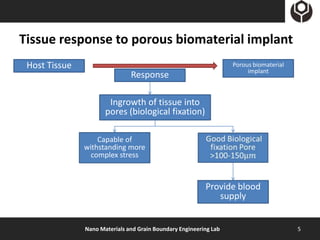
Tissue response to porous biomaterial implant
 Host Tissue                                                       Porous biomaterial
                                                                        implant
                               Response

                       Ingrowth of tissue into
                      pores (biological fixation)

                   Capable of
               withstanding more
                 complex stress


                                                          Provide blood
                                                             supply


               Nano Materials and Grain Boundary Engineering Lab                        5
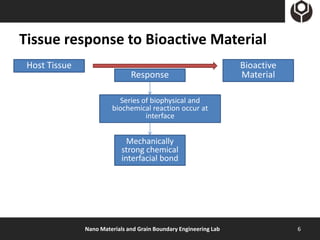
Tissue response to Bioactive Material
 Host Tissue                                                       Bioactive
                               Response                            Material

                          Series of biophysical and
                        biochemical reaction occur at
                                  interface


                              Mechanically
                            strong chemical
                            interfacial bond


               Nano Materials and Grain Boundary Engineering Lab               6
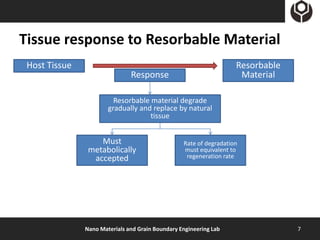
Tissue response to Resorbable Material
 Host Tissue                                                        Resorbable
                               Response                              Material

                         Resorbable material degrade
                       gradually and replace by natural
                                    tissue


                   Must                           Rate of degradation
                metabolically                     must equivalent to
                 accepted                          regeneration rate


               Nano Materials and Grain Boundary Engineering Lab                 7
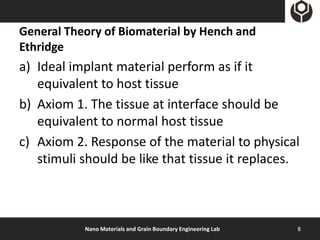
General Theory of Biomaterial by Hench and
Ethridge
a) Ideal implant material perform as if it
   equivalent to host tissue
b) Axiom 1. The tissue at interface should be
   equivalent to normal host tissue
c) Axiom 2. Response of the material to physical
   stimuli should be like that tissue it replaces.


           Nano Materials and Grain Boundary Engineering Lab   8
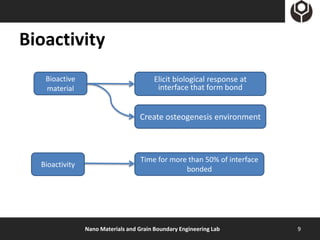
Bioactivity
   Bioactive                             Elicit biological response at
   material                               interface that form bond


                                   Create osteogenesis environment


                                    Time for more than 50% of interface
  Bioactivity
                                                 bonded


                Nano Materials and Grain Boundary Engineering Lab         9
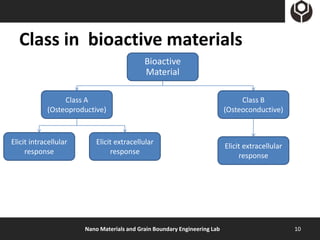
Class in bioactive materials
                                            Bioactive
                                            Material

                 Class A                                                        Class B
            (Osteoproductive)                                              (Osteoconductive)


Elicit intracellular       Elicit extracellular
                                                                           Elicit extracellular
     response                   response
                                                                                response


                       Nano Materials and Grain Boundary Engineering Lab                          10
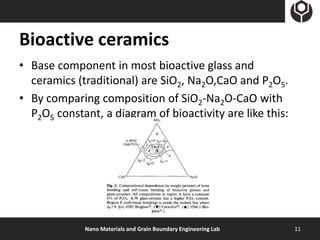
Bioactive ceramics
• Base component in most bioactive glass and
  ceramics (traditional) are SiO2, Na2O,CaO and P2O5.
• By comparing composition of SiO2-Na2O-CaO with
  P2O5 constant, a diagram of bioactivity are like this:


             Nano Materials and Grain Boundary Engineering Lab   11
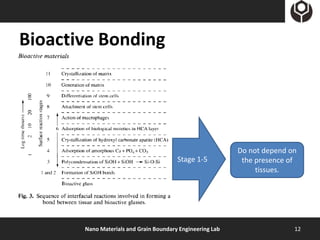
Bioactive Bonding


                                                           Do not depend on
                                        Stage 1-5           the presence of
                                                                tissues.


       Nano Materials and Grain Boundary Engineering Lab                  12
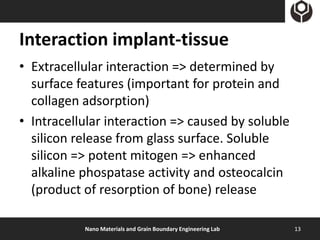
Interaction implant-tissue
• Extracellular interaction => determined by
  surface features (important for protein and
  collagen adsorption)
• Intracellular interaction => caused by soluble
  silicon release from glass surface. Soluble
  silicon => potent mitogen => enhanced
  alkaline phospatase activity and osteocalcin
  (product of resorption of bone) release

           Nano Materials and Grain Boundary Engineering Lab   13
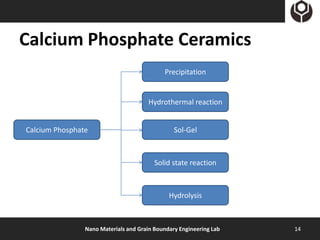
Calcium Phosphate Ceramics
                                            Precipitation


                                       Hydrothermal reaction


Calcium Phosphate                               Sol-Gel


                                         Solid state reaction


                                              Hydrolysis


                Nano Materials and Grain Boundary Engineering Lab   14
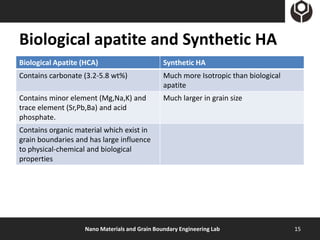
Biological apatite and Synthetic HA
Biological Apatite (HCA)                        Synthetic HA
Contains carbonate (3.2-5.8 wt%)                Much more Isotropic than biological
                                                apatite
Contains minor element (Mg,Na,K) and            Much larger in grain size
trace element (Sr,Pb,Ba) and acid
phosphate.
Contains organic material which exist in
grain boundaries and has large influence
to physical-chemical and biological
properties


                    Nano Materials and Grain Boundary Engineering Lab                 15
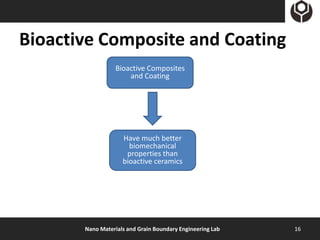
Bioactive Composite and Coating
                  Bioactive Composites
                      and Coating


                    Have much better
                      biomechanical
                     properties than
                    bioactive ceramics


       Nano Materials and Grain Boundary Engineering Lab   16
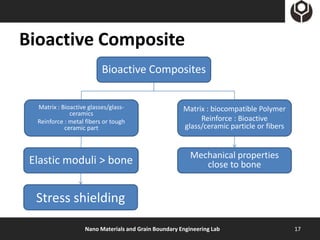
Bioactive Composite
                          Bioactive Composites


  Matrix : Bioactive glasses/glass-                   Matrix : biocompatible Polymer
              ceramics
  Reinforce : metal fibers or tough                        Reinforce : Bioactive
            ceramic part                              glass/ceramic particle or fibers


                                                         Mechanical properties
 Elastic moduli > bone                                      close to bone


  Stress shielding

                   Nano Materials and Grain Boundary Engineering Lab                     17
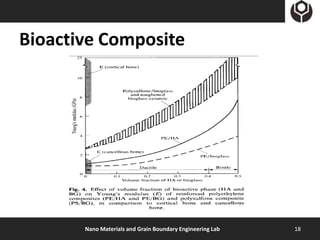
Bioactive Composite


       Nano Materials and Grain Boundary Engineering Lab   18
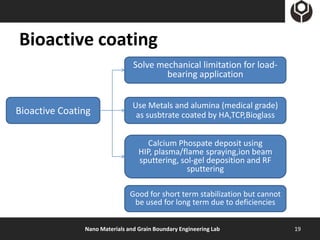
Bioactive coating
                                Solve mechanical limitation for load-
                                        bearing application


                                Use Metals and alumina (medical grade)
Bioactive Coating                as susbtrate coated by HA,TCP,Bioglass


                                     Calcium Phospate deposit using
                                  HIP, plasma/flame spraying,ion beam
                                  sputtering, sol-gel deposition and RF
                                                sputtering

                               Good for short term stabilization but cannot
                                be used for long term due to deficiencies


               Nano Materials and Grain Boundary Engineering Lab              19
Conclusion
• There are many factors influence bioactivity
  such as Morphology (surface
  morphology,pores), composition, mechanical
  properties,etc.
• To achieve biochemically and biophysically
  strong interface between host tissues-implant
  is very important


           Nano Materials and Grain Boundary Engineering Lab   20
Future Work
• Produce MBG using Sol-Gel methode for temp
  400 C and 600C


          Nano Materials and Grain Boundary Engineering Lab   21
Nano Materials and Grain Boundary Engineering Lab   22

introduction to bioactive glass

  • 1.
    Literature Review Bioactive Materials byWanpeng Cao & Larry L. Hench Sept 20th 2012 By : Leon Valentino Advisor : Prof. Shao-Ju Shih
  • 2.
    Main Objective • ToStudy about what is:  Tissue attachment  General Theory of Biomaterials  Bioactivity  Bioactive Ceramics  Mechanism of Bioactive Bonding  Bioactive Coating and Composites Nano Materials and Grain Boundary Engineering Lab 2
  • 3.
    Tissue attachment ofBiomaterials 1. Nearly Inert Host Tissue Response Implant 2. Porous 3. Bioactive 4. Resorbable 1. Morphological fixation 2. Biological fixation 3. Bioactive fixation 4. Replacement with tissue Nano Materials and Grain Boundary Engineering Lab 3
  • 4.
    Tissue response tonear inert implant Host Tissue Nearly Inert implant Response Non-adherent fibrous capsule (mechanical lock) Micromotion More reactive Degradation of Thicker Non- adherent fibrous implan/tissue capsule layer Nano Materials and Grain Boundary Engineering Lab 4
  • 5.
    Tissue response toporous biomaterial implant Host Tissue Porous biomaterial implant Response Ingrowth of tissue into pores (biological fixation) Capable of withstanding more complex stress Provide blood supply Nano Materials and Grain Boundary Engineering Lab 5
  • 6.
    Tissue response toBioactive Material Host Tissue Bioactive Response Material Series of biophysical and biochemical reaction occur at interface Mechanically strong chemical interfacial bond Nano Materials and Grain Boundary Engineering Lab 6
  • 7.
    Tissue response toResorbable Material Host Tissue Resorbable Response Material Resorbable material degrade gradually and replace by natural tissue Must Rate of degradation metabolically must equivalent to accepted regeneration rate Nano Materials and Grain Boundary Engineering Lab 7
  • 8.
    General Theory ofBiomaterial by Hench and Ethridge a) Ideal implant material perform as if it equivalent to host tissue b) Axiom 1. The tissue at interface should be equivalent to normal host tissue c) Axiom 2. Response of the material to physical stimuli should be like that tissue it replaces. Nano Materials and Grain Boundary Engineering Lab 8
  • 9.
    Bioactivity Bioactive Elicit biological response at material interface that form bond Create osteogenesis environment Time for more than 50% of interface Bioactivity bonded Nano Materials and Grain Boundary Engineering Lab 9
  • 10.
    Class in bioactivematerials Bioactive Material Class A Class B (Osteoproductive) (Osteoconductive) Elicit intracellular Elicit extracellular Elicit extracellular response response response Nano Materials and Grain Boundary Engineering Lab 10
  • 11.
    Bioactive ceramics • Basecomponent in most bioactive glass and ceramics (traditional) are SiO2, Na2O,CaO and P2O5. • By comparing composition of SiO2-Na2O-CaO with P2O5 constant, a diagram of bioactivity are like this: Nano Materials and Grain Boundary Engineering Lab 11
  • 12.
    Bioactive Bonding Do not depend on Stage 1-5 the presence of tissues. Nano Materials and Grain Boundary Engineering Lab 12
  • 13.
    Interaction implant-tissue • Extracellularinteraction => determined by surface features (important for protein and collagen adsorption) • Intracellular interaction => caused by soluble silicon release from glass surface. Soluble silicon => potent mitogen => enhanced alkaline phospatase activity and osteocalcin (product of resorption of bone) release Nano Materials and Grain Boundary Engineering Lab 13
  • 14.
    Calcium Phosphate Ceramics Precipitation Hydrothermal reaction Calcium Phosphate Sol-Gel Solid state reaction Hydrolysis Nano Materials and Grain Boundary Engineering Lab 14
  • 15.
    Biological apatite andSynthetic HA Biological Apatite (HCA) Synthetic HA Contains carbonate (3.2-5.8 wt%) Much more Isotropic than biological apatite Contains minor element (Mg,Na,K) and Much larger in grain size trace element (Sr,Pb,Ba) and acid phosphate. Contains organic material which exist in grain boundaries and has large influence to physical-chemical and biological properties Nano Materials and Grain Boundary Engineering Lab 15
  • 16.
    Bioactive Composite andCoating Bioactive Composites and Coating Have much better biomechanical properties than bioactive ceramics Nano Materials and Grain Boundary Engineering Lab 16
  • 17.
    Bioactive Composite Bioactive Composites Matrix : Bioactive glasses/glass- Matrix : biocompatible Polymer ceramics Reinforce : metal fibers or tough Reinforce : Bioactive ceramic part glass/ceramic particle or fibers Mechanical properties Elastic moduli > bone close to bone Stress shielding Nano Materials and Grain Boundary Engineering Lab 17
  • 18.
    Bioactive Composite Nano Materials and Grain Boundary Engineering Lab 18
  • 19.
    Bioactive coating Solve mechanical limitation for load- bearing application Use Metals and alumina (medical grade) Bioactive Coating as susbtrate coated by HA,TCP,Bioglass Calcium Phospate deposit using HIP, plasma/flame spraying,ion beam sputtering, sol-gel deposition and RF sputtering Good for short term stabilization but cannot be used for long term due to deficiencies Nano Materials and Grain Boundary Engineering Lab 19
  • 20.
    Conclusion • There aremany factors influence bioactivity such as Morphology (surface morphology,pores), composition, mechanical properties,etc. • To achieve biochemically and biophysically strong interface between host tissues-implant is very important Nano Materials and Grain Boundary Engineering Lab 20
  • 21.
    Future Work • ProduceMBG using Sol-Gel methode for temp 400 C and 600C Nano Materials and Grain Boundary Engineering Lab 21
  • 22.
    Nano Materials andGrain Boundary Engineering Lab 22