1
-- CONTENTS --
• Definition
• Classification of biomaterial
• Synthesis of biomaterial
• Structure of biomaterial
• Properties
• Applications
13/11/2019 2Dept. of Electronics and Communication Engineering, GUIST
Biomaterials :
• A biomaterial is any substance that has been engineered to
interact with biological system for a medical purpose- either a
therapeutic or a diagnostic one.
• The study of biomaterials is called biomaterials science or
biomaterials engineering.
Need for biomaterials :
• Millions of patients suffer from end stage organ and tissue
failure annually.
• Treatment option include transplantation , reconstruction ,
medical devices.
13/11/2019 3Dept. of Electronics and Communication Engineering, GUIST
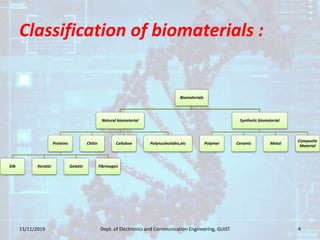
Classification of biomaterials :
Biomaterials
Natural biomaterial
Proteins
Silk Keratin Gelatin Fibrinogen
Chitin Cellulose Polynucleotides,etc
Synthetic biomaterial
Polymer Ceramic Metal
Composite
Material
13/11/2019 4Dept. of Electronics and Communication Engineering, GUIST
Natural Biomaterial :
• Biomaterial that are naturally available are called
Natural Biomaterial.
• They include :
– Protein
– Cellulose
– Silk
– Chitin
– Fibrin
13/11/2019 5Dept. of Electronics and Communication Engineering, GUIST
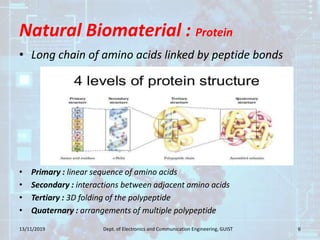
Natural Biomaterial : Protein
• Long chain of amino acids linked by peptide bonds
• Primary : linear sequence of amino acids
• Secondary : interactions between adjacent amino acids
• Tertiary : 3D folding of the polypeptide
• Quaternary : arrangements of multiple polypeptide
13/11/2019 6Dept. of Electronics and Communication Engineering, GUIST
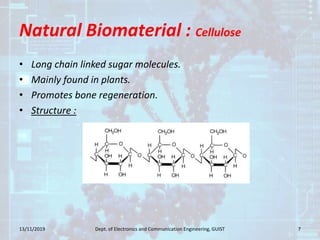
Natural Biomaterial : Cellulose
• Long chain linked sugar molecules.
• Mainly found in plants.
• Promotes bone regeneration.
• Structure :
13/11/2019 7Dept. of Electronics and Communication Engineering, GUIST
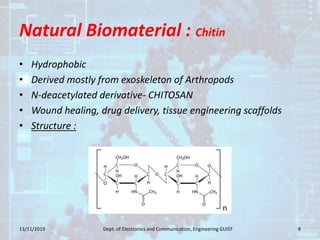
Natural Biomaterial : Chitin
• Hydrophobic
• Derived mostly from exoskeleton of Arthropods
• N-deacetylated derivative- CHITOSAN
• Wound healing, drug delivery, tissue engineering scaffolds
• Structure :
13/11/2019 8Dept. of Electronics and Communication, Engineering GUIST
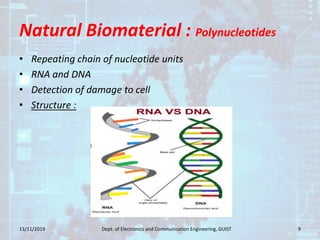
Natural Biomaterial : Polynucleotides
• Repeating chain of nucleotide units
• RNA and DNA
• Detection of damage to cell
• Structure :
13/11/2019 9Dept. of Electronics and Communication Engineering, GUIST
Synthetic Biomaterial :
• Biomaterials that are produced in laboratory or in industry by
human efforts are called as Synthetic biomaterials.
• They are mainly classified into four categories :
– Polymer
– Ceramic
– Metal
– Composite material
13/11/2019 10Dept. of Electronics and Communication Engineering, GUIST
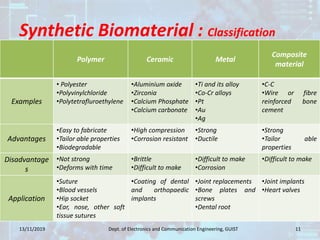
Synthetic Biomaterial : Classification
Polymer Ceramic Metal
Composite
material
Examples
• Polyester
•Polyvinylchloride
•Polytetrafluroethylene
•Aluminium oxide
•Zirconia
•Calcium Phosphate
•Calcium carbonate
•Ti and its alloy
•Co-Cr alloys
•Pt
•Au
•Ag
•C-C
•Wire or fibre
reinforced bone
cement
Advantages
•Easy to fabricate
•Tailor able properties
•Biodegradable
•High compression
•Corrosion resistant
•Strong
•Ductile
•Strong
•Tailor able
properties
Disadvantage
s
•Not strong
•Deforms with time
•Brittle
•Difficult to make
•Difficult to make
•Corrosion
•Difficult to make
Application
•Suture
•Blood vessels
•Hip socket
•Ear, nose, other soft
tissue sutures
•Coating of dental
and orthopaedic
implants
•Joint replacements
•Bone plates and
screws
•Dental root
•Joint implants
•Heart valves
13/11/2019 11Dept. of Electronics and Communication Engineering, GUIST
Synthetic Biomaterial: PMMA
PMMA (Poly methyl methacrylate) :
• Polymer-type synthetic biomaterial
• An ophthalmologist working with the Royal Air Force, Sir Harold Ridley, used
PMMA to replace damaged lenses in people suffering from cataracts. He achieved
permanent implantation in 1949 at St. Thomas Hospital. [1]
• About 3.5 million cataract surgeries are performed each year in US [2]
Properties :
• Tough
• Biocompatible
• Highly transparent material with excellent resistance to ultraviolet
radiation and weathering.
• It can be coloured, molded, cut, drilled, and formed.
13/11/2019 12Dept. of Electronics and Communication Engineering, GUIST
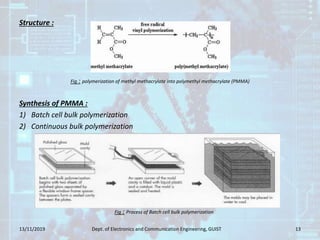
Structure :
Synthesis of PMMA :
1) Batch cell bulk polymerization
2) Continuous bulk polymerization
13/11/2019 Dept. of Electronics and Communication Engineering, GUIST 13
Fig : polymerization of methyl methacrylate into polymethyl methacrylate (PMMA)
Fig : Process of Batch cell bulk polymerization
13/11/2019 Dept. of Electronics and Communication Engineering, GUIST 14
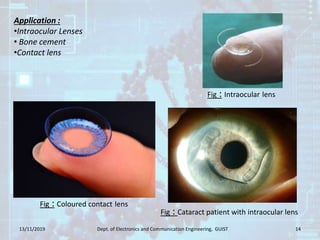
Fig : Intraocular lens
Application :
•Intraocular Lenses
• Bone cement
•Contact lens
Fig : Cataract patient with intraocular lens
Fig : Coloured contact lens
Synthetic Biomaterial: Calcium Phosphate
Calcium Phosphate :
• Ceramic-type synthetic biomaterial
• Most frequently used are the hydroxyapatite and the tricalcium phosphate.
• The first calcium phosphate materials were used in the 1920s. They were used as
bone substitute or bone graft.[3]
• In 1971, Monroe and his colleagues reported a method for the preparation of a
calcium phosphate, principally mineral calcium-fluorapatite, and suggested the
possible use of this apatite ceramic for dental and medical implant materials. [4]
Properties :
• It is osteoconductivity, crystallographic structures, and chemical
composition similar to the skeletal tissue.
• Excellent biocompatibility and the nontoxicity of their chemical
components.
13/11/2019 15Dept. of Electronics and Communication Engineering, GUIST
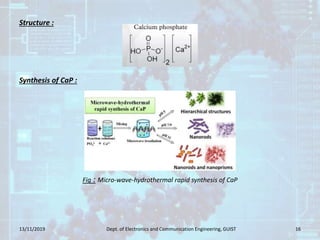
Structure :
Synthesis of CaP :
13/11/2019 Dept. of Electronics and Communication Engineering, GUIST 16
Fig : Micro-wave-hydrothermal rapid synthesis of CaP
13/11/2019 Dept. of Electronics and Communication Engineering, GUIST 17
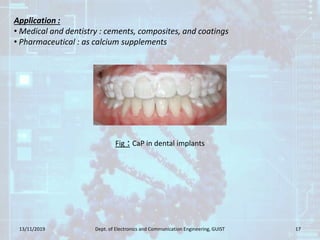
Fig : CaP in dental implants
Application :
• Medical and dentistry : cements, composites, and coatings
• Pharmaceutical : as calcium supplements
Synthetic Biomaterial: Titanium and it’s alloys
Titanium :
• Metal-type synthetic biomaterial
• Titanium can be alloyed with Iron, aluminium, vanadium molybdenum, etc.
• According to U.S. National Center for Health Statistics (NCHS) , over the 10 years of
the study, the number of hip replacement procedures doubled, from 138,700 in
2000 to 310,800 in 2010. [5]
Structure :
13/11/2019 18Dept. of Electronics and Communication Engineering, GUIST
Fig : Iron lithium titanium oxide Fig : Aluminium magnesium titanium oxide
13/11/2019 Dept. of Electronics and Communication Engineering, GUIST 19
Properties :
• Corrosion resistant, high strength, low density
• Light weight
• Refractory properties
• Abundant in nature
Application :
• Joint replacement(Hip, knee)
•Bone plate
•Dental implants
•Surgical implants, surgical tools.
13/11/2019 Dept. of Electronics and Communication Engineering, GUIST 20
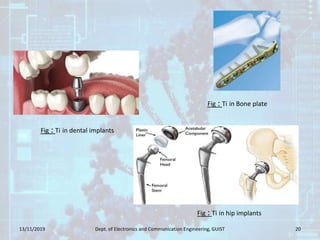
Fig : Ti in Bone plate
Fig : Ti in dental implants
Fig : Ti in hip implants
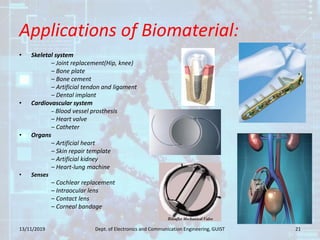
Applications of Biomaterial:
• Skeletal system
– Joint replacement(Hip, knee)
– Bone plate
– Bone cement
– Artificial tendon and ligament
– Dental implant
• Cardiovascular system
– Blood vessel prosthesis
– Heart valve
– Catheter
• Organs
– Artificial heart
– Skin repair template
– Artificial kidney
– Heart-lung machine
• Senses
– Cochlear replacement
– Intraocular lens
– Contact lens
– Corneal bandage
13/11/2019 21Dept. of Electronics and Communication Engineering, GUIST
13/11/2019 22Dept. of Electronics and Communication Engineering, GUIST
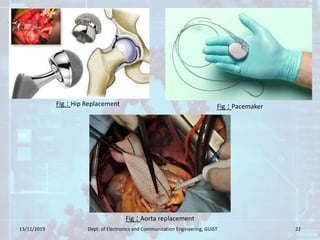
Fig : Aorta replacement
Fig : PacemakerFig : Hip Replacement
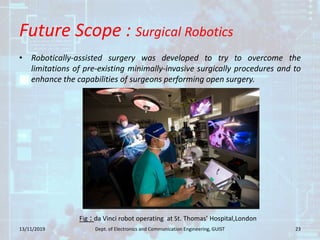
Future Scope : Surgical Robotics
• Robotically-assisted surgery was developed to try to overcome the
limitations of pre-existing minimally-invasive surgically procedures and to
enhance the capabilities of surgeons performing open surgery.
13/11/2019 23Dept. of Electronics and Communication Engineering, GUIST
Fig : da Vinci robot operating at St. Thomas’ Hospital,London
References :
[1] https://www.ncbi.nlm.nih.gov/pmc/articles/PMC1323886/?page=8
[2] https://www.ucihealth.org/blog/2018/03/cataract-surgery
[3] Albee FH. Studies in bone growth. Triple calcium phosphate as a stimulus
to osteogenesis. Annals of Surgery. 1920;71:32–39.
[4] Monroe EA, Votava W, Bass DB, McMullen J. New calcium phosphate
ceramic material for bone and tooth implants. Journal of Dental Research.
1971;50(4):860–861.
[5]https://www.webmd.com/arthritis/news/20150212/number-of-hip-
replacements-has-skyrocketed-us-report-shows#1
13/11/2019 24Dept. of Electronics and Communication Engineering, GUIST
Thank You
13/11/2019 25Dept. of Electronics and Communication Engineering, GUIST

Biomaterials

  • 1.
  • 2.
    -- CONTENTS -- •Definition • Classification of biomaterial • Synthesis of biomaterial • Structure of biomaterial • Properties • Applications 13/11/2019 2Dept. of Electronics and Communication Engineering, GUIST
  • 3.
    Biomaterials : • Abiomaterial is any substance that has been engineered to interact with biological system for a medical purpose- either a therapeutic or a diagnostic one. • The study of biomaterials is called biomaterials science or biomaterials engineering. Need for biomaterials : • Millions of patients suffer from end stage organ and tissue failure annually. • Treatment option include transplantation , reconstruction , medical devices. 13/11/2019 3Dept. of Electronics and Communication Engineering, GUIST
  • 4.
    Classification of biomaterials: Biomaterials Natural biomaterial Proteins Silk Keratin Gelatin Fibrinogen Chitin Cellulose Polynucleotides,etc Synthetic biomaterial Polymer Ceramic Metal Composite Material 13/11/2019 4Dept. of Electronics and Communication Engineering, GUIST
  • 5.
    Natural Biomaterial : •Biomaterial that are naturally available are called Natural Biomaterial. • They include : – Protein – Cellulose – Silk – Chitin – Fibrin 13/11/2019 5Dept. of Electronics and Communication Engineering, GUIST
  • 6.
    Natural Biomaterial :Protein • Long chain of amino acids linked by peptide bonds • Primary : linear sequence of amino acids • Secondary : interactions between adjacent amino acids • Tertiary : 3D folding of the polypeptide • Quaternary : arrangements of multiple polypeptide 13/11/2019 6Dept. of Electronics and Communication Engineering, GUIST
  • 7.
    Natural Biomaterial :Cellulose • Long chain linked sugar molecules. • Mainly found in plants. • Promotes bone regeneration. • Structure : 13/11/2019 7Dept. of Electronics and Communication Engineering, GUIST
  • 8.
    Natural Biomaterial :Chitin • Hydrophobic • Derived mostly from exoskeleton of Arthropods • N-deacetylated derivative- CHITOSAN • Wound healing, drug delivery, tissue engineering scaffolds • Structure : 13/11/2019 8Dept. of Electronics and Communication, Engineering GUIST
  • 9.
    Natural Biomaterial :Polynucleotides • Repeating chain of nucleotide units • RNA and DNA • Detection of damage to cell • Structure : 13/11/2019 9Dept. of Electronics and Communication Engineering, GUIST
  • 10.
    Synthetic Biomaterial : •Biomaterials that are produced in laboratory or in industry by human efforts are called as Synthetic biomaterials. • They are mainly classified into four categories : – Polymer – Ceramic – Metal – Composite material 13/11/2019 10Dept. of Electronics and Communication Engineering, GUIST
  • 11.
    Synthetic Biomaterial :Classification Polymer Ceramic Metal Composite material Examples • Polyester •Polyvinylchloride •Polytetrafluroethylene •Aluminium oxide •Zirconia •Calcium Phosphate •Calcium carbonate •Ti and its alloy •Co-Cr alloys •Pt •Au •Ag •C-C •Wire or fibre reinforced bone cement Advantages •Easy to fabricate •Tailor able properties •Biodegradable •High compression •Corrosion resistant •Strong •Ductile •Strong •Tailor able properties Disadvantage s •Not strong •Deforms with time •Brittle •Difficult to make •Difficult to make •Corrosion •Difficult to make Application •Suture •Blood vessels •Hip socket •Ear, nose, other soft tissue sutures •Coating of dental and orthopaedic implants •Joint replacements •Bone plates and screws •Dental root •Joint implants •Heart valves 13/11/2019 11Dept. of Electronics and Communication Engineering, GUIST
  • 12.
    Synthetic Biomaterial: PMMA PMMA(Poly methyl methacrylate) : • Polymer-type synthetic biomaterial • An ophthalmologist working with the Royal Air Force, Sir Harold Ridley, used PMMA to replace damaged lenses in people suffering from cataracts. He achieved permanent implantation in 1949 at St. Thomas Hospital. [1] • About 3.5 million cataract surgeries are performed each year in US [2] Properties : • Tough • Biocompatible • Highly transparent material with excellent resistance to ultraviolet radiation and weathering. • It can be coloured, molded, cut, drilled, and formed. 13/11/2019 12Dept. of Electronics and Communication Engineering, GUIST
  • 13.
    Structure : Synthesis ofPMMA : 1) Batch cell bulk polymerization 2) Continuous bulk polymerization 13/11/2019 Dept. of Electronics and Communication Engineering, GUIST 13 Fig : polymerization of methyl methacrylate into polymethyl methacrylate (PMMA) Fig : Process of Batch cell bulk polymerization
  • 14.
    13/11/2019 Dept. ofElectronics and Communication Engineering, GUIST 14 Fig : Intraocular lens Application : •Intraocular Lenses • Bone cement •Contact lens Fig : Cataract patient with intraocular lens Fig : Coloured contact lens
  • 15.
    Synthetic Biomaterial: CalciumPhosphate Calcium Phosphate : • Ceramic-type synthetic biomaterial • Most frequently used are the hydroxyapatite and the tricalcium phosphate. • The first calcium phosphate materials were used in the 1920s. They were used as bone substitute or bone graft.[3] • In 1971, Monroe and his colleagues reported a method for the preparation of a calcium phosphate, principally mineral calcium-fluorapatite, and suggested the possible use of this apatite ceramic for dental and medical implant materials. [4] Properties : • It is osteoconductivity, crystallographic structures, and chemical composition similar to the skeletal tissue. • Excellent biocompatibility and the nontoxicity of their chemical components. 13/11/2019 15Dept. of Electronics and Communication Engineering, GUIST
  • 16.
    Structure : Synthesis ofCaP : 13/11/2019 Dept. of Electronics and Communication Engineering, GUIST 16 Fig : Micro-wave-hydrothermal rapid synthesis of CaP
  • 17.
    13/11/2019 Dept. ofElectronics and Communication Engineering, GUIST 17 Fig : CaP in dental implants Application : • Medical and dentistry : cements, composites, and coatings • Pharmaceutical : as calcium supplements
  • 18.
    Synthetic Biomaterial: Titaniumand it’s alloys Titanium : • Metal-type synthetic biomaterial • Titanium can be alloyed with Iron, aluminium, vanadium molybdenum, etc. • According to U.S. National Center for Health Statistics (NCHS) , over the 10 years of the study, the number of hip replacement procedures doubled, from 138,700 in 2000 to 310,800 in 2010. [5] Structure : 13/11/2019 18Dept. of Electronics and Communication Engineering, GUIST Fig : Iron lithium titanium oxide Fig : Aluminium magnesium titanium oxide
  • 19.
    13/11/2019 Dept. ofElectronics and Communication Engineering, GUIST 19 Properties : • Corrosion resistant, high strength, low density • Light weight • Refractory properties • Abundant in nature Application : • Joint replacement(Hip, knee) •Bone plate •Dental implants •Surgical implants, surgical tools.
  • 20.
    13/11/2019 Dept. ofElectronics and Communication Engineering, GUIST 20 Fig : Ti in Bone plate Fig : Ti in dental implants Fig : Ti in hip implants
  • 21.
    Applications of Biomaterial: •Skeletal system – Joint replacement(Hip, knee) – Bone plate – Bone cement – Artificial tendon and ligament – Dental implant • Cardiovascular system – Blood vessel prosthesis – Heart valve – Catheter • Organs – Artificial heart – Skin repair template – Artificial kidney – Heart-lung machine • Senses – Cochlear replacement – Intraocular lens – Contact lens – Corneal bandage 13/11/2019 21Dept. of Electronics and Communication Engineering, GUIST
  • 22.
    13/11/2019 22Dept. ofElectronics and Communication Engineering, GUIST Fig : Aorta replacement Fig : PacemakerFig : Hip Replacement
  • 23.
    Future Scope :Surgical Robotics • Robotically-assisted surgery was developed to try to overcome the limitations of pre-existing minimally-invasive surgically procedures and to enhance the capabilities of surgeons performing open surgery. 13/11/2019 23Dept. of Electronics and Communication Engineering, GUIST Fig : da Vinci robot operating at St. Thomas’ Hospital,London
  • 24.
    References : [1] https://www.ncbi.nlm.nih.gov/pmc/articles/PMC1323886/?page=8 [2]https://www.ucihealth.org/blog/2018/03/cataract-surgery [3] Albee FH. Studies in bone growth. Triple calcium phosphate as a stimulus to osteogenesis. Annals of Surgery. 1920;71:32–39. [4] Monroe EA, Votava W, Bass DB, McMullen J. New calcium phosphate ceramic material for bone and tooth implants. Journal of Dental Research. 1971;50(4):860–861. [5]https://www.webmd.com/arthritis/news/20150212/number-of-hip- replacements-has-skyrocketed-us-report-shows#1 13/11/2019 24Dept. of Electronics and Communication Engineering, GUIST
  • 25.
    Thank You 13/11/2019 25Dept.of Electronics and Communication Engineering, GUIST