Functionilized
Conducting
polymers
Prepared by Mohd. Usman
MSc. Applied Science
Content
1. Problem with Prestine Conducting polymers
2. Why do we need to functionalized
3. Tehcniques to functionalise the conducting polymers
4. Recent application and advances
5. Summmery
1. Problem/limitations with prestine CP’s
Selectivity: Pristine CPs often lack selectivity, meaning they may have difficulty distinguishing between different analytes.
This can result in false positive or false negative signals when detecting target substances in complex environments.
Sensitivity: While CPs possess semiconducting properties that make them sensitive to changes in their environment,
they may not always exhibit the desired level of sensitivity required for detecting low concentrations of analytes.
Stability: Pristine CPs can be susceptible to degradation over time, particularly when exposed to environmental factors
such as humidity, temperature variations, and prolonged exposure to light. This instability can affect the reliability and
longevity of CP-based sensors.
Processability: Some pristine CPs may have limited processability, meaning they are difficult to fabricate into practical
sensor devices with desired shapes, sizes, and configurations. This limitation can hinder their integration into sensor
platforms or devices.
Reproducibility: Achieving consistent and reproducible sensor responses with pristine CPs can be challenging due to
variations in synthesis methods, material properties, and environmental conditions. This lack of reproducibility can
impact the reliability and robustness of CP-based sensors.
2. Why to Functionalize the polymer?
• One of the main advantages of functionalized conductive polymer-based sensors is their ability to
detect a wide range of analytes, such as gases, vapors, and liquids.
• These sensors can be tailored to detect specific analytes by modifying the chemical structure of the
conductive polymer or by adding functional groups to the polymer backbone.
• However, the electrical conductivity of functionalized polymers is usually lower than that of the
base CP due to several factors: (i) Since charge carriers in p-doped CPs are cation radicals, the
attachment of negatively charged groups made it a self-doped polymer (i.e., has fixed counterions
linked to the chain which cannot be lost) but pin the charge carriers to fixed locations, reducing their
mobility.
1. Enhanced Selectivity
2. Improved Sensitivity
3. Tunable Properties
4. Biological Compatibility
5. Controlled Deposition and Assembly
6. Stability and Durability
https://doi.org/10.3390/polym15010205
https://doi.org/10.1016/j.progpolymsci.2018.08.001
1. Biofunctionalized conducting polymers
• CP functionalization is achieved by chemically
modifying the conjugated monomer, polymer or
dopant with a reactive functional group (RFG).
The RFGs can promote interactions with
biomolecules in aqueous media or be further
functionalized by covalently coupling with
biomolecules.
• Lee et al. synthesized 1-aminopropylpyrrole (3,
APy), which was electrochemically
copolymerized with varied concentrations of
pyrrole onto goldcoated glass slides with PSS as
dopant.
https://doi.org/10.1080/23746149.2021.1899850
• As amines are very stable as quaternary
salts, they are also useful for synthesizing
zwitterionic functionality that have both
positive and negative charge.
• Zwitterions are beneficial chemical
moieties in CPs as they provide water
solubility as well as controllable
antibacterial properties.
• The PEDOT sulphobetaine was synthesized
via electrochemical oxidation from the
zwitterionic monomer . The resulting CP
film was shown to kill up to 89% of
attached bacterial cells when a potential of
0.6 V (vs. Hg/HgCl2) was applied to the
film demonstrating its antifouling potential
https://doi.org/10.1080/23746149.2021.1899850
Biofunctionalized conducting polymers
http://surl.li/srsbk
Nanorods in which the polymer is in the middle and the
piezoelectric material is on the outside is been made.
With 2,000 sensors per square millimeter,the hybrid material
is more sensitive than human finger tip.
The sensing ability can detect the skin moisture, pH value and
temperature etc.
2. Monomer Biofunctionality
Biomolecules or biocompatible molecules can be attached to
the CP via the monomer RFGs prior to polymerization.
Liang et al. developed conductive hydrogel implantable
patches for treatment of myocardial infarction (MI). The
conductive hydrogel was synthesized from hyperbranched
poly(dopamine-co-acrylate) copolymer containing vinyl
groups that were further reacted with pyrrole through Michael
addition.
Polymerization of the terminal pyrrole groups was initiated by
FeCl3 where Fe3+ served dual functionalities. It initiated the
polymerization of pyrrole to produce PPy nanoparticles,
introducing conductivity (up to 0.065 S m−1) in the network,
and it complexed with the dopamine groups resulting in a
hydrogel network with improved adhesion properties in the
wet state.
The system exhibited biologically relevant mechanical
strength, with a storage modulus of 35kPa, along with
significant tissue adhesion attributed to the dopamine
catechols binding to amine and sulfhydryl groups in the
tissue. https://doi.org/10.1080/23746149.2021.1899850
https://doi.org/10.3390%2Fpolym12030709
3. Substituted/ Derivatized Conducting polymers
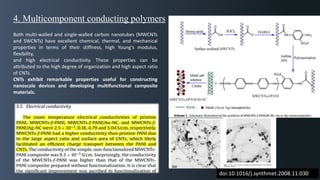
4. Multicomponent conducting polymers
Both multi-walled and single-walled carbon nanotubes (MWCNTs
and SWCNTs) have excellent chemical, thermal, and mechanical
properties in terms of their stiffness, high Young’s modulus,
flexibility,
and high electrical conductivity. These properties can be
attributed to the high degree of organization and high aspect ratio
of CNTs.
CNTs exhibit remarkable properties useful for constructing
nanoscale devices and developing multifunctional composite
materials.
doi:10.1016/j.synthmet.2008.11.030
5. Nanostructure functionalized conducting polymers
Currently, many papers dealing with conducting polymer nanostructures, especially for ordered nanostructures
produced by electrochemical soft template synthesis methods have been reported.
The well aligned nanostructures have a
combined advantage of 1D
nanowires/nanotubes and a highly
ordered alignment.
A conducting PANI nanotube array
based ultra-sensitive biosensor has
been developed for DNA hybridization
detection.
The combination of top-down
nanofabrication technology and
bottom-up preparation techniques for
1D nanomaterials has paved
the way for the development of
nanobiosensors and sensor arrays.
doi:10.1016/j.jcis.2009.09.029
Thank you
J. M. Lehn, Angew. Chem. 100 (1988) 91 ; Angeu. Chem. Int. Ed. Engl. 27
(1988) 89; D. J. Cram, ibid. 100 (1988) 1041 and 27 (1988) 1009; C. J.
Pedersen, ibid. 100 (1988) 1053 and 27 (1988) 1021.
F. Carter (Ed.): Molecular Elecrronic Devices, Marcel Dekker, New York
1982.
T. A. Skotheim (Ed.): Handbook of Conducring Polymers. Marcel Dekker,
New York 1986.
H. Shirakawa, E. Louis, A. MacDiarmid, C. Chiang. A. J. Heeger, J.
Chem. Soc. Chem. Commun. 1977, 758.
A. E Diaz, K. K. Kanazawa, J. P. Gardini, J. Chem. SOC. Chem. Commun.
1979, 635.
G. Tourillon, F. Gamier, J. Electround Chem. 135 (1982) 173.
A. G. MacDiarmid, J. C. Chiang, M. Halpern, W S. Huang, S. L. Mu,
N. D. L. Somasiri, W Wu, S. Yaniger, Mu/. Crysr. Liq. Crysr. 121 (1985)
173.
N. Basescu, Z. X. Liu, D. Moses, A. J. Heeger, H. Naarmann, H.
Teophilou, Nature (London) 327 (1987) 403.
F. Gamier, G. Tourillon, M. Garzard, J. C. Dubois, J. Electruunal. Chem.
148 (1983) 299.
J. Roncali, R. Garreau, D. Delabouglise, F. Gamier, M. Lemaire, Synrh.
Mel. 28 (1989) C341
G. Bidan, A. Deronzier, J. C. Moutet, Nouv. J. Chim. 8 (1984) 501.
Y K. Korshak, T. V. Medvedeva, A. A. Ovchinnikov, V. N. Spector, Nature (London) 326 (1987) 370
References

Functionalized Conducting polymers.pptx

  • 1.
  • 2.
    Content 1. Problem withPrestine Conducting polymers 2. Why do we need to functionalized 3. Tehcniques to functionalise the conducting polymers 4. Recent application and advances 5. Summmery
  • 3.
    1. Problem/limitations withprestine CP’s Selectivity: Pristine CPs often lack selectivity, meaning they may have difficulty distinguishing between different analytes. This can result in false positive or false negative signals when detecting target substances in complex environments. Sensitivity: While CPs possess semiconducting properties that make them sensitive to changes in their environment, they may not always exhibit the desired level of sensitivity required for detecting low concentrations of analytes. Stability: Pristine CPs can be susceptible to degradation over time, particularly when exposed to environmental factors such as humidity, temperature variations, and prolonged exposure to light. This instability can affect the reliability and longevity of CP-based sensors. Processability: Some pristine CPs may have limited processability, meaning they are difficult to fabricate into practical sensor devices with desired shapes, sizes, and configurations. This limitation can hinder their integration into sensor platforms or devices. Reproducibility: Achieving consistent and reproducible sensor responses with pristine CPs can be challenging due to variations in synthesis methods, material properties, and environmental conditions. This lack of reproducibility can impact the reliability and robustness of CP-based sensors.
  • 4.
    2. Why toFunctionalize the polymer? • One of the main advantages of functionalized conductive polymer-based sensors is their ability to detect a wide range of analytes, such as gases, vapors, and liquids. • These sensors can be tailored to detect specific analytes by modifying the chemical structure of the conductive polymer or by adding functional groups to the polymer backbone. • However, the electrical conductivity of functionalized polymers is usually lower than that of the base CP due to several factors: (i) Since charge carriers in p-doped CPs are cation radicals, the attachment of negatively charged groups made it a self-doped polymer (i.e., has fixed counterions linked to the chain which cannot be lost) but pin the charge carriers to fixed locations, reducing their mobility. 1. Enhanced Selectivity 2. Improved Sensitivity 3. Tunable Properties 4. Biological Compatibility 5. Controlled Deposition and Assembly 6. Stability and Durability https://doi.org/10.3390/polym15010205
  • 5.
  • 6.
  • 7.
    • CP functionalizationis achieved by chemically modifying the conjugated monomer, polymer or dopant with a reactive functional group (RFG). The RFGs can promote interactions with biomolecules in aqueous media or be further functionalized by covalently coupling with biomolecules. • Lee et al. synthesized 1-aminopropylpyrrole (3, APy), which was electrochemically copolymerized with varied concentrations of pyrrole onto goldcoated glass slides with PSS as dopant. https://doi.org/10.1080/23746149.2021.1899850
  • 8.
    • As aminesare very stable as quaternary salts, they are also useful for synthesizing zwitterionic functionality that have both positive and negative charge. • Zwitterions are beneficial chemical moieties in CPs as they provide water solubility as well as controllable antibacterial properties. • The PEDOT sulphobetaine was synthesized via electrochemical oxidation from the zwitterionic monomer . The resulting CP film was shown to kill up to 89% of attached bacterial cells when a potential of 0.6 V (vs. Hg/HgCl2) was applied to the film demonstrating its antifouling potential https://doi.org/10.1080/23746149.2021.1899850 Biofunctionalized conducting polymers
  • 9.
    http://surl.li/srsbk Nanorods in whichthe polymer is in the middle and the piezoelectric material is on the outside is been made. With 2,000 sensors per square millimeter,the hybrid material is more sensitive than human finger tip. The sensing ability can detect the skin moisture, pH value and temperature etc.
  • 10.
    2. Monomer Biofunctionality Biomoleculesor biocompatible molecules can be attached to the CP via the monomer RFGs prior to polymerization. Liang et al. developed conductive hydrogel implantable patches for treatment of myocardial infarction (MI). The conductive hydrogel was synthesized from hyperbranched poly(dopamine-co-acrylate) copolymer containing vinyl groups that were further reacted with pyrrole through Michael addition. Polymerization of the terminal pyrrole groups was initiated by FeCl3 where Fe3+ served dual functionalities. It initiated the polymerization of pyrrole to produce PPy nanoparticles, introducing conductivity (up to 0.065 S m−1) in the network, and it complexed with the dopamine groups resulting in a hydrogel network with improved adhesion properties in the wet state. The system exhibited biologically relevant mechanical strength, with a storage modulus of 35kPa, along with significant tissue adhesion attributed to the dopamine catechols binding to amine and sulfhydryl groups in the tissue. https://doi.org/10.1080/23746149.2021.1899850
  • 11.
  • 12.
    4. Multicomponent conductingpolymers Both multi-walled and single-walled carbon nanotubes (MWCNTs and SWCNTs) have excellent chemical, thermal, and mechanical properties in terms of their stiffness, high Young’s modulus, flexibility, and high electrical conductivity. These properties can be attributed to the high degree of organization and high aspect ratio of CNTs. CNTs exhibit remarkable properties useful for constructing nanoscale devices and developing multifunctional composite materials. doi:10.1016/j.synthmet.2008.11.030
  • 13.
    5. Nanostructure functionalizedconducting polymers Currently, many papers dealing with conducting polymer nanostructures, especially for ordered nanostructures produced by electrochemical soft template synthesis methods have been reported. The well aligned nanostructures have a combined advantage of 1D nanowires/nanotubes and a highly ordered alignment. A conducting PANI nanotube array based ultra-sensitive biosensor has been developed for DNA hybridization detection. The combination of top-down nanofabrication technology and bottom-up preparation techniques for 1D nanomaterials has paved the way for the development of nanobiosensors and sensor arrays. doi:10.1016/j.jcis.2009.09.029
  • 14.
    Thank you J. M.Lehn, Angew. Chem. 100 (1988) 91 ; Angeu. Chem. Int. Ed. Engl. 27 (1988) 89; D. J. Cram, ibid. 100 (1988) 1041 and 27 (1988) 1009; C. J. Pedersen, ibid. 100 (1988) 1053 and 27 (1988) 1021. F. Carter (Ed.): Molecular Elecrronic Devices, Marcel Dekker, New York 1982. T. A. Skotheim (Ed.): Handbook of Conducring Polymers. Marcel Dekker, New York 1986. H. Shirakawa, E. Louis, A. MacDiarmid, C. Chiang. A. J. Heeger, J. Chem. Soc. Chem. Commun. 1977, 758. A. E Diaz, K. K. Kanazawa, J. P. Gardini, J. Chem. SOC. Chem. Commun. 1979, 635. G. Tourillon, F. Gamier, J. Electround Chem. 135 (1982) 173. A. G. MacDiarmid, J. C. Chiang, M. Halpern, W S. Huang, S. L. Mu, N. D. L. Somasiri, W Wu, S. Yaniger, Mu/. Crysr. Liq. Crysr. 121 (1985) 173. N. Basescu, Z. X. Liu, D. Moses, A. J. Heeger, H. Naarmann, H. Teophilou, Nature (London) 327 (1987) 403. F. Gamier, G. Tourillon, M. Garzard, J. C. Dubois, J. Electruunal. Chem. 148 (1983) 299. J. Roncali, R. Garreau, D. Delabouglise, F. Gamier, M. Lemaire, Synrh. Mel. 28 (1989) C341 G. Bidan, A. Deronzier, J. C. Moutet, Nouv. J. Chim. 8 (1984) 501. Y K. Korshak, T. V. Medvedeva, A. A. Ovchinnikov, V. N. Spector, Nature (London) 326 (1987) 370 References