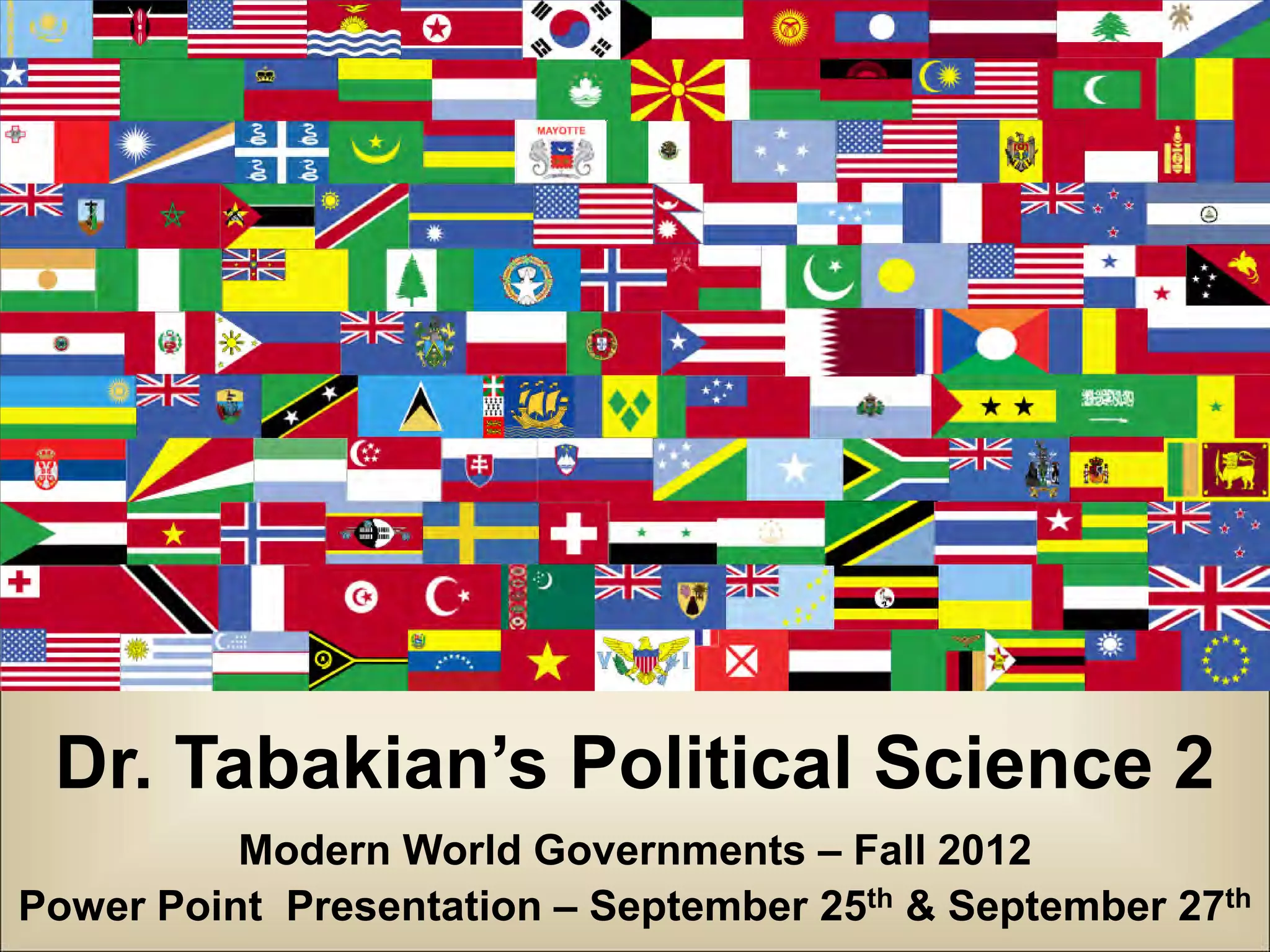
Dr. Tabakian’s Political Science 2
          Modern World Governments – Fall 2012
Power Point Presentation – September 25th & September 27th
COURSE LECTURE TOPICS
This Week’s Lecture Covers:
•Defining Democracy
•Direct Democracy
•Democratic Transition
•Democracy – 5 Generalizations
•Democratic Peace Theory
•Republican Forms Of Government
•Human Rights
•Capitalism & Open Markets
•Capitalism
    Efficiency
    Innovation
•Similarities Of Democracy & Capitalism
•Seeking Market Share
COURSE LECTURE: WEEK #5 (2)
Reading Assignments For Week #5

•Course Pack Articles:
   “The Paradoxes Of Contemporary Democracy” By:
   Evelyn Huber, Dietrich Rueschemeyer and John D.
   Stephens
   “Reflections On The End Of History Five Years Later”
   By: Francis Fukuyama
DEMOCRACY (1)
A successful democracy is based on the consent of the
governed along with widespread support. Democratic
governments allow its citizens the right to speak freely and
elect its leaders. A formal democracy is a political system
that possesses four factors:

(1)regular and fair elections.
(2)universal suffrage.
(3)accountability of government policies to elected
   representatives.
(4)guaranteeing right to free expression, association and
   reasonable protections against capricious government
   action.
DEMOCRACY (2)
Elites would agree that power and power sharing
influence all democracies. Pluralists would argue that the
subordinate classes are driven to self-organization by
uniting together as evidenced in associations, unions, and
parties. This gives them power although all do not
necessarily possess property, high social status, or
command over cultural hegemony. Elites show favor
towards formal democracies, for they do not see
subordinates as posing much of a threat as their
organizational power base is weak.
DEMOCRATIC TRANSITION
TRANSITIONING FROM AUTHORITARIAN RULE
Many researchers attest that transitions from authoritarian rule
have begun with discord emerging from within military
governments and their relations with bourgeois allies. Most
disagreements have been found to be over economic problems.
The push for liberalization and democratization would be pushed
forward by a reemerging civil society that may be calling for
greater representation due to their influences with capital
development. Constant conflict developed fissures with gaps
developing between those groups in control. These divisions
allowed civil society to surge into these free areas, enabling
coalitions to form between soft-liners in the state apparatus and
those in the democratic opposition. Decentralization can lead to
the formation of new positions of power that local elites staff for the
benefit of clientelistic networks.
TWO CONDITIONS FOR
           DEMOCRATIZATION
Two Conditions For Successful Democratization:
1. Settled borders
2. Popular consensus that supports an inclusive definition of
   the nation.

Evidence has shown that nations having more authoritarian or
controlled economies are more prone to failure than the
American economy. Elites show favor towards formal
democracies for they do not see subordinates as posing much
of a threat as their organizational power base is weak. It also
helps that the most powerful members of the economic elite
support the capitalist economic model. Subordinates living in
formal democracies are especially in favor of the current
economic model.
DEMOCRACY – CHANGE FROM WITHIN
 Arguing that external environments encourage states to
 become democratic cannot adequately explain why the Soviet
 Union fell from superpower status into a consortium of
 democratic republics. Threat assessments from within Soviet
 society had changed whereas the external environment did not
 change significantly. The only change was from within the
 Soviet Union in terms of its ideology, which in turn determines
 how threats are assessed. Ideology can serve as a filter of
 sorts that helps determine whether a people are dedicated to
 peaceful coexistence or war with other peoples. Distributions of
 power in the international system serve only as a second
 consideration, especially how the international community
 reacts to a change in the internal ideology of a state.
DEMOCRACY – 5 GENERALIZATIONS
There are five generalization inherent in the comparative study of
democratization that are pertinent to new democracies as well as all
democracies regardless of when they had taken form:
1. High levels of capital development helps to maintain democracy.
2. Political leaders are needed to create and maintain democracies
    both in good times or bad.
3. Parliamentary rather than presidential systems seem to be more
    successful in maintaining democracies.
4. Issues pertaining to national and state power structures have to
    be determined early on for democracy to survive.
5. All democracies, regardless of their age or fragility are never
    certain about the future, but share a common adherence to
    procedures of governance that should not change.
NOTE: Regional effects in terms of general historical experiences can
help determine whether democracy can easily take root in certain
regions.
DEMOCRATIC PEACE THEORY
Democracies have not fought each other not out of respect for other
democracies, but that the threat of a third party helped to unite
democratic states. Democratic peace theory is unfounded, for if it
were valid then the United States would not have helped overthrow
the democratically elected Juan Bosch of the Dominican Republic by
sending 23,000 troops whose mere presence helped to topple his
government. Henry Kissinger would validate this action under the
tenets of democratic peace theory by arguing that the Dominican
Republic is a “wayward” democracy that may be in danger of tilting
toward communism or authoritarian rule. Kenneth Waltz claims that
democracies may currently live at peace with other democracies, but
even if all states became democratic that the international system
would remain anarchic. Democracies may fight as often as other
states, but rarely if ever fight one another.
DIRECT DEMOCRACY
A direct democracy requires every citizen to participate in all forms of
policy making. This is impossible in a large nation-state like the United
States. America’s Founding Fathers were adamant about maintaining
internal stability, thereby foregoing direct democracy in favor of a
republican form of government. Ensuring elite gains during periods of
innovation is the best prescription to prevent rampant instability for
they are the ones most threatened. Slow transitions allow enough
time for threatened elites to prepare for periods of transitions. Opinion
leaders then inform the masses about the impending change so that
the capitalist marketplace retains its consumer base. Destruction
ensues if the majority of elites and masses do not benefit during the
period of transition.
WHY SOME DON’T EMBRACE
           DEMOCRACY
Various reasons exist that help explain why some countries have
failed to fully embrace liberal and free-market reforms.

1. The public may have different opinions about these reforms that
   may or may not be equally shared by opposition forces. Those
   decisions reached can determine whether state socialism remains
   or is replaced.
2. How the transition to liberal and free-market reforms are
   undertaken can affect the decision of authoritarian elites to trade
   in their political capital for economic gains.
3. The method of the transition to capitalism can determine what
   side wins or loses.
4. Degrees of nationalism can determine whether political leaders
   are able to hold their society together during the tribulation
   transformation to democracy.
CAPITALISM & DEMOCRACY ARE SIMILAR (1)
For freedom to rein it is required for the market place to determine the fate of all
products, services and ideas. No interference can burden this process.
Oversight is not necessarily detrimental as is the policy of the United States to
regulate various industries. The death kneel comes when powerful spheres of
influence serve to squash competition. John Locke argues it best when he
suggests that liberalism can never exist without capitalism. This is the
philosophy of Adam Smith’s “invisible hand” where he explains how markets
determine the fate of all competing interests seeking society’s acceptance. We
are today living in a time of unprecedented technological innovation that is
helping to propel humanity further the ladder of evolution. This would not be
possible if vested interests were prevented from pursuing market acceptance.
CAPITALISM & DEMOCRACY ARE SIMILAR (2)
John Locke and Adam Smith would agree that there is no fundamental
difference between a marketed product, service or even political idea. All
interest groups competing in the marketplace are engaged in the same pursuit:
acceptance. Companies competing for market dollars strive to offer the most
cost efficient product or service that is also the most innovative. This in turn
encourages competing peers to further maximize efficiency while also
stretching the bounds of innovation in order to offer the best value. Marketing
ideas is in essence the same we have witnessed with political campaigns
striving for societal acceptance. Political organizations seeking for example the
election of a particular individual to office must secure a majority of the market
within a certain region. Competing campaigns offer different ideas to the market
that seek to offer a better value. This constant battle allows all individuals to
decide for themselves what “product” “service” or even “idea” is best. We all
benefit from conflict.
CAPITALISM & DEMOCRACY ARE SIMILAR (3)
Let us look at the example of telecommunications to understand the benefits of conflict.
Prior to 1996, there existed in Southern California like most other regions in the United
States, two cellular telephone companies. These were the days of analog
communications, or AMPS (Advanced Mobile Phone System). Southern California was
home to Airtouch and LA Cellular prior to 1996. Both companies maintained prices that
prevented the average consumer from fully utilizing their services, or even purchasing
them at all. Everything changed with the signage of the 1996 Telecommunications Act by
President Bill Clinton. The bill allowed for more efficient use of spectrum, thereby
allowing easier access for companies to compete in wireless communications. Various
competitors entered to compete for market acceptance, requiring all companies to strive
for greater efficiency, while also providing even greater services. Consumers today face a
wide selection of companies who individually offer greater communication services that
go beyond voice services to encompass video calling and broadband internet. The
invisible hand eliminates those companies that do not provide the greatest benefit for
consumers.
CAPITALISM & DEMOCRACY ARE SIMILAR (4)
The ultimate nightmare may be the elimination of debate. Many have
unwittingly called for this in the halls of government. It is not debate that
threatens society, but the lack of contesting ideas. Policies enacted to prevent
overly powerful monopolies help to maintain open competition. To have one
overly powerful sphere of interest prevent debate is destructive to the system
itself. Pluralism emphasizes both conflict and compromise with interest groups
engaged in a constant pursuit of power that naturally results in established
alliances to compete with peer spheres that are doing the same, resulting in the
formation of two major spheres. Public policy would thereby stall until reaching
a compromise between these two majority powers. This in turn helps to protect
the majority of those residing in society. Every policy requires constant
improvement for humanity to arrive closer to perfection. Those that call for the
elimination of special interest groups or even the restriction of political debate
are ignorant for this process benefits society immensely.

Political Science 2 – Comparative Politics - Power Point #5

  • 1.
    Dr. Tabakian’s PoliticalScience 2 Modern World Governments – Fall 2012 Power Point Presentation – September 25th & September 27th
  • 2.
    COURSE LECTURE TOPICS ThisWeek’s Lecture Covers: •Defining Democracy •Direct Democracy •Democratic Transition •Democracy – 5 Generalizations •Democratic Peace Theory •Republican Forms Of Government •Human Rights •Capitalism & Open Markets •Capitalism Efficiency Innovation •Similarities Of Democracy & Capitalism •Seeking Market Share
  • 3.
    COURSE LECTURE: WEEK#5 (2) Reading Assignments For Week #5 •Course Pack Articles: “The Paradoxes Of Contemporary Democracy” By: Evelyn Huber, Dietrich Rueschemeyer and John D. Stephens “Reflections On The End Of History Five Years Later” By: Francis Fukuyama
  • 4.
    DEMOCRACY (1) A successfuldemocracy is based on the consent of the governed along with widespread support. Democratic governments allow its citizens the right to speak freely and elect its leaders. A formal democracy is a political system that possesses four factors: (1)regular and fair elections. (2)universal suffrage. (3)accountability of government policies to elected representatives. (4)guaranteeing right to free expression, association and reasonable protections against capricious government action.
  • 5.
    DEMOCRACY (2) Elites wouldagree that power and power sharing influence all democracies. Pluralists would argue that the subordinate classes are driven to self-organization by uniting together as evidenced in associations, unions, and parties. This gives them power although all do not necessarily possess property, high social status, or command over cultural hegemony. Elites show favor towards formal democracies, for they do not see subordinates as posing much of a threat as their organizational power base is weak.
  • 6.
    DEMOCRATIC TRANSITION TRANSITIONING FROMAUTHORITARIAN RULE Many researchers attest that transitions from authoritarian rule have begun with discord emerging from within military governments and their relations with bourgeois allies. Most disagreements have been found to be over economic problems. The push for liberalization and democratization would be pushed forward by a reemerging civil society that may be calling for greater representation due to their influences with capital development. Constant conflict developed fissures with gaps developing between those groups in control. These divisions allowed civil society to surge into these free areas, enabling coalitions to form between soft-liners in the state apparatus and those in the democratic opposition. Decentralization can lead to the formation of new positions of power that local elites staff for the benefit of clientelistic networks.
  • 7.
    TWO CONDITIONS FOR DEMOCRATIZATION Two Conditions For Successful Democratization: 1. Settled borders 2. Popular consensus that supports an inclusive definition of the nation. Evidence has shown that nations having more authoritarian or controlled economies are more prone to failure than the American economy. Elites show favor towards formal democracies for they do not see subordinates as posing much of a threat as their organizational power base is weak. It also helps that the most powerful members of the economic elite support the capitalist economic model. Subordinates living in formal democracies are especially in favor of the current economic model.
  • 8.
    DEMOCRACY – CHANGEFROM WITHIN Arguing that external environments encourage states to become democratic cannot adequately explain why the Soviet Union fell from superpower status into a consortium of democratic republics. Threat assessments from within Soviet society had changed whereas the external environment did not change significantly. The only change was from within the Soviet Union in terms of its ideology, which in turn determines how threats are assessed. Ideology can serve as a filter of sorts that helps determine whether a people are dedicated to peaceful coexistence or war with other peoples. Distributions of power in the international system serve only as a second consideration, especially how the international community reacts to a change in the internal ideology of a state.
  • 9.
    DEMOCRACY – 5GENERALIZATIONS There are five generalization inherent in the comparative study of democratization that are pertinent to new democracies as well as all democracies regardless of when they had taken form: 1. High levels of capital development helps to maintain democracy. 2. Political leaders are needed to create and maintain democracies both in good times or bad. 3. Parliamentary rather than presidential systems seem to be more successful in maintaining democracies. 4. Issues pertaining to national and state power structures have to be determined early on for democracy to survive. 5. All democracies, regardless of their age or fragility are never certain about the future, but share a common adherence to procedures of governance that should not change. NOTE: Regional effects in terms of general historical experiences can help determine whether democracy can easily take root in certain regions.
  • 10.
    DEMOCRATIC PEACE THEORY Democracieshave not fought each other not out of respect for other democracies, but that the threat of a third party helped to unite democratic states. Democratic peace theory is unfounded, for if it were valid then the United States would not have helped overthrow the democratically elected Juan Bosch of the Dominican Republic by sending 23,000 troops whose mere presence helped to topple his government. Henry Kissinger would validate this action under the tenets of democratic peace theory by arguing that the Dominican Republic is a “wayward” democracy that may be in danger of tilting toward communism or authoritarian rule. Kenneth Waltz claims that democracies may currently live at peace with other democracies, but even if all states became democratic that the international system would remain anarchic. Democracies may fight as often as other states, but rarely if ever fight one another.
  • 11.
    DIRECT DEMOCRACY A directdemocracy requires every citizen to participate in all forms of policy making. This is impossible in a large nation-state like the United States. America’s Founding Fathers were adamant about maintaining internal stability, thereby foregoing direct democracy in favor of a republican form of government. Ensuring elite gains during periods of innovation is the best prescription to prevent rampant instability for they are the ones most threatened. Slow transitions allow enough time for threatened elites to prepare for periods of transitions. Opinion leaders then inform the masses about the impending change so that the capitalist marketplace retains its consumer base. Destruction ensues if the majority of elites and masses do not benefit during the period of transition.
  • 12.
    WHY SOME DON’TEMBRACE DEMOCRACY Various reasons exist that help explain why some countries have failed to fully embrace liberal and free-market reforms. 1. The public may have different opinions about these reforms that may or may not be equally shared by opposition forces. Those decisions reached can determine whether state socialism remains or is replaced. 2. How the transition to liberal and free-market reforms are undertaken can affect the decision of authoritarian elites to trade in their political capital for economic gains. 3. The method of the transition to capitalism can determine what side wins or loses. 4. Degrees of nationalism can determine whether political leaders are able to hold their society together during the tribulation transformation to democracy.
  • 13.
    CAPITALISM & DEMOCRACYARE SIMILAR (1) For freedom to rein it is required for the market place to determine the fate of all products, services and ideas. No interference can burden this process. Oversight is not necessarily detrimental as is the policy of the United States to regulate various industries. The death kneel comes when powerful spheres of influence serve to squash competition. John Locke argues it best when he suggests that liberalism can never exist without capitalism. This is the philosophy of Adam Smith’s “invisible hand” where he explains how markets determine the fate of all competing interests seeking society’s acceptance. We are today living in a time of unprecedented technological innovation that is helping to propel humanity further the ladder of evolution. This would not be possible if vested interests were prevented from pursuing market acceptance.
  • 14.
    CAPITALISM & DEMOCRACYARE SIMILAR (2) John Locke and Adam Smith would agree that there is no fundamental difference between a marketed product, service or even political idea. All interest groups competing in the marketplace are engaged in the same pursuit: acceptance. Companies competing for market dollars strive to offer the most cost efficient product or service that is also the most innovative. This in turn encourages competing peers to further maximize efficiency while also stretching the bounds of innovation in order to offer the best value. Marketing ideas is in essence the same we have witnessed with political campaigns striving for societal acceptance. Political organizations seeking for example the election of a particular individual to office must secure a majority of the market within a certain region. Competing campaigns offer different ideas to the market that seek to offer a better value. This constant battle allows all individuals to decide for themselves what “product” “service” or even “idea” is best. We all benefit from conflict.
  • 15.
    CAPITALISM & DEMOCRACYARE SIMILAR (3) Let us look at the example of telecommunications to understand the benefits of conflict. Prior to 1996, there existed in Southern California like most other regions in the United States, two cellular telephone companies. These were the days of analog communications, or AMPS (Advanced Mobile Phone System). Southern California was home to Airtouch and LA Cellular prior to 1996. Both companies maintained prices that prevented the average consumer from fully utilizing their services, or even purchasing them at all. Everything changed with the signage of the 1996 Telecommunications Act by President Bill Clinton. The bill allowed for more efficient use of spectrum, thereby allowing easier access for companies to compete in wireless communications. Various competitors entered to compete for market acceptance, requiring all companies to strive for greater efficiency, while also providing even greater services. Consumers today face a wide selection of companies who individually offer greater communication services that go beyond voice services to encompass video calling and broadband internet. The invisible hand eliminates those companies that do not provide the greatest benefit for consumers.
  • 16.
    CAPITALISM & DEMOCRACYARE SIMILAR (4) The ultimate nightmare may be the elimination of debate. Many have unwittingly called for this in the halls of government. It is not debate that threatens society, but the lack of contesting ideas. Policies enacted to prevent overly powerful monopolies help to maintain open competition. To have one overly powerful sphere of interest prevent debate is destructive to the system itself. Pluralism emphasizes both conflict and compromise with interest groups engaged in a constant pursuit of power that naturally results in established alliances to compete with peer spheres that are doing the same, resulting in the formation of two major spheres. Public policy would thereby stall until reaching a compromise between these two majority powers. This in turn helps to protect the majority of those residing in society. Every policy requires constant improvement for humanity to arrive closer to perfection. Those that call for the elimination of special interest groups or even the restriction of political debate are ignorant for this process benefits society immensely.