Western Political Thought
John Paul Tabakian, Ed.D.
Political Science 5
Fall 2014 – Power Point #9
COURSE LECTURE: WEEK 9 (1)
Today’s Lecture Covers The Following:
• Muckrackers – Upton Sinclair
• How The Masses Perceive The Parties
• Pluralism Example – Obama Vs. Apple
• Conflict, Violence & War - Causes Of War:
1. Nationalism
2. Ethnicity
3. Religion
4. Culture
5. Natural Resources
COURSE LECTURE: WEEK 9 (1)
• “Kin-Country” Syndrome
• Redefining Civilization Identity
• West Versus The Rest
• American Military Power
• Ethical Issues
• Unconventional Military Options:
• American Biological Weapons Program
• Public Influences Policy
• Legislatures
UPTON SINCLAIR’S “THE JUNGLE”
•Upton Sinclair was a poor reformer who sought to write the Great
American Novel.
•“The Jungle” examined the unsanitary methods of Chicago’s
meatpacking industry of Chicago. It was released in 1906.
•President Theodore Roosevelt received advanced copy. Used his
influence to push Congress to pass a law establishing the Food and
Drug Administration (FDA). Roosevelt coined the term “muckrakers”
to describe Sinclair and other reformist crusaders.
•Roosevelt’s phrase was not meant to be wholly complimentary.
•Muckrackers are journalists who expose political and commercial
corruption.
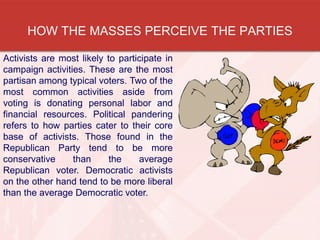
HOW THE MASSES PERCEIVE THE PARTIES
Activists are most likely to participate in
campaign activities. These are the most
partisan among typical voters. Two of the
most common activities aside from
voting is donating personal labor and
financial resources. Political pandering
refers to how parties cater to their core
base of activists. Those found in the
Republican Party tend to be more
conservative than the average
Republican voter. Democratic activists
on the other hand tend to be more liberal
than the average Democratic voter.
HOW THE MASSES VIEW THE PARTIES
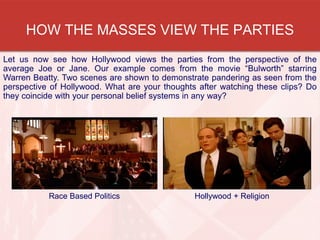
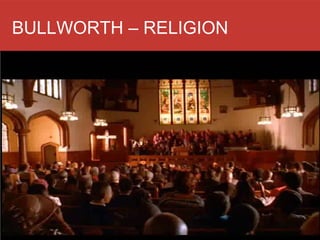
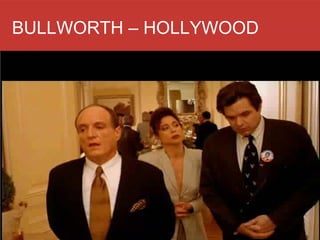
Let us now see how Hollywood views the parties from the perspective of the
average Joe or Jane. Our example comes from the movie “Bulworth” starring
Warren Beatty. Two scenes are shown to demonstrate pandering as seen from the
perspective of Hollywood. What are your thoughts after watching these clips? Do
they coincide with your personal belief systems in any way?
Hollywood + ReligionRace Based Politics
BULLWORTH – RELIGION
BULLWORTH – HOLLYWOOD
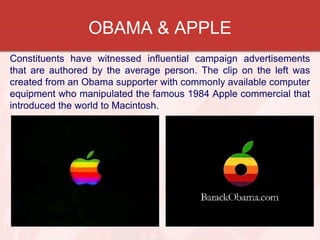
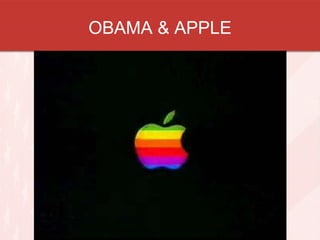
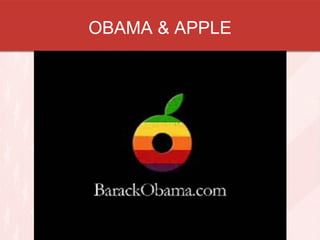
OBAMA & APPLE
Constituents have witnessed influential campaign advertisements
that are authored by the average person. The clip on the left was
created from an Obama supporter with commonly available computer
equipment who manipulated the famous 1984 Apple commercial that
introduced the world to Macintosh.
OBAMA & APPLE
OBAMA & APPLE
CULTURAL CONFLICT - NEW COLD WAR?
• Tensions between civilizations are supplanting the
political and ideological rivalries persistent during the
Cold War.
• Samuel Huntington argue, "the values that are most
important in the West are least important worldwide.”
• World politics will be directed in the future by
conflicts that according to Kishore Mahbubani
will be between "the West and the Rest".
• Samuel P. Huntington adds "...and the
responses of non-Western civilizations to
Western power and values.”
CONFLICT, VIOLENCE, AND WAR
1. Non-Western civilizations isolate themselves from the
Western-dominated global community.
2. "Band-Wagoning" can lead non-Western countries to
join with the West and accept its values and
institutions.
3. Non-Western countries can attempt to "balance" the
West by developing an alternative economic and
military power and ally with one another to effective
counter Western dominance.
CAUSES OF WAR
• Nationalism
• Ethnicity
• Religion
• Culture
• Natural Resources
“KIN-COUNTRY” SYNDROME
• States try to rally support from states that
share a similar culture.
• Replaces political ideology and traditional
balance of power as the principal basis for
cooperation and coalitions.
REDEFINING CIVILIZATION IDENTITY
Samuel Huntington’s Three Requirements For Torn
Countries To Redefine Its Civilization Identity:
• The Country’s economic and political elites have to
enthusiastically endorse the transition.
• Its public has to endorse whatever new definition is
adopted.
• Dominant groups in the recipient civilization have to
embrace the convert.
WEST VS. THE REST
• Samuel P. Huntington stresses that civilization-
consciousness is increasing and that global politics will
be focused on "the West and the Rest".
• This applies to conflicts between the Western powers,
especially the United States, against "others".
• The first conflict(s) will be between the West and
several Islamic-Confucian states.
• Samuel Huntington made these arguments in the
article “The Clash of Civilizations (1993)”.
AMERICAN MILITARY POWER
• The main reasons for the US to maintain such a high
military expenditure are:
• US commitments on a global basis. US military forces
must be able to project power to regions located
thousands of miles away.
• US forces require high technology in order to defeat its
enemies with limited casualties.
• US maintains a much more expensive all-volunteer
force.
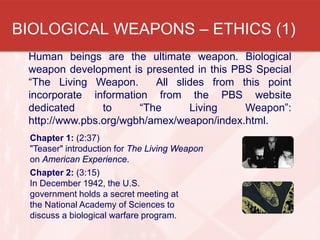
Human beings are the ultimate weapon. Biological
weapon development is presented in this PBS Special
“The Living Weapon. All slides from this point
incorporate information from the PBS website
dedicated to “The Living Weapon”:
http://www.pbs.org/wgbh/amex/weapon/index.html.
Chapter 1: (2:37)
"Teaser" introduction for The Living Weapon
on American Experience.
Chapter 2: (3:15)
In December 1942, the U.S.
government holds a secret meeting at
the National Academy of Sciences to
discuss a biological warfare program.
BIOLOGICAL WEAPONS – ETHICS (1)
TEASER – THE LIVING WEAPON
SECRET MEETING – THE LIVING WEAPON
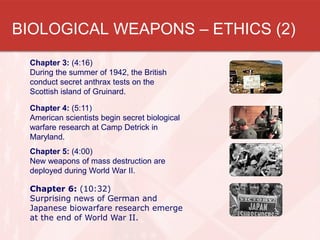
Chapter 3: (4:16)
During the summer of 1942, the British
conduct secret anthrax tests on the
Scottish island of Gruinard.
Chapter 4: (5:11)
American scientists begin secret biological
warfare research at Camp Detrick in
Maryland.
Chapter 5: (4:00)
New weapons of mass destruction are
deployed during World War II.
Chapter 6: (10:32)
Surprising news of German and
Japanese biowarfare research emerge
at the end of World War II.
BIOLOGICAL WEAPONS – ETHICS (2)
BRITISH SECRET – THE LIVING WEAPON
CAMP DETRICK – THE LIVING WEAPON
NEW WEAPONS – THE LIVING WEAPON
SUPRISE – THE LIVING WEAPON
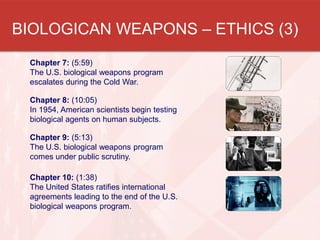
Chapter 7: (5:59)
The U.S. biological weapons program
escalates during the Cold War.
Chapter 8: (10:05)
In 1954, American scientists begin testing
biological agents on human subjects.
Chapter 9: (5:13)
The U.S. biological weapons program
comes under public scrutiny.
Chapter 10: (1:38)
The United States ratifies international
agreements leading to the end of the U.S.
biological weapons program.
BIOLOGICAN WEAPONS – ETHICS (3)
ESCALATION – THE LIVING WEAPON
HUMAN SUBJECTS – THE LIVING WEAPON
SCRUTINY – THE LIVING WEAPON
RATIFICATION – THE LIVING WEAPON
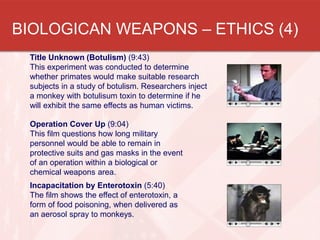
Title Unknown (Botulism) (9:43)
This experiment was conducted to determine
whether primates would make suitable research
subjects in a study of botulism. Researchers inject
a monkey with botulisum toxin to determine if he
will exhibit the same effects as human victims.
Operation Cover Up (9:04)
This film questions how long military
personnel would be able to remain in
protective suits and gas masks in the event
of an operation within a biological or
chemical weapons area.
Incapacitation by Enterotoxin (5:40)
The film shows the effect of enterotoxin, a
form of food poisoning, when delivered as
an aerosol spray to monkeys.
BIOLOGICAN WEAPONS – ETHICS (4)
BOTULISM – THE LIVING WEAPON
COVER UP – THE LIVING WEAPON
INCAPACITATION – THE LIVING WEAPON
• Foreign policies are the strategies
governments use to guide their actions in
the international arena.
–Spell out the objectives state leaders
have decided to pursue in a given
relationship or situation.
–Foreign policy process: How policies
are arrived at and implemented.
MAKING FOREIGN POLICY (1)
• Range of views on foreign policy issues
held by the citizens of a state.
• Has a greater influence on foreign policy in
democracies than in authoritarian
governments.
–Legitimacy
–Propaganda
–Journalists as gatekeepers
PUBLIC INFLUENCES POLICY (1)
• In democracies, public opinion generally
has less effect on foreign policy than on
domestic policy.
–Attentive public
–Foreign policy elite
–Rally ’round the flag syndrome
–Diversionary foreign policy
PUBLIC INFLUENCES POLICY (2)
• Comparative foreign policy.
–Study of foreign policy in various states
in order to discover whether similar
types of societies or governments
consistently have similar types of foreign
policies.
• Foreign policy outcomes result from
multiple forces at various levels of
analysis.
MAKING FOREIGN POLICY (2)
• Conduit through which interest groups and public opinion
can wield influence.
– Presidential systems; separate elections.
• Legislatures play a direct role in making foreign
policy.
• Different rules apply, however, to the use of military
force.
– Rally ’round the flag.
– May challenge the president if they have power
of the “purse”.
LEGISLATURES (1)
• Parliamentary systems; political parties are
dominant
• Often parliamentary executives do not need
to submit treaties or policies for formal
approval by the legislature.
• Call elections; new executive
• Legislatures play a key role in designing
and implementing foreign policy.
LEGISLATURES (2)

Tabakian Pols 5 PP9 Fall 2014

  • 1.
    Western Political Thought JohnPaul Tabakian, Ed.D. Political Science 5 Fall 2014 – Power Point #9
  • 2.
    COURSE LECTURE: WEEK9 (1) Today’s Lecture Covers The Following: • Muckrackers – Upton Sinclair • How The Masses Perceive The Parties • Pluralism Example – Obama Vs. Apple • Conflict, Violence & War - Causes Of War: 1. Nationalism 2. Ethnicity 3. Religion 4. Culture 5. Natural Resources
  • 3.
    COURSE LECTURE: WEEK9 (1) • “Kin-Country” Syndrome • Redefining Civilization Identity • West Versus The Rest • American Military Power • Ethical Issues • Unconventional Military Options: • American Biological Weapons Program • Public Influences Policy • Legislatures
  • 4.
    UPTON SINCLAIR’S “THEJUNGLE” •Upton Sinclair was a poor reformer who sought to write the Great American Novel. •“The Jungle” examined the unsanitary methods of Chicago’s meatpacking industry of Chicago. It was released in 1906. •President Theodore Roosevelt received advanced copy. Used his influence to push Congress to pass a law establishing the Food and Drug Administration (FDA). Roosevelt coined the term “muckrakers” to describe Sinclair and other reformist crusaders. •Roosevelt’s phrase was not meant to be wholly complimentary. •Muckrackers are journalists who expose political and commercial corruption.
  • 5.
    HOW THE MASSESPERCEIVE THE PARTIES Activists are most likely to participate in campaign activities. These are the most partisan among typical voters. Two of the most common activities aside from voting is donating personal labor and financial resources. Political pandering refers to how parties cater to their core base of activists. Those found in the Republican Party tend to be more conservative than the average Republican voter. Democratic activists on the other hand tend to be more liberal than the average Democratic voter.
  • 6.
    HOW THE MASSESVIEW THE PARTIES Let us now see how Hollywood views the parties from the perspective of the average Joe or Jane. Our example comes from the movie “Bulworth” starring Warren Beatty. Two scenes are shown to demonstrate pandering as seen from the perspective of Hollywood. What are your thoughts after watching these clips? Do they coincide with your personal belief systems in any way? Hollywood + ReligionRace Based Politics
  • 7.
  • 8.
  • 9.
    OBAMA & APPLE Constituentshave witnessed influential campaign advertisements that are authored by the average person. The clip on the left was created from an Obama supporter with commonly available computer equipment who manipulated the famous 1984 Apple commercial that introduced the world to Macintosh.
  • 10.
  • 11.
  • 12.
    CULTURAL CONFLICT -NEW COLD WAR? • Tensions between civilizations are supplanting the political and ideological rivalries persistent during the Cold War. • Samuel Huntington argue, "the values that are most important in the West are least important worldwide.” • World politics will be directed in the future by conflicts that according to Kishore Mahbubani will be between "the West and the Rest". • Samuel P. Huntington adds "...and the responses of non-Western civilizations to Western power and values.”
  • 13.
    CONFLICT, VIOLENCE, ANDWAR 1. Non-Western civilizations isolate themselves from the Western-dominated global community. 2. "Band-Wagoning" can lead non-Western countries to join with the West and accept its values and institutions. 3. Non-Western countries can attempt to "balance" the West by developing an alternative economic and military power and ally with one another to effective counter Western dominance.
  • 14.
    CAUSES OF WAR •Nationalism • Ethnicity • Religion • Culture • Natural Resources
  • 15.
    “KIN-COUNTRY” SYNDROME • Statestry to rally support from states that share a similar culture. • Replaces political ideology and traditional balance of power as the principal basis for cooperation and coalitions.
  • 16.
    REDEFINING CIVILIZATION IDENTITY SamuelHuntington’s Three Requirements For Torn Countries To Redefine Its Civilization Identity: • The Country’s economic and political elites have to enthusiastically endorse the transition. • Its public has to endorse whatever new definition is adopted. • Dominant groups in the recipient civilization have to embrace the convert.
  • 17.
    WEST VS. THEREST • Samuel P. Huntington stresses that civilization- consciousness is increasing and that global politics will be focused on "the West and the Rest". • This applies to conflicts between the Western powers, especially the United States, against "others". • The first conflict(s) will be between the West and several Islamic-Confucian states. • Samuel Huntington made these arguments in the article “The Clash of Civilizations (1993)”.
  • 18.
    AMERICAN MILITARY POWER •The main reasons for the US to maintain such a high military expenditure are: • US commitments on a global basis. US military forces must be able to project power to regions located thousands of miles away. • US forces require high technology in order to defeat its enemies with limited casualties. • US maintains a much more expensive all-volunteer force.
  • 19.
    Human beings arethe ultimate weapon. Biological weapon development is presented in this PBS Special “The Living Weapon. All slides from this point incorporate information from the PBS website dedicated to “The Living Weapon”: http://www.pbs.org/wgbh/amex/weapon/index.html. Chapter 1: (2:37) "Teaser" introduction for The Living Weapon on American Experience. Chapter 2: (3:15) In December 1942, the U.S. government holds a secret meeting at the National Academy of Sciences to discuss a biological warfare program. BIOLOGICAL WEAPONS – ETHICS (1)
  • 20.
    TEASER – THELIVING WEAPON
  • 21.
    SECRET MEETING –THE LIVING WEAPON
  • 22.
    Chapter 3: (4:16) Duringthe summer of 1942, the British conduct secret anthrax tests on the Scottish island of Gruinard. Chapter 4: (5:11) American scientists begin secret biological warfare research at Camp Detrick in Maryland. Chapter 5: (4:00) New weapons of mass destruction are deployed during World War II. Chapter 6: (10:32) Surprising news of German and Japanese biowarfare research emerge at the end of World War II. BIOLOGICAL WEAPONS – ETHICS (2)
  • 23.
    BRITISH SECRET –THE LIVING WEAPON
  • 24.
    CAMP DETRICK –THE LIVING WEAPON
  • 25.
    NEW WEAPONS –THE LIVING WEAPON
  • 26.
    SUPRISE – THELIVING WEAPON
  • 27.
    Chapter 7: (5:59) TheU.S. biological weapons program escalates during the Cold War. Chapter 8: (10:05) In 1954, American scientists begin testing biological agents on human subjects. Chapter 9: (5:13) The U.S. biological weapons program comes under public scrutiny. Chapter 10: (1:38) The United States ratifies international agreements leading to the end of the U.S. biological weapons program. BIOLOGICAN WEAPONS – ETHICS (3)
  • 28.
    ESCALATION – THELIVING WEAPON
  • 29.
    HUMAN SUBJECTS –THE LIVING WEAPON
  • 30.
    SCRUTINY – THELIVING WEAPON
  • 31.
    RATIFICATION – THELIVING WEAPON
  • 32.
    Title Unknown (Botulism)(9:43) This experiment was conducted to determine whether primates would make suitable research subjects in a study of botulism. Researchers inject a monkey with botulisum toxin to determine if he will exhibit the same effects as human victims. Operation Cover Up (9:04) This film questions how long military personnel would be able to remain in protective suits and gas masks in the event of an operation within a biological or chemical weapons area. Incapacitation by Enterotoxin (5:40) The film shows the effect of enterotoxin, a form of food poisoning, when delivered as an aerosol spray to monkeys. BIOLOGICAN WEAPONS – ETHICS (4)
  • 33.
    BOTULISM – THELIVING WEAPON
  • 34.
    COVER UP –THE LIVING WEAPON
  • 35.
  • 36.
    • Foreign policiesare the strategies governments use to guide their actions in the international arena. –Spell out the objectives state leaders have decided to pursue in a given relationship or situation. –Foreign policy process: How policies are arrived at and implemented. MAKING FOREIGN POLICY (1)
  • 37.
    • Range ofviews on foreign policy issues held by the citizens of a state. • Has a greater influence on foreign policy in democracies than in authoritarian governments. –Legitimacy –Propaganda –Journalists as gatekeepers PUBLIC INFLUENCES POLICY (1)
  • 38.
    • In democracies,public opinion generally has less effect on foreign policy than on domestic policy. –Attentive public –Foreign policy elite –Rally ’round the flag syndrome –Diversionary foreign policy PUBLIC INFLUENCES POLICY (2)
  • 39.
    • Comparative foreignpolicy. –Study of foreign policy in various states in order to discover whether similar types of societies or governments consistently have similar types of foreign policies. • Foreign policy outcomes result from multiple forces at various levels of analysis. MAKING FOREIGN POLICY (2)
  • 40.
    • Conduit throughwhich interest groups and public opinion can wield influence. – Presidential systems; separate elections. • Legislatures play a direct role in making foreign policy. • Different rules apply, however, to the use of military force. – Rally ’round the flag. – May challenge the president if they have power of the “purse”. LEGISLATURES (1)
  • 41.
    • Parliamentary systems;political parties are dominant • Often parliamentary executives do not need to submit treaties or policies for formal approval by the legislature. • Call elections; new executive • Legislatures play a key role in designing and implementing foreign policy. LEGISLATURES (2)